The stakes are real. Pick the wrong course and you've lost months and money. Pick the right one and you could be job-ready in web development, AI, or backend engineering within a year.
This guide cuts through the noise. Below you'll find a curated breakdown of the top five programming platforms for 2026, what makes each one worth your time, and how to match your choice to your actual goals.
Key Takeaways
- Coursera offers the strongest employer-recognized credentials through Google, IBM, and Meta partnerships
- freeCodeCamp is the top free option for self-motivated learners building full-stack skills from scratch
- Beginners who learn through hands-on practice tend to get the most from Codecademy and Treehouse
- Udemy delivers the best value for targeting a specific language or skill — especially during sales
- Course completion alone rarely satisfies employers — pairing self-study with a third-party, industry-recognized credential makes the difference
Why 2026 Is a Pivotal Year to Learn Programming
Why 2026 Is the Right Time to Learn Programming
The numbers make a clear case. The Bureau of Labor Statistics projects 16% growth for software developers through 2034 — roughly 129,200 annual job openings. Web developer roles are projected to grow at 8% over the same period.
That growth isn't evenly distributed, though. Generic "computer programmer" roles are declining as automation handles repetitive tasks and higher-skilled work shifts to software developers and engineers. The roles in demand require modern skills — and that distinction matters when choosing what to study.
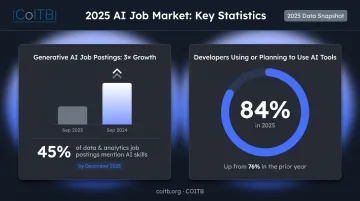
That shift is being driven largely by AI. According to Indeed's Hiring Lab, US job postings mentioning generative AI more than tripled between September 2023 and September 2024, with AI skills appearing in nearly 45% of data and analytics postings by December 2025. The 2025 Stack Overflow Developer Survey found that 84% of developers used or planned to use AI tools — up from 76% the year before.
For anyone starting or pivoting into tech in 2026, foundational skills in Python and JavaScript remain essential. Pair those with AI literacy — prompt engineering, GPT API integration, AI-assisted development — and you're positioned for roles that are actually growing.
Best Programming Courses for 2026
Courses below were evaluated on curriculum depth, certificate recognition, learner support, 2026 skill relevance, and value relative to cost. Each platform excels in a distinct learner scenario — which one fits you depends on your starting point and goals.
Coursera
Coursera partners with universities and employers — Google, IBM, Meta, Stanford, DeepLearning.AI — to deliver professional certificates and specializations that carry genuine employer weight. It's the strongest option for learners who want structured, credential-backed learning paths in web development, data science, or AI.
What sets it apart: university- and employer-branded certificates, financial aid availability, and the ability to build a complete skill pathway self-paced. Active certificates include the Meta Front-End Developer, IBM Full Stack Software Developer, and DeepLearning.AI Data Analytics programs.
| Attribute | Details |
|---|---|
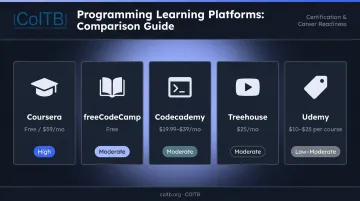
| Pricing | Free preview available for most courses; Coursera Plus at $59/month or $399/year (promotional rates may apply); financial aid available for eligible learners |
| Key Technologies | Python, JavaScript, SQL, React, HTML/CSS, machine learning, AI fundamentals |
| Certificate Value | High — Google, IBM, and Meta-branded credentials carry strong weight with US employers; Google's consortium includes 150+ companies |
freeCodeCamp
freeCodeCamp is a fully free, nonprofit platform offering what it describes as a 3,000-hour curriculum covering front-end, back-end, and full-stack web development. Over 100,000 graduates report working at technology companies, making it the benchmark for zero-cost structured learning.
Its differentiators: project-based certifications, GitHub integration, and an active community forum — all without a subscription. For self-motivated learners, the combination of free access and structured curriculum is genuinely difficult to match. Learners who finish freeCodeCamp's curriculum often pair their portfolio with a third-party credential — such as a COITB JavaScript or HTML-CSS certification — to give employers an independently verified signal of job-ready skills.
| Attribute | Details |
|---|---|
| Pricing | 100% free — no subscription, no hidden fees |
| Key Technologies | HTML, CSS, JavaScript, React, Node.js, Python, SQL, data visualization |
| Certificate Value | Moderate — recognized within the developer community, but portfolio projects and GitHub activity carry more employer weight than the certificate itself |
Codecademy
Codecademy combines a free tier with a paid Pro subscription across career paths in full-stack engineering, data science, and front-end development. Its browser-based environment eliminates local setup friction: you write code immediately, without installing anything locally.
Pro adds structured career paths, quizzes, and completion certificates. The Full-Stack Engineer path has attracted over 312,000 learners; the Data Scientist: Machine Learning Specialist path over 190,000. Learner volume signals curriculum quality, though enrollment alone isn't an employment outcome.
| Attribute | Details |
|---|---|
| Pricing | Free tier available; Pro at approximately $19.99/month billed annually |
| Key Technologies | Python, JavaScript, HTML/CSS, SQL, React, Java, C++, Git |
| Certificate Value | Moderate — Pro certificates supplement a résumé; employers prioritize demonstrated projects over platform badges |
Treehouse
Treehouse is a subscription-based platform built around structured, video-based learning across web development, Python, JavaScript, and more. Its Techdegree programs, available at higher tiers, offer dedicated support and an advertised completion range of 3–9 months.
Its core strength is guided progression. Learners who struggle with self-directed study benefit from Treehouse's organized curriculum, pause-and-resume enrollment, and community forum. Over 300 courses span HTML basics through iOS development.
| Attribute | Details |
|---|---|
| Pricing | $25/month for general access; Techdegree at $199/month with additional support |
| Key Technologies | HTML, CSS, JavaScript, Python, React, Java, PHP, iOS/Android development |
| Certificate Value | Moderate — Techdegree certificates signal structured commitment; best paired with portfolio projects |
Udemy
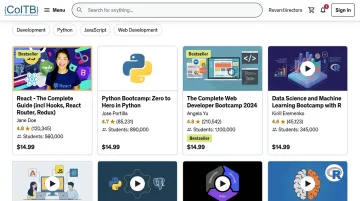
Udemy is a marketplace, not a curated curriculum. That distinction is both its strength and its limitation. With over 10,000 results in its Development category, you can find highly specific, instructor-led courses in nearly any language or framework. Angela Yu's 100 Days of Code Python Bootcamp (4.7 stars, 1.8M+ students) and Colt Steele's Web Developer Bootcamp (4.6 stars, 962,000+ students) are consistently among the most-recommended in the industry.
Frequent sales bring most courses to $10–$25. Lifetime access means you can return to a course as technologies evolve, though update frequency varies by instructor.
| Attribute | Details |
|---|---|
| Pricing | Individual courses from $10.99 during promotions; list prices range $50–$200; no subscription required |
| Key Technologies | Python, JavaScript, React, Java, SQL, machine learning, AWS, GPT/AI — breadth depends on the course selected |
| Certificate Value | Low to moderate — completion certificates have limited standalone value; prioritize courses with 4.5+ ratings and recent update dates |
How We Chose — and What to Look for When You Choose
Every course in this guide was evaluated across five criteria: curriculum depth and structure, certificate recognition, learner support availability, relevance to 2026 in-demand skills, and overall value relative to cost.
The most common mistake learners make is choosing based on brand recognition or price without checking whether the credential is actually valued by employers — or whether the curriculum has been updated in the last year. A course last updated in 2022 that still teaches outdated React patterns isn't serving you well, regardless of how many five-star reviews it carries.
Practical checks before committing to a course:
- When was the course last updated? (Look for 2024 or later for framework-heavy content)
- Does the curriculum include hands-on projects, not just video lectures?
- Is the certificate issued by a platform alone, or by an employer-recognized body?
- Does the syllabus include current technologies — React Hooks, async/await, GPT API integration, or whatever's relevant to your target role?
Once you've run through those checks, one more gap is worth considering: course platforms can't fill the need for independent, employer-verifiable credential validation. A completion certificate confirms you finished the content — it doesn't show employers you can apply those skills under proctored, timed conditions.
That's where independent credentialing bodies like COITB come in. As a nonprofit credentialing organization, COITB offers ISO/IEC 17024-aligned certifications in HTML/CSS, JavaScript, React, Python, MySQL, and GPT — each earned by passing a proctored exam (58–90 questions, 75–90 minutes, 70–75% passing threshold) rather than completing coursework.
The credentials target learners with 0–6 months of hands-on experience. A course completer or bootcamp graduate can sit for an exam and earn an employer-verifiable digital badge without needing years of professional history.
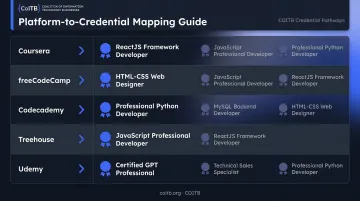
Each platform maps naturally to specific COITB credentials:
| Platform | Best-Fit COITB Credential | Supporting Options |
|---|---|---|
| Coursera | Certified GPT Professional | Professional Python Developer, MySQL Backend Developer |
| freeCodeCamp | JavaScript Professional Developer | HTML-CSS Web Designer, ReactJS Framework Developer |
| Codecademy | JavaScript Professional Developer | HTML-CSS Web Designer, Professional Python Developer |
| Treehouse | HTML-CSS Web Designer | JavaScript Professional Developer, ReactJS Framework Developer |
| Udemy | ReactJS Framework Developer | Professional Python Developer, Certified GPT Professional |
Conclusion
Picking the right programming course comes down to fit, not fame. Platform prestige doesn't matter if you abandon the curriculum halfway through — and choosing based on marketing rather than your actual learning style wastes months you could spend building real skills.
Whether that means the structured rigor of a Coursera specialization, the zero-cost commitment of freeCodeCamp, or the targeted depth of a Udemy bootcamp-style course, what matters is consistent progress toward a specific, employable skill.
Once the skills are built, the next question employers ask is: how do I verify that? A portfolio helps. A proctored, employer-verifiable credential answers it directly. COITB's ISO/IEC 17024-aligned certifications in web development, AI, and application development are designed to serve as that capstone, giving learners from any background a third-party credential that stands on its own.
Take a free practice assessment at coitb.org/assessment to gauge where you stand before registering.
Frequently Asked Questions
What is the best programming course for absolute beginners in 2026?
freeCodeCamp and Codecademy are the strongest starting points for complete beginners. Both offer interactive, structured curricula that don't require local setup or prior experience. Start with Python or JavaScript — both are versatile, well-supported, and directly relevant to the job market.
Are free programming courses enough to get a tech job?
Free courses can absolutely build job-ready skills, but outcomes depend heavily on self-discipline, consistent project work, and a strong portfolio. Pairing free coursework with a third-party verified credential proves your skills to employers without relying on self-reporting. That combination improves your standing far more than coursework alone.
How long does it take to complete an online programming course?
Timelines vary widely — from a few weeks for a single-skill Udemy course to 6–12 months for a full Coursera specialization. Consistent daily practice of 1–2 hours tends to produce better retention and faster progress than sporadic weekend sessions.
Do programming course certificates actually matter to employers?
It depends on who issued them. Google and IBM certificates from Coursera carry genuine weight; generic platform completion badges carry much less. Portfolio projects and proctored credentials — where a neutral third party validates your skills — generally carry more credibility than course certificates alone.
What programming languages should I prioritize in 2026?
Python, JavaScript, and SQL are the most versatile choices, covering web development, data, and AI roles. According to the 2025 Stack Overflow Developer Survey, JavaScript leads usage at 66%, followed by HTML/CSS at 62%, SQL at 59%, and Python at 58%. Learners targeting AI roles should also explore prompt engineering and GPT API integration.
How do I choose between a free and a paid programming course?
Match the choice to your goals and timeline. Free courses suit explorers and self-motivated learners; paid options add structure, mentorship, and faster outcomes for career-focused learners. Always verify certificate recognition before paying a premium — whether the credential helps you land a role matters more than its price.