IT certifications sit at the center of this shift. The Bureau of Labor Statistics projects roughly 317,700 annual job openings across computer and IT occupations through 2034, with a median annual wage of $105,990 — more than double the national median for all occupations. The roles driving that demand span web development, AI, cybersecurity, and cloud computing.
The question isn't whether certifications pay off. It's which ones are worth your time.
Key Takeaways
- IT certifications can lead to salaries rivaling or exceeding many four-year degree paths
- Credentials in cybersecurity, cloud computing, and AI consistently rank among the highest-paying
- Certifications aligned to ISO/IEC 17024 standards carry the most weight with employers during hiring
- Many entry-level IT certifications can be earned in under 90 days with focused preparation
- Choosing a certification that aligns with your target role — not just the quickest or cheapest option — determines long-term career ROI
Why IT Certifications Pay So Well
The Talent Gap Is Real
Tech employers can't hire fast enough. Information security analysts alone are projected to grow 29% through 2034, and data scientists are projected to grow 34% over the same period — both far outpacing average job growth across the economy. These aren't niche roles; they represent broad, sustained hiring demand that the traditional education pipeline struggles to fill.
That gap benefits credentialed candidates. When qualified applicants are scarce, employers move quickly on candidates who can demonstrate skills immediately. A certification does exactly that: it signals job-ready competency before the first interview.
Skills-Based Hiring Is Reshaping Who Gets Hired
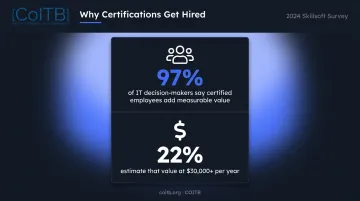
Major employers, particularly in tech, have shifted toward competency-based screening. According to a 2024 Skillsoft survey of 5,191 technology professionals, certified employees are valued across the board:
- 97% of IT decision-makers believe certified employees add measurable value
- 22% estimate that value at $30,000 or more per year
This shift directly benefits career changers, bootcamp graduates, and self-taught developers. A proctored, third-party certification gives employers an objective signal they can verify — something a portfolio or self-described résumé line simply can't match.
The ROI Case Is Strong
Certifications are cheaper and faster than degrees, with a direct line to high-paying roles. Most take weeks to a few months — not four years — and they validate the exact skills employers are screening for today.
Top IT Career Certifications That Pay Well
The five credentials below were selected based on employer recognition, median salary potential, time-to-earn, and projected hiring demand. Each represents a distinct, well-compensated pathway into IT.
Web Development Certification
Web development certifications validate front-end and full-stack skills including HTML, CSS, JavaScript, and frameworks like React — the foundational languages behind virtually every digital product and application in use today.
Web developers are hired across nearly every industry, entry points require minimal prior experience, and skills are immediately demonstrable through portfolio work.
For job seekers who want to stand out beyond a portfolio alone, credentials aligned to ISO/IEC 17024 standards — such as the HTML-CSS Web Designer and ReactJS Framework Developer certifications from COITB — provide employer-verifiable validation of exactly these skills.
| Specification | Details |
|---|---|
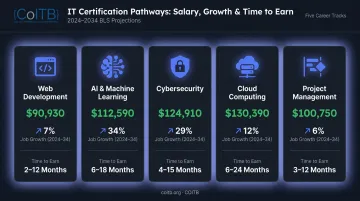
| Median Salary | $90,930/year (BLS, Web Developers, May 2024) |
| Time to Earn | Weeks to a few months depending on experience |
| Top Skills Validated | HTML, CSS, JavaScript, React, responsive design |
| Job Growth (2024–34) | 7%, ~14,500 annual openings |
COITB's ReactJS Framework Developer and HTML-CSS Web Designer certifications are designed for candidates with 0–6 months of hands-on experience. Both exams are 90 questions over 90 minutes, delivered online via remote proctoring or at an authorized test center.
AI & Machine Learning Certification
AI and machine learning certifications cover Python programming, prompt engineering, GPT model usage, and applied AI workflows. Demand for professionals with practical AI skills has surged as businesses across sectors integrate AI into daily operations.
Lightcast reports that AI skills appeared in 2.5% of all U.S. job postings in 2024 and carried a 28% advertised salary premium — with more than half of those listings outside traditional IT and computer science roles. This reach extends well beyond Silicon Valley — demand is coming from healthcare, finance, logistics, and retail alike.
| Specification | Details |
|---|---|
| Median Salary | $112,590/year (BLS, Data Scientists, May 2024) |
| Time to Earn | Weeks to a few months for foundational credentials |
| Top Skills Validated | Python, GPT prompt engineering, AI application development, ML fundamentals |
| Job Growth (2024–34) | 34% for data scientists, ~23,400 annual openings |
COITB offers the Certified GPT Professional certification, designed for professionals with 0–6 months of AI experience. The exam covers prompt engineering, OpenAI API integration, responsible AI practices, and applied GPT use cases.
For deeper AI/ML capability, pairing it with the Professional Python Developer certification mirrors the standard stack used by AI/ML teams.
Cybersecurity Certification
Cybersecurity certifications validate skills in threat detection, network security, risk management, and security protocols. CompTIA Security+ is the most widely recognized entry-level credential in this space.
The numbers reflect just how acute the shortage is. ISC2 estimated a 4.8 million worker global cybersecurity workforce gap in 2024, and CyberSeek tracked over 514,000 active U.S. employer listings for cybersecurity positions in the 12 months ending April 2025.
| Specification | Details |
|---|---|
| Median Salary | $124,910/year (BLS, Information Security Analysts, May 2024) |
| Time to Earn | 2–6 months for entry-level credentials like Security+ |
| Top Skills Validated | Threat detection, network security, risk management, security protocols |
| Job Growth (2024–34) | 29%, ~16,000 annual openings |
Top credentialing bodies: CompTIA (Security+), ISC2 (CISSP — requires five years of experience, not entry-level), and EC-Council. Note that COITB does not currently offer a cybersecurity credential; this pathway requires a dedicated security certification provider.
Cloud Computing Certification
Cloud certifications validate skills in cloud infrastructure, deployment, storage, and platform services across AWS, Microsoft Azure, and Google Cloud. These credentials are now expected as organizations shift core operations off-premise.
Cloud roles command consistently high salaries. Skillsoft's 2024 U.S. survey reports certification holders earning an average of $155,597 (AWS Solutions Architect – Associate) and $148,849 (Azure Administrator Associate). The BLS closest benchmark — Computer Network Architects — shows a $130,390 median wage with 12% projected growth.
| Specification | Details |
|---|---|
| Median Salary | $130,390/year (BLS, Computer Network Architects, May 2024) |
| Time to Earn | Weeks for foundational; 3–6 months for associate-level |
| Top Skills Validated | Cloud infrastructure, deployment, storage, platform services |
| Job Growth (2024–34) | 12%, ~14,900 annual openings (BLS, Computer Network Architects) |
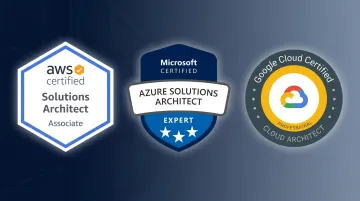
Top credentialing bodies: Amazon Web Services (AWS), Microsoft (Azure), and Google Cloud. COITB does not currently offer a cloud certification; this pathway requires a provider-specific credential from one of the three major cloud platforms.
Project Management Certification
Project management certifications validate skills in planning, resource allocation, risk management, and stakeholder communication. The PMP is the gold standard; CAPM is the entry-level alternative.
PMI reports that U.S. PMP-certified professionals earn a $135,000 median salary compared to $109,157 for non-certified peers — a nearly 24% difference. PMI also projects a possible global shortfall of up to 30 million project professionals by 2035.
| Specification | Details |
|---|---|
| Median Salary | $100,750/year (BLS, Project Management Specialists, May 2024) |
| Time to Earn | CAPM accessible with limited experience; PMP requires documented project hours + 35-hour education requirement |
| Top Skills Validated | Planning, resource allocation, risk management, stakeholder communication |
| Job Growth (2024–34) | 6%, ~78,200 annual openings |
Credentialing body: Project Management Institute (PMI). Note that COITB does not offer a project management credential — but for PMP holders looking to add technical depth, COITB certifications stack directly on top of existing PM credentials to close the technical credibility gap that often blocks advancement into engineering manager or technical PM roles.
How to Choose the Right Certification for Your Career Goals
Start With Job Postings, Not Certification Catalogs
Search for the roles you want before you pick a credential. Identify which certifications appear most frequently in job requirements or preferences — this prevents you from earning something that doesn't move your applications forward. If "React developer" listings consistently mention a specific framework credential, that's your signal.
Match the Credential to Where You Are Now
Not every certification is built for the same starting point. Consider where you currently stand:
- Entry-level accessible: COITB's HTML-CSS Web Designer and Certified GPT Professional certifications list 0–6 months of hands-on experience as the recommended range
- Experience-gated: Credentials like the PMP require 3–5 years of project experience (depending on your education level), plus documented work hours
- Stacking credentials: Project managers adding technical certifications can layer COITB credentials onto existing PMP, PSM, or CSM credentials without replacing them
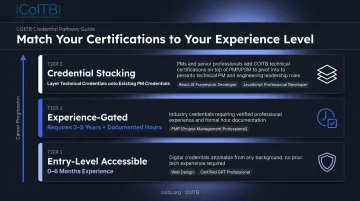
Choose based on your current starting point, not just your destination.
Verify the Certification Body's Standards
Look for credentials that are employer-known, appear in actual job postings, and are operated by bodies that follow recognized standards. ISO/IEC 17024 sets the international benchmark for personnel certification quality — it governs impartiality, exam integrity, competency validation, and audit accountability. When a credential meets this standard, hiring managers can trust the exam was independently administered and the results weren't self-reported — which matters when two candidates list similar skills on a résumé.
Frequently Asked Questions
What is the easiest professional certification to get?
Entry-level IT certifications — such as foundational web development or IT support credentials — and healthcare support certifications like phlebotomy are among the most accessible. Many require only a high school diploma and can be completed in weeks to a few months with focused self-study.
What certification makes the most money?
IT certifications in cybersecurity and cloud computing consistently rank highest. CISSP holders report an average salary of $168,060, AWS Solutions Architect – Associate holders average $155,597, and Azure Administrator holders average $148,849, according to Skillsoft's 2024 U.S. survey data. Web development and AI credentials — including ReactJS and GPT-focused certifications — are increasingly tied to strong starting salaries as demand for these skills grows.
How long does it take to earn an IT certification?
It depends on the credential. Foundational certifications — such as HTML/CSS web design or entry-level AI credentials — can be completed in weeks with focused preparation. More advanced technical credentials typically require months of study; COITB's exams target candidates with 0–6 months of hands-on experience, making them realistic milestones for career changers and early-stage professionals.
Can I get a career certification without a college degree?
Most IT certifications have no college degree requirement. COITB's full credential portfolio — covering web development, JavaScript, Python, React, MySQL, AI, and technical sales — is open to career changers, self-taught professionals, and bootcamp graduates. Evaluation is based on demonstrated skill, not academic background.
How do I know if a certification is legitimate and employer-recognized?
Check whether the credential appears in real job postings for your target roles, whether the certifying body is known in your target industry, and whether the program is aligned to standards like ISO/IEC 17024. These signals — especially the combination of all three — indicate employers are likely to recognize and respect the credential. COITB's certifications meet all three criteria, with programs aligned to ISO/IEC 17024 and credentials designed around skills that appear in active job listings.
Can I earn a career certification completely online?
Yes. Most IT certifications — including COITB's full portfolio — offer fully remote, online proctored exams with flexible scheduling. COITB accepts military CAC and VA-issued IDs for identity verification, making it a practical option for transitioning service members regardless of location.
Take the Next Step
The highest-paying certifications have three things in common: real hiring demand, credible credentialing standards, and roles where qualified candidates are hard to find.
COITB is a non-profit credentialing body offering ISO/IEC 17024-aligned certifications across six in-demand disciplines:
- ReactJS Framework Developer
- HTML-CSS Web Designer
- JavaScript Professional Developer
- Professional Python Developer
- MySQL Backend Developer
- Certified GPT Professional
Exams are fully online, open to candidates at any experience level, and built for career changers, veterans, bootcamp graduates, and self-taught developers. Explore available credentials and take a free practice assessment at coitb.org.