Introduction
The IT job market heading into 2026 doesn't look like it did even two years ago. AI adoption is reshaping job descriptions weekly. Cloud platforms dominate infrastructure hiring. And more employers are quietly dropping the degree requirement in favor of proof-of-skill.
That shift matters. Generative-AI job postings jumped from just 55 in January 2021 to nearly 10,000 by May 2025, according to Lightcast's 2025 generative AI job market analysis. Employers need people who can do the work now, not people who checked a box four years ago.
Certifications fill that gap by giving hiring managers something concrete to evaluate: a specific, verifiable skill instead of a four-year credential that may not even cover today's tools.
This guide breaks down the top IT certifications for 2026 across web design, application development, backend development, AI, and technical sales — plus how to pick the right one whether you're starting from scratch, switching careers, or stacking a technical credential onto an existing PM background.
Key Takeaways
- 97% of IT decision-makers say certified staff deliver measurable value, with a third citing $25,000+ in annual value per employee
- Cloud, cybersecurity, and AI/ML certifications command the highest salaries and fastest-growing demand in 2026
- Entry-level, skills-based credentials like HTML-CSS Web Designer certification give career changers with no tech background a practical starting point
- Project managers and career changers get the most value by stacking a technical credential onto existing experience, not chasing the highest-paying cert alone
Overview of the IT Certification Landscape Heading into 2026
An IT certification is a standardized exam that verifies you can actually do a specific job function — configure a network, secure a cloud environment, build a web app, integrate an AI model. It's third-party proof, separate from a résumé's self-reported skills list.
That distinction matters more now than it did five years ago. Companies that removed degree requirements saw non-degree hiring increase by 3.5 percentage points on average. Still, the economy-wide shift has been smaller than headlines suggest — about 97,000 of 77 million annual hires, per Harvard Business School research on skills-based hiring.
Roughly 45% of firms changed their stated requirements without meaningfully changing who they actually hired.
Translation: the degree wall is cracking, but it hasn't fallen. Certifications are becoming the tiebreaker — the thing that gets your résumé a second look when you don't have a four-year degree to lean on.
Meanwhile, the skills gap keeps widening. 65% of IT decision-makers report skill gaps on their teams, and 56% expect those gaps to persist for one to two more years, per Skillsoft's IT Skills & Salary Report.
Below, we break down the top certifications by category — starting with entry-level web development basics and moving through backend development, AI, and technical sales.
Top IT Certifications for 2026
Selection here comes down to four factors: industry recognition, actual employer demand (not just search volume), relevance to career stage, and skills alignment with 2026's direction. That direction points squarely at AI, cloud, and automation.
Foundational & Entry-Level IT Certifications
If you're starting from zero, three CompTIA credentials still anchor most entry-level paths:
- CompTIA A+ — Validates hardware, operating systems, and troubleshooting basics. Two exams (Core 1 and Core 2) are required to earn it.
- CompTIA Network+ — Covers networking fundamentals: protocols, infrastructure, and troubleshooting.
- CompTIA ITF+/Tech+ — CompTIA's exploratory credential for people testing the waters before committing to IT as a career.
None of these carry formal prerequisites. CompTIA recommends 9-12 months of hands-on lab experience before attempting A+ or Network+, but that's guidance, not a gate.
| Certification | Approximate Cost | Prerequisites | Potential Roles |
|---|---|---|---|
| CompTIA A+ (2 exams) | ~$253/exam | None; 9-12 months experience recommended | Help desk analyst, technical support specialist |
| CompTIA Network+ | $399 | A+ recommended, not required | Network administrator, support specialist |
| CompTIA Tech+ (formerly ITF+) | ~$146 | None | Entry-level IT exploration |
These certs won't land you a six-figure salary. What they do is get your foot in the door at a service desk or support role — the launchpad most IT careers start from.
Cloud Computing & Security Certifications
This is where the money is. Cloud and cybersecurity roles consistently top salary rankings, and the gap between certified and non-certified professionals in this space is significant.
- AWS Certified Solutions Architect – Associate — The most recognized cloud architecture credential, validating your ability to design cost-effective, scalable systems on AWS.
- Microsoft Azure Fundamentals / Administrator Associate — Azure's entry point (Fundamentals) and hands-on management credential (Administrator Associate).
- CompTIA Security+ — The baseline cybersecurity credential most employers reference in job postings for analyst and admin roles.
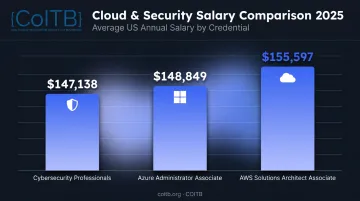
Skillsoft's 2025 salary survey put average US pay at $155,597 for AWS Solutions Architect – Associate holders and $148,849 for Azure Administrator Associate holders. Cybersecurity professionals broadly reported an average $147,138 salary, per ISC2's 2024 workforce research, based on nearly 15,000 respondents.
That demand isn't slowing. ISC2 estimates a global cybersecurity workforce gap of 4.8 million people.
| Certification | Approximate Cost | Prerequisites | Potential Roles |
|---|---|---|---|
| AWS Solutions Architect – Associate | $150 | ~1 year hands-on AWS experience recommended | Cloud engineer, solutions architect |
| Azure Fundamentals | $99 | None | Cloud support, entry-level cloud roles |
| Azure Administrator Associate | $165 | Familiarity with networking, PowerShell, Azure CLI | Cloud administrator, systems admin |
| CompTIA Security+ | $439 | Network+ + 2 years recommended | Security analyst, systems administrator |
AI, Application Development & Emerging Tech Certifications
This category is growing faster than any other heading into 2026. 71% of organizations now report regular generative-AI use in at least one business function, according to McKinsey's 2025 State of AI report. That adoption is pulling job postings with it — generative AI skill requests in IT postings grew 35x between 2022 and 2024.
Established options here include:
- Microsoft Azure AI Fundamentals — A no-prerequisite entry point into Azure's AI services, priced at $99.
- Google Professional Machine Learning Engineer — A rigorous, $200 credential recommending 3+ years of experience, aimed at engineers already building production ML systems.
Both are solid, but they assume you're either brand new to AI concepts (Azure Fundamentals) or already deep into ML engineering (Google's credential). That leaves a gap for people who've spent months actually building things — apps, prompts, integrations — without three years of formal experience to show for it.
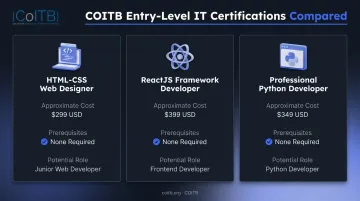
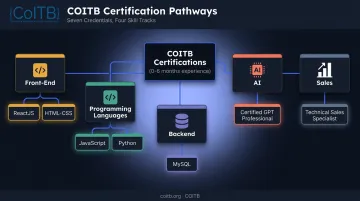
This is the space COITB occupies. As a non-profit credentialing body, COITB offers seven ISO/IEC 17024-aligned certifications built specifically for candidates with 0-6 months of hands-on experience:
- ReactJS Framework Developer and HTML-CSS Web Designer — front-end fundamentals
- JavaScript Professional Developer and Professional Python Developer — core programming languages
- MySQL Backend Developer — database and backend skills
- Certified GPT Professional — prompt engineering, OpenAI API integration, and responsible AI use
- Technical Sales Specialist — for those pivoting into sales engineering roles
The Certified GPT Professional exam, for example, weights 40% of its questions on hands-on OpenAI API integration — building GPT-powered chatbots, summarizers, and automation workflows — not just theory about how transformers work.
Why this matters for bootcamp grads and self-taught developers: most AI credentials assume years of experience you may not have yet. COITB's model assumes the opposite — that you've been building for months, not years, and need a way to prove it.
| Certification | Approximate Cost | Prerequisites | Potential Roles |
|---|---|---|---|
| Azure AI Fundamentals | $99 | None | AI solutions associate |
| Google Professional ML Engineer | $200 | 3+ years recommended | ML engineer |
| COITB certifications (7 credentials) | Visit coitb.org for current pricing | None; 0-6 months experience recommended | AI/GPT developer, front-end/backend developer, application developer |
Project Management & IT Governance Certifications
For technical professionals eyeing leadership, these three credentials open the door to project and process-oriented roles:
- CAPM (Certified Associate in Project Management) — No work experience required, just a high school diploma and 23 hours of PM education.
- PMP (Project Management Professional) — Requires 2-5 years of project leadership experience depending on education level. PMI reports a $135,000 US median salary for PMP holders.
- ITIL 4 Foundation — No prerequisites; validates IT service management fundamentals.
Even technical professionals who never plan to leave engineering benefit from these. A developer who understands ITIL's service lifecycle or a PM foundation communicates better with stakeholders and often gets first pick for lead roles.
| Certification | Approximate Cost | Prerequisites | Potential Roles |
|---|---|---|---|
| CAPM | $225 (member) / $300 (non-member) | None; 23 hours PM education | Project coordinator |
| PMP | $405 (member) / $655 (non-member) | 2-5 years leading projects (varies by education) | IT project manager |
| ITIL 4 Foundation | ~$517-690 | None | IT service manager |
How to Choose the Right IT Certification for Your Career Goals
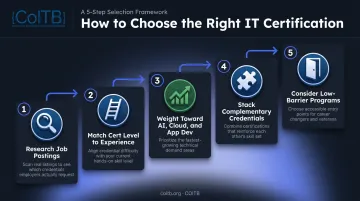
Don't start with a "highest paying certifications" list. Start here instead:
- Read 10-15 target job postings first. Note which certifications actually appear in requirements, not "nice to have" wish lists. This tells you what employers in your specific target role want, not what's trending on LinkedIn.
- Match certification level to your actual experience. Beginners jumping straight to CISSP or CCIE without foundational knowledge tend to abandon their study plans halfway through. Build up: foundational → associate → expert.
- Weight toward AI, cloud, and app development for long-term ROI. IT decision-makers named these as top investment priorities in Skillsoft's 2025 survey, with AI/ML leading at 47% and cloud at 36%.
- Stack a technical cert with a complementary credential. A developer with a React certification plus an Agile or PM credential stands out more than someone with either alone. COITB's technical credentials are built for PMPs, CSMs, and PSMs adding this depth without giving up their existing PM credential.
- Consider low-barrier programs if your experience is limited. COITB's certifications, for instance, are designed for 0-6 months of hands-on practice — no years of prior work history required, no formal prerequisites gatekeeping registration.
How We Selected These Certifications
Every certification on this list met four criteria: recognized industry standing, documented employer demand (not assumed popularity), direct relevance to where tech is heading in 2026, and accessibility across different experience levels.
One mistake worth avoiding: picking a certification purely off a salary ranking list. A $200,000 average salary tied to a credential that requires 5+ years of specialized experience won't help you if you're two years into your career. You'll likely abandon the study plan once the material outpaces your current skill level.
That's why this list intentionally mixes foundational credentials (like HTML-CSS Web Designer), specialized mid-tier options (like JavaScript Professional Developer and Professional Python Developer), and emerging-tech, low-barrier certifications such as Certified GPT Professional — because the "right" certification looks different depending on where you're starting from.
Conclusion
The right certification isn't necessarily the one topping a salary chart. It's the one that matches your current skill level and points toward the role you actually want next.
Treat certification as one piece of a larger strategy. Pair it with hands-on projects, a portfolio, and continuous learning, and you'll stand out far more than a certificate alone ever could.
If you're building skills in AI, front-end development, or backend engineering and need a practical, accessible way to prove it, COITB's ReactJS, HTML-CSS, and GPT Professional certifications offer a straightforward next step — no years of experience required, just real skills validated through a rigorous exam.
Frequently Asked Questions
What are the top 3 IT certifications for 2025?
Front-end development, cloud, and AI/GPT skills top most hiring lists heading into 2026. Credentials like COITB's ReactJS Framework Developer and Certified GPT Professional reflect this shift toward practical, in-demand skill validation.
Which IT certifications will be most in demand in 2026?
AI/ML, cloud, and cybersecurity certifications lead the pack. Generative AI job postings grew nearly 200x between 2021 and 2025, making AI credentials the fastest-rising category.
Are IT certifications worth it without a college degree?
Yes. Many employers now prioritize skills-first hiring, and a relevant certification serves as credible proof of job-ready skills without requiring a four-year degree. This applies well to career changers, bootcamp graduates, and veterans transitioning from military service (verify GI Bill or VET TEC eligibility with the VA before registering).
What is the easiest IT certification to get started with?
COITB's HTML-CSS Web Designer certification is a common starting point for total beginners, requiring as little as 0-6 months of hands-on experience. It's a practical entry credential before advancing to JavaScript or ReactJS.
How much does it cost to get an IT certification?
Costs range widely across the industry, from under $150 for entry-level exams to $700 or more for advanced credentials. COITB certifications fall in the accessible mid-tier range, reflecting their focus on entry- to mid-level skill validation.
How do I choose the right certification for my career path?
Research job postings in your target role to see which certifications employers actually request. Then match the certification's difficulty level to your current experience, not the other way around.