
Introduction
If you're over 40 with 15 or 20 years of professional experience, the current AI hiring surge can feel more threatening than exciting. It shouldn't.
The reality is that AI adoption is creating urgent demand not just for engineers, but for people who understand business problems, know how to lead teams, and can translate technology into real-world results. According to the World Economic Forum's 2025 Future of Jobs Report, AI and big data roles rank among the fastest-growing jobs globally — and employers are increasingly prioritizing domain expertise alongside technical skills. That combination is where mid-career professionals have a real edge over recent grads.
The fear that learning AI at this stage is too late, too technical, or requires a computer science degree simply isn't supported by today's course landscape. Beginner-friendly, self-paced programs from Google, IBM, Microsoft, and DeepLearning.AI are designed for people with full schedules and no prior coding background.
This guide covers the best AI courses for career changers over 40, what to look for when choosing one, and how to turn course-based learning into credentials that employers can actually verify.
Key Takeaways
- Professionals over 40 often move into AI roles faster than new graduates — domain expertise accelerates real-world application.
- The best AI courses for career changers are self-paced, beginner-friendly, and lead to verifiable credentials.
- Top options include Andrew Ng's AI for Everyone, Google AI Essentials, IBM AI Fundamentals, and Microsoft's Generative AI path.
- Non-technical AI roles — AI Business Analyst, Prompt Engineer, AI Project Manager — value business judgment over coding ability.
- Adding a credential like COITB's Certified GPT Professional gives employers verifiable proof of your AI competence.
Why Switching to AI Over 40 Makes More Sense Than You Think
Here's the misconception worth addressing upfront: AI career changes don't require a tech degree or 22-year-old reflexes. What they require is AI literacy paired with the professional judgment that comes from years of real work — and that's something most mid-career professionals already have.
According to a 2025 McKinsey workplace report based on over 3,600 employees surveyed in late 2024, 62% of workers aged 35–44 already rated their AI expertise highly, and 90% were comfortable using generative AI at work. Mid-career professionals aren't behind the curve — they're already in it.
Demand is also moving well beyond traditional tech roles. Lightcast found that generative AI requirements in non-IT job postings grew 9x between 2022 and 2024, with 51% of AI-skill postings now sitting outside IT and computer science entirely. Employers aren't just looking for engineers — they're looking for finance professionals, healthcare administrators, marketing leads, and operations managers who understand how to deploy AI in context.
What Career Changers Over 40 Actually Bring
That market demand matters most when you know what you bring to it. Mid-career professionals carry concrete advantages into AI roles:
- Domain knowledge — A former healthcare manager understands clinical workflows in ways a 24-year-old AI developer simply doesn't. That context makes AI implementations smarter.
- Cross-functional communication — AI teams need people who can translate between technical outputs and business decisions. This is a learned skill that takes years.
- Project management fluency — Shipping AI tools inside an organization requires stakeholder management, timeline discipline, and risk awareness. These aren't technical skills.
- Institutional credibility — Career changers with track records get taken seriously in ways that entry-level candidates don't.
Realistic Entry Points for Career Changers
Not every AI role requires machine learning expertise. The most accessible paths for career changers include:
- AI Business Analyst — Identifies AI opportunities and translates them into requirements
- Prompt Engineer — Designs and optimizes inputs to AI systems
- AI Project Manager — Oversees AI implementation projects without coding
- AI Content Strategist — Applies generative AI to content creation workflows
- AI Trainer — Evaluates and refines AI model outputs
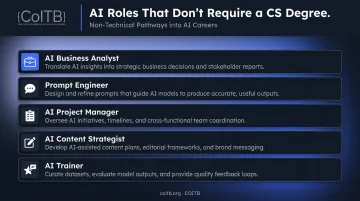
None of these roles require a computer science degree. What hiring managers increasingly look for is demonstrated AI competency — which is where third-party credentials help career changers stand out against candidates with longer tech résumés.
Best AI Courses for Career Change Over 40
These courses were selected based on beginner accessibility, flexibility for working adults, credibility of the issuing platform, and practical relevance to career changers — not just technical depth.
AI for Everyone by Andrew Ng (Coursera)
Andrew Ng, founder of the Google Brain project and one of the most recognized AI educators globally, designed this course specifically for non-technical professionals. It currently has over 2.5 million enrolled learners and a 4.8/5 rating from more than 52,000 reviews — numbers that reflect its consistent usefulness for people coming from business, operations, healthcare, and education backgrounds.
The course skips the math entirely. Instead, it focuses on how to spot AI opportunities in your industry, how to collaborate with AI teams, and how to evaluate AI projects from a business perspective. If you're coming from a non-technical role, this is the strategic foundation worth building on first.
| Specification | Details |
|---|---|
| Format / Duration | Self-paced online; approximately 7 hours across 4 modules |
| Cost | Certificate available via Coursera subscription; financial aid available |
| Best For | Non-technical professionals wanting a strategic overview of AI across industries |
Google AI Essentials (Coursera)
Developed by Google and delivered via Coursera, this course introduces hands-on use of AI tools — including Google's own products — rather than staying at the conceptual level. It's one of the most practical beginner-level AI courses available, and it results in a certificate issued directly by Google.
Career changers targeting AI-powered productivity, content generation, or business analysis roles will find the Google-issued certificate adds real credibility to a résumé. The self-paced format fits around a full-time schedule.
| Specification | Details |
|---|---|
| Format / Duration | Self-paced online; under 5 hours across 5 parts |
| Cost | $49/month after 7-day trial (US/Canada via Coursera) |
| Best For | Career changers who want a Google-backed credential and practical, tool-level AI skills |
IBM AI Fundamentals (IBM SkillsBuild)
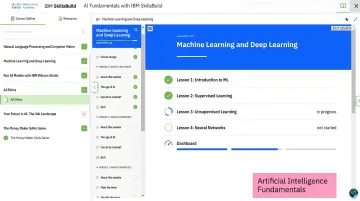
IBM's free AI Fundamentals program on SkillsBuild covers machine learning basics, natural language processing, deep learning, computer vision, and AI ethics in a modular format. Completing the program earns an IBM-issued digital badge administered through Credly — verifiable and shareable directly on LinkedIn.
IBM structures the content around how AI transforms specific business functions: HR, operations, finance, and customer service. That framing gives 40+ career changers an immediate anchor — the examples connect directly to roles they've already held, so the material lands as practical rather than theoretical.
| Specification | Details |
|---|---|
| Format / Duration | Self-paced, modular; 10+ hours |
| Cost | Free; IBM/Credly digital badge awarded on completion |
| Best For | Professionals in business, operations, or enterprise roles seeking an industry-recognized credential at no cost |
Career Essentials in Generative AI by Microsoft and LinkedIn
This five-course path from Microsoft and LinkedIn Learning focuses on generative AI tools — including Microsoft 365 Copilot — and their day-to-day professional applications. It's built for people moving into AI-adjacent roles rather than deep technical positions, which makes it particularly well-suited to career changers.
The Microsoft/LinkedIn co-branded badge of completion holds meaningful recognition with recruiters already familiar with the LinkedIn Learning ecosystem. Professionals who already work within Microsoft 365 environments — a significant portion of corporate workplaces — can apply the Copilot content to real tasks within the first week of completing the path.
| Specification | Details |
|---|---|
| Format / Duration | Self-paced online; approximately 4 hours 15 minutes across 5 courses |
| Cost | Available via LinkedIn Learning subscription; check LinkedIn Learning for current pricing |
| Best For | Professionals in any industry who want to apply generative AI tools in current or new roles, especially within Microsoft 365 environments |
AI Python for Beginners by DeepLearning.AI (Coursera)
DeepLearning.AI's beginner Python course — taught by Andrew Ng's team — is the next logical step for career changers ready to move beyond AI literacy into hands-on skills. It introduces Python specifically through AI applications. The four modules cover practical tasks: prompt-based interactions, data and document analysis, task automation, and working with APIs and packages.
Many career changers avoid coding entirely out of intimidation. This course addresses that directly by grounding every lesson in real AI use cases rather than abstract syntax. Basic Python knowledge expands the roles available — data analyst, AI developer, automation specialist — without requiring a full programming background.
| Specification | Details |
|---|---|
| Format / Duration | Self-paced online; approximately 11.5 hours across 4 modules |
| Cost | Available via Coursera Plus; financial aid available; verify audit options |
| Best For | Career changers who want entry-level coding skills for AI applications without prior programming experience |
What to Look for in an AI Course as a Career Changer Over 40
Choosing the wrong course is a common and fixable mistake. Here's what matters:
Scheduling Flexibility
For working adults with family obligations, financial commitments, and full-time jobs, asynchronous delivery is a requirement, not a preference. Look for courses that offer self-paced modules, allow pausing and resuming at any point, and don't require live attendance windows. OECD research found that work-related time constraints prevent desired training for 31% of high- and medium-skilled adults — a significant structural barrier that self-paced formats directly address.
Credential Verification
Completing a course matters far less than being able to prove you completed it. Prioritize:
- Verifiable digital badges issued through platforms like Credly (IBM's badge program is a common example)
- Platform-issued certificates you can share directly on LinkedIn
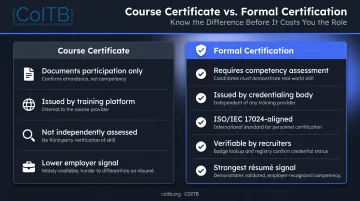
- ISO/IEC 17024-aligned certifications, which carry the strongest signal with employers
Course completion certificates and formal certifications are not the same thing. Certificates document participation; certifications from governed credentialing bodies — like COITB's Certified GPT Professional — require independent assessment against defined competency standards. For career changers without an AI employment history, that difference is what a recruiter actually sees on a résumé.
Role-Relevant Content Over Technical Depth
Most career changers over 40 don't need machine learning theory on day one. What they need:
- How to apply AI tools in real business scenarios
- How to communicate with AI teams effectively
- How to evaluate AI project outcomes from a business perspective
- How to use generative AI tools in daily professional tasks
Courses that prioritize these outcomes over abstract technical depth deliver more immediate career value for non-technical career changers.
How We Chose These Courses
Each course in this list was evaluated against four criteria: beginner-friendliness (no assumed programming or math background), format flexibility (self-paced or asynchronous delivery), credential credibility (whether the issuing body carries employer recognition), and practical relevance to the roles career changers over 40 realistically enter.
Two mistakes career changers commonly make: choosing the most technically complex course available assuming difficulty equals value, or completing a course without any credential mechanism that employers can verify. Both traps leave you with skills but nothing verifiable to show for them.
For career changers serious about demonstrating validated AI skills to employers, course completion carries more weight when followed by a formal credentialing step. COITB's Certified GPT Professional certification is built precisely for this — an ISO/IEC 17024-aligned exam that validates practical GPT competencies including prompt engineering, API integration, and responsible AI implementation.
The exam format is straightforward:
- 60 multiple-choice and scenario-based items
- 75-minute time limit
- 71% passing threshold
- Digital badge verifiable by employers on LinkedIn and résumés
COITB doesn't deliver training or courses. The certification is a standalone exam — meaning candidates study through resources like those above and then sit the exam to formalize their skills with a third-party, independently proctored credential. Entry-level candidates with as little as 0–6 months of hands-on AI practice are eligible.
Conclusion
Breaking into AI after 40 is more achievable now than at any previous point in the field's history. The courses in this guide are designed for people with full schedules, non-technical backgrounds, and real professional experience that AI teams genuinely need.
The practical step: pick one course from this list that fits your current background, commit to completing it, and then plan how to validate those skills in a way employers can verify. Knowledge and credentials are different things, and in a competitive job market, both matter.
That's where COITB's Certified GPT Professional certification comes in — a credential built specifically for career changers, with remote online testing and flexible scheduling that fits around a full life. Reach out at support@coitb.org or call +1 877 402 0840 with any questions.
Frequently Asked Questions
Can I learn AI at the age of 40?
Age is not a barrier to learning AI. Most platforms offer self-paced, beginner-level courses with no technical prerequisites, and mid-career professionals frequently transition faster than younger candidates because they bring domain expertise and professional context that accelerates practical application.
Which AI course is most in demand?
Andrew Ng's AI for Everyone on Coursera is consistently the most enrolled non-technical AI course globally, with over 2.5 million learners. Google AI Essentials and Microsoft's Career Essentials in Generative AI path are among the most employer-recognized options for career changers seeking practical, credential-backed learning.
Do I need a programming background to start an AI course?
No. Most beginner AI courses — including all five listed in this article — require zero coding experience. Programming only becomes relevant for more technical roles like machine learning engineer, and even purpose-built options like DeepLearning.AI's AI Python for Beginners start from scratch for non-programmers.
How long does it take to transition into an AI career from a different field?
It depends on your target role. Non-technical positions — Business Analyst, Prompt Engineer, AI Project Manager — can become accessible after a focused period of learning. More technical paths require longer, more intensive upskilling, and actual timelines vary based on your prior background and target role.
Are AI certifications worth it for career changers over 40?
Yes. Employer-recognized certifications provide verifiable proof of competence that a résumé-listed course completion cannot. For career changers without AI employment history, credentials aligned to standards like ISO/IEC 17024 give recruiters an independent, verifiable signal of skill — especially when you have no prior AI job titles to point to.
What AI jobs can I realistically get after completing an AI course?
Entry-level, non-coding AI roles accessible to career changers include AI Business Analyst, AI Project Manager, Prompt Engineer, AI Content Strategist, and AI Trainer. These roles value domain expertise and business judgment over deep programming skills, making them strong targets for professionals transitioning from other industries.