The problem? The certification landscape is a mess. Vendor-specific exams from Oracle and Microsoft sit alongside Coursera programs, non-profit credentials, and tool-specific certifications from companies like dbt Labs — and there's no obvious answer for which one is worth your time and money.
This guide cuts through that confusion. You'll find five standout SQL certifications and courses reviewed with real specs, a clear selection framework based on career goals and experience level, and an honest take on what each credential actually signals to employers in 2026.
Key Takeaways
- SQL ranks #8 on the TIOBE Index as of July 2026, reflecting sustained relevance across both development and data roles.
- Certifications validate skills; courses build them — the strongest career signal combines both.
- Vendor certs suit enterprise roles; platform programs suit beginners; specialized credentials (dbt, COITB) suit developers and engineers.
- Cost alone shouldn't drive your decision — a $99 exam and a $245 exam can both be the right choice depending on context.
- Pairing a recognized credential with hands-on project work strengthens job applications.
Why SQL Certifications and Courses Matter in 2026
SQL is the standard language for querying and managing relational databases. It underpins most business applications, analytics pipelines, and backend systems — and its role has expanded further as cloud platforms like Google BigQuery now let users train and deploy predictive analytics models directly using SQL, without switching languages.
That expansion shows up in hiring data. Lightcast's 2025 labor market analysis lists SQL among the top skills in data science roles, with over 249,000 current-demand postings for data scientists alone. For anyone working in data, it's a baseline requirement.
Courses vs. Certifications: What's the Difference?
These two things serve different purposes and are frequently confused:
- Courses build skills through structured learning. They're ideal when you're starting from scratch or filling knowledge gaps.
- Certifications validate those skills through a proctored assessment that employers can independently verify.
The most effective approach combines both: build real querying ability first, then earn a credential that proves it. A certification without genuine skill is easy to spot in a technical interview. Skill without a credential is harder to communicate on a résumé.
Best SQL Certifications and Courses for 2026
These options were selected based on employer recognition, curriculum depth, cost, and fit across different experience levels. Whether you're entering the field or moving into a specialized role, there's a credential here worth your time.
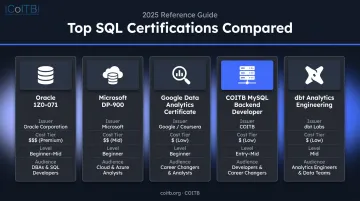
Oracle Database SQL Certified Associate (1Z0-071)
Oracle remains one of the dominant enterprise database vendors globally, and the 1Z0-071 exam reflects that position. It covers SQL fundamentals, data retrieval, joins, subqueries, DML statements, indexes, views, user access, and the Oracle data dictionary — a broad scope that rewards candidates who understand both SQL theory and Oracle-specific implementation.
This is one of the most recognized vendor-specific SQL credentials in enterprise IT, particularly relevant in industries where Oracle databases are standard infrastructure.
| Detail | Specification |
|---|---|
| Exam Format | 63 multiple-choice questions; 120 minutes; 63% passing score |
| Exam Cost | Contact Pearson VUE for current pricing |
| Time to Prepare | Typically 3–6 months depending on prior SQL experience |
| Best For | Database administrators and developers in Oracle-heavy enterprise environments |
One important note: Oracle's official exam page doesn't publicly list pricing — check Pearson VUE directly for current fees. Similarly, the specific recertification period for 1Z0-071 isn't publicly confirmed on Oracle's official pages, so verify renewal requirements with Oracle before registering.
Microsoft Azure Data Fundamentals (DP-900)
DP-900 is Microsoft's entry-level cloud data certification, designed for professionals who are beginning to work with data in the cloud. The exam covers relational and non-relational data concepts on Azure, plus analytics workloads — broader than a pure SQL credential, but highly accessible for non-technical candidates and career switchers.
DP-900 works best as a starting point. It isn't a prerequisite for Microsoft's role-based certifications, but it builds the vocabulary and conceptual foundation needed to pursue them confidently.
| Detail | Specification |
|---|---|
| Exam Cost | $99 USD |
| Exam Duration | ~45 minutes; 700/1000 passing score |
| Renewal Policy | Microsoft Fundamentals certifications do not expire |
| Best For | Beginners, non-technical professionals, and those entering the Microsoft cloud ecosystem |
The no-expiration policy is a genuine differentiator at this price point. Once you've earned it, you keep it — no ongoing recertification fees.
Google Data Analytics Professional Certificate
This Coursera program is a 9-course learning path built by Google, covering SQL, spreadsheets, R, Tableau, data cleaning, analysis, and visualization. It's structured to take complete beginners to job-ready analysts, with a capstone project that produces real portfolio work.
What sets it apart is the employer pipeline. According to Coursera's program page, 75% of graduates report a positive career outcome — a new job, promotion, or raise — within 6 months of completion. The program also connects graduates to an employer consortium of over 150 U.S. companies, including Target, Verizon, Wells Fargo, and Google itself.
| Detail | Specification |
|---|---|
| Cost | ~$49/month after a 7-day free trial |
| Time to Complete | ~6 months at under 10 hours/week; self-paced |
| Credential Type | Course completion certificate (not a proctored exam) |
| Best For | Complete beginners and career switchers targeting data analyst roles |
Note that this is a completion certificate, not an exam-based credential. That distinction matters when comparing it to proctored certifications — but the capstone project and employer consortium partially compensate by giving you documented, reviewable work.
COITB MySQL Backend Developer Certification
COITB is a non-profit credentialing body aligned to ISO/IEC 17024 standards. Their MySQL Backend Developer Certification targets developers and backend professionals working with MySQL, one of the most widely deployed open-source relational databases in production.
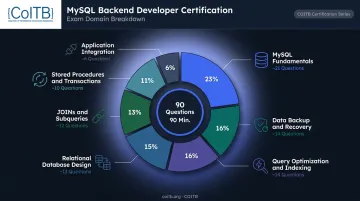
The exam spans 10 domains across 90 questions. Key areas include:
- MySQL Fundamentals (~21 questions, highest weight)
- Data Backup and Recovery
- Query Optimization and Indexing
- Relational Database Design
- JOINs, subqueries, aggregate functions (GROUP BY, HAVING, CTEs)
- Stored procedures, transactions, ACID properties, and triggers
- Integrating MySQL with backend application code
| Detail | Specification |
|---|---|
| Exam Format | 90 questions; 90 minutes; 70% passing score |
| Credential Standard | ISO/IEC 17024-aligned; issued by a non-profit credentialing body |
| Testing Format | Remote online proctoring (24/7, military CAC and VA-issued ID accepted) or authorized test centers |
| Best For | Self-taught developers, bootcamp graduates, career changers, and transitioning veterans seeking recognized MySQL validation |
Pricing isn't publicly listed — contact COITB directly at support@coitb.org or +1 877 402 0840 for current fees. A free practice assessment is available at coitb.org/assessment to gauge readiness before committing. Veterans interested in GI Bill, VET TEC, MyCAA, or VR&E funding should verify current approval status through VA WEAMS or their State Approving Agency before registering.
Upon passing, candidates receive a verifiable digital badge suitable for LinkedIn, résumés, and employer verification portals.
dbt Analytics Engineering Certification
dbt (data build tool) has become the standard for transforming data in analytics workflows. This certification validates the ability to build, test, document, and maintain scalable data models — the core skill set of the Analytics Engineer role, which bridges data analysis and data engineering.
The exam is proctored and vendor-issued, covering dbt model development, governance, debugging, pipeline optimization, dbt tests, and external dependencies. It requires at least 6 months of hands-on dbt experience to prepare effectively — not an entry-level credential.
| Detail | Specification |
|---|---|
| Exam Cost | $200 USD |
| Exam Format | 65 questions; 2 hours; 65% passing score; online proctored |
| Validity | 2 years; recertification required every 2 years |
| Best For | Mid-level to senior analytics professionals and data engineers building modern data pipelines |
For anyone working in a cloud warehouse environment (Snowflake, BigQuery, Databricks), this certification signals a concrete shift from ad hoc querying to production-grade data modeling — a clear differentiator at the mid-to-senior level.
How to Choose the Right SQL Certification
The certifications above were evaluated on employer recognition, curriculum depth, cost, renewal requirements, audience fit, and alignment with actual industry tech stacks. Here's how to apply that framework to your own decision:
Two Questions That Matter Most
1. Does it match your target tech stack? A certification is most valuable when it reflects the database technology used in the role you're targeting. If your target employers run Oracle, the 1Z0-071 is the obvious choice. If they use MySQL and you're coming from a self-taught or bootcamp background, COITB's MySQL Backend Developer Certification is a better fit. If they're on the modern data stack with dbt, that's where your attention should go.
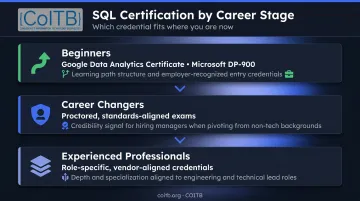
2. Does it match your career stage?
- Beginners benefit most from structured learning paths with employer connections — Google's certificate or Microsoft's DP-900.
- Career changers need credentials that signal credibility to skeptical hiring managers — proctored, standards-aligned exams carry more weight here than completion certificates.
- Experienced professionals should prioritize role-specific, vendor-aligned credentials that validate depth over breadth.
Cost Isn't the Right Filter
Once you've matched a credential to your tech stack and career stage, price becomes a secondary consideration. A $99 exam and a $245 exam can each be the right call depending on what you're trying to accomplish. What matters is whether the credential is recognized in your target industry and role, and whether you can demonstrate the underlying skills in an interview or portfolio. Use the credential to get past the résumé screen — then make sure your portfolio and interview answers back it up.
Conclusion
SQL fluency keeps showing up in job descriptions across backend, analytics, and data engineering roles — and that's not changing. Certification won't substitute for hands-on querying practice, but it does give you a structured, verifiable way to show what you've built.
The path that works for most people:
- Build real querying ability through practice — not just tutorials
- Put together a small portfolio showing what you can actually do with SQL
- Choose a credential that matches your target role and tech stack
If you're a self-taught developer, bootcamp graduate, or career changer looking for a MySQL credential with third-party verification, COITB's MySQL Backend Developer Certification is worth a look. It's aligned to ISO/IEC 17024 standards, delivered via remote online proctoring with flexible scheduling, and issues a verifiable digital badge on passing. Visit coitb.org to review the exam details or take the free practice assessment before registering.
Frequently Asked Questions
Is it worth learning SQL in 2026?
SQL remains one of the most in-demand technical skills across data analyst, backend developer, business analyst, and data engineering roles. Its relevance has grown with AI-integrated data workflows — cloud platforms like BigQuery now support predictive model deployment directly via SQL queries.
What are the best SQL certifications for 2026?
The right choice depends on your goals:
- Oracle 1Z0-071 — enterprise DBAs and database professionals
- Microsoft DP-900 — beginners entering cloud data roles
- Google Data Analytics Certificate — career switchers with no prior tech background
- COITB MySQL Backend Developer Certification — developers seeking an ISO/IEC 17024-aligned credential
- dbt Analytics Engineering Certification — analytics engineers building modern data pipelines
Which SQL certification is best for beginners?
Microsoft Azure Data Fundamentals (DP-900) and Google's Data Analytics Professional Certificate are the most accessible starting points. Both have low barriers to entry, structured learning paths, and broad employer recognition. DP-900 never expires, so there's no recertification cost to factor in.
Do SQL certifications expire?
Expiration policies vary. Microsoft Fundamentals certifications (including DP-900) do not expire. The dbt Analytics Engineering Certification is valid for 2 years and requires recertification. Oracle's recertification requirements for 1Z0-071 are not publicly confirmed on official pages — verify directly with Oracle before registering.
How long does it take to get SQL certified?
Preparation time ranges from 1–2 weeks for entry-level exams like DP-900 to 3–6 months for rigorous credentials like Oracle 1Z0-071 or the dbt Analytics Engineering Certification. Prior experience and the depth of the credential are the primary variables.
Can I get a data job with just an SQL certification?
A certification improves hiring chances but works best alongside a portfolio of hands-on SQL projects and complementary skills like Python, Excel, or data visualization tools. Hiring managers evaluate both credentials and demonstrated problem-solving ability, so treat the certification as one piece of a larger application, not the whole picture.