SQL certifications exist specifically to close that gap. A verifiable, third-party credential turns "MySQL proficiency" on a resume into something an employer can actually confirm.
This guide covers why SQL matters for web and IT careers, the key differences between certification types, the top credentials worth considering, and how to pick the right one based on your current stage and target role.
Key Takeaways
- Web development is one of the most credentialed fields in tech — front-end, full-stack, and backend skills each have dedicated certification pathways, and employers increasingly expect third-party validated proof of competency
- Completion certificates from learning platforms build skills; proctored credentials from independent credentialing bodies verify them to employers
- Match your certification to your target tech stack, not just what's easiest to obtain
- ISO/IEC 17024-aligned credentials carry additional employer credibility as independently validated personnel certifications
- COITB's ReactJS Framework Developer and HTML-CSS Web Designer certifications are designed for entry- to mid-level web developers — including bootcamp graduates, self-taught developers, and career changers — with 0–6 months of hands-on experience
Why SQL Skills Matter for Web and IT Professionals
SQL isn't a data analyst specialty. It's the backbone of backend web development.
Every time a user logs into a web app, submits a form, or pulls up a product page, SQL is working in the background — querying records, updating tables, enforcing data integrity. MySQL is the "M" in the LAMP stack (Linux, Apache, MySQL, PHP), a bundle developers use to build websites and web applications according to AWS.
Backend APIs, content management systems, and e-commerce platforms all depend on relational databases powered by SQL.
The demand data backs this up. According to the 2025 Stack Overflow Developer Survey, MySQL is used by 41.1% of all respondents and 39.1% of professional developers — ranking second among databases overall. That's not a niche skill. It's table stakes for most backend roles.
The Credibility Gap for Self-Taught Developers
Self-taught learners and bootcamp graduates often hit a specific wall: credentials.
The Harvard Business School Hidden Workers report found that 99% of Fortune 500 companies and 63% of midsize enterprises use applicant tracking systems (ATS) to filter candidates. Over 90% use these tools to rank middle- and high-skill applicants. Systems like these can filter by credentials — meaning a resume without a verifiable certification may never reach a human reviewer.
A certification signals two things employers care about:
- Validated knowledge — not just self-reported familiarity, but a standardized assessment of real competency
- Follow-through — finishing a structured program and passing a formal exam requires discipline that employers notice
Courses build the skill. A credential like COITB's MySQL Backend Developer Certification proves it — with a standardized, proctored exam that gives employers something concrete to verify.
The Two Types of SQL Certifications You Need to Know
Two distinct credential types appear on SQL job postings — and they carry very different weight with hiring managers. Knowing which is which saves you from investing time in the wrong one.
Platform Certificates vs. Proctored Credentials
| Type | Examples | How Earned | Employer Weight | |------|----------|------------|-----------------|\n| Platform completion certificate | Coursera, Codecademy, LinkedIn Learning | Finish the coursework | Lower — no independent assessment | | Proctored industry credential | Oracle, Microsoft, COITB, CompTIA | Pass a standardized exam | Higher — third-party validated |
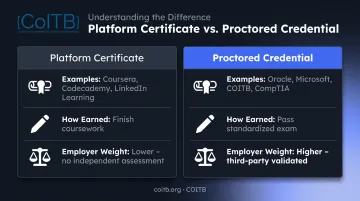
Platform certificates are valuable for structured learning, but because millions of learners hold them, their signal value to employers has diluted. They're most useful as a learning tool, not a standalone credential for job applications.
Proctored credentials require passing an independent exam from a body that doesn't also teach the coursework. Because the credentialing organization is separate from the training provider, the result is a genuinely third-party validation — which is what employers actually trust.
Vendor-Specific vs. Vendor-Neutral
- Vendor-specific (Oracle SQL, Microsoft Azure SQL, COITB MySQL Developer): Deep expertise in one platform. Choose this when you know your target employer's tech stack.
- Vendor-neutral (CompTIA DataSys+): Database concepts that transfer across platforms. The better starting point if you're entering the field without a specific environment in mind.
The ISO/IEC 17024 Standard
Beyond vendor scope, one more factor separates credentials that hold up to scrutiny: whether the issuing body operates under ISO/IEC 17024 — the international standard for personnel certification bodies.
ISO/IEC 17024 defines how organizations must develop, administer, and maintain certification programs. Credentials from aligned bodies carry additional credibility because the certification process itself meets independently verified competency standards — not just internal guidelines.
COITB's certification programs, including the MySQL Backend Developer credential, are aligned to ISO/IEC 17024 standards.
Top SQL Certifications to Consider
Developer-Focused SQL Credential
If your goal is backend web development — not general data analysis or cloud database administration — a certification built around MySQL and application integration is the right fit. One credential stands out for that specific profile.
COITB MySQL Backend Developer Certification
Designed specifically for backend and full-stack developers who work with MySQL in web application contexts. The exam consists of 90 questions in 90 minutes with a 70% passing score — a mix of multiple-choice and scenario-based items.
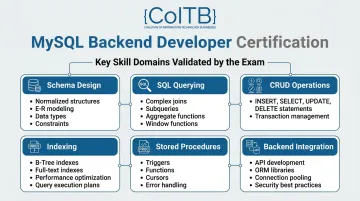
Skills validated include:
- Relational database schema design and normalization
- SQL querying with SELECT, JOIN, GROUP BY, subqueries, and CTEs
- Full CRUD operations (INSERT, UPDATE, DELETE)
- Indexing and query optimization
- Stored procedures, triggers, and transactions
- ACID properties and referential integrity
- Database connection and integration with backend application code
The credential is accessible to candidates with 0–6 months of hands-on experience, available via remote online proctoring (military CAC and VA-issued IDs accepted), and includes a verifiable digital badge for LinkedIn and resume use. As a non-profit credentialing body, COITB does not deliver training — it strictly validates skills through independent examination.
How to Choose the Right SQL Certification for Your Goals
The right credential depends on three factors: where you are now, what role you're targeting, and which technology stack your target employer uses.
Decision Framework by Career Stage
Complete beginners — Build foundational SQL skills through self-study (freeCodeCamp, MDN, or structured practice), then validate with a proctored credential before applying for roles. Self-study alone won't get you through ATS filters — a verifiable credential will.
Career changers entering tech — Choose a certification that signals commitment to your target stack. If job descriptions at target companies mention MySQL, pursue a MySQL-specific credential. If you see MySQL paired with web application or backend development roles, COITB's MySQL Backend Developer certification is a direct fit.
Developers already using MySQL — Don't learn a new platform just to get certified. Validate what you already know. A MySQL-specific credential like COITB's MySQL Backend Developer certification confirms skills you've already built and adds a verifiable artifact to your resume.
Vendor-Neutral vs. Vendor-Specific
- Job postings specifying MySQL → MySQL Backend Developer certification (validates backend development with MySQL directly)
- Entry-level data or backend roles without a named platform → an ISO/IEC 17024-aligned credential signals standardized, third-party verified competency
- Backend web development roles (APIs, databases, web apps) → MySQL Backend Developer, which covers the full backend skill set employers expect
- Roles requiring proof of skill, not just course completion → remote-proctored exams carry more hiring weight than platform badges
Cost vs. Credibility Tradeoff
Once you've identified your target stack, the next decision is investment level. Platform certificates cost little but carry less hiring weight. Proctored credentials require more investment — in time and exam fees — but function as stronger resume filters and ATS keywords.
| Credential Type | Cost | Hiring Signal | Verifiability |
|---|---|---|---|
| Platform badge (Coursera, etc.) | Low | Moderate | Self-reported |
| Proctored certification | Moderate | Strong | Third-party verified |
| ISO/IEC 17024-aligned exam | Moderate | Strong | Internationally standardized |
For MySQL specifically, COITB's MySQL Backend Developer exam is remote-proctored, ISO/IEC 17024-aligned, and targets 0–6 months of hands-on experience — making it accessible whether you're self-taught, a bootcamp graduate, or already working with MySQL professionally.
Building a Study Plan: Timeline and Preparation Tips
Underestimating preparation time is the most common reason candidates fail on their first attempt — so plan before you register.
General timeline guidance:
- Foundational platform certificates: 4–12 weeks of consistent study
- Entry-level proctored credentials (including COITB's MySQL exam): 4–12 weeks depending on prior exposure
- Technical developer credentials (ReactJS, JavaScript, Python): 6–12 weeks for candidates with some hands-on exposure
Effective Preparation Approach
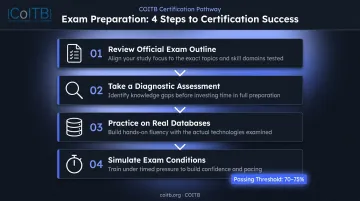
- Start with the official exam outline — For COITB's MySQL credential, the outline is available at coitb.org/certification-resources/exam-outlines/mysql-backend-developer-outline. It maps every domain, task, and question weighting across the 90-item exam.
- Take a diagnostic early. COITB offers a free practice assessment at coitb.org/assessment. Use it to identify weak areas before committing to an exam date.
- Practice on real databases — Reading theory isn't enough. Write actual queries, build schemas, and simulate the operations covered in your exam domain list.
- Simulate exam conditions — Time yourself on practice questions and review any domain where your accuracy dips below 75%. COITB's passing threshold sits between 70–75%, so consistent drilling on weak areas is where most score improvements happen.
Once your preparation is solid, the exam itself is designed to fit your schedule. COITB's remote proctoring means no test center commute — the exam runs 24/7 from any location with a webcam and stable internet. That flexibility matters for candidates balancing jobs, family responsibilities, or active military service commitments.
Frequently Asked Questions
Can I master SQL in 3 months?
Foundational SQL skills are achievable in 3 months with consistent daily practice. Codecademy's beginner SQL course is listed at 17 hours; Coursera's SQL basics specialization estimates 2 months at 10 hours per week. Advanced topics like query optimization, stored procedures, and complex joins typically require ongoing real-world application beyond initial certification.
Which SQL certification is best for beginners?
It depends on your goal. Platform-based learning certificates provide structured learning but less employer validation. COITB's MySQL Backend Developer certification is designed for candidates with 0–6 months of experience, accessible without extensive prerequisites but rigorous enough to carry real credential weight.
Which SQL certification is most in demand?
Oracle 1Z0-071 and Microsoft's DP-300 carry strong recognition in enterprise and cloud environments. MySQL-specific credentials are most relevant for web development and full-stack roles. Demand varies significantly by industry and job type, so align your choice to your target role.
Is it worth getting a SQL certification?
For career entrants and career changers, yes. Certifications function as credibility filters that help resumes pass ATS screening and reach hiring managers. The credential is most valuable when paired with demonstrable hands-on skills, not treated as a shortcut around practical experience.
Do web developers need SQL certification?
No certification is universally required, but SQL proficiency is expected in backend and full-stack development roles. A MySQL-focused certification formally validates that competency, which is particularly valuable for developers without a traditional CS degree or prior tech employment history.
What SQL skills should a web developer learn first?
Start with these foundational operations used in every relational database-driven web application:
- Writing SELECT queries with WHERE conditions
- Filtering and sorting data with ORDER BY and LIMIT
- Understanding table relationships and JOINs
- Using INSERT, UPDATE, and DELETE statements
- Designing basic schemas with primary and foreign keys