Certifications solve both problems. They provide third-party validation of skills that would otherwise require years of role-specific experience to prove, and they send a clear signal to hiring managers that you've invested deliberately in the hybrid competency the TAM role demands.
This guide covers the five most relevant certifications for TAMs, how to choose between them by career stage, and what foundational technical credentials to earn first if you're still building your technical baseline.
Key Takeaways
- TAM certifications span four skill domains: IT service management, cloud architecture, project leadership, and customer success
- ITIL 4, AWS Solutions Architect, and PMP carry the strongest employer recognition in enterprise TAM job postings
- Early-career TAMs should start with CTAM or ITIL Foundation; mid-career TAMs benefit from adding a platform-specific or technical credential
- TAMs without a technical background should build foundational credentials in Python, JavaScript, or AI before pursuing platform-specific certs
- Most TAM certifications cost $150–$750 and require 20–100+ hours of study
What Is a Technical Account Manager and Why Do Certifications Matter?
A Technical Account Manager serves as the technical liaison between a vendor and its enterprise clients — responsible for solutions architecture, relationship management, and escalation handling. Unlike a standard account manager, a TAM is expected to understand the customer's technical environment deeply. A customer success manager focuses on value delivery; a TAM brings the technical credibility to back it up.
AWS describes its TAMs as principal technical advisors who help customers adopt services, manage operational health, and navigate incidents, trade-offs, and risk. That job description requires demonstrated competency in both technical domains and client-facing functions — exactly the gap certifications address.
What TAM Certifications Prove to Hiring Managers
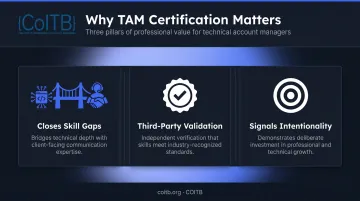
- Closes skill gaps when transitioning from pure engineering (strong on technical, weak on account management) or pure sales (strong on relationships, limited on technical depth)
- Provides third-party validation that a job title alone can't prove — credentials signal demonstrated competency, not just claimed experience
- Signals intentionality to hiring managers evaluating candidates for high-stakes enterprise accounts
For TAMs whose technical foundation needs strengthening before pursuing platform-specific credentials, foundational certifications in programming, AI, or application development are the right first step. COITB — a non-profit credentialing body aligned to ISO/IEC 17024 standards — offers industry-recognized credentials in Python, JavaScript, ReactJS, and AI/GPT that validate the technical depth enterprise TAM roles require.
Best Technical Account Manager Certifications
The following certifications were selected based on relevance to core TAM responsibilities, employer recognition in actual job postings, accessibility across experience levels, and verified renewal requirements.
Certified Technical Account Manager (CTAM) — HDI
The CTAM is the most role-specific credential available for TAMs. Issued by HDI (Help Desk Institute), it is designed directly for account managers operating in technical environments, covering customer service excellence, technical problem-solving, and account planning.
Unlike most credentials TAMs pursue, the CTAM is built specifically for the TAM career path — not adapted from project management or cloud architecture frameworks.
| Detail | Specifics |
|---|---|
| Prerequisites | 2+ years in technical support or account management; high school diploma or equivalent |
| Cost & Study Time | ~$300–$500 exam fee; 40–60 hours of self-study |
| Renewal | Every 3 years (30 hours continuing education or retake) |
| Best For | Professionals new to the TAM role or transitioning from non-TAM backgrounds |
Note: Verify current CTAM availability and pricing directly with HDI at thinkhdi.com, as official program details should be confirmed with the issuing body before registering.
ITIL 4 Foundation — PeopleCert (formerly AXELOS)
ITIL 4 Foundation gives TAMs a shared language for incident management, change control, and service delivery — the operational vocabulary enterprise clients expect their vendors' TAMs to speak fluently. According to PeopleCert, 90% of organizations use ITIL practices in some capacity, making this one of the most universally recognized credentials on this list.
The exam itself is 40 multiple-choice questions, 60 minutes, with a 65% pass mark.
| Detail | Specifics |
|---|---|
| Prerequisites | None required for Foundation level |
| Cost & Study Time | $200–$400+ depending on bundle; 20–40 hours of study |
| Renewal | Every 3 years (20 CPD points per year) |
| Best For | TAMs in IT service management, managed services, or infrastructure-heavy customer environments |
AWS Certified Solutions Architect – Associate — Amazon Web Services
For TAMs supporting cloud-native or AWS-heavy accounts, this is the benchmark credential. It validates knowledge of core AWS architecture, high availability, cost optimization, and deployment best practices — all skills clients expect their TAMs to apply during technical reviews and escalations.
As of January 2025, AWS reported 1.42M+ active AWS Certifications, with 91% of organizations with AWS Certified staff citing increased innovation. The Associate level strikes the right balance between technical depth and achievable study time for most TAMs.
| Detail | Specifics |
|---|---|
| Prerequisites | No formal prerequisites; 1+ year hands-on AWS experience recommended |
| Cost & Study Time | $150 exam fee; 40–60 hours of study |
| Renewal | Every 3 years |
| Best For | TAMs supporting cloud-native or AWS-heavy customer accounts |
Project Management Professional (PMP) — Project Management Institute
The PMP is the most widely recognized project management credential globally. For TAMs managing multi-phase implementations, coordinating cross-functional delivery teams, or leading enterprise migrations, it formalizes project leadership authority in a way that other certifications don't.
PMI requires either a bachelor's degree plus 36 months of project management experience, or a high school diploma plus 60 months — plus 35 contact hours of PM education. The study commitment is the steepest on this list: 100+ hours. Renewal requires 60 PDUs every 3 years.
TAMs who already hold a PMP often find the credential pairs well with technical credentials that validate hands-on skills — particularly for those pivoting toward technical program management or account leadership roles.
| Detail | Specifics |
|---|---|
| Prerequisites | Bachelor's + 36 months PM experience, or high school + 60 months; 35 contact hours |
| Cost & Study Time | ~$405 (PMI member) / ~$655 (non-member); 100+ hours of study |
| Renewal | Every 3 years (60 PDUs required) |
| Best For | Experienced TAMs managing large-scale implementations or moving into account leadership |
Certified Customer Success Manager (CCSM) — SuccessCOACHING
TAM responsibilities are increasingly converging with customer success functions — particularly in SaaS and subscription environments where health scoring, renewal risk, and expansion are part of the TAM's remit. The CCSM (offered through SuccessCOACHING) addresses exactly that overlap.
The Level 1 program runs 12 weeks and is open to both current and aspiring CS professionals — no formal CS background required. Core focus areas include:
- Metrics-driven account management and lifecycle health
- Renewal risk identification and expansion signals
- QBR facilitation and executive stakeholder communication
| Detail | Specifics |
|---|---|
| Prerequisites | Open to current and aspiring CS professionals; some providers require no prerequisites |
| Cost & Study Time | Contact SuccessCOACHING for current pricing; 12-week program |
| Renewal | Contact provider for current expiration policy |
| Best For | TAMs in SaaS companies or managing recurring-revenue, post-sale relationships |
Technical Sales Specialist — COITB
For TAMs who came up through non-technical sales — medical device, B2B industrial, financial services, telecom — or who are transitioning into SaaS account management, COITB's Technical Sales Specialist certification validates the technical fluency side of the role. It's specifically designed for professionals bridging commercial and technical responsibilities.
The exam covers solution selling, technical communication, and the ability to translate product capabilities into client outcomes — directly applicable to TAM workflows like solution reviews, escalation handling, and renewal conversations.
| Detail | Specifics |
|---|---|
| Prerequisites | None required; designed for 0–6 months hands-on experience and career changers |
| Format | Online proctored exam (webcam + internet); also available at authorized test centers |
| Credential | Digital badge for LinkedIn and résumé verification |
| Best For | TAMs from non-technical sales backgrounds, or career changers entering SaaS account management |
Learn more at coitb.org or contact support@coitb.org.
How to Choose the Right TAM Certification for Your Career Stage
The right certification depends on three variables: your current skill gap, the technology stack your clients actually use, and where you are in your career.
Step 1: Identify Your Skill Gap
- Coming from engineering? Start with CTAM or CCSM to build client-facing structure
- Coming from sales? Earn a foundational technical credential first — Python, JavaScript, or cloud fundamentals — before pursuing platform-specific certs. A credential like COITB's Professional Python Developer or JavaScript Professional Developer validates those fundamentals with a third-party, employer-recognized exam
- Already in a TAM role? Pinpoint whether your weakest link is service management knowledge, cloud architecture depth, or project coordination authority
Step 2: Match the Cert to Your Technology Stack
A credential your customers don't recognize adds limited value. Audit the platforms your accounts rely on most and select certifications that match:
- SaaS / cloud TAM: AWS SAA or a cloud platform credential outperforms a PM cert
- Enterprise IT migration TAM: PMP or ITIL 4 typically delivers more return than a customer success cert
- Technical sales or pre-sales TAM: A technical credential (JavaScript, Python, or a recognized sales-engineering cert) strengthens your credibility on both sides of the conversation
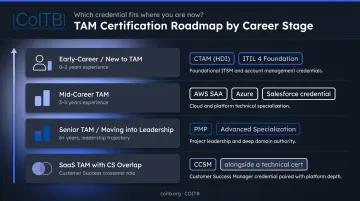
Step 3: Apply Career-Stage Logic
| Career Stage | Recommended Starting Point |
|---|---|
| Early-career / new to TAM | CTAM (HDI) or ITIL 4 Foundation |
| Mid-career TAM | Add AWS SAA, Azure, or Salesforce credential |
| Senior TAM / moving into leadership | PMP or advanced specialization |
| SaaS TAM with CS overlap | CCSM alongside a technical cert |
Step 4: Check Job Postings Before Committing
Scan 10–15 TAM job listings at your target companies. Note which certifications appear as "required" vs. "preferred." Pursuing credentials your target employers explicitly list shortens your ROI timeline — faster interview wins and less wasted study time.
How We Selected These Certifications
These five certifications were selected based on four criteria:
- Industry recognition — frequency in actual TAM job postings and employer preference signals
- Relevance to core TAM responsibilities — technical advising, account planning, service delivery, and client communication
- Accessibility — range of entry points across experience levels and backgrounds
- Verified renewal cadences — credentials with active renewal requirements keep holders current; we excluded credentials we couldn't independently verify
The list intentionally spans the full scope of the TAM role — covering technical foundations, client-facing communication, and sales engineering competency — rather than clustering around a single skill domain. If you're earlier in your TAM career, start with credentials that reinforce your technical credibility. If you're established, prioritize those that sharpen your commercial and advisory skills.
Conclusion
No single certification defines a successful TAM career. The strongest candidates combine hands-on experience with a deliberate credential strategy that fills real gaps and reflects the technologies their clients actually use.
Think of certifications as a multi-year roadmap. Start with a foundational credential to build structured knowledge, layer in a technology-specific cert aligned to your accounts, then advance toward project or leadership credentials as implementation complexity grows.
For TAMs still building their technical foundation, COITB's industry-recognized credentials offer an accessible, third-party-validated starting point before pursuing platform-specific TAM credentials:
- Python and JavaScript for scripting and API literacy
- ReactJS for front-end client-side context
- Certified GPT Professional for AI-adjacent account work
All exams are remote-proctored, require no formal prerequisites, and target professionals with 0–6 months of hands-on experience in the relevant technology.
Your next step: Audit your current skill gaps, shortlist two certifications that address them, and research exam requirements this week. Most candidates who stall do so before they start — picking a direction and registering is what separates credentials earned from credentials planned.
Frequently Asked Questions
How do I become a technical account manager?
Most TAMs start in technical support, software engineering, or solutions sales, then build the complementary skill set through experience and targeted credentials. A relevant degree helps, but at least one industry certification — CTAM or ITIL 4 Foundation — notably strengthens candidacy for competitive enterprise roles.
What is the best certification for account management?
For TAM-specific roles, CTAM from HDI is the most direct credential. For broader account management, PMP and CCSM are widely recognized. If your role skews toward technical client engagement or pre-sales, a Technical Sales credential — such as COITB's Technical Sales Specialist certification — pairs well with cloud or ITIL credentials. If relationship management is the priority, CCSM or CTAM are the stronger fit.
Is being a TAM a good career?
TAM is a strong career path. Glassdoor reports median total pay at $164,122 (range: $128K–$214K) as of early 2026, while PayScale shows an average base of $96,629. Demand grows alongside cloud adoption and SaaS expansion — and the dual-skill nature of the role makes experienced TAMs difficult to replace.
Do TAM certifications expire?
Most do. AWS, Azure, and GCP certifications expire every 3 years; PMP requires 60 PDUs per 3-year cycle; ITIL 4 Foundation requires renewal every 3 years via CPD. Salesforce certifications require annual maintenance modules. Factor renewal costs and time into your certification decision.
Can I become a TAM without a degree?
Many employers prefer a bachelor's degree, but several accept equivalent hands-on experience combined with relevant certifications (CTAM, ITIL, cloud credentials). Candidates without formal degrees often use certifications to demonstrate structured, verifiable competency — and hiring managers have taken notice.
How long does it take to earn a TAM certification?
ITIL 4 Foundation and entry-level credentials take 20–40 hours of study (roughly 1–2 months part-time). AWS SAA typically requires 40–60 hours (2–3 months). PMP is the most intensive at 100+ hours and usually takes 3–6 months while working full-time.