
Introduction
Job postings mentioning AI skills have surged in the US over the past year, according to recent labor market tracking. Employers aren't just asking for degrees anymore. They want proof.
That's the challenge. With hundreds of certification options scattered across vendors, most professionals have no idea which credentials actually move the needle on hiring decisions or paychecks. Chase the wrong one, and you've spent months and hundreds of dollars on a line item recruiters barely glance at.
This guide breaks down the certifications worth your time in 2026, with a focus on the application development, AI, and front-end/back-end credentials employers are increasingly asking for by name.
TL;DR
- Certifications validate real skills and can boost hiring odds, especially for AI, web development, and application development roles
- Top picks span career stages: HTML-CSS Web Designer (entry-level front-end), ReactJS Framework Developer (front-end/full-stack), Professional Python Developer and MySQL Backend Developer (backend), and Certified GPT Professional (AI)
- Match certifications to your career goals and current experience, not just what pays the most on paper
- Non-profit credentialing bodies like COITB now offer online-proctored AI and app development credentials open to candidates with 0-6 months of hands-on experience
Overview of IT Certifications in the 2026 Job Market
An IT certification is third-party proof that you can do a specific job. Unlike a degree or a training certificate of completion, it's an exam-based credential issued by a vendor or independent credentialing body, confirming you've demonstrated a defined set of skills under testing conditions.
The market for these credentials has exploded alongside AI adoption. More than 1.3 billion job postings were analyzed by Lightcast, and researchers found that AI-related skill requests now appear in over half of postings outside traditional IT and computer science roles. Generative AI job postings in non-tech industries grew 800% since 2022, according to that same analysis.
There's also a real pay signal attached to certification:
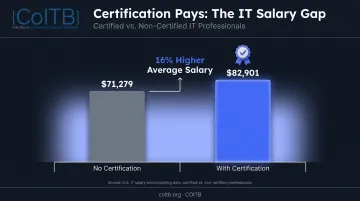
- Skillsoft's 2025 IT Skills and Salary survey found professionals holding an industry IT certification averaged $82,901 globally
- Those with no certifications averaged $71,279
- That's a 16% gap, based on responses from more than 5,100 tech professionals surveyed between May and September 2024
Certification alone won't guarantee a raise. Paired with actual hands-on skill, though, it's a credible signal that employers respond to. The next section ranks the certifications worth prioritizing in 2026, based on demand, career stage, and how well they map to where the industry is actually heading.
Top IT Certifications to Pursue in 2026
Selection here comes down to four things: industry recognition, employer demand in real job postings, relevance to your current career stage, and coverage of high-growth areas like cloud, cybersecurity, AI, and application development.
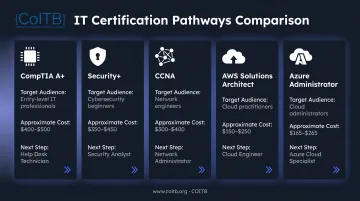
The market includes established vendor certifications from CompTIA, Cisco, AWS, and Microsoft, alongside newer credentialing bodies like COITB that focus specifically on AI and application development skills. Here's how the major options compare.
CompTIA A+
This is the most widely recognized entry-level IT certification on the market, covering hardware, operating systems, networking basics, and troubleshooting. If you're starting from zero, this is usually where you start.
Why it stands out:
- No prerequisites required
- Applies to nearly every help desk and support role
- Widely accepted as the baseline credential for entering IT
| Attribute | Details |
|---|---|
| Best For | Complete beginners and career changers entering help desk/support roles |
| Cost | Around $253 per exam based on CompTIA's last confirmed pricing; two exams are required, so budget roughly $500 total, but confirm current pricing before registering |
| Career Path | Leads into Network+, Security+, or CCNA |
Once you've covered the fundamentals, cybersecurity is a natural next step.
CompTIA Security+
Security+ is the baseline cybersecurity certification, covering risk management, threat detection, and incident response. CompTIA recommends candidates have Network+-level knowledge and around two years in a security or systems admin role, though this isn't a hard prerequisite.
Why it stands out:
- Globally recognized across industries
- Aligned with DoD 8140 work roles (the framework that replaced the older DoD 8570 program), making it valuable for government and compliance-driven positions
- A strong entry point into cybersecurity, the fastest-growing segment of IT
| Attribute | Details |
|---|---|
| Best For | IT professionals transitioning into cybersecurity or entry-level security analysts |
| Cost | Check CompTIA's official store directly for current pricing |
| Career Path | Leads into CySA+, CISSP, or CISM |
Cisco Certified Network Associate (CCNA)
CCNA is the associate-level standard for networking. The single 200-301 exam covers network fundamentals, IP connectivity, network access, security fundamentals, and automation.
Why it stands out:
- Cisco still dominates enterprise networking infrastructure
- Highly valued for network engineering and infrastructure support roles
- Single-exam format keeps the certification path straightforward
| Attribute | Details |
|---|---|
| Best For | Learners targeting network engineering or infrastructure support roles |
| Cost | $300 USD for the 200-301 exam |
| Career Path | Leads into CCNP or advanced networking specializations |
AWS Certified Solutions Architect – Associate
This credential validates your ability to design secure, scalable, cost-optimized solutions on AWS. AWS doesn't require a formal prerequisite but recommends at least one year of hands-on cloud experience.
Why it stands out: Cloud computing consistently ranks among the highest-paying certification categories, and AWS remains the dominant cloud provider by market share.
- Skillsoft's 2025 ranking placed this credential #14 among the highest-paying IT certifications in the US
- Average reported salary: $155,597
| Attribute | Details |
|---|---|
| Best For | Professionals with hands-on cloud experience seeking architect or engineer roles |
| Cost | $150 USD |
| Career Path | Leads into AWS DevOps Engineer or advanced specialty certifications |
Microsoft Certified: Azure Administrator Associate
The AZ-104 exam validates skills managing Azure identity, storage, networking, virtual machines, and monitoring — the day-to-day operational work of running cloud infrastructure.
Why it stands out: Most enterprises run hybrid Microsoft environments, keeping Azure certifications in steady demand for admin and DevOps career tracks.
| Attribute | Details |
|---|---|
| Best For | IT admins and systems professionals managing cloud infrastructure |
| Cost | $165 USD (pricing varies by country/region where the exam is proctored) |
| Career Path | Leads into Azure Security Engineer or DevOps Engineer Expert |
The certifications above assume months or years of prior experience before you're exam-ready. That's where COITB fills a gap — for candidates who need a credential now, not after a multi-year runway.
COITB AI & Application Development Certifications
COITB is a non-profit, ISO/IEC 17024-aligned credentialing body offering seven certifications built around the technologies powering modern application development: HTML, CSS, JavaScript, React, Python, MySQL, and GPT/generative AI. There's also a Technical Sales Specialist credential for sales engineers and pre-sales consultants.
Why it stands out: Most certification bodies assume years of experience. COITB doesn't. Its programs target candidates with 0-6 months of hands-on practice, making it a realistic option for:
- Bootcamp graduates looking to validate skills with a third-party credential
- Self-taught developers who learned through freeCodeCamp, Udemy, or similar platforms
- Career changers with no formal computer science background
- Veterans and military spouses using GI Bill, VET TEC, or MyCAA benefits (eligibility must be verified with the VA before registering)
Exams run 58-90 questions depending on the certification, take 75-90 minutes, and require passing scores between 70-75%. Every passed exam earns a digital badge that's verifiable through LinkedIn, résumés, and employer background-check platforms.
| Attribute | Details |
|---|---|
| Best For | Career changers, bootcamp graduates, and self-taught developers entering AI or application development roles |
| Format | Remote online proctoring 24/7, or in-person at authorized COITB test centers |
| Career Path | Strengthens résumés for UI design, application development, AI, and backend development roles |
How We Chose the Best IT Certifications
Each certification on this list was evaluated against four criteria: industry recognition, alignment with current job postings, relevance to 2026's dominant technology areas (cloud and AI in particular), and accessibility for different experience levels.
That last point matters more than most guides admit. Here's a common mistake:
Chasing the "highest-paying" certification without matching it to your actual experience level.
A self-taught developer who jumps straight into an advanced AI or backend credential without foundational coding experience often fails the exam, or passes it without the practical skill to back it up in an interview. Both outcomes waste time and money.
The better approach: match the certification to where you are right now, then stack credentials as your experience grows. It's why COITB structures its seven credentials, from HTML-CSS Web Designer through Certified GPT Professional, around the 0-6 month experience range, giving career changers and bootcamp grads a realistic entry point before layering on more advanced skills.
Certification Trends to Watch in 2026
AI and Agentic AI Skills Are Becoming Their Own Category
Gartner forecasts that task-specific AI agents will appear in 40% of enterprise applications in 2026, up from less than 5% in 2025. That shift is driving demand for AI governance knowledge and AI-integrated development skills, not just traditional programming certifications. Credentials like the Certified GPT Professional reflect this shift, validating practical AI development skills rather than theory alone.
Specialized Technical Skills Still Command Salary Premiums
Skillsoft's 2025 data shows certain specialized credentials carry a salary gap above $50,000 compared to entry-level ones, even accounting for differences in role, seniority, and location. The pattern is clear: employers pay more for validated, specialized technical skills over generalist ones. This reinforces why stacking a focused credential, such as a Professional Python Developer or ReactJS Framework Developer certification, onto existing experience can move the needle on compensation.
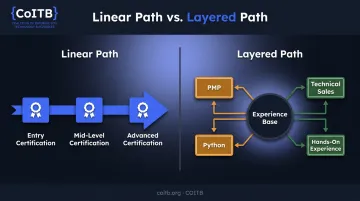
Certification Paths Are Getting Layered, Not Linear
Instead of picking one track and climbing a single ladder, professionals increasingly combine foundational credentials with specialized ones as their careers evolve. A project manager might stack a COITB Python certification onto an existing PMP. A career changer might pair a Technical Sales Specialist credential with hands-on selling experience rather than waiting years to specialize.
Conclusion
There's no single "best" certification for 2026. The right one depends on where you're starting from, what skills employers in your target role are actually asking for, and where you want your career to go in the next three to five years.
Evaluate certifications for their long-term relevance, not their resume-flash value. Ask yourself:
- Does this skill match what employers in my target role actually ask for?
- Will I use it in my day-to-day work, not just list it on a resume?
- Does it build toward where I want to be in three to five years?
If you're new to AI or application development and want a starting point that doesn't require years of prior experience, COITB's Certified GPT Professional certification and its front-end credentials (HTML-CSS Web Designer, JavaScript Professional Developer) are built for exactly that: entry-level candidates with 0-6 months of hands-on experience. Each one gives you a digital badge you can add to your resume or LinkedIn the moment you pass.
Frequently Asked Questions
Which IT certifications are most in demand in 2026?
Employers are prioritizing cloud, cybersecurity, and AI/application development skills, with AI-related roles seeing the fastest hiring growth. Credentials in React, Python, and GPT/AI development, like those offered through COITB, are increasingly recognized as proof of job-ready skills in these areas.
Are IT certifications worth it without a college degree?
Yes. Certifications are widely accepted as skill validation and can open entry-level roles even without a formal degree, especially when paired with hands-on project experience or a portfolio.
How much do IT certification exams typically cost?
Costs vary widely by provider and range from under $150 to over $300 in the US. Non-profit credentialing bodies, like COITB, typically price entry-level exams lower than for-profit alternatives.
Can I get an IT certification with no prior experience?
Yes. COITB's certifications specifically target candidates with 0-6 months of hands-on experience, making them accessible to career changers and bootcamp graduates without prior IT work history.
How do I choose the right IT certification for my career goals?
Review job postings for your target role and note which skills and technologies appear most frequently. Match your certification choice to those specific, recurring requirements.
Do IT certifications need to be renewed?
Yes, in most cases. Renewal requirements vary by certifying body, with many requiring continuing education credits or retesting every few years to keep credentials current.