Introduction
Java isn't going anywhere. It powers core banking systems, government infrastructure, Android apps, and the microservices backends behind some of the largest enterprise platforms in the world. According to the Bureau of Labor Statistics, software developer employment is projected to grow 15% from 2024 to 2034 — roughly 129,200 openings per year.
The challenge isn't the demand. It's standing out. For career changers, bootcamp graduates, and self-taught developers, a Java certification does something a portfolio alone can't: it gives hiring managers a standardized, verifiable signal of competency before the first interview.
This guide breaks down the five best Java certifications for 2026: what each covers, who it targets, how much it costs, and which experience level it fits.
Key Takeaways
- OCP Java SE 17 Developer covers the broadest ground for enterprise Java roles in 2026.
- OCP Java SE 21 suits developers targeting modern tech companies and cloud-native teams — built around where Java is heading.
- Broadcom Spring Certified Professional validates microservices and cloud-native Java development specifically.
- Java EE 7 remains relevant for developers building enterprise backend systems in finance, healthcare, and government.
- Certification choice should follow your target job description — not just your experience level.
Why Java Certifications Still Matter in 2026
Java consistently ranks among the top programming languages globally. The TIOBE Index places Java at #4 as of July 2026 with an 8.03% rating, while Statista's 2025 developer survey shows 29.4% of developers worldwide use it regularly.
Java runs across so many industries and stack configurations that employers can't easily assess competency from a resume alone. A credential from Oracle — the company that owns Java itself — fills that gap directly.
Certifications matter most for three groups:
- Career changers who lack a traditional CS degree or recognizable employer on their resume
- Self-taught developers whose skills are real but unverified
- Bootcamp graduates competing against candidates with more conventional credentials
The job market numbers back this up. With 129,200 annual openings projected through 2034, Java-skilled developers have a long window ahead. Getting certified now means entering that market with a credential built to last.
Best Java Certifications for Career Growth in 2026
The five certifications below were selected based on employer recognition, exam currency, issuing body credibility, and career-level coverage. They span from foundational to advanced — use this as a comparison map, not a ranked list.
Oracle Certified Associate (OCA), Java SE 8 Programmer (1Z0-808)
The OCA Java SE 8 is the recognized entry point for Java certification. It validates core fundamentals: data types, operators, arrays, basic object-oriented programming, and exception handling. For beginners or career switchers who haven't touched Java before, it provides structured proof that the syntax-level basics are covered.
It's widely referenced in job postings for junior and entry-level Java roles. It also serves as a prerequisite for the OCP Java SE 8 path. Note: it is not required for the SE 17 or SE 21 OCP tracks.
| Detail | Info |
|---|---|
| Cost | ~$245 USD (verify current pricing with Oracle) |
| Exam Format | 56 multiple-choice questions, 120 minutes, 65% passing score |
| Best For | Beginners and students entering Java development |
Oracle Certified Professional (OCP): Java SE 17 Developer (1Z0-829)
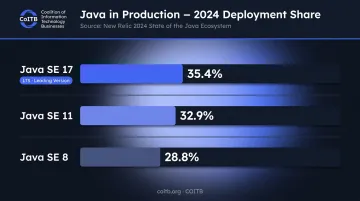
This is the most employer-relevant professional-level credential for 2026. Java SE 17 is a long-term support (LTS) release, and according to New Relic's 2024 State of the Java Ecosystem report, it leads production deployment at 35.4% — ahead of Java 11 (32.9%) and Java 8 (28.8%).
The exam covers advanced skills that show up in mid-level and senior job descriptions: streams, lambda expressions, the Java Platform Module System, switch expressions, and exception handling patterns. Developers with 1–3 years of hands-on Java experience should prioritize this path. It maps directly to what production teams are running right now.
| Detail | Info |
|---|---|
| Cost | ~$245 USD (verify current pricing with Oracle) |
| Exam Format | 50 multiple-choice questions, 90 minutes, 68% passing score |
| Best For | Mid-level developers targeting enterprise Java roles on modern LTS stacks |
Oracle Certified Professional: Java SE 21 Developer (1Z0-830)
Oracle's newest professional-level certification covers Java SE 21 — the latest LTS release, released in September 2023. The exam validates modern Java features: records, sealed classes, pattern matching with instanceof and switch, virtual threads, and enhanced switch expressions.
The strategic case for SE 21 is strong. It represents only 1.4% of production deployments in New Relic's 2024 data, but JetBrains' 2025 State of Java report shows 40% of developers now use it regularly, up from 28% the year before.
Developer adoption typically leads production adoption by 12–24 months. Earning this certification now puts developers ahead of that curve.
| Detail | Info |
|---|---|
| Cost | ~$245 USD (verify current pricing with Oracle) |
| Exam Format | 50 multiple-choice questions, 120 minutes, 68% passing score |
| Best For | Experienced developers targeting forward-looking engineering environments |
Oracle Certified Professional, Java EE 7 Application Developer (1Z0-900)
This credential covers Java Enterprise Edition technologies: Servlets, JSPs, EJBs, JPA, JMS, REST and SOAP web services, WebSockets, and CDI Beans. It's less about writing Java code and more about architecting and deploying complete enterprise applications.
The 2025 Jakarta EE Developer Survey found that finance, banking, and insurance account for 18% of Jakarta EE users, with government and public sector at 10%. These sectors still run Java EE architecture in high-transaction backend systems, and this credential directly signals readiness for those environments.
Note that Java EE was transferred to the Eclipse Foundation in late 2017 and now lives as Jakarta EE. The Oracle Java EE 7 certification tests the legacy version, but the architecture patterns it validates remain broadly applicable.
| Detail | Info |
|---|---|
| Cost | ~$245 USD (verify current pricing with Oracle) |
| Exam Format | 70 multiple-choice questions, 120 minutes, 66% passing score |
| Best For | Intermediate-to-advanced developers targeting enterprise backend roles in finance or government |
Broadcom Spring Certified Professional (2V0-72.22)
Spring leads the Java framework landscape at 65% adoption according to JetBrains' 2025 data, making this the most practical framework credential a Java developer can hold. The exam tests major Spring and Spring Boot features, covering the areas that appear most frequently in modern Java job descriptions.
Two things make this credential particularly durable:
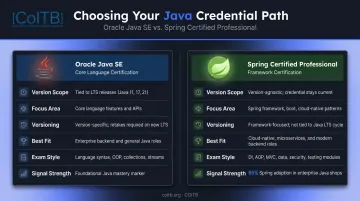
- Version stability: Oracle certifications are tied to specific Java releases; the Spring credential validates framework expertise that travels across versions without going stale.
- Cloud-native relevance: It signals readiness for cloud-native architectures and API-driven development, which dominate current Java workloads.
Candidates with 6–12 months of Spring experience are well-positioned to sit for this exam without additional preparation time.
| Detail | Info |
|---|---|
| Cost | $250 USD |
| Exam Format | 60 questions, 130 minutes, scaled passing score of 300/500 |
| Best For | Developers targeting Spring-based, microservices, and cloud-native Java roles |
How to Choose the Right Java Certification for Your Career Goals
Match Your Experience Level First
Beginners (0–12 months of Java exposure): Start with the OCA Java SE 8. It's the recognized entry point and builds the foundational knowledge required before tackling professional-level content.
Developers with 1–3 years of experience: Skip the OCA. Go directly to OCP SE 17 or Spring Professional — the OCA on a mid-level resume can actually raise questions rather than answer them.
Senior developers: OCP SE 21 or Java EE 7, depending on your target role. A senior candidate sitting the OCA sends the wrong signal.
Align the Credential to the Role
- Software developer / backend engineer: OCP SE 17 or OCP SE 21
- Cloud-native / microservices roles: Spring Certified Professional
- Enterprise architect / backend in regulated industries: Java EE 7
- Full-stack developer: OCP SE credential + practical project portfolio
SE 17 vs. SE 21 — The Version Tradeoff
SE 17 is the safe, proven choice for most 2026 job seekers. Enterprises run it in production, and hiring managers recognize it. SE 21 is the future-facing choice — worth pursuing for developers at modern tech companies or those planning a 3–5 year career horizon. Avoid targeting SE 8 or SE 11 unless your specific employer's tech stack requires it.
Budget and Prep Time
Oracle exams run approximately $245 per attempt; Spring Professional is $250. Factor in prep materials and the possibility of a retake.
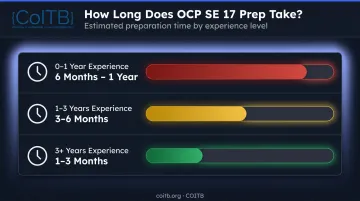
Realistic timelines for the OCP SE 17:
- 0–1 year Java experience: 6 months to 1 year
- 1–3 years experience: 3–6 months
- 3+ years experience: 1–3 months
Free resources (Oracle documentation, GitHub practice projects, community forums) cover the material; paid Udemy and Pluralsight courses add structure for those who need it.
Complement Java with Broader Credentials
Java certifications validate one language — and for Oracle credentials, one specific version. If you're early in your backend career — or transitioning from a non-technical background — pairing a Java credential with certifications in adjacent technologies strengthens your profile significantly.
COITB, a non-profit credentialing body offering ISO/IEC 17024-aligned certifications, is worth exploring for those adjacent domains. Their credentials are designed for entry-to-mid-level candidates and career changers validating job-ready skills through remote-proctored exams. Relevant options for developers rounding out a backend skill set include:
- MySQL Backend Developer — validates relational database fundamentals
- Professional Python Developer — covers scripting and backend logic in Python
- JavaScript Professional Developer — validates client-side and full-stack JavaScript skills
Each exam is remotely proctored and accessible from any location with a webcam and stable internet. Visit coitb.org to explore what's available.
How We Chose These Certifications
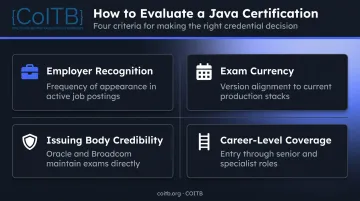
These five credentials were selected using four criteria:
- Employer recognition — how frequently these certifications appear in Java job postings and recruiter conversations
- Exam currency — how closely the version being tested maps to actual production Java environments in 2026
- Issuing body credibility — Oracle and Broadcom maintain and update the exams directly, meaning the content reflects the actual technology, not a third-party interpretation
- Career-level coverage — the list serves developers from entry level through senior and specialist roles
These criteria exist because version targeting is where most candidates go wrong. Chasing OCP SE 8 when most employers are benchmarking against SE 17 or SE 21 is a real and frequent error — one that costs time and exam fees. The second common mistake is choosing a certification based on cost or availability alone, without checking whether the issuing body and version match what your target employers actually require.
The best approach: pull three to five job listings for your desired role before registering for any exam. Note which certifications appear. Build your study plan from there.
Conclusion
Java certifications aren't interchangeable. The right credential depends on where you are in your career, what role you're targeting, and which version of Java your target employers actually run in production.
For most 2026 job seekers, the OCP Java SE 17 Developer is the anchor credential — broadly recognized, version-relevant, and aligned to real production environments. The Spring Certified Professional is the right call for cloud-native and microservices roles. Java EE 7 serves enterprise architects in regulated sectors. And OCP SE 21 rewards developers willing to bet on where the market is heading.
Start with a job posting, not a certification catalog. Find three to five listings for your target role, identify which credentials appear, and build your preparation plan from there.
Java is often one piece of a broader credential stack. For developers adding front-end, AI, or database credentials alongside their Java path, COITB offers ISO/IEC 17024-aligned certifications in MySQL, Python, JavaScript, ReactJS, AI/GPT, and technical sales, all remote-proctored and built around real-world skill validation. Take a free practice assessment at coitb.org/assessment.
Frequently Asked Questions
What is the best Java certification for career growth?
The OCP Java SE 17 Developer is the strongest all-around choice for 2026 — it aligns with what enterprises actually run in production and carries strong employer recognition. For developers targeting cloud-native or microservices roles specifically, the Broadcom Spring Certified Professional is the better fit.
Is Java certification worth it in 2026?
Yes. With the BLS projecting 15% growth for software developers through 2034, the market for Java skills remains strong. Certifications give hiring managers a standardized signal of competency, which is especially valuable for career changers and self-taught developers navigating resume screening.
Which Java certification should I start with as a beginner?
The Oracle Certified Associate (OCA) Java SE 8 Programmer is the recognized industry entry point. It covers core Java fundamentals and is the most appropriate starting credential for those with little or no prior Java exposure. Developers with prior programming experience in another language sometimes skip directly to an OCP track.
How long does it take to prepare for a Java certification exam?
OCP SE 17 prep ranges from 1–3 months for senior developers to 3–6 months for those with 1–3 years of experience. The OCA typically takes 1–2 months with prior Java exposure; Spring Professional candidates with hands-on Spring experience can often be ready in 4–6 weeks.
Do Java certifications expire?
Oracle Java certifications are version-specific, tied to the Java SE release they test, and carry no formal expiration date. That said, they lose market relevance as newer LTS versions are adopted — an OCA SE 8 credential carries significantly less weight today than it did in 2018.
What jobs can I get with a Java certification?
The most direct paths are Java software developer, backend engineer, Android developer, full-stack developer, and enterprise application architect. Combining a Java credential with practical project work — and potentially adjacent credentials in SQL or frameworks like Spring — significantly improves job placement outcomes.