The problem? Most professionals learning AI on their own have no verifiable way to prove it. Completing a YouTube tutorial or tinkering with ChatGPT doesn't translate into a credential recruiters can trust.
That's where the Certified GPT Professional certification from COITB comes in. This article covers what the credential validates, who it's built for, what career paths it opens, and how veterans can potentially use GI Bill benefits to pursue it.
Key Takeaways
- COITB's Certified GPT Professional is an entry-to-intermediate AI credential aligned to ISO/IEC 17024 standards
- The exam covers prompt engineering, OpenAI API integration, responsible AI, and applied GPT use cases
- Built for candidates with 0–6 months of AI/GPT experience, including career changers, bootcamp grads, and self-taught learners
- Veterans may qualify for GI Bill reimbursement up to $2,000 (verify eligibility via VA WEAMS before registering)
- Stackable with COITB's Python and backend credentials to build a complete AI practitioner profile
What Is the Certified GPT Professional Certification?
COITB's Certified GPT Professional is a foundational-level credential that validates real-world competency in working with GPT models and large language models (LLMs) — including prompt engineering, API integration, responsible AI practices, and applied business use cases.
COITB is a non-profit credentialing body whose certification programs are aligned to ISO/IEC 17024, the international standard for personnel certification bodies. That alignment signals to employers that the credential follows independently benchmarked standards for candidate assessment — not an ad hoc quiz or a course completion badge.
What "Foundation Level" Actually Means
The Certified GPT Professional targets candidates with 0–6 months of hands-on AI/GPT experience, gained through bootcamps, self-study, coursework, or on-the-job use. It's specifically designed as an entry-to-intermediate credential, not a post-graduate program requiring years of machine learning background.
Most people entering AI roles today are not traditional computer science graduates. They're developers, marketers, analysts, and career changers who've built skills independently and need a recognized way to prove it.
Why a Formal Credential Beats a Self-Reported Skill
Listing "AI proficiency" on a résumé tells an employer very little. A formal credential from a credentialing body aligned to ISO/IEC 17024 tells them something specific: this person took a proctored exam, met a defined competency standard, and earned a verifiable digital badge.
The SHRM Foundation reported in 2025 that 95% of executives and HR professionals said individuals with skilled credentials perform as well as or better than those with traditional degrees. For anyone pivoting into AI roles, that's direct evidence that formal credentials carry real hiring weight.
Exam Format at a Glance
| Specification | Details |
|---|---|
| Questions | 60 multiple-choice and scenario-based items |
| Time Limit | 75 minutes |
| Passing Score | 71% or higher |
| Delivery | Remote online-proctored or authorized test center |
| Scheduling | Flexible, candidate-selected timing |
The exam is administered remotely with flexible scheduling, so candidates can test from anywhere with a webcam and stable internet connection.
What Skills Does This Certification Validate?
The Certified GPT Professional exam assesses five domains, each weighted based on its relevance to practical AI work.
Domain 2: Prompt Engineering and Output Control (20%)
This domain covers the hands-on mechanics of prompt engineering — what the exam tests directly:
- Zero-shot, few-shot, and chain-of-thought prompting — all three are explicitly tested
- Role-based and system-level instructions — writing prompts that define user, system, and assistant context
- Temperature, top-p, and max token parameters — controlling model creativity and verbosity
- Output formatting — using JSON, Markdown, delimiters, and tone controls to shape responses
- Prompt debugging — diagnosing and correcting poor GPT outputs
Domain 3: OpenAI Syntax and GPT Integration (40%)
The highest-weighted domain moves into practical implementation:
- Passing system and user roles correctly through the
/v1/chat/completionsendpoint - Adjusting temperature and max tokens programmatically in Python and JavaScript
- Handling token overflow errors and managing context window constraints
- Designing structured, multi-turn conversations
Supporting Domains
- Domain 1 (10%): Generative AI foundations — tokenization, embeddings, context windows, transformer architecture
- Domain 4 (15%): Responsible AI, security, and compliance — bias mitigation, privacy (GDPR, FERPA, COPPA), content moderation, API key security
- Domain 5 (15%): Applied GPT use cases — chatbots, document assistants, automation workflows
Why These Skills Have Market Value
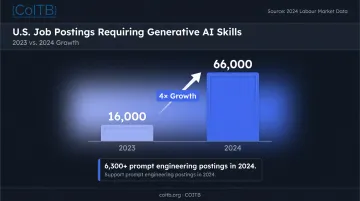
Lightcast reported that U.S. job postings mentioning generative AI as a skill reached more than 66,000 in 2024, up from 16,000 in 2023. Demand for prompt engineering specifically reached nearly 6,300 postings in 2024. Job postings at that volume signal that employers want candidates who can already work with these tools, not just candidates curious about them.
Who Should Earn the Certified GPT Professional Certification?
COITB's official materials explicitly name several groups this credential is built for:
- Career changers and bootcamp graduates who've been practicing with GPT tools — the eligibility documentation acknowledges that a formal CS degree isn't required, giving self-study candidates a clear path to a verifiable credential
- Developers, IT professionals, and web designers already using AI in their workflows who want to formally validate those capabilities with a digital badge employers can verify
- Veterans and military-to-civilian transitioners — COITB has dedicated veteran-facing content for this credential, and those with analytical, signals, communications, or data systems backgrounds bring structured problem-solving skills that translate directly into prompt engineering and AI application design
That last group is broader than many expect. Lightcast found that 51% of job postings requiring AI skills were for roles outside IT and computer science — spanning marketing, operations, customer experience, and beyond. Anyone working in those fields has a realistic case for pursuing this credential.
Career Paths and Opportunities After Certification
Roles That Value This Credential Directly
Prompt engineering and applied GPT skills are increasingly showing up in dedicated job titles:
- AI Prompt Engineer
- AI Content Specialist
- Conversational AI Designer
- AI Integration Specialist
These roles are growing as companies build AI into their products, customer service operations, and internal workflows. While BLS doesn't yet list "Prompt Engineer" as a distinct occupation, the adjacent category of Computer and Information Research Scientists is projected to grow 20% from 2024 to 2034 — much faster than average.
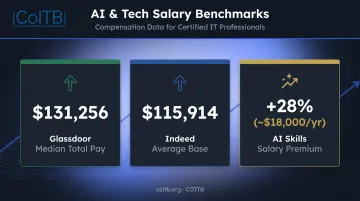
On compensation: Glassdoor reports a median total pay of $131,256 for Prompt Engineers in the United States, while Indeed's current data puts the average base at $115,914. Lightcast found that job postings requiring AI skills commanded a 28% salary premium — nearly $18,000 more per year — compared to postings without AI skills.
Adjacent Roles Where AI Credentials Add Value
The Certified GPT Professional also strengthens candidacy for roles where AI-assisted output quality directly affects results:
- Technical writers using AI for documentation at scale
- UX designers building conversational interfaces
- Software developers integrating LLMs into applications
- Digital marketers automating content workflows
- Business analysts building GPT-powered reporting tools
Stacking Toward a Broader AI Profile
The Certified GPT Professional is the first step in a stackable credential pathway. The core AI/ML practitioner stack is:
Certified GPT Professional → Professional Python Developer → MySQL Backend Developer
Each credential adds a distinct layer:
- Certified GPT Professional — generative AI design and prompt strategy
- Professional Python Developer — programming foundation for real AI application development
- MySQL Backend Developer — data management skills relevant to AI pipelines
For project managers pivoting into technical roles, pairing the GPT credential with the ReactJS Framework Developer certification covers the Technical PM track.
Can You Use the GI Bill for This Certification?
Veterans may be eligible to use GI Bill benefits toward the Certified GPT Professional exam — but eligibility must be verified before registering.
How GI Bill Certification Reimbursement Works
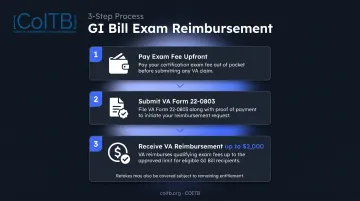
The Post-9/11 GI Bill (Chapter 33) reimburses approved licensing and certification exam fees up to $2,000 per exam, covering the test fee, registration fees, and administrative fees. The process works like this:
- Pay the exam fee upfront at registration
- Submit VA Form 22-0803 (Request for Reimbursement of Licensing or Certification Test Fees) along with proof of payment
- Receive reimbursement from the VA — including for retakes, subject to remaining entitlement and benefit time limits
Other Veteran Benefit Pathways
Chapter 33 isn't the only option. Depending on your situation, these programs may also apply — verify each before registering:
- VET TEC — does not consume remaining GI Bill months, making it valuable for veterans who want to preserve Chapter 33 entitlement
- MyCAA — available to eligible military spouses pursuing portable, remote-friendly careers
- VR&E (Chapter 31) — for veterans with service-connected disabilities seeking vocational rehabilitation support
How to Verify Eligibility
Approval status for specific exams is tracked through the VA's WEAMS (Web Enabled Approval Management System) database. Before registering, veterans should:
- Search the VA's certification search tool at VA.gov for the specific COITB credential
- Confirm approval with their State Approving Agency (SAA) — state-level approval is a separate requirement from federal WEAMS listing
- Contact a VA Education Benefits counselor for direct verification
- Reach COITB at support@coitb.org or +1 877 402 0840 with eligibility questions
Important: COITB's own documentation states that GI Bill, VET TEC, MyCAA, and VR&E coverage depends on current WEAMS approval status. Do not assume eligibility — verify before registering.
How to Earn the Certified GPT Professional Certification
The path from registration to earning your badge follows a clear process:
- Create a COITB account at coitb.org/auth/signup
- Take the free practice assessment at coitb.org/assessment to gauge readiness
- Review the official exam outline at coitb.org/certification-resources/exam-outlines/certified-gpt-professional-outline — this document defines exactly what will be tested across all five domains
- Complete self-study or training using external courses, bootcamps, or hands-on practice. Focus on prompt engineering methods, Python-based AI integrations, and real-world GPT applications. COITB is a credentialing body, not a training provider
- Register and schedule your exam : select online remote-proctored (available 24/7) or an authorized test center
- Pass with 71% or higher on the 60-question, 75-minute exam
On Exam Day
For online candidates: log into your COITB account, complete ID verification via webcam, and launch the proctored session. COITB explicitly accepts military CAC and VA-issued IDs as valid identification — active-duty and veteran candidates can test without obtaining separate civilian ID.
After Passing
Once you pass, COITB issues a digital certification badge at no additional cost. To make the credential easy for employers to find and verify, list it as:
- Credential Name: Certified GPT Professional
- Issuing Organization: COITB
- Date: Month and year earned
- Badge URL: Include the verification link so employers can independently confirm authenticity
Adding the badge URL to LinkedIn's Licenses & Certifications section enables one-click verification by recruiters and ATS systems.
Frequently Asked Questions
What certifications can I get with my GI Bill?
The GI Bill covers a wide range of VA-approved certification exams across IT, cybersecurity, project management, healthcare, skilled trades, and emerging AI fields. Veterans should verify eligibility for any specific exam through the VA WEAMS database and their State Approving Agency before registering — approval status changes over time.
How do I find my Certificate of Eligibility for the GI Bill?
Apply through VA.gov using VA Form 22-1990, or connect with the testing organization's VA certifying official to start the process. Either way, allow a few weeks — apply early.
What is the Certified GPT Professional certification?
It's an industry-recognized credential from COITB that validates foundational competency in prompt engineering, OpenAI API integration, and responsible AI practices. The exam consists of 60 questions over 75 minutes, requires a passing score of 71%, and is aligned to ISO/IEC 17024 standards.
Is prompt engineering a good career path in 2025 and beyond?
The data makes a strong case. U.S. job postings mentioning generative AI skills exceeded 66,000 in 2024, up from 16,000 in 2023. Earning a formal, verifiable credential now positions you ahead of professionals still self-reporting AI skills without proof.
How long does it take to prepare for the Certified GPT Professional certification?
It varies, but the credential targets candidates with 0–6 months of AI/GPT experience. Focused study of prompt patterns, LLM behavior, OpenAI API basics, and responsible AI principles — plus hands-on practice — is the recommended approach. COITB's free practice assessment helps identify gaps before you register.
What jobs can I get with a prompt engineering certification?
Direct roles include AI Prompt Engineer, AI Content Specialist, and Conversational AI Designer. The credential also strengthens applications for technical writing, UX design, software development, and digital marketing roles where AI-generated output quality directly impacts results.