That shift shows up in the numbers. 48% of large employers now use IT certifications as a hiring prerequisite, and another 47% factor them into promotion decisions, according to Pearson VUE's 2026 Value of IT Certification Employer Report. The U.S. Bureau of Labor Statistics also projects 15% growth in software developer jobs from 2024 to 2034, with roughly 129,200 openings a year — a market that rewards verifiable skills over pedigree.
Certifications are increasingly the bridge between bootcamp or self-taught learning and what hiring managers actually expect, especially as AI tools reshape day-to-day development work. This guide breaks down the certifications worth pursuing in 2026, how to match one to your experience level, and which credentials actually move the needle on a résumé.
TL;DR
- Front-end and full-stack credentials (ReactJS, JavaScript, HTML-CSS) remain the highest-value certifications for developers entering the field
- Backend and AI credentials (Python, MySQL, GPT) round out a job-ready skill set for mid-level roles
- Match certification choice to career stage: foundational skills for 0-6 months experience, specialized stacking for mid-level pivots
- Costs range from accessible non-profit pricing to $445+ for advanced vendor exams, with study time running 2-6 months
- Non-profit bodies like COITB offer seven ISO/IEC 17024-aligned credentials, giving career changers, bootcamp grads, and transitioning veterans affordable, real-world skill validation
Overview of Software Developer Certifications in 2026
A developer certification is a third-party validated credential proving you can competently work with a specific language, cloud platform, or development methodology. It's an external body vouching for your skills, so a hiring manager doesn't have to take your word for it.
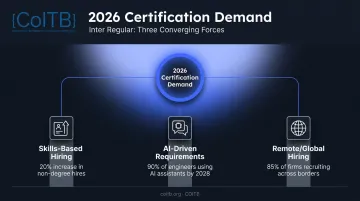
Three forces are making certifications matter more in 2026 specifically:
- Skills-based hiring: Employers who lead on skills-based hiring increased their share of non-degree hires by nearly 20%, per research from Harvard Business School and the Burning Glass Institute.
- AI-driven job requirements: Gartner projects 90% of enterprise software engineers will use AI code assistants by 2028, up from under 14% in early 2024. Static résumés matter less than demonstrated, current skills.
- Remote and global hiring: When a hiring manager in Austin is evaluating a candidate in Manila, a recognized certification does work a diploma from an unfamiliar university can't.
Among employers investing in workforce upskilling, 78% choose professional certification programs over other training formats, according to Pearson VUE's workforce research. That's a strong signal: certifications are becoming a core hiring filter, not a side note.
Here's a breakdown of the certifications worth your time this year.
Top Software Developer Certifications in 2026
Selection here comes down to four factors: industry recognition, relevance to current demand (cloud, AI, full-stack), cost-to-value ratio, and accessibility across experience levels. Selection here comes down to four factors: industry recognition, relevance to current demand (cloud, AI, full-stack), cost-to-value ratio, and accessibility across experience levels. The list below spans major enterprise cloud and language certifications alongside more accessible entry-level credentials built for career changers and self-taught developers.
AWS Certified Developer – Associate
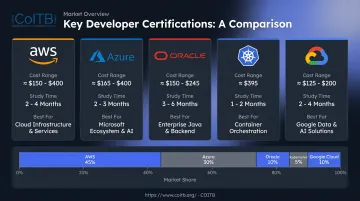
Issued by Amazon Web Services, this certification validates your ability to build, deploy, and maintain applications on AWS infrastructure, including services like Lambda, DynamoDB, API Gateway, and S3.
It stands out because AWS still leads the cloud market with a 28% share as of Q1 2026, according to Synergy Research Group. That dominance translates directly into job postings, especially at startups and remote-first companies.
| Cost | Study Time | Best For |
|---|---|---|
| $150 | 3-6 months | Cloud-focused developers, DevOps-track engineers |
The exam (DVA-C02) runs 130 minutes with 65 questions and requires a scaled score of 720 out of 1,000. Certification is valid for 3 years.
Microsoft Certified: Azure Developer Associate (AZ-204)
This credential validates skills in designing, building, and maintaining cloud applications on Microsoft Azure, covering compute, storage, security, and monitoring.
Azure holds roughly 23.9% of the worldwide IaaS market, per Gartner, and dominates enterprise and government environments. If you're targeting a Microsoft-heavy organization, this is your credential.
| Cost | Study Time | Best For |
|---|---|---|
| ~$165 | 3-4 months | Enterprise and full-stack developers |
One caveat: Microsoft has scheduled AZ-204 to retire on July 31, 2026. If you're planning to sit this exam, don't wait until Q3.
Oracle Certified Professional: Java SE Developer
Java isn't going anywhere. It still ranks 4th on the TIOBE Index as of July 2026, and this certification remains one of the most enduring credentials in enterprise development.
The current version tests against Java SE 21 (exam 1Z0-830): 50 questions, 120 minutes, 68% passing score. It's especially relevant for backend roles and Android development, where Java's footprint runs deep.
| Cost | Study Time | Best For |
|---|---|---|
| ~$245 | 4-6 months | Backend and enterprise Java developers |
Certified Kubernetes Application Developer (CKAD)
Issued by the Cloud Native Computing Foundation (CNCF), CKAD validates your ability to design and deploy cloud-native applications on Kubernetes.
Containerization isn't a niche skill anymore. It's baseline infrastructure: 82% of container users ran Kubernetes in production in 2025, up from 66% in 2023, according to the CNCF Annual Cloud Native Survey. Sixty-six percent of organizations running generative AI models use Kubernetes for inference workloads.
| Cost | Study Time | Best For |
|---|---|---|
| ~$395-445 | 2-4 months | Cloud-native and microservices developers |
The exam itself is a 2-hour, hands-on, performance-based test with no multiple choice. You're working directly in a command-line environment.
That hands-on, skills-first format carries over into Google's cloud credential, which has evolved fastest to reflect where cloud development is actually heading.
Google Professional Cloud Developer
This certification validates your ability to build and deploy applications using Google Cloud services, with growing emphasis on AI integration.
Google's April 2026 exam guide now includes generative-AI APIs, AI coding assistants, and automated debugging agents, a clear signal of where the platform and its job market are heading.
| Cost | Study Time | Best For |
|---|---|---|
| ~$200 | 3-6 months | AI/data-integrated application developers |
The certifications above carry weight with enterprise employers, but they also carry enterprise price tags and multi-month study timelines. For career changers, bootcamp grads, and self-taught developers who need credible, affordable skill validation now, COITB fills that gap.
COITB Certifications (AI & Application Development Track)
COITB is a non-profit credentialing body offering certifications aligned to ISO/IEC 17024 standards, covering HTML-CSS, JavaScript, ReactJS, Python, MySQL, and GPT/AI skills.
Unlike the enterprise vendor certs above, COITB is built for a distinct audience: career changers, bootcamp grads, and self-taught developers with 0-6 months of experience who need affordable, credible skill validation without navigating steep vendor pricing.
- Exam format: 90 minutes, 90 questions, multiple-choice and scenario-based
- Passing scores: 73-75% depending on credential (HTML-CSS requires 75%, ReactJS requires 73%)
- Delivery: Remote proctoring (webcam + minimum 1 Mbps connection) or authorized test centers
| Pricing | Format | Best For |
|---|---|---|
| Per-credential fee (contact COITB); bulk/enterprise team pricing available | Remote online proctoring or in-person test centers | Aspiring developers, career changers, UI/backend/AI beginners |
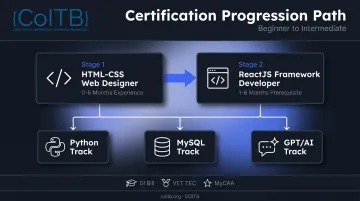
The HTML-CSS Web Designer certification is the most accessible entry point. It requires zero prior coding background, just 0-6 months of hands-on practice building web pages. From there, the ReactJS Framework Developer credential (which recommends 1-6 months of HTML, CSS, and basic JavaScript experience first) is a natural next step for front-end-focused candidates.
Funding options including GI Bill, VET TEC, MyCAA, and VR&E may help offset costs for eligible candidates, though eligibility should always be verified directly with the VA before registering.
How We Chose the Best Certifications
The most common mistake developers make: chasing the most expensive or "prestigious" certification without checking whether it matches actual job market demand or their own current skill level. A self-taught developer with three months of practice registering for an advanced, enterprise-level architecture exam is wasting time and money.
To avoid that trap, we evaluated every certification against a consistent set of criteria:
- Industry recognition — does this credential actually show up in job postings and hiring criteria?
- Alignment with hiring trends — cloud, AI integration, and full-stack versatility
- Cost-to-value ratio — what you pay versus what it unlocks in salary or role access
- Accessibility — can someone with 0-6 months of hands-on experience realistically prepare for and pass it?
- Renewal and validity terms — some certs expire in 2 years, others (like Java SE) have no stated expiration
Choosing the Right Certification for Your Career Level
Most tech organizations use a rough L1-L4 hierarchy: junior (L1), intermediate (L2), senior (L3), and lead/architect (L4). Understanding where you sit helps you avoid two common traps. Under-credentialing leaves you with nothing to prove your skills, while over-credentialing means spending $400+ on an architect-level exam you're not yet positioned to use.
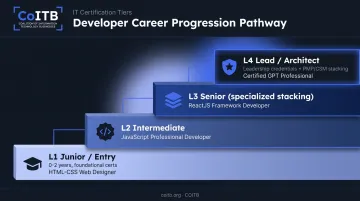
Junior/L1 Developers (0-2 Years or Career Changers)
Focus on foundational, accessible certifications first. This is where COITB's entry-level tracks make sense: HTML-CSS Web Designer or Certified GPT Professional both suit candidates with zero to six months of experience and no assumed coding background.
MySQL Backend Developer is another solid option at this stage, building a verifiable database skill base before you specialize further.
Mid-Level/L2-L3 Developers (2-5 Years)
Once you've picked a lane, specialization pays off:
- ReactJS Framework Developer for front-end and component-driven roles
- Professional Python Developer for backend and data-driven application work
- Certified GPT Professional if you're moving into AI-integrated feature development
These align a specific tech stack with a specific certification : not a generalist credential, but proof of depth.
Senior/L4 Developers (5+ Years)
At this stage, certifications should support technical leadership, not basic competency. Look for credentials that signal you can mentor others and guide platform-level decisions, such as stacking multiple technical certifications (ReactJS, Python, GPT) alongside an existing PMP or CSM to move into a technical lead or engineering manager role.
One note for PM-to-technical pivots: if you already hold a PMP, PSM, or CSM and want to move into a technical program manager or engineering lead role, stacking a COITB credential on top of your existing PM certification is often more efficient than starting from scratch with a new specialty exam. It proves hands-on technical fluency without abandoning the project management credibility you've already built.
Conclusion
The "best" certification isn't the one with the highest price tag or the most recognizable logo. It's the one that matches your current skill level, your target role, and the technologies employers in your specific market are actually hiring for.
Before you commit to an exam, ask yourself:
- Does this align with jobs I can realistically apply for right now?
- Can I validate real skills through this, not just memorize exam answers?
- Does the cost make sense relative to where I am in my career?
Once you've answered those questions honestly, you'll have a clearer sense of where to start. Career changers, bootcamp grads, and self-taught developers looking for an affordable, credible entry point can check out COITB's certifications in React, HTML/CSS, JavaScript, Python, MySQL, and GPT/AI, aligned to ISO/IEC 17024 standards. A free practice assessment at coitb.org/assessment lets you gauge readiness before committing to an exam fee.
Frequently Asked Questions
What is L1, L2, L3, and L4 developer?
These terms describe a common industry hierarchy: L1 (junior/entry-level), L2 (intermediate), L3 (senior), and L4 (lead/architect). COITB's credentials are built for the L1-L2 range, validating the hands-on skills employers expect before someone advances further.
Is the ReactJS Framework Developer certification worth it?
ReactJS is worth pursuing if you're targeting front-end or full-stack roles, since React remains one of the most widely used JavaScript libraries in production applications. It's especially valuable for career changers and bootcamp grads who need third-party proof of their skills.
Do software developer certifications actually help you get hired in 2026?
Certifications support but don't replace a strong portfolio. They help significantly with résumé screening and skills validation, especially for career changers without a traditional CS background.
How much do software developer certifications typically cost?
Costs vary widely across the industry, from accessible non-profit pricing to $400+ for advanced, vendor-specific exams. Non-profit credentialing bodies like COITB typically charge per-credential fees well below that range, making them a practical entry point for career changers and veterans using education benefits.
What's the best certification for someone with no prior coding experience?
Foundational, accessible certifications — like COITB's HTML-CSS Web Designer track — are the best starting point. They validate core skills without assuming prior programming logic, before you move into specialized cloud or language certifications.
How long does it typically take to prepare for a developer certification?
Most certifications require 2-6 months of study, depending on exam complexity and your prior experience level. Entry-level credentials trend toward the shorter end; architect-level exams take longer.