
Introduction
You earned your education benefits. Using them shouldn't feel like navigating a minefield. Yet for many veterans transitioning into civilian tech careers, that's what searching through thousands of GI Bill-approved schools feels like — overwhelming and full of conflicting information from schools whose marketing rarely matches VA reality.
The stakes are real. Common missteps include:
- Enrolling in a program that loses VA approval mid-semester, leaving you responsible for tuition costs
- Choosing a credential employers don't recognize, wasting months of preparation time
- Relying on a school's veterans services office instead of verifying status directly with the VA
This guide covers what GI Bill approval actually means, which benefit chapters apply to tech training, how to verify program status using VA's official tools, and which IT career paths are realistic after completing a funded program.
Key Takeaways
- GI Bill approval is a formal VA designation — not automatic for any accredited school or course
- Verify current approval status through the VA's GI Bill Comparison Tool — not a school's marketing materials
- IT certification programs can qualify under Chapter 33 and VET TEC 2.0 as non-college-degree programs
- Credentials designed to ISO/IEC 17024 standards carry greater employer credibility than certificates of completion
- Confirm benefit eligibility with your VA Education Benefits counselor before registering
What Does "GI Bill Approved" Actually Mean?
GI Bill approval means a school, training program, or certification course has been formally reviewed and authorized by the State Approving Agency (SAA) in its state — then accepted by the VA to receive GI Bill funding. Accreditation alone doesn't qualify a program. Neither does popularity or reputation.
Two Program Categories Veterans Need to Know
The VA recognizes two broad approved-program types:
- Institutions of Higher Learning (IHL) — traditional degree-granting colleges and universities
- Non-College Degree (NCD) programs — vocational training, apprenticeships, and professional certification courses
IT certification programs fall almost exclusively into the NCD category. This distinction matters when you're searching the VA's comparison tools, because filtering correctly determines whether you find what you're actually looking for.
What Approval Actually Requires
SAAs don't rubber-stamp programs. VA documentation on school program approval confirms that reviews can cover:
- Curricula and training outlines
- Student records and instructor qualifications
- Physical facilities and equipment
- Evidence of clear vocational objectives
- Demonstrated pathways to gainful employment
Approval Can — and Does — Lapse
This is the part many veterans miss: approval status changes. Programs can lose approval or let it expire without updating their marketing materials. A school's website saying "GI Bill accepted" may reflect status from two years ago. Always verify through VA tools before you enroll.
Approved vs. Accredited — Not the Same Thing
Accreditation (regional or national) and GI Bill approval are entirely separate designations. A school can be accredited without being GI Bill approved. Some vocational programs hold GI Bill approval without traditional accreditation. Veterans evaluating a program need both pieces of information — one doesn't imply the other.
Which GI Bill Benefits Apply to Tech Training Programs?
Two chapters cover most veterans pursuing IT training, with a third option specifically designed for tech.
Chapter 33 — Post-9/11 GI Bill
This is the most widely used benefit for tech programs. Key mechanics:
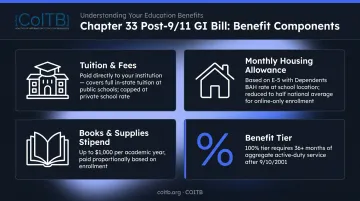
- Tuition and fees paid directly to the school (not to you)
- Monthly Housing Allowance (MHA) based on E-5-with-dependents BAH for the training location ZIP code (online-only programs use half the national average)
- Books and supplies stipend up to $1,000 per academic year
- Full benefit (100%) requires 36+ months (1,095 days) of qualifying active duty service; shorter service periods receive a proportional percentage
Use the VA's eligibility checker to confirm your tier before assuming 100% coverage.
Chapter 30 — Montgomery GI Bill (Active Duty)
Chapter 30 pays a monthly stipend directly to you rather than to the school. This creates a practical challenge: you pay tuition out of pocket, then receive the monthly benefit to offset costs. Category I eligibility requires a $1,200 contribution, deducted as $100/month during the first 12 months of service.
For expensive programs, Chapter 33 typically delivers more value. Your service history determines which chapter you actually qualify for.
VET TEC 2.0 — The Tech-Specific Option
VET TEC 2.0 is a high-technology training program funded through September 30, 2027, capped at 4,000 paid participants per fiscal year. Eligible training areas include computer programming, computer software, media application, data processing, and information sciences.
What sets it apart from standard GI Bill chapters:
- VET TEC does NOT consume your remaining GI Bill months
- Provider payments are milestone-based (25% at start, 25% at graduation, 50% after qualifying employment)
Capacity is limited, so check availability on VA.gov before counting on it.
How to Find GI Bill Approved Schools and Programs
Using the VA GI Bill Comparison Tool
The GI Bill Comparison Tool at va.gov is the primary resource for veterans. You can search by:
- School or employer name
- Program type (non-college degree, apprenticeship, licensing/certification)
- Location
- Benefit chapter
The tool also displays caution flags, student complaints, and accreditation data — information schools rarely publish on their own websites. For IT certification programs specifically, use the licenses/certifications and prep courses search path rather than the general school search.
How to Use WEAMS for Verification
WEAMS (Web Enabled Approval Management System) is the VA's backend approval database. If a Comparison Tool result looks incomplete or outdated, go directly to the source:
- WEAMS Public Institution Search — verify school-based programs
- WEAMS National Exams Search — verify licensing exams and certifications
Even after cross-referencing WEAMS, don't rely solely on the school's veterans services office. Schools don't always update their benefit offices promptly when a program loses approval. Confirm current approval status directly through VA tools before signing any enrollment agreement.
Finding GI Bill Approved IT and Certification Programs
The technology sector has one of the highest concentrations of GI Bill-eligible NCD programs. The VA recognizes tech occupations as high-wage, in-demand fields — making IT one of the strongest areas to direct education benefits.
Common IT Programs Veterans Fund with GI Bill Benefits
- Cybersecurity bootcamps
- Software development programs
- Data science and analytics courses
- Cloud computing training
- IT certification prep courses (CompTIA, AWS, application development)
The VA can also reimburse up to $2,000 per licensing/certification test, including registration and administrative fees — not just prep courses.
Three VET TEC 2.0 Providers Currently Listed in the VA Comparison Tool
These providers appear as preferred or approved VET TEC 2.0 training options — verify current status directly before enrolling:
| Provider | Location | VA Facility Code |
|---|---|---|
| ICOHS College | San Diego, CA | 3T000205 |
| Intellectual Point | Sterling, VA | 2V000046 |
| ACI Learning Tech Academy | Irving, TX | 25143943 |
A Note on Exam-Based Certifications
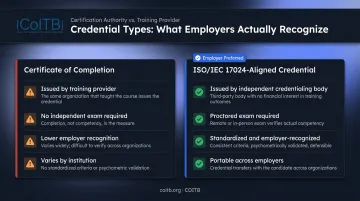
When searching for IT certification programs, filter by "non-college degree" or look under the licenses/certifications search path. The strongest employment outcome typically combines instruction from an approved provider with a pathway to a recognized third-party credential exam administered by an independent credentialing body.
Credentials designed to ISO/IEC 17024 standards — the international standard for personnel certification bodies — are issued by an independent organization that administers and validates the exam separately from whoever provided the training. COITB, a non-profit credentialing body based in Oklahoma City, offers seven certifications in AI and application development (React, Python, JavaScript, HTML/CSS, MySQL, GPT, and Technical Sales) aligned to these standards. Veterans interested in COITB credentials should verify current WEAMS approval status directly by contacting COITB at support@coitb.org or +1 877 402 0840, and confirm eligibility with their VA Education Benefits counselor before registering.
What to Look for in a GI Bill Approved IT Program
VA approval status tells you a program is eligible for funding. It doesn't tell you whether the program is worth your time. That distinction matters before you commit your benefit.
Curriculum Alignment with Real Job Requirements
Look at actual job postings in your target field, then compare them to the program curriculum. If the program teaches tools or frameworks that don't appear in job postings, that's a red flag. If the skills taught map directly to what employers list as requirements, that's meaningful.
Employer-Recognized Outcomes
Ask these three questions before enrolling:
- Does the program prepare you for a specific third-party certification exam?
- Is that certification listed on job postings in your target field?
- Is the credentialing body independent from the training provider?
A certificate of completion from a training provider carries less weight than a proctored exam administered by an independent credentialing body. SHRM research shows 78% of HR professionals used skilled credentials in hiring in 2025, up from 72% in 2021 — and hiring managers are increasingly distinguishing between exam-based credentials and course completion certificates.
Practical Factors That Matter for Veterans
- Instructor credentials and mentorship — especially for veterans entering tech with no prior industry experience
- Career placement support — job placement rates, employer partnerships, and career services access
- Flexible scheduling and remote access — critical for veterans managing relocations or transition timelines; look for credentialing bodies (such as COITB) that accept military CAC and VA-issued ID for remote exam verification
Career Paths Veterans Can Pursue After GI Bill IT Training
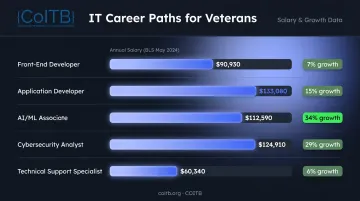
The demand is real. BLS projects 29% growth for information security analysts from 2024 to 2034, and 15% growth for software developers over the same period.
Accessible Roles and Median Salaries (BLS, May 2024)
| Role | BLS Proxy Occupation | Median Annual Wage | Growth (2024–2034) |
|---|---|---|---|
| Front-end developer | Web developers | $90,930 | 7% |
| Application developer | Software developers | $133,080 | 15% |
| AI/ML associate | Data scientists | $112,590 | 34% |
| Cybersecurity analyst | Information security analysts | $124,910 | 29% |
| Technical support specialist | Computer user support specialists | $60,340 | 6% |
The Veteran Advantage in Tech
Veterans bring discipline, structured problem-solving, and high-pressure decision-making into roles where those qualities are genuinely scarce. Employers in cybersecurity, logistics software, and defense contracting actively seek veterans with IT credentials because the skill set transfers directly.
Exam-based credentials are also built for veterans' career patterns:
- Travel with you regardless of employer changes or PCS relocations
- Recognized by hiring managers without institutional context
- Stackable — add credentials as your role evolves without restarting a degree
- Verifiable via digital badge on LinkedIn or a résumé, instantly
Frequently Asked Questions
Can I use the GI Bill for IT certification programs?
Yes. Certain GI Bill chapters — particularly Chapter 33 and VET TEC 2.0 — cover approved non-college-degree IT training programs and, in some cases, the certification exams themselves. Verify approval status for the specific program through the VA Comparison Tool before enrolling.
How do I verify if a school or program is currently GI Bill approved?
Use the VA GI Bill Comparison Tool and cross-reference with WEAMS if needed. Confirm status directly with the VA or your SAA — not just the school — since approval can lapse without the school updating its marketing materials.
What is the difference between Chapter 33 and Chapter 30 for tech training?
Chapter 33 (Post-9/11) pays tuition directly to the school plus a monthly housing allowance. Chapter 30 (Montgomery) pays a monthly stipend directly to the veteran. Eligibility for each depends on your service history and discharge status — check the VA eligibility page to confirm which chapter applies to you.
Which AI certification is best for beginners?
COITB's Certified GPT Professional is built for candidates with no prior AI experience, covering prompt engineering, API integration, and responsible AI practices. It's backed by an independent, ISO/IEC 17024-aligned credentialing body — making it a verifiable credential employers can recognize.
How do I get into AI with no experience?
No prior tech background is required for many entry-level AI credentials. COITB's Certified GPT Professional targets candidates with 0–6 months of experience and covers GPT fundamentals, prompt engineering, and API integration — concrete, job-relevant skills you can demonstrate immediately.
What IT jobs can veterans realistically get after completing a GI Bill-funded certification program?
Front-end developer, application developer, AI associate, cybersecurity analyst, and technical support specialist are all reachable through a recognized certification. Employers in defense contracting and government IT value veterans with verified credentials. Military discipline paired with a verifiable technical certification is a genuine competitive edge.