Introduction
Java has been running enterprise systems, backend APIs, and Android applications for nearly three decades — and heading into 2025, it shows no signs of slowing down. According to the 2025 Stack Overflow Developer Survey, 29.4% of developers actively use Java, placing it firmly among the most-used languages in the world.
Hundreds of Java courses exist — the harder question is which ones actually prepare you for the job market rather than just walking you through syntax in isolation from real development workflows.
What follows is a curated breakdown of the best Java courses for career growth in 2025, the skills employers prioritize, and how to choose the right path based on where you are right now.
Key Takeaways
- Java ranks 4th on the TIOBE Index and is used by nearly 30% of surveyed developers — making it a reliable career investment.
- The best Java courses combine structured curriculum, hands-on projects, and credentials that employers recognize.
- Beginners should prioritize structured fundamentals — experienced developers should target advanced frameworks and portfolio depth.
- Employers consistently look for Java OOP, Spring Boot, REST APIs, SQL, and Git proficiency.
- Certifications from recognized bodies give employers an objective way to verify your skills — especially if you lack a CS degree.
Why Java Still Matters for Your Career in 2025
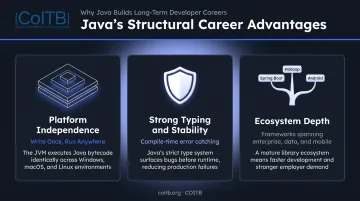
Java launched in 1995 and has never left the top tier of programming languages. Three structural advantages explain why it has stayed there:
- Platform independence: Write once, run anywhere. Java's JVM architecture makes it deployable across operating systems without modification.
- Strong typing and stability: Enterprise teams trust Java precisely because its type system catches errors at compile time, reducing runtime surprises in production.
- Ecosystem depth: From Spring Boot for backend APIs to Hadoop for big data to Android for mobile, Java's framework ecosystem covers virtually every major application domain.
The numbers back this up. The TIOBE Index currently ranks Java 4th globally with an 8.03% rating. On the enterprise side, Azul's 2025 State of Java Survey found that 99% of surveyed organizations actively use Java, with nearly 70% reporting more than half of their enterprise applications are Java or JVM-based.
Android development adds another dimension. Google's official Android documentation confirms that Android build source code can be written in Java, Kotlin, or both — keeping Java relevant for the world's most widely deployed mobile platform.
That market position translates directly into hiring demand — which makes choosing the right learning path one of the most consequential decisions for anyone pursuing a Java-focused career.
Best Java Courses for Career Growth in 2025
These courses were selected based on curriculum depth, hands-on practice, instructor credibility, certification value, and alignment with skills that appear in actual Java job postings. Whether you're starting from scratch or pushing toward a senior role, there's a structured path here for your situation.
Oracle Certified Professional (OCP) Java SE — Oracle
The OCP is Oracle's flagship professional-level Java certification. The current path — Oracle Certified Professional: Java SE 21 Developer (exam 1Z0-830) — is widely recognized by enterprise employers and frequently listed as a preferred qualification in senior Java developer job postings.
This is a vendor-issued credential from the company that owns Java. That matters to hiring managers at large organizations who want objective proof of advanced proficiency.
| Detail | Information |
|---|---|
| Level | Advanced / Professional |
| Format | 50 multiple-choice questions, 120 minutes, 68% passing score |
| Duration | ~2–3 months of preparation; proctored exam |
| Cost | $245 USD (verify current pricing at Oracle's exam page) |
Best for: Experienced developers targeting senior roles or enterprise employers who list OCP as a preferred qualification.
Java Programming Masterclass — Udemy (Tim Buchalka)
With 960,000+ enrolled students and 213,000+ ratings, Tim Buchalka's Java Masterclass is one of the most extensively reviewed self-paced Java courses on the market. It covers Java from beginner through advanced with 135+ hours of content, IntelliJ IDEA integration, and real-world coding projects throughout.
The course covers Java 17, 11, and 8, with Java 21 features noted as coming. Regular updates keep the curriculum from going stale — a common problem with self-paced Java content.
| Detail | Information |
|---|---|
| Level | Beginner to Advanced |
| Rating | 4.6/5 across 213,000+ reviews |
| Duration | 135+ hours, self-paced |
| Cost | Dynamic pricing; verify current pricing at Udemy's course page |
Best for: Self-motivated learners who want a comprehensive, project-heavy course they can work through at their own pace.
Java Programming and Software Engineering Fundamentals — Coursera (Duke University)
This five-course specialization from Duke University is built for beginners who want university-quality instruction. It doesn't just teach syntax — it integrates algorithm design and software engineering principles from the start, which gives it an edge over courses that treat Java as a vocabulary lesson rather than a professional discipline.
The Coursera certificate from Duke carries recognizable institutional credibility, making this particularly valuable for career changers who want academic backing on their résumé.
| Detail | Information |
|---|---|
| Level | Beginner |
| Reviews | ~22,000 reviews on Coursera |
| Duration | ~4 months at 10 hours/week |
| Cost | Included in Coursera Plus ($59/month or $399/year); financial aid available |
Best for: Complete beginners and career changers who want structured, university-backed learning with a shareable credential.
Java Developer Track — Hyperskill
Hyperskill takes a project-first approach: learners build real Java applications across a structured track, covering everything from syntax fundamentals to working with databases and HTTP requests. The platform integrates directly with IntelliJ IDEA through a dedicated plugin, so you're working in the same environment professional developers use.
Projects include practical applications like chat bots, game logic, and database-connected tools — not toy examples.
| Detail | Information |
|---|---|
| Level | Beginner to Intermediate |
| IDE Integration | IntelliJ IDEA via Hyperskill plugin |
| Duration | Flexible; approximately 41 hours for the core track |
| Cost | Free and Premium plans available; verify current pricing at Hyperskill's pricing page |
Best for: Learners who want a workflow that mirrors real development and prefer building projects over watching lectures.
Java Programming Course (Self-Paced) — GeeksforGeeks
GeeksforGeeks takes a placement-preparation angle that sets it apart. Alongside 45+ hours of video covering basic through advanced Java, the course includes 150+ coding problems and 300+ MCQs designed specifically for tech interviews. Doubt support is available 24/7 for 12 months (first 6 months included).
This dual focus — core Java concepts plus interview preparation — makes it practical for learners targeting their first tech job or preparing for FAANG-style interviews.
| Detail | Information |
|---|---|
| Level | Beginner to Advanced |
| Content | 45+ hours video, 150+ coding problems, 300+ MCQs |
| Support | 24/7 doubt assistance for 12 months |
| Cost | Verify current pricing at GeeksforGeeks course page |
Best for: Learners focused on landing a first job or acing technical interviews at competitive companies.
Java Skills You Need to Land a Job in 2025
Completing a course gets you knowledge. Getting hired requires a specific combination of technical skills that appear consistently across Java job postings.
Core Technical Skills
These appear in the overwhelming majority of Java developer job descriptions:
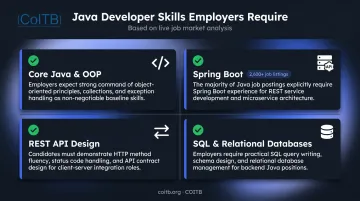
- Core Java and OOP: Classes, inheritance, polymorphism, encapsulation, exception handling, data structures form the foundation everything else builds on.
- Spring Boot: The dominant framework for Java backend development. Indeed shows over 2,600 Java developer with Spring Boot job listings in a single snapshot, making it a baseline expectation for backend roles.
- REST API design: Building and consuming HTTP-based APIs is central to modern backend development. Employers expect this at even the entry level.
- SQL and relational databases: Java applications talk to databases. MySQL and PostgreSQL knowledge is consistently listed alongside Java in job postings.
Complementary Skills That Increase Hirability
These aren't always listed as primary requirements, but they appear alongside Java in modern job descriptions and differentiate candidates:
- Git: Version control is expected in every professional development environment.
- Maven or Gradle: Build tools that manage dependencies and automate compilation across Java projects.
- Docker basics: Container knowledge is increasingly common in Java backend postings. Indeed shows over 1,000 Java Developer Docker Container listings.
- Cloud familiarity (AWS preferred): Cloud deployment awareness shows up regularly in mid-to-senior Java postings.
Validating Your Skills
Skills matter more when you can prove them — especially when competing against candidates with CS degrees or longer work histories.
COITB, a non-profit credentialing body, offers industry-recognized certifications in AI and Application Development. For Java backend developers, the MySQL Backend Developer credential is directly relevant: it validates schema design, SQL querying, stored procedures, and ACID-compliant transactions — skills you'll use daily in Java application work.
Certifications target candidates with 0–6 months of hands-on experience and are available via remote proctoring or in-person test centers. Visit coitb.org to find the credential that fits your current skill set.
How We Chose These Java Courses
Each course was evaluated on five criteria:
- Covers Java from the right starting point to the right depth for its stated level
- Includes real projects, not just exercises
- Comes from a recognized expert, university, or vendor
- Produces a credential employers actually recognize upon completion
- Reflects what Java job postings ask for in 2025 — not what was relevant five years ago
Common Mistakes Learners Make
- The cheapest option rarely covers what employers expect — don't let price drive the decision over curriculum depth.
- Java evolves. Courses that haven't addressed Java 17 or 21 may teach outdated practices.
- Employers want to see working code. A course with no project component leaves you with knowledge but no portfolio.
Matching Course to Career Goal
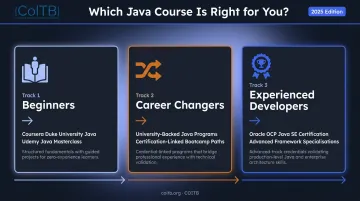
No single course is right for every learner:
- Beginners need structured fundamentals with clear progression — Coursera (Duke) or the Udemy Masterclass.
- Career changers benefit from university-backed programs or certification-linked paths that provide academic credibility.
- Experienced developers should target OCP or courses with advanced framework coverage and portfolio-building depth.
Conclusion
Java remains one of the most valuable skills a developer can hold in 2025. It powers enterprise backends, Android applications, and large-scale data systems — and its demand shows no sign of softening heading into 2026.
The right course depends entirely on where you're starting and where you're going. Beginners should prioritize structured fundamentals and project-based learning before worrying about advanced topics. Experienced developers should invest in framework depth — Spring Boot in particular — and consider the Oracle OCP to formalize their expertise with a vendor-recognized credential.
One thing applies at every level: pair coursework with practical projects. Employers evaluate candidates on demonstrated ability, not course completion certificates alone. Rounding out that demonstrated ability with validated credentials in adjacent skills can further strengthen your profile.
COITB is a non-profit credentialing body offering industry-recognized certifications across web development, backend development, and AI — including MySQL Backend Developer, Professional Python Developer, and Certified GPT Professional credentials. For developers looking to validate skills beyond Java, these credentials provide third-party verification that holds up with employers. Visit coitb.org to explore certification options and what fits your goals.
Frequently Asked Questions
Which Java course is best for career growth?
It depends on your current level. Beginners get the most structured foundation from the Coursera Duke specialization or the Udemy Masterclass. Developers targeting senior enterprise roles should prioritize Oracle's OCP certification — it's vendor-issued and widely recognized in professional hiring.
What Java skills should I learn to get a job?
Focus on Core Java and OOP, Spring Boot for backend development, REST API design, SQL basics, and Git. These appear as minimum requirements in most entry-level Java postings. Docker and cloud basics (AWS) strengthen your profile for mid-level roles.
Is Java still in demand in 2026?
Yes. Java ranks in the top 5 most-used programming languages globally, powers the majority of enterprise backend infrastructure, and remains a primary language for Android development. Demand is stable and consistent across industries.
How long does it take to learn Java well enough to get a job?
Most learners reach an employable level in 3–6 months of consistent study, depending on prior coding experience. Hands-on project work accelerates this significantly — prioritize building real applications over theory-only study.
Should I get a Java certification or just complete a course?
Both. Courses build your skills; certifications give employers an objective way to verify them. This matters most if you don't have a CS degree or years of professional experience to point to. The Oracle OCP is the most recognized Java-specific option. The Oracle OCP is the most recognized Java-specific option; third-party credentialing bodies can also provide accessible validation if you're earlier in your career.
What is the best Java course for complete beginners?
The Coursera Duke University specialization and the Udemy Masterclass are both strong starting points. Choose based on learning progression structure, hands-on exercises, and community support — not brand name or price.