What makes Python genuinely different from most programming languages is its range. A Python developer can work in data pipelines, AI infrastructure, web back-ends, or security automation — often with the same core skill set. That flexibility creates a real decision problem: which direction do you go?
This guide breaks down the six most viable Python career paths in 2026, including what each role actually involves, what tools it requires, and what it pays.
Key Takeaways
- Python ranks #1 globally on the TIOBE Index (July 2026) and appeared in 258,674 U.S. AI job postings in 2025
- The six strongest Python paths are: back-end development, data analytics, data science, ML/AI engineering, full stack development, and cybersecurity
- ML/AI engineering commands the highest salaries; data analytics offers the most accessible entry point
- Six of the top paths are reachable with 6–12 months of focused practice
- Credentials like COITB's Professional Python Developer certification help self-taught developers and career changers signal job-ready skills to employers
Why Python Is One of the Most Valuable Skills in 2026
The Numbers Behind the Hype
According to the Stanford AI Index 2026 via Lightcast, Python was the single most in-demand specialized skill in U.S. AI job postings in 2025, appearing in 258,674 listings. At that scale, Python fluency isn't adjacent to AI hiring — it's central to it.
GitHub's Octoverse 2024 report added another data point: Python overtook JavaScript to become the most-used language on GitHub, driven by a 98% increase in generative AI projects and 59% growth in contributions to those projects.
What's Pulling Python Demand Up
Three macro forces are keeping Python in high demand across industries:
- AI and machine learning adoption — McKinsey's 2025 State of AI report found that 78% of organizations now use AI in at least one business function, up from 72% earlier in 2024. Python is the primary language for building those systems.
- Cloud infrastructure growth — Gartner forecast global public cloud spending at $723B in 2025, with infrastructure and platform services growing 24.2%. Python is embedded in the automation and tooling that runs cloud environments.
- Automation demand — The World Economic Forum projects tasks performed by technology to rise from 22% in 2025 to 33% by 2030, creating sustained demand for Python scripting and automation skills.
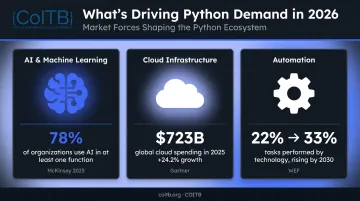
What these forces have in common: they all run on Python. Beyond demand, the language's readability makes it one of the few that works for both a beginner writing their first function and a senior engineer building production AI pipelines. That range is rare, and it matters for career longevity.
Best Python Career Paths to Pursue in 2026
The paths below were selected based on job market demand, salary data, growth trajectory, and how accessible they are to people at different experience levels. Some require strong math foundations; others are approachable with a few months of hands-on Python. Either way, there's a realistic entry point for career changers, bootcamp graduates, and self-taught developers alike.
Back-End Python Developer
Back-end developers build and maintain the server-side logic that powers applications — the part users never see but always depend on. FastAPI alone jumped 5 percentage points in usage in the 2025 Stack Overflow survey, joining Django and Flask as the go-to Python frameworks for this work.
Core tools: Django, Flask, FastAPI, REST APIs, SQL/NoSQL databases, Git, basic AWS or Azure knowledge
What this path suits: Developers who prefer structured problem-solving over visual design. It's one of the most accessible entry points for new Python learners because the skill ladder is clear and job volume is high.
| Factor | Details |
|---|---|
| Experience needed | 0–3 years for junior roles |
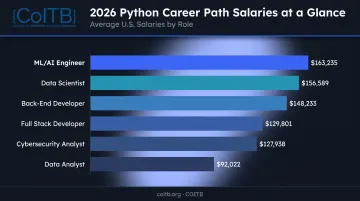
| Avg. U.S. salary | $148,233/year (ZipRecruiter, July 2026) |
| Primary tools | Django, Flask, FastAPI, REST APIs, SQL |
Data Analyst
Data analysts turn raw data into answers. They clean datasets, build queries, and create visualizations that help business teams understand what's happening — whether that's customer churn, revenue trends, or operational bottlenecks. Python sits alongside Excel and SQL as the core analytical toolkit.
Core tools: Pandas, NumPy, Matplotlib, Seaborn, SQL, Jupyter Notebooks, Tableau or Power BI
What this path suits: Detail-oriented candidates who enjoy finding patterns in numbers. Deep programming experience isn't required to start — analytical thinking matters more at the entry level.
| Factor | Details |
|---|---|
| Experience needed | 0–2 years for entry roles |
| Avg. U.S. salary | $92,022/year (Glassdoor, 2026) |
| Primary tools | Pandas, SQL, Jupyter, Tableau/Power BI |
Data Scientist
Data scientists go further than analysts. They build predictive models, run statistical experiments, and develop machine learning solutions that directly influence product and business strategy. This role demands stronger math foundations — statistics, probability, and linear algebra all come up regularly.
Core tools: Scikit-learn, Pandas, NumPy, TensorFlow or PyTorch, Jupyter Notebooks, experience with large datasets
What this path suits: Analytically minded developers with a statistics background who want to build models rather than just read results.
The BLS projects 34% employment growth for data scientists from 2024 to 2034 — among the fastest of any role tracked. A math background in statistics and linear algebra is often a hard requirement for mid-level roles and above.
| Factor | Details |
|---|---|
| Experience needed | 1–3 years; statistics background often required |
| Median U.S. salary | $112,590/year (BLS, May 2024) |
| Market avg. salary | $156,589/year (Glassdoor, 2026) |
| Primary tools | Scikit-learn, TensorFlow/PyTorch, Pandas |
Machine Learning / AI Engineer
ML and AI engineers design, build, and deploy machine learning models — and in 2026, that increasingly means working with large language models, generative AI pipelines, and LLM-based applications. The WEF projects AI and ML specialists will see more than 100% net job growth between 2025 and 2030, the steepest trajectory of any role in this list.
Core tools: TensorFlow, PyTorch, Scikit-learn, Hugging Face, LangChain, MLOps tooling, strong math foundations (linear algebra, calculus, statistics)
What this path suits: Developers with a systems-thinking mindset who want to work at the frontier of AI.
| Factor | Details |
|---|---|
| Experience needed | 2–5 years; math background often required |
| Avg. U.S. salary | $163,235/year ML Engineer (Glassdoor, 2026) |
| Median AI Engineer | $155,000/year (Levels.fyi, 2025–2026) |
| Primary tools | PyTorch, TensorFlow, Hugging Face, LangChain |
Full Stack Developer
Full stack developers build complete web applications — both what users see and the server logic that powers it. Python typically handles the back-end through Django or Flask, while JavaScript frameworks like React or Vue.js handle the front end. The role requires broader knowledge than pure back-end work, but it gives you ownership of entire features — which is why smaller teams and product startups often hire full-stack first.
Core tools: Django or Flask (back-end), React or Vue.js (front-end), REST APIs, SQL and NoSQL databases, Docker, basic DevOps knowledge
What this path suits: Developers who want to own entire features end-to-end and don't mind context-switching between front-end and back-end concerns.
| Factor | Details |
|---|---|
| Experience needed | 1–3 years typical |
| Avg. U.S. salary | $129,801/year (ZipRecruiter, July 2026) |
| Median U.S. salary | $123,300/year (ZipRecruiter, July 2026) |
| Primary tools | Django/Flask, React/Vue.js, Docker, SQL |
Cybersecurity Analyst
The BLS projects 29% employment growth for information security analysts from 2024 to 2034 — and Python is more central to that work than most people expect. Analysts use it to write automation scripts, build threat detection tools, conduct penetration testing, and automate vulnerability assessments. CISA's NICCS catalog explicitly lists Python courses for security workflows, and SANS's SEC573 now covers AI-powered security automation using Python and LLMs.
Core tools: Python scripting, network protocols, Metasploit, Nmap, Scapy, security automation frameworks
What this path suits: Developers drawn to defensive and offensive security rather than application development.
| Factor | Details |
|---|---|
| Experience needed | Less than 5 years typical (BLS) |
| Median U.S. salary | $124,910/year (BLS, May 2024) |
| Market avg. salary | $127,938/year (Glassdoor, 2026) |
| Primary tools | Python scripting, Nmap, Scapy, Metasploit |
How to Choose the Right Python Career Path
Start With How You Think, Not What Pays
The salary spread between these paths is real, but it narrows over time if you end up doing work you're not suited for. A more durable question to ask first:
- Do you prefer building systems? Back-end and full stack development.
- Do you prefer interpreting information? Data analytics and data science.
- Are you drawn to math and model-building? Data science and ML/AI engineering.
- Does securing infrastructure interest you? Cybersecurity.
Match Your Starting Point to the Path
Some paths are more accessible than others at the beginning:
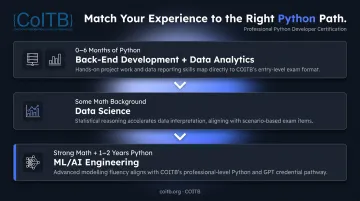
- 0–6 months of Python practice: Back-end development and data analytics are the most achievable starting points. The tools are practical, the job volume is high, and the math requirements are manageable.
- Some math background: Data science becomes viable. Statistics and linear algebra open up more options in modeling roles.
- Strong math + 1–2 years of Python: ML/AI engineering. Don't skip the math — it's not optional in this track.
Validate Your Skills Before Applying
Whether you're self-taught, a bootcamp graduate, or a career changer from finance, healthcare, or another field, a portfolio alone often isn't enough to clear initial resume screening. An industry-recognized credential gives employers an independent signal that your skills are real.
COITB's Professional Python Developer certification is structured for candidates with 0–6 months of hands-on Python experience. It validates practical competencies across:
- Object-oriented programming
- Automation scripting
- File and API handling
- Exception handling
- Python standard library
The exam is 58 questions, 75 minutes, with a 70% passing score — available online with remote proctoring or in person at authorized test centers.
COITB is a non-profit credentialing body — exams only, no training or instruction. The credential stacks naturally with COITB's MySQL Backend Developer and Certified GPT Professional certifications for candidates targeting back-end or AI/ML roles.
Frequently Asked Questions
Is Python a good career choice in 2026?
Yes. Python ranked #1 on the TIOBE Index in July 2026 and appeared in 258,674 U.S. AI job postings in 2025. Demand spans data, AI, back-end development, and security — making it one of the few languages with strong hiring across multiple industries simultaneously.
What Python career path pays the most?
ML/AI engineering commands the highest salaries, with Glassdoor reporting a $163,235 average for ML Engineers and Levels.fyi reporting a $155,000 median for AI Engineers. Senior data scientists and experienced back-end developers follow closely behind.
Can I get a Python job without a college degree?
Yes, particularly in back-end development and data analytics. Employers in these roles increasingly prioritize demonstrated skills, portfolio projects, and third-party credentials over a four-year degree. A credential like COITB's Professional Python Developer certification gives employers a verified, third-party signal of your skills — which matters when a degree isn't on your résumé.
How long does it take to learn Python well enough to get a job?
Basic proficiency typically takes 2–6 months with consistent daily practice. Job readiness — including domain-specific tools and frameworks — usually takes 6–12 months depending on which career path you're targeting.
What skills should I learn alongside Python?
It depends on your path:
- Data roles: SQL and data visualization tools (Tableau, Power BI)
- Development roles: Django or Flask, plus REST API fundamentals
- AI/data science: Statistics, linear algebra, and ML frameworks
Git, basic cloud knowledge, and clear written communication are valuable across all six paths.
Will AI replace Python developers?
Unlikely. Python usage on Stack Overflow rose 7 percentage points from 2024 to 2025, and Python appeared in more U.S. AI job postings than any other specialized skill. Python is the primary language used to build AI systems — which puts Python developers at the center of the AI era, not on the margins of it.
Choosing a Python career path comes down to matching your natural strengths to the role's actual demands. The salary data matters, but sustainable career growth comes from doing work that fits how you think. Pick a path that engages you, build real projects, and validate those skills with a credential employers can verify.
Explore COITB's Professional Python Developer certification to validate your real-world Python skills — and take the free practice assessment before you register to gauge where you stand.