The honest answer is: it depends on how you use it. Certifications aren't a guaranteed shortcut to employment, but when chosen strategically and paired with hands-on work, they produce real, measurable results — faster resume screening, better salary negotiation leverage, and employer-verifiable credibility that a GitHub portfolio alone doesn't always provide.
This guide covers what programming certifications actually do, their core career advantages, what you risk by skipping them, and how to get the most value from the credential you choose.
Key Takeaways
- Certifications give ATS systems and hiring managers a verifiable skill signal — especially valuable when your work history is limited.
- Certified tech professionals earn approximately $2,000 more per year than non-certified peers.
- Credentials carry the most weight in cloud computing, cybersecurity, AI and machine learning, and application development.
- A certification paired with a portfolio is substantially more competitive than either alone.
- ISO/IEC 17024-aligned credentials from independent credentialing bodies carry more employer weight than course-completion badges.
What Are Programming Certifications?
A programming certification is a formal credential issued by an independent credentialing body that validates proficiency in a specific technology, language, or development domain. The issuing body matters: it is not the platform where you learned the skill.
That distinction matters more than most candidates realize. A course completion badge from Udemy or Coursera confirms you watched content. A certification from an independent credentialing body confirms you performed under standardized, monitored conditions against a published passing standard. Employers and ATS systems treat these very differently.
Who Certifications Are Actually For
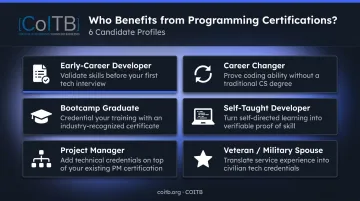
Certifications apply across a wide range of career situations, not just beginners:
- Early-career developers building a first resume without professional experience
- Career changers from finance, marketing, sales, or non-technical fields who need to prove technical ability quickly
- Bootcamp graduates who want third-party validation a hiring manager can independently verify
- Self-taught developers whose GitHub portfolio is real but whose skills are difficult for employers to assess without a credential
- Project managers stacking technical credentials on top of existing PMP or PSM credentials to move into technical PM or engineering manager roles
- Veterans and military spouses translating service experience into civilian tech careers
Each of those situations shares a common need: a credential that a hiring manager can independently verify, regardless of how the skills were acquired. COITB, a non-profit credentialing body aligned to ISO/IEC 17024 standards, offers industry-recognized certifications across HTML/CSS, JavaScript, React, Python, MySQL, and GPT. The exams are specifically designed for candidates with 0–6 months of hands-on experience, whether that experience came from employment, self-study, a bootcamp, or coursework. No prior professional employment required.
Certifications are a means to a career outcome, not the outcome itself. Their value is in the signal they send to hiring managers, recruiters, and automated screening systems, and in the structured knowledge they enforce.
Key Advantages of Programming Certifications
Three advantages consistently show up when comparing certified to non-certified candidates in competitive tech hiring: career differentiation, salary credibility, and validated skill depth. Each ties to measurable career outcomes.
Career Differentiation in a Competitive Job Market
When hundreds of candidates apply for the same role, something has to act as a first-pass filter before a human ever reads a resume. In many enterprise and government hiring workflows, that filter is a combination of ATS keyword matching and credential verification. A recognized certification gives both systems — automated and human — a standardized, verifiable signal to evaluate.
Portfolios and bootcamp credentials vary considerably in quality and format. A hiring manager reviewing 200 applications cannot assess each GitHub repo with equal depth. A certification shortens that evaluation by confirming a candidate meets a baseline threshold before the portfolio ever gets opened.
According to Dice, nearly half of surveyed tech professionals already hold technical certifications — which means the bar for "baseline credentialed" is rising. In saturated applicant pools, a credential isn't a differentiator on its own, but the absence of one creates a measurable disadvantage.
Measurable hiring impact:
- Resume screening pass rate
- Recruiter response rate
- Interview conversion rate
- Time to first offer
This advantage is highest for candidates with limited work history. For experienced developers, a strong employment record often compensates. For bootcamp graduates, career changers, and self-taught developers, a certification substitutes for the professional track record they don't yet have.
Salary and Earning Credibility
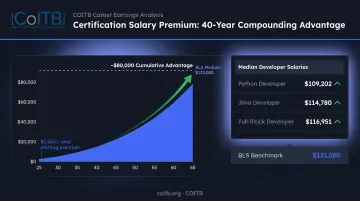
Certified tech professionals earn, on average, about $2,000 more per year than non-certified peers, according to Dice's salary research — and that premium compounds over a full career. A credential also gives you something concrete to reference in salary negotiations, rather than relying on soft claims about skill level.
The BLS median wage for software developers sits at $133,080 as of May 2024, and role-level averages from Dice put Python developers around $109,202, Java developers near $114,780, and full-stack developers at approximately $116,951. These figures don't distinguish certified from non-certified, but they establish the baseline compensation context where even a modest credential-driven premium adds up quickly.
That $2,000 annual premium compounds significantly over time. Starting at age 25, it adds approximately $80,000 in cumulative compensation by age 65, not counting raises applied to a higher base salary. Certifications also correlate with faster advancement into mid-level and senior roles, where the compensation gaps widen significantly.
Highest-impact contexts for salary uplift:
- Regulated industries — government contracting, healthcare IT, financial services — where certifications are sometimes tied directly to job classifications
- Professionals transitioning between roles where negotiation leverage would otherwise be thin
- Entry-level candidates positioning for higher starting salary brackets
Structured Skill Validation for Real-World Roles
Self-directed learning has a known weakness: you don't know what you don't know. A developer who learned React from YouTube tutorials might be excellent at building UIs but have no exposure to performance optimization, unit testing, or proper hook patterns. A structured certification curriculum forces coverage of the full domain, not just the parts that felt interesting or came up in tutorials.
Standardized exams measure against a defined benchmark. A candidate who passed a proctored React certification was assessed against the same criteria as every other certified candidate in that domain, giving hiring managers a consistent reference point that self-study claims can't provide. For candidates who can't yet point to a job title, that consistency closes the trust gap fast.
Who benefits most from structured validation:
- Candidates with 0–2 years of experience who need to prove technical credibility quickly
- Professionals expanding into new domains — a frontend developer adding Python or AI credentials, for example
- Career changers from non-technical backgrounds who need to close a credibility gap fast
What Happens When Certifications Are Missing
In a low-competition environment — small startup, strong referral, or highly specialized niche — skipping a certification rarely costs you. But in saturated applicant pools, the absence of any credential validation creates a specific set of problems worth understanding before dismissing certifications entirely.
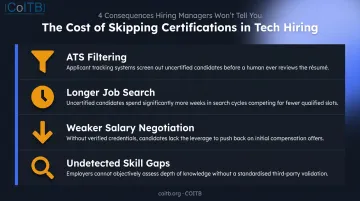
The most common consequences:
- Resumes get filtered before a human reads them — ATS systems at enterprise and government employers routinely deprioritize candidates without recognized credentials.
- Job searches run longer at entry and mid-level stages, where experience alone rarely differentiates one candidate from the next.
- Salary negotiations become harder to anchor without a standardized credential to cite as a skill benchmark, particularly for career changers crossing industries.
- Skill gaps go undetected longer — structured certification programs often catch blind spots that self-directed learners miss, and those gaps tend to surface at the worst time: a technical interview or the first week on the job.
The risk is highest for career changers. Without a computer science degree or years of tech employment, skipping certifications removes one of the few ways to prove role readiness to someone who doesn't know you. A portfolio helps — but without an independent credential behind it, it's still an unverified claim in the eyes of many hiring managers.
How to Get the Most Value from Your Programming Certification
Align the Credential to a Specific Job Outcome
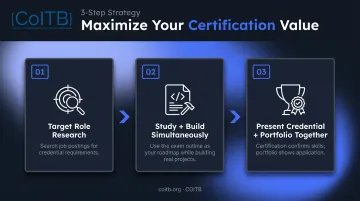
Don't choose a certification because it's well-known. Search job postings for your target role and location, and identify which credentials appear most frequently as requirements or preferred qualifications. That's your target list — not the most popular certification in the general market.
Pair Certification Study with Actual Projects
Use the certification's exam outline as your study roadmap, and build projects simultaneously that apply the concepts you're learning. A certified candidate who can demo a working React application or a deployed Python script is far more competitive than one who holds the credential but has nothing to show for it. The portfolio shows what you built; the certification independently confirms you had the skills to build it.
Consider Credentials That Match Modern Hiring Demand
Veterans and military-connected candidates should verify eligibility through the appropriate benefit program before registering:
- GI Bill / Chapter 33 — confirm VA WEAMS approval for the specific credential
- VET TEC — check current program participation status
- MyCAA — available for eligible military spouses pursuing portable careers
- VR&E (Chapter 31) — requires vocational rehabilitation counselor approval
Benefit coverage depends on current VA WEAMS approval status, so verify directly with VA or your State Approving Agency before enrolling.
Conclusion
Programming certifications aren't a guarantee of employment. But when chosen strategically and paired with hands-on practice, they're one of the most efficient tools available for building credibility, passing screening filters, and negotiating better compensation — especially for those breaking into tech or pivoting from a different field.
A credential earned today does more than signal readiness to one employer. The structured knowledge it validates shows up again in technical interviews, performance reviews, and salary conversations — often for years after you first earned it.
If you're weighing whether to start, the clearest signal is this: the credential is easier to earn before you're under hiring pressure. Pick the certification that matches where you want to work, build toward it with deliberate practice, and have something concrete to show when the right role opens up.
Frequently Asked Questions
Are programming certifications worth it?
Certifications are worth it in specific contexts — particularly for early-career professionals, career changers, and those targeting high-demand domains like cloud, AI, and application development. Their value increases significantly when combined with a portfolio of practical projects, since neither credential alone nor portfolio alone is as competitive as both together.
What programming certifications can lead to a $100,000 salary?
Certifications in AI/machine learning and application development are most commonly associated with six-figure compensation. The BLS median for software developers reached $133,080 in May 2024, with role averages for Python, JavaScript, and full-stack developers already in the $109K–$117K range — well above the $100K threshold on median.
Do employers actually care about programming certifications?
Employer attitudes vary considerably. Large enterprises and government contractors often use certifications as screening tools, while startups tend to prioritize portfolios and demonstrated skills. Certifications work best as a complement to practical experience — not a substitute for it.
Are programming certifications worth it without experience?
Certifications are most valuable precisely when experience is limited. They provide a standardized, verifiable signal of competency that compensates for a thin resume. Paired with even a few personal or practice projects, they significantly improve a candidate's chances of reaching the interview stage.
What is the best programming certification for beginners?
It depends on your career target. COITB's HTML-CSS Web Designer credential is the most accessible entry point for those with no prior technical background; the Professional Python Developer certification suits candidates targeting back-end or AI roles. ISO/IEC 17024-aligned credentials carry more employer weight than informal course completion badges.
How long does it take to earn a programming certification?
Entry-level certifications typically require 20–60 hours of study; advanced credentials may require 100–300 hours. COITB's online proctored format lets working adults and career changers schedule exams remotely, with no time off or travel to a test center required.