Introduction
Tech hiring has never been more competitive — or more accessible. The BLS projects software developer employment to grow 15% from 2024 to 2034, generating roughly 129,200 openings annually. Meanwhile, ManpowerGroup's 2026 Talent Shortage Survey found 75% of Information industry employers struggle to fill roles — meaning the window to enter tech is wide open for motivated beginners.
The real challenge is choosing where to start. Dozens of platforms promise to teach coding, but quality varies wildly, pricing structures are confusing, and few explain which skills translate to real employment.
Below you'll find the five best coding programs for beginners in 2026, evaluated on curriculum quality, cost, hands-on learning, and credential value — plus guidance on how to pick the right one for your goals.
Key Takeaways
- Free options work — freeCodeCamp and The Odin Project rival paid platforms in curriculum depth
- Python, JavaScript, and HTML/CSS are the best first languages in 2026, depending on your target role
- Paid platforms like Codecademy and Coursera add structure and career-path guidance worth considering
- Employers want proof, not just progress — a third-party certification validates your skills in ways a completed course alone cannot
- Every program here starts from zero — no prior coding experience needed to begin
What to Look for in a Beginner Coding Program
A coding program, in this context, means a structured online platform or course that teaches programming through progressive lessons, real projects, and assessments — not a single standalone video.
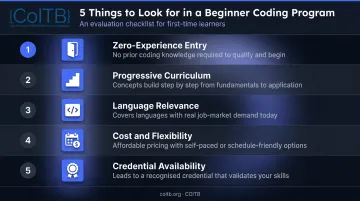
Before picking a platform, evaluate programs against these five factors:
- Zero-experience entry — starts from scratch, with no prior knowledge assumed
- Progressive curriculum — concepts build on each other, reinforced by real projects at every stage
- Language relevance — covers languages employers actually hire for: Python, JavaScript, HTML/CSS, and React
- Cost and flexibility — fits your budget and works around your schedule, not the other way around
- Credential or certification availability — a recognized certificate or digital badge gives your completed work something employers can verify
Keep these factors in front of you as you review the programs below — they're the difference between a platform that looks good and one that actually moves your career forward.
Best Coding Programs for Beginners in 2026
freeCodeCamp
freeCodeCamp is a 501(c)(3) nonprofit that has helped millions of learners build web development skills from scratch. It covers HTML, CSS, JavaScript, Python, data analysis, relational databases, and more — entirely free.
No paywalls, no upsells, no premium tiers. The curriculum includes 12 certifications across responsive web design, JavaScript, React, Python, back-end development, and foundational C# (with Microsoft). Each certification requires completing hands-on projects, not just watching videos. Verifiable certificates integrate with GitHub so you build a portfolio as you learn.
| Category | Details |
|---|---|
| Best For | Self-motivated beginners who want a free, comprehensive path to web development |
| Price | Free (donation-supported) |
| Key Features | 12 certifications, project-based learning, GitHub integration, active forum community |
Credential match: freeCodeCamp graduates targeting front-end roles align well with COITB's HTML-CSS Web Designer, JavaScript Professional Developer, and ReactJS Framework Developer certifications — a natural next step for adding a verifiable, employer-facing credential on top of freeCodeCamp's curriculum.
Codecademy
One of the most recognized interactive coding platforms globally, Codecademy offers browser-based lessons in Python, JavaScript, HTML/CSS, SQL, React, and more — with both free and paid tiers.
The beginner-friendly interface gives instant feedback as you type, which accelerates early learning. The Pro plan unlocks structured career paths — Front-End Engineer, Data Scientist, Back-End Engineer — that guide you from zero to job-ready in a defined sequence.
Codecademy's own certificates aren't employer-verified industry credentials, but the skills you build translate directly to third-party credentialing exams.
| Category | Details |
|---|---|
| Best For | Beginners who want interactive, guided learning with structured career paths |
| Price | Free (basic); Plus at $14.99/month billed annually; Pro at $19.99/month billed annually |
| Key Features | Browser-based IDE, 12 career paths, professional certificates, community forums |
Credential match: Codecademy's track determines your best starting COITB credential — web design track → HTML-CSS Web Designer; Python track → Professional Python Developer; JavaScript track → JavaScript Professional Developer.
The Odin Project
The Odin Project is a free, open-source full-stack web development curriculum built and maintained by a community of developers. It covers HTML, CSS, JavaScript, React, Node.js, Express, and foundational computer science through an entirely project-based approach.
Where most platforms teach through passive lessons, The Odin Project makes you build things from day one. That difference matters. Its Discord community functions like a peer-driven bootcamp — you're never stuck alone. Graduates typically have stronger portfolios than students from structured platforms because the curriculum forces real problem-solving rather than guided exercises.
| Category | Details |
|---|---|
| Best For | Beginners who want a rigorous, bootcamp-style experience at zero cost |
| Price | Free |
| Key Features | Project-first curriculum, full-stack JavaScript coverage, active Discord community |
Credential match: Odin Project graduates are particularly well-prepared for COITB's JavaScript Professional Developer and ReactJS Framework Developer exams — two credentials that signal complete front-end engineering capability.
Coursera
Coursera partners with universities and companies including Google, IBM, Meta, Stanford, and the University of Michigan to deliver structured, university-quality courses and professional certificates. Courses can be audited free; you pay for certificates.
University-backed credentials carry weight with employers in a way that platform-specific certificates often don't. Beginner-friendly specializations in Python (University of Michigan's Python for Everybody), web development (Duke's HTML/CSS/JavaScript course), and AI cover the most in-demand skills for 2026. Coursera offers financial aid for paid certificates.
| Category | Details |
|---|---|
| Best For | Beginners who want university-quality instruction with shareable credentials |
| Price | Free to audit; Coursera Plus at $59/month or $399/year |
| Key Features | University-partnered courses, guided projects, peer-reviewed assignments, shareable certificates |
Credential match: Meta Front-End certificate graduates should consider COITB's HTML-CSS Web Designer and ReactJS Framework Developer credentials. IBM AI/Python certificate graduates align with COITB's Professional Python Developer and Certified GPT Professional exams.
Scrimba
Scrimba is an interactive coding platform built around a unique "scrimcast" format — you can pause any video lesson and edit the instructor's code directly inside the tutorial. It specializes in front-end development with a particular emphasis on React.
The format removes the biggest barrier beginners face: the gap between watching and doing. Rather than pausing a video and switching to a separate editor, you interact with the code inside the lesson itself.
Scrimba's Front-End Developer Career Path targets job-readiness in under six months. The platform's career support program adds mentorship and accountability for learners who need more than a self-guided track.
| Category | Details |
|---|---|
| Best For | Beginners targeting front-end or React roles who learn best by doing |
| Price | Free (limited); Pro at $24.50/month billed annually |
| Key Features | Interactive scrimcast lessons, in-video code editing, React focus, career bootcamp track |
Credential match: Scrimba graduates are among the best-prepared candidates for COITB's ReactJS Framework Developer exam. Stacking the JavaScript Professional Developer credential alongside it signals complete front-end engineering competence.
How We Chose These Programs
Programs were evaluated across five criteria:
- Beginner accessibility — no prior experience required to start
- Curriculum quality — progressive difficulty, real projects, not just passive lessons
- Credential availability — does completing the program give you something verifiable?
- Cost-to-value ratio — does the price reflect the quality and career value delivered?
- Community and support — active learner communities dramatically improve completion rates
One common mistake beginners make: choosing a program based on brand name without checking whether the curriculum matches their career goal. A data science aspirant spending six months on HTML won't get far. Match the platform's core language focus to your target role first, then evaluate everything else. That curriculum choice also shapes which credentials are worth pursuing once you've finished.
Why Credentials Matter Beyond the Program
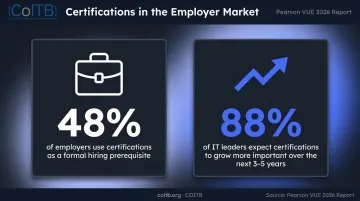
Pearson VUE's 2026 employer report found that 48% of employers use certifications as a formal hiring prerequisite. A separate finding from the same report shows 88% of leaders expect IT certifications to become more important over the next three to five years. Completing a learning platform builds skills, but a standalone platform certificate isn't enough for employers to verify competency independently.
For credentials aligned to ISO/IEC 17024 standards (the international benchmark for rigorous personnel certification), COITB offers industry-recognized exams in HTML/CSS, JavaScript, React, Python, MySQL, and GPT. These complement any of the programs listed above. COITB doesn't deliver training; it validates the skills you've already built through whichever platform you choose.
Conclusion
The best coding program isn't the most popular one — it's the one that matches your goals and keeps you moving forward. Each platform on this list teaches real, job-relevant skills — the differences come down to learning style, budget, and career target.
Start by identifying your goal: web development, data science, AI, back-end engineering, or front-end design. Then pick the program that matches that goal and your preferred learning style, and commit to it consistently. Switching platforms mid-stream is the most common reason beginners lose momentum and stall.
Once you've built your skills, consider validating them with an industry-recognized credential. COITB offers certifications aligned to ISO/IEC 17024 standards across HTML/CSS, JavaScript, React, Python, MySQL, and GPT — each backed by a digital badge that signals verified competency to hiring managers and clients.
Take the free practice assessment at coitb.org/assessment to gauge your readiness, or register directly at coitb.org/auth/signup. Questions? Reach the COITB team at support@coitb.org or +1 877 402 0840.
Frequently Asked Questions
Which coding language is best for beginners?
Python is the most widely recommended first language — its readable syntax is easier to follow from day one, and it applies directly to data science, AI, and back-end development. HTML and CSS are the better starting point if your goal is web design or front-end development specifically.
Is ChatGPT useful for learning to code?
It can help explain concepts, debug errors, and generate examples — but using it as a primary learning tool is counterproductive. Beginners who rely on AI-generated code before developing problem-solving fundamentals often struggle to write anything independently later.
Can I learn to code for free in 2026?
Yes. freeCodeCamp and The Odin Project both offer comprehensive, structured curricula at no cost. Some platforms let you audit courses for free but charge for certificates, so keep that in mind if credential validation is part of your plan.
How long does it take to learn coding as a beginner?
Most beginners develop foundational skills in three to six months with consistent daily practice. Reaching a level where employers will seriously consider you typically takes six to twelve months of focused effort, depending on the language and role.
Do I need a computer science degree to get a coding job?
No. Stack Overflow's 2024 survey found that 82% of developers used online resources to learn to code, and companies including IBM and Google have actively reduced degree requirements in recent years. What matters more is a demonstrable skill set — a portfolio, verifiable credentials such as industry-recognized certifications, or both.