Introduction
Many aspiring IT professionals run into the same wall: they've built real skills through self-study, bootcamps, or experience from another industry — but have no formal proof of those skills. Traditional certifications from major vendors can cost hundreds to thousands of dollars, and that's before adding mandatory training packages.
Free and low-cost technical certifications have become a genuine entry point into tech careers. According to CompTIA's 2025 survey of 1,109 HR and learning professionals, 93% said industry-recognized certifications factor into hiring for technology roles — making credential validation one of the most consistent signals in tech hiring.
This guide covers the most career-relevant certification categories, how to choose the right credential for your goals, and how to put it to work once you've earned it.
Key Takeaways:
- Employer-recognized certifications (not just course badges) carry real weight in tech hiring decisions
- Free learning resources exist across web development, AI, and application development — but free learning ≠ a free exam
- ISO/IEC 17024-aligned credentials signal independent, third-party skill validation to employers
- Matching your certification to a target job title matters more than stacking credentials
- Non-profit credentialing bodies often provide accessible exam fees without mandatory training purchases
Why Free Technical Certifications Matter for Your Career
Certifications as a Credibility Signal
For self-taught developers, bootcamp graduates, and career changers, a degree isn't always in the picture. That creates a real problem: employers want verifiable proof of skill, and without a CS degree or work history in the field, candidates struggle to demonstrate competency on paper.
Certifications fill that gap. They're third-party validation that a specific skill set has been independently tested — not just self-reported.
Beyond individual hiring, Skillsoft's survey of more than 5,100 global IT professionals found that 97% of decision-makers said certified staff add value, with the most commonly cited benefits being faster problem resolution (49%) and improved productivity (48%).
The Critical Distinction: Badges vs. True Certifications
Not all credentials carry equal weight. Here's what actually matters:
| Credential Type | What It Proves | Employer Weight |
|---|---|---|
| Course completion badge | You attended training | Low — no independent assessment |
| Digital certificate of attendance | You completed a course | Low — issuer has a conflict of interest |
| Industry certification (exam-based) | You passed a standardized assessment | Higher — independent validation |
| ISO/IEC 17024-aligned credential | You passed a governed, psychometrically validated exam | Strongest signal available |
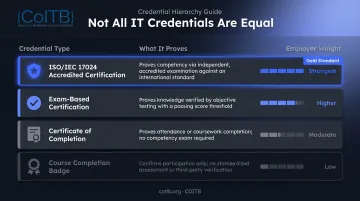
ISO/IEC 17024 sets the international standard for organizations that certify people. When a credentialing body operates under this standard, exam development, credential integrity, appeals processes, and recertification requirements are all independently governed, rather than designed to maximize pass rates for commercial reasons. That independent governance is what separates a credential worth listing on a résumé from one that gets skimmed past.
Top Categories of Free Technical Certifications to Explore
Free and accessible certifications span several key IT domains. Before choosing a path, it helps to understand what's actually available — and where the "free" label applies to learning versus the exam itself.
Cloud and Infrastructure
Two major providers dominate this space:
- Google Cloud Skills Boost provides eligible learners with monthly credits for selected labs and skill badges through its Starter/GEAR access tier — note that this does not include a free professional cloud certification exam.
- Microsoft Learn offers free self-paced modules, learning paths, and practice assessments for Azure credentials, with some Applied Skills assessments available separately.
Free training ≠ free exam in both cases. These resources suit IT support, infrastructure, and cloud administration roles.
Cybersecurity
Google's Cybersecurity Professional Certificate on Coursera offers financial aid for eligible learners and awards a Coursera Professional Certificate on completion. That's a course-series credential, not an ISO/IEC 17024 personnel certification — a meaningful distinction when comparing credentials for employer recognition.
CompTIA provides free Security+ exam objectives and sample practice questions for self-study, though its full prep tools (CertMaster Learn, Labs, Practice) are paid products. Both open doors to security analyst and IT support roles for early-career candidates.
Data and Programming
IBM SkillsBuild offers free learning and eligible digital badges across AI, cybersecurity, data science, and web development — administered through Credly. These badges document learning or demonstrated skills but are not automatically personnel certifications. Coursera also offers full course access (no certificate) for selected courses under its no-cost option, though traditional auditing is not universally available.
Web and Application Development
HTML, CSS, JavaScript, React, and Python are the backbone of most software jobs. Dedicated credentialing bodies, including non-profits like COITB, now offer certification in these specific technologies — making validation accessible without high exam fees or mandatory training purchases.
AI and Emerging Technologies
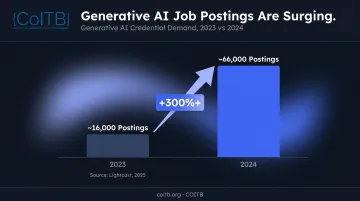
Lightcast data shows U.S. job postings mentioning generative AI grew from approximately 16,000 in 2023 to more than 66,000 in 2024 — a signal that validated AI skills are moving from nice-to-have to expected. IBM AI Fundamentals and Google's AI courses provide free learning entry points, while dedicated AI certifications — like COITB's Certified GPT Professional — validate applied, employer-recognized skills in generative AI.
Free and Accessible Technical Certifications for Modern Tech Skills
The Case for Non-Profit Credentialing Bodies
For web developers, front-end designers, application developers, and AI professionals, the most career-relevant certifications validate what employers are actually hiring for: HTML, CSS, JavaScript, React, Python, MySQL, and GPT.
Non-profit credentialing bodies have emerged specifically to address the gap for early-career and self-taught professionals. Unlike commercial certification vendors, they typically:
- Keep exam fees accessible without bundling mandatory training
- Focus on open-standard technologies rather than proprietary vendor ecosystems
- Operate as independent assessors rather than training providers with a financial incentive to pass candidates
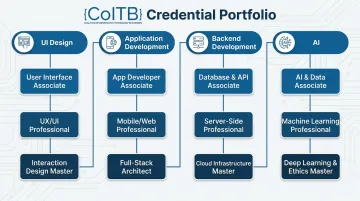
COITB (Council of IT Professionals and Businesses) is a non-profit credentialing body that keeps exam fees accessible — well below commercial vendor pricing — and offers ISO/IEC 17024-aligned certifications across:
- UI Design: HTML-CSS Web Designer
- Application Development: JavaScript Professional Developer, ReactJS Framework Developer
- Backend Development: Professional Python Developer, MySQL Backend Developer
- AI: Certified GPT Professional
Exams are delivered via remote online proctoring (webcam and stable internet required; military CAC and VA-issued IDs accepted) or at authorized test centers. Each exam includes 58–90 multiple-choice and scenario-based items, with passing scores set at 70–75% depending on the credential. A digital badge is included at no additional cost, and every badge reflects a candidate who actually cleared the passing threshold.
What ISO/IEC 17024 Alignment Actually Means
For employers, ISO/IEC 17024 alignment signals three things a course completion badge cannot:
- COITB does not deliver training or bootcamps, removing the conflict of interest that undermines training-issued credentials
- Each certification carries a unique Certification ID, verifiable via digital badge URL directly from LinkedIn profiles or résumés
- Credentials require renewal, so the certification on a résumé reflects current competency — not a one-time historical snapshot
Choosing Applied Credentials Over Theoretical Ones
When evaluating any certification, prioritize exams that include scenario-based items alongside multiple-choice questions — these better reflect on-the-job problem-solving. Before committing preparation time, confirm the credential is recognized by the employers or roles you're targeting. A certification that validates practical skill in a specific technology carries more weight than a broad theoretical badge.
How to Choose the Right Free Technical Certification for Your Career Goals
Start With the Job Posting, Not the Certification
The most common mistake is choosing a certification based on what's convenient or free, rather than what target employers are asking for. Before registering for any exam, pull 10–20 job postings in your target role and note which technologies and credentials appear most frequently. That's your certification roadmap.
Evaluate Credential Quality
When assessing any certification, check for:
- Governed exam process aligned to ISO/IEC 17024 — independent oversight, not self-certification
- Training and credentialing kept separate — the body issuing your credential should not also be selling you the prep course
- Scenario-based assessments that test applied skills, not just course attendance
Beginner vs. Advanced Paths
Some certifications require no prior experience — ideal for candidates with 0–6 months of hands-on exposure. Others require demonstrated professional experience. For beginners:
- Start with foundational credentials in specific technologies (HTML/CSS, Python, JavaScript)
- Stack additional credentials as your experience and income grow
- Avoid jumping to advanced specializations before the fundamentals are verified
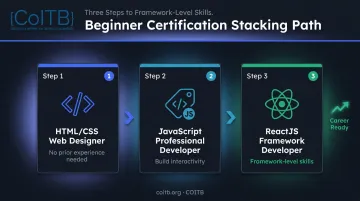
COITB's HTML-CSS Web Designer certification is built for candidates with no prior tech background — covering core front-end skills that employers expect from entry-level web roles. From there, it stacks directly into the ReactJS Framework Developer credential as a logical next step.
Avoid Certificate Collection Without Strategy
That stacking logic is the key distinction. One or two certifications tied directly to your target job titles will outperform a collection of unrelated credentials. Employers evaluate relevance and rigor — a ReactJS certification from a governed credentialing body carries more weight than multiple course completion badges from unrelated platforms.
Tips for Making Your Technical Certification Work for Your Career
On Your Résumé
- Create a dedicated Certifications section — don't bury credentials in your education section
- Include: credential name, issuing body, year earned, and badge verification URL
- Mirror the language from job descriptions where the credential appears — if postings say "ReactJS developer," your résumé should reflect that phrasing exactly
In Interviews
Treat the certification as a launchpad, not a destination. Interviewers will probe the credential:
- Be ready to explain what the certification covered and what skills it assessed
- Describe something specific you built or solved using those skills
- Connect the credential to a project or problem in your portfolio
The more specifically you can tie the credential to real work, the stronger the impression you leave.
Staying Current With Renewals
Many technical certifications require renewal. COITB credentials, for example, include recertification requirements, continuing education units (CEUs), and audit procedures as part of maintaining the credential. Renewal cycles vary by issuing body, so check the requirements before you register.
Staying current signals professionalism and keeps your skills sharp in a field where technologies shift quickly. Knowing the renewal timeline upfront means it won't catch you off guard later.
Frequently Asked Questions
What is a technical training certification?
A technical certification is a credential awarded by an independent or industry body that formally validates a person's skills in a specific technology or discipline, typically through a standardized exam. Unlike a course completion certificate, a true certification is issued by a body that assesses — not teaches — the skill.
Is a technical training certification worth it?
For career changers and early-career professionals, certifications deliver measurable results. CompTIA's 2025 survey found that 93% of HR and L&D professionals said recognized certifications factor into hiring decisions for technology roles — a meaningful advantage in competitive screening.
What is the best technical training certification to have?
"Best" depends entirely on your target role. Cloud certifications suit infrastructure careers; web and application development credentials (HTML/CSS, JavaScript, React) suit software roles; and AI/GPT credentials are increasingly valuable across most tech disciplines. Align your choice with job descriptions in your target role, not general popularity.
What is the best certification to become a technical trainer?
Technical trainers benefit most from holding a verified credential in their specialty area. A Python instructor with a Professional Python Developer certification, for example, carries more credibility with learners than one without any validated technical background.
Can I get a free technical certification online?
Free and low-cost options exist — including auditable courses, digital badges, and non-profit credentialing bodies with accessible exam fees. Before investing preparation time, verify employer recognition: free learning and a free exam are often two different things.
How long does it take to earn a technical certification?
Entry-level certifications can be achievable in a few weeks for candidates with foundational knowledge; more complex credentials may take several months. Your starting point is the biggest variable. A free practice assessment at coitb.org/assessment is the most reliable way to gauge how close you are before scheduling an exam.