
Introduction
The numbers tell a clear story: Coursera reported GenAI course enrollments growing 195% year over year in 2025, averaging 12 enrollments per minute. Millions of professionals are actively reskilling — not because it sounds good on paper, but because employers have shifted what they're actually hiring for.
Traditional four-year degrees are losing ground as hiring gatekeepers. CompTIA reported that roughly half of all April 2025 tech job postings did not require a four-year degree, with nearly 450,000 active listings that month alone. People who learned online, built portfolios, and validated their skills with recognized credentials are filling that gap.
Picking the wrong course wastes months. Picking the right one — paired with a credential employers can verify — is what converts learning into an offer letter.
This guide covers the best online course categories for career changers in 2026, how to evaluate them, and how to validate what you've learned so it holds up under recruiter scrutiny.
Key Takeaways
- AI, web development, and Python rank as the highest-ROI skill categories for tech career changers in 2026.
- Half of tech job postings no longer require a degree — demonstrated, verifiable skills are what employers are screening for.
- Portfolio-building before you sit for certification is non-negotiable for entry-level candidates without prior tech titles.
- Earn an independent, proctored certification to convert self-reported skills into employer-verifiable proof.
- Most career changers reach job-ready status in 3–12 months with 10–15 hours of focused weekly practice.
Why Online Courses Are the Fastest Path to a Tech Career in 2026
The Degree Requirement Is Fading
Skills-based hiring has become the default for major employers. IBM removed degree requirements from 50% of its US job openings and has since hired roughly 1,000 US apprentices, with a 90% conversion rate to full-time employment. Google's career certificate programs connect graduates to a consortium of 150+ companies, with over 70% of certificate completers reporting a positive career outcome within six months.
For software developers specifically, about 40% of job ads no longer require a bachelor's degree. That percentage is rising.
Why Online Courses Work for Career Changers
That employer shift creates a real opening — but only if you can demonstrate skills clearly. Four factors make online learning the practical way to do that:
- Self-paced formats allow studying around existing jobs and family commitments
- Lower cost than traditional degrees, often by an order of magnitude
- Faster curriculum updates — platforms revise content in weeks, not years
- Built-in portfolio work — quality courses include real projects that build your portfolio alongside skills
Pairing that hands-on learning with a recognized third-party credential — like those offered by non-profit credentialing bodies such as COITB — gives employers a verifiable signal that the skills are real. The categories below are ranked by job demand, salary potential, and the strength of the credential each path supports.
Best Online Courses for Career Change and Growth 2026
Courses below are organized by skill domain and selected for beginner accessibility, hiring demand in 2026, and the quality of outcomes they produce.
AI & Generative AI Courses
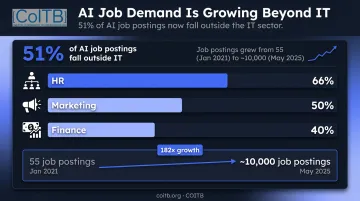
AI literacy is the single fastest-growing skill category across industries — and it's no longer confined to engineering teams. Lightcast data shows 51% of AI-related job postings in 2024 were outside IT and computer science occupations, with HR demand growing 66%, Finance up 40%, and Marketing at 50% annual growth. Job postings requiring generative AI skills climbed from 55 in January 2021 to nearly 10,000 by May 2025.
Who these courses suit: Non-technical professionals moving into AI-adjacent roles — prompt engineers, AI product coordinators, AI operations analysts, or anyone integrating GPT tools into existing workflows.
Top platforms and offerings:
| Factor | Details |
|---|---|
| Key Platforms | Coursera (Google AI Essentials), edX (IBM AI for Everyone), DeepLearning.AI (Generative AI for Everyone) |
| Typical Duration | 1–6 months; many beginner programs run 3–5 weeks at 1–2 hours/week |
| Career Outcomes | AI Prompt Engineer: avg $141,770/yr; AI Analyst: median $103,316/yr |
No coding prerequisites required for foundational programs. GPT-based skills are now appearing explicitly in job descriptions across marketing, healthcare, finance, and operations — not just software roles.
Credential next step: COITB's Certified GPT Professional certification validates prompt engineering, GPT API integration, responsible AI practices, and applied use cases across business domains. It's a 60-question, 75-minute exam requiring no CS background, built specifically for professionals who've completed AI coursework and need employer-verifiable proof.
Front-End Web Development Courses (HTML, CSS, JavaScript, React)
Front-end development is one of the clearest routes into tech for career changers — especially those with design, communications, or visual-thinking backgrounds. The learning path is logical, the portfolio feedback is immediate, and the job market for React and JavaScript developers remains consistently strong.
Top platforms:
| Factor | Details |
|---|---|
| Key Platforms | freeCodeCamp (free), The Odin Project (free), Udemy Web Developer Bootcamp 2026, Scrimba Frontend Path (81.6 hrs) |
| Typical Duration | 3–9 months depending on pace; Udemy's Bootcamp covers 74 hours of structured content |
| Career Outcomes | Junior Front-End Developer: ~$81K/yr median; Junior React Developer: ~$112K/yr avg; BLS projects 7% growth through 2034 |
Front-end stands out for one practical reason: you're producing real, visible work from week one. A portfolio of deployed projects carries more weight than any line on a résumé.
Credential next step: COITB offers three directly aligned certifications for this path:
- HTML-CSS Web Designer — 90 questions, 90 minutes, validates semantic HTML5, Flexbox, CSS Grid, and responsive design
- JavaScript Professional Developer — 90 questions, 90 minutes, covers ES6+, async/await, the Fetch API, and DOM manipulation
- ReactJS Framework Developer — 90 questions, 90 minutes, validates Hooks, React Router, component architecture, and API integration
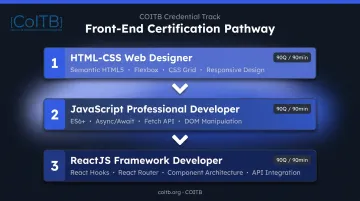
Stacking these three credentials signals a complete front-end engineering capability to employers — not just course completion.
Python & Backend Development Courses
Python is the most versatile first language a career changer can learn. It ranked #1 on the TIOBE Index in 2025 with an 18.94% share, and Stack Overflow's 2025 Developer Survey showed adoption climbing another 7 percentage points year over year.
The career applications are wide: data analysis, automation, backend development, and AI/ML all run on Python. One course category, four job title categories.
Top platforms:
| Factor | Details |
|---|---|
| Key Platforms | Coursera – Python for Everybody (UMich, 2 months), Codecademy Back-End Engineer Path (105 hrs), DataCamp Python Developer (71 hrs), Udemy Python courses |
| Typical Duration | 2–6 months depending on depth and pace |
| Career Outcomes | Python Developer: avg $129,969/yr; Backend Developer: avg $120,623/yr; Data Analyst: entry-level $37K–$75K/yr |
SQL and database skills are commonly bundled into backend paths — Coursera's Python for Everybody includes SQL, JSON, and RESTful APIs; Codecademy's backend path includes PostgreSQL.
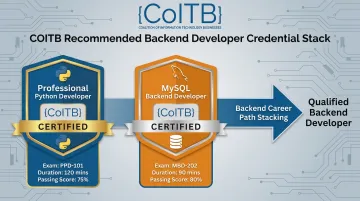
Credential next step: COITB's Professional Python Developer certification (58 questions, 75 minutes) validates Python 3 OOP, exception handling, standard library, and applied scripting. The MySQL Backend Developer certification (90 questions, 90 minutes) covers schema design, SQL querying, indexes, transactions, and backend integration. COITB explicitly recommends stacking both for backend developer career targets.
UI/UX Design Courses
UI/UX is the tech career path that tends to suit people from graphic design, marketing, psychology, or communications backgrounds — fields where understanding user behavior is already second nature.
Quick distinction that trips up many beginners: UI (user interface) focuses on visual design — layouts, color systems, typography, interactive components. UX (user experience) centers on research — user flows, wireframing, usability testing, and information architecture. Most roles blend both, but knowing which you're stronger in helps you choose the right course emphasis.
Top platforms:
| Factor | Details |
|---|---|
| Key Platforms | Google UX Design Certificate on Coursera (6 months, 200+ hours, 3 portfolio projects), Interaction Design Foundation (1.1M+ enrollments), CareerFoundry (5–10 months, job guarantee), Skillshare (Figma UI/UX Essentials) |
| Typical Duration | 5–10 months for comprehensive programs; shorter standalone courses available |
| Career Outcomes | UX Designer: avg $108,367/yr; BLS projects 7% growth for digital designers through 2034 |
A portfolio built during coursework can carry real weight at the entry level — it demonstrates process thinking, not just visual polish.
Credential note: COITB's current portfolio does not include a standalone UI/UX research or interaction design credential. The closest alignment is the HTML-CSS Web Designer certification, which validates the front-end implementation side of UI work — semantic structure, responsive layout, and accessibility. For learners focused on the visual-design and research dimensions of UX, the HTML-CSS credential covers the implementation layer most employers expect designers to understand.
Full-Stack & Application Development Courses
Full-stack development combines front-end and back-end skills into a single, broadly employable package. It takes longer to learn than a single-discipline path, but it also opens the widest range of role options — and signals a level of commitment that self-study alone rarely communicates.
Top platforms:
| Factor | Details |
|---|---|
| Key Platforms | App Academy Open (free, 16 weeks), Codecademy Full-Stack Engineer Path (150 hrs), Flatiron School (15 weeks, 100% online), Meta Back-End Developer Certificate on Coursera |
| Typical Duration | 4–9 months at consistent pace |
| Career Outcomes | Full-Stack Developer: avg $118,864/yr; over 7,100 entry-level postings on Glassdoor; entry-level ranges from $47K–$119K |
App Academy Open is free with lifetime access and covers JavaScript, Python, SQL, React, Express, and Flask — one of the most comprehensive free options available.
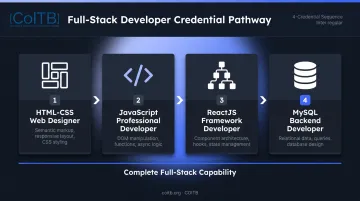
Credential next step: COITB's recommended full-stack credential stack combines four certifications: HTML-CSS Web Designer → JavaScript Professional Developer → ReactJS Framework Developer → MySQL Backend Developer. This four-credential pathway validates end-to-end capability — from visual layout through JavaScript engineering, React component architecture, and relational database management. It's the most comprehensive employer-recognizable signal COITB offers for full-stack candidates.
From Courses to Credentials: How to Validate What You've Learned
The Gap Online Courses Leave
Completing a course proves you finished it. That's not the same as proving you can do the work.
For career changers without a prior tech job title, employers face a verification problem: they can't easily distinguish someone who genuinely mastered React from someone who watched the videos. Course completion certificates help, but they're issued by the same platform that sold you the course — not by an independent assessor.
An independent certification closes that gap. It gives employers a signal they can actually trust.
What ISO/IEC 17024-Aligned Certifications Actually Mean
ISO/IEC 17024 is the international standard governing bodies that certify persons. Organizations aligned to this standard operate under formal governance frameworks that cover exam integrity, candidate fairness, psychometric validity, and ongoing program oversight. They don't issue badges based on course attendance.
COITB is a non-profit credentialing body whose certification programs are aligned to ISO/IEC 17024. It does not deliver training or courses. Its sole function is validating skills through proctored examination — a meaningful distinction for employers who can't rely on self-reported course completions.
What the Exam Process Looks Like
COITB exams are timed and proctored, with scenario-based questions designed to test applied skill — not memorized definitions. You can sit the exam in two ways:
- Online proctoring — webcam, stable internet, and government-issued ID required (military CAC and VA-issued ID accepted)
- In-person test centers — authorized COITB locations available across the US
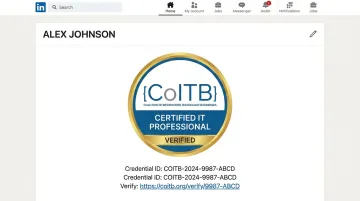
Upon passing, candidates receive a digital badge that employers can verify through LinkedIn, résumés, or background-check vendors via a unique Credential ID and badge URL.
When to Pursue Certification
The right timing: after completing a course and building at least one portfolio project. At that point, a certification exam confirms that your skills meet an objective, externally set standard. For career changers without a degree or prior tech title, that external validation is often what converts a résumé review into a first interview.
Conclusion
The combination that works in 2026 is straightforward: choose a course based on the specific role you want, build real projects while you study, then validate what you've learned with a credential that employers can verify directly.
Online courses get you the skills. A recognized certification shows employers you do.
If you've completed coursework in web development, AI, Python, or application development — or you're building toward that point — explore COITB's industry-recognized certifications at coitb.org. Designed for career changers, self-taught developers, and bootcamp graduates, COITB's credentials are remotely proctored, employer-verifiable, and aligned to ISO/IEC 17024 standards across the technologies — React, JavaScript, Python, HTML/CSS, MySQL, and GPT — that appear most consistently in entry-level and mid-level tech job postings.
Frequently Asked Questions
How do I switch careers in 2026?
Identify a target role in a high-demand field, build skills through self-study, a bootcamp, or prior work experience, and create a portfolio of real projects. Then validate those skills with an industry-recognized certification. For most US tech employers, that combination is a credible path in without a traditional degree.
What are the most in-demand online skills for career change in 2026?
AI and GPT tools, front-end web development (JavaScript and React), Python, UI/UX design, and full-stack application development each map to active US job openings with entry-level salaries well above the national median.
Which certifications are most in demand in 2026?
CompTIA Security+, AWS, and Azure certifications lead in cybersecurity and cloud. For application development and AI, ISO/IEC 17024-aligned credentials — like those from COITB in React, Python, JavaScript, MySQL, and GPT — carry stronger employer credibility than platform-issued course badges because they are independently verified rather than self-issued.
How long does it take to change careers through online courses?
Most career changers reach job-ready skills in 3–12 months depending on the field and weekly time commitment. Front-end development and Python are achievable in 3–6 months with consistent study; full-stack paths typically take 6–9 months.
Can I get a tech job without a degree if I take online courses?
Many US tech employers no longer require a degree for entry-level roles. A portfolio of real projects paired with an industry-recognized certification gives hiring managers concrete proof of ability — no degree required.
What is the difference between an online course and a certification?
A course teaches skills. A certification is an independent, proctored assessment that validates those skills against an external standard. Employers place more trust in certifications because they are independently issued and verified, not self-reported.