The problem isn't a shortage of AI courses. It's figuring out which ones actually mean something to a hiring manager. Completion badges, proctored exams, vendor credentials, and ISO-aligned certifications all look similar on paper — but carry very different weight in a job search.
This guide evaluates five standout AI courses and certificates available in 2026 based on curriculum depth, credentialing rigor, and real career relevance — covering options from free beginner programs to exam-backed professional certifications.
Key Takeaways
- 66% of hiring managers won't hire candidates without demonstrated AI skills — certifications provide that proof
- Exam-backed credentials (proctored, scored, pass/fail) signal more to employers than completion badges
- Programs range from under 5 hours (Google AI Essentials) to 4 months (IBM AI Engineering)
- The right credential depends on your career goal — AI fluency vs. AI engineering require different paths
- For hands-on GPT and API skills, look for credentials built around practical application — not just theory — with third-party exam standards that employers can verify
Why AI Certifications Matter in 2026
The World Economic Forum's Future of Jobs Report 2025 projects 170 million new jobs created by 2030, with AI and data roles among the fastest-growing categories. Meanwhile, Lightcast data via the Stanford AI Index found over 66,000 job postings explicitly listing generative AI as a required skill — a number that barely registered three years ago.
AI Literacy vs. AI Proficiency
There's a meaningful difference between knowing what AI is and being able to use it. Employers increasingly want the latter.
- AI literacy = understanding concepts, use cases, and general workflows
- AI proficiency = hands-on capability with Python, GPT APIs, ML frameworks, and deployment
Most free courses deliver literacy. Employers screening for AI roles want proficiency — and that's where the credential you choose matters.
The Credentialing Quality Gap
That gap between literacy and proficiency maps directly onto a gap in how credentials are issued — and what they actually prove.
Not all certificates are equal. Here's the difference:
| Completion Badge | ISO/IEC 17024-Aligned Credential | |
|---|---|---|
| Assessment | Self-paced, no exam | Proctored exam with scored assessment |
| Passing standard | None (finish = pass) | Defined passing score required |
| External oversight | None | Independent credentialing standards body |
| Employer signal | Course attended | Competency verified |
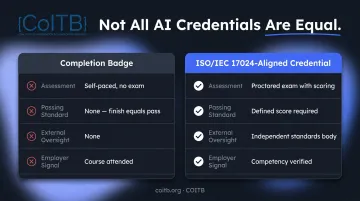
According to ANAB, ISO/IEC 17024-aligned credentials confirm that a holder underwent "a valid, fair, and reliable assessment to verify necessary competencies." For a hiring manager screening dozens of AI résumés, that standardized proof of competency carries weight that a completion badge simply cannot.
Best AI Courses & Certificates in 2026
The five programs below were selected for curriculum rigor, credentialing credibility, and accessibility across different learner levels — from complete beginners to working professionals targeting technical AI roles.
COITB Certified GPT Professional
COITB is a US-based non-profit credentialing body headquartered in Oklahoma City that offers industry-recognized certifications in AI, GPT, and application development. The Certified GPT Professional credential is built for career changers, bootcamp graduates, veterans, and early-stage professionals entering generative AI roles — regardless of prior experience.
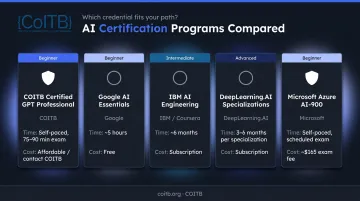
The exam runs 75 minutes, 60 questions, with a 71% passing score. It's delivered via remote online proctoring (webcam + stable internet) or at authorized test centers, with military CAC and VA-issued IDs accepted for verification.
What sets it apart is the exam blueprint. The largest domain — 40% of the exam — covers OpenAI API integration using Python and JavaScript, including API calls, JSON parsing, environment variable security, and connecting GPT to external tools like N8N, Flowise, and Zapier. The remaining domains cover:
- Prompt engineering techniques (zero-shot, few-shot, chain-of-thought) — 20%
- Responsible AI, security, and compliance (GDPR, FERPA, content moderation) — 15%
- Applied GPT use cases (chatbots, document assistants, automation workflows) — 15%
- Foundations of generative AI and ML concepts — 10%
COITB's certifications are designed to align with ISO/IEC 17024 standards — the internationally recognized framework for personnel credentialing. That alignment distinguishes the credential from unvalidated completion programs.
A free practice assessment is available at coitb.org/assessment before you register.
| Key Features | ISO/IEC 17024-aligned design; covers Python, GPT APIs, prompt engineering, responsible AI; remote proctored exam |
| Best For | Career changers, bootcamp graduates, veterans, and professionals entering AI/GPT roles |
| Credential Type | Industry-recognized certification from a non-profit credentialing body |
Google AI Essentials Certificate
Google AI Essentials is a short-form certificate offered through Google Career Certificates, designed to introduce foundational AI concepts and practical AI tool use in workplace settings. No prior experience required.
At under 5 hours and $49/month after a 7-day free trial, it's one of the most accessible entry points into AI education. Topics include AI fundamentals, prompting basics, responsible AI use, and integrating AI tools into everyday workflows.
Its strength is Google's brand recognition and its suitability for non-technical professionals. A marketing manager, teacher, or operations lead who wants to signal AI tool fluency to their employer will find this a low-barrier starting point.
The limitation: it's a completion certificate, not a proctored exam. There's no scored assessment or external validation — which matters when an employer is distinguishing between candidates.
| Key Features | AI fundamentals, prompt engineering basics, responsible AI; self-paced, under 5 hours |
| Best For | Beginners and non-technical professionals seeking foundational AI fluency |
| Credential Type | Google Career Certificate (completion badge) |
IBM AI Engineering Professional Certificate (Coursera)
IBM's AI Engineering Professional Certificate is a multi-course program offered through Coursera, covering machine learning, deep learning, neural networks, and model deployment. It's built for learners targeting technical AI and ML roles.
The curriculum runs 4 months at 10 hours per week and covers Python, Scikit-learn, Keras, TensorFlow, PyTorch, generative AI, LLMs (including GPT and BERT), and AI agents using RAG and LangChain. The program includes an AI capstone project and a generative AI application project — hands-on work that can be shown in a portfolio.
The program costs $239/year (usually $399) via Coursera's annual plan, with financial aid available.
IBM's brand carries weight in enterprise hiring, and the depth of technical content is genuine. The credential is a Coursera professional certificate, not a proctored exam — but for someone building toward ML engineer or data science roles, the curriculum substance often matters more than the assessment format.
| Key Features | Machine learning, deep learning, Python, TensorFlow, Keras, LLMs, RAG/LangChain; capstone project |
| Best For | Aspiring ML engineers and technical professionals targeting AI developer or data science roles |
| Credential Type | IBM-backed professional certificate via Coursera |
DeepLearning.AI — AI For Everyone + Specializations (Andrew Ng)
DeepLearning.AI is Andrew Ng's education platform — he's the founder of DeepLearning.AI, co-founder of Coursera, and adjunct professor at Stanford. His courses carry strong recognition among ML practitioners and hiring managers.
The platform offers tiered learning paths:
| Program | Duration | Focus |
|---|---|---|
| AI For Everyone | 7 hours | AI literacy for business professionals |
| Machine Learning Specialization | 2 months (10 hrs/wk) | Supervised/unsupervised learning, reinforcement learning |
| Deep Learning Specialization | 3 months (10 hrs/wk) | Neural networks, CNNs, sequence models |
| Generative AI with LLMs | 17 hours | LLM training, fine-tuning, deployment |
The curriculum is regularly updated — the generative AI content reflects current developments in LLMs and production deployment. Specialization certificates are shareable on Coursera and carry strong name recognition among AI practitioners.
Like other Coursera programs, these are completion-based certificates — no proctored exam. But for someone building depth in a specific area, the curriculum quality and Andrew Ng's instruction are hard to beat.
| Key Features | Tiered paths from AI literacy to advanced ML/DL; covers generative AI, NLP, MLOps |
| Best For | Learners at all levels — from business professionals to engineers pursuing ML specializations |
| Credential Type | Coursera specialization certificate under DeepLearning.AI |
Microsoft Azure AI Fundamentals (AI-900)
AI-900 is Microsoft's foundational certification for Azure AI services — a proctored exam covering core AI concepts, machine learning, computer vision, NLP, generative AI workloads, and Azure Cognitive Services. It costs $99 USD and is scheduled through Pearson VUE.
As a vendor-specific, exam-based credential from Microsoft, it carries significant weight in enterprise environments built on Azure infrastructure. Passing requires genuine comprehension — this isn't a completion badge.
AI-900 works well as a stepping stone. Organizations running Azure-based AI pipelines often use it as a baseline requirement, and it positions candidates for more advanced Azure AI certifications (like AI-102 at the associate level).
| Key Features | Proctored exam via Pearson VUE; covers Azure ML, cognitive services, NLP, responsible AI; $99 USD |
| Best For | IT professionals and developers working in or targeting Azure-based enterprise environments |
| Credential Type | Microsoft official certification (exam-based, proctored via Pearson VUE) |
How We Chose These AI Courses & Certificates
Every program on this list was evaluated against three criteria:
- Curriculum relevance — Coverage of skills employers actually hire for: Python, GPT, ML frameworks, prompt engineering, and model deployment — not just conceptual overviews.
- Credentialing rigor — Is the credential validated by a proctored exam, vendor assessment, or recognized standard (ISO/IEC 17024 alignment, Pearson VUE delivery)? Or is it just a completion badge?
- Accessibility — Can working adults realistically finish this program given schedule, cost, and experience requirements?
Knowing what to look for helps — but knowing what to avoid matters just as much.
Common Mistakes When Choosing an AI Certification
- A well-known provider name doesn't guarantee the credential is exam-backed or employer-recognized — verify before enrolling
- Free and low-cost courses build knowledge but rarely validate applied skills that hiring managers can verify
- Completion certificates work for personal upskilling; a career pivot to an AI role requires an exam-backed credential with a scored assessment
Matching Credential to Career Stage
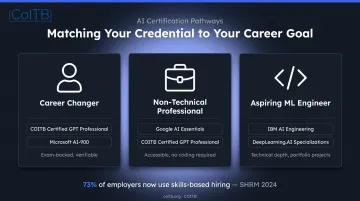
- Career changers need credentials that signal job-readiness — look for ISO-aligned or vendor-backed exams with scored assessments
- Non-technical professionals adding AI fluency benefit from accessible programs like Google AI Essentials or COITB's Certified GPT Professional
- Engineers targeting ML roles need technical depth — IBM AI Engineering or DeepLearning.AI specializations fit better than foundational certificates
SHRM research found 73% of employers now use skills-based hiring (up from 56% in 2022). Demonstrable, verifiable skills now matter as much as credentials. A proctored exam is still the clearest way to prove those skills to a hiring manager who hasn't seen your work firsthand.
Conclusion
The AI skills gap is real. Only 1 in 10 workers have been offered AI-specific training by their employer — yet two-thirds of hiring managers won't consider candidates who lack demonstrated AI capability. The path forward is choosing a credential that validates hands-on skills, not just course completion.
The programs here cover the full range: quick-start options for non-technical professionals, deep technical tracks for aspiring ML engineers, vendor-specific credentials for Azure environments, and exam-backed certifications for those making a career change.
Match your choice to a specific outcome. An aspiring ML engineer needs different credentials than a project manager adding AI fluency. The right fit depends on where you're starting and where you want to land.
Career changers and early-stage IT professionals should look at COITB's Certified GPT Professional — an ISO/IEC 17024-aligned credential designed for candidates without a coding background. The exam covers prompt engineering, API integration, and responsible AI use: the practical competencies that come up in AI-adjacent hiring.
No coding background is required. The exam is remotely proctored, available from any location, and accepts military CAC and VA-issued ID. Visit coitb.org/certifications/certified-gpt-professional to review the exam outline and registration details.
Frequently Asked Questions
What is the best AI certification for beginners in 2026?
It depends on your goal. For foundational awareness with minimal time investment, Google AI Essentials is a practical starting point. For a job-ready, validated credential — especially if you're changing careers — look at exam-backed programs like COITB's Certified GPT Professional or Microsoft AI-900, which require you to actually pass a scored assessment.
Do AI certifications actually help you get a job?
Exam-backed certifications give hiring managers a verifiable signal of practical skills — something a completion badge can't provide. Credentials aligned to ISO/IEC 17024 or issued by major vendors like Microsoft or IBM carry measurably more weight when a recruiter is screening a crowded applicant pool.
How long does it take to complete an AI certification?
Timelines vary widely: Google AI Essentials takes under 5 hours, while IBM AI Engineering runs roughly 4 months at 10 hours per week. Exam-based credentials like AI-900 ($99 USD) or COITB's Certified GPT Professional (75-minute exam) are short to sit — preparation time depends on your background.
Are free AI courses worth it, or should I pay for a certification?
Free courses build knowledge, but rarely carry credentialing weight. If your goal is personal learning or exploration, free options work fine. If you're trying to demonstrate verified skills to an employer — especially for a career change — a paid, exam-based certification is worth the investment.
What technical skills should a good AI certification cover?
Strong AI certifications should cover:
- Python programming and machine learning fundamentals
- Generative AI and prompt engineering (GPT)
- Model deployment or real-world API integration
- Responsible AI topics: bias, GDPR, and content moderation
Is prior coding experience required to earn an AI certificate?
Not always. COITB's Certified GPT Professional and Google AI Essentials are designed for non-coders with little to no prior experience. Technical programs like IBM AI Engineering or DeepLearning.AI's ML Specialization benefit significantly from basic Python familiarity before you start.