Introduction
Python is now the most-used language on GitHub — overtaking JavaScript for the first time in 2024, driven largely by explosive growth in AI development. Meanwhile, 51% of developers use Python according to Stack Overflow's 2024 Developer Survey, and it's the most desired language among those who don't yet use it.
That demand has made Python skills table stakes — and self-taught experience alone is harder to differentiate when every candidate on a hiring screen lists the same projects and tutorials.
That's where a formal credential comes in. COITB's Professional Python Developer certification gives developers a third-party, verifiable proof of Python competency — one that holds up in hiring screens, ATS filters, and direct employer conversations. Below, you'll find exactly what the exam tests, who benefits most from it, and how to walk in prepared.
Key Takeaways
- The Professional Python Developer certification validates foundational-to-mid-level Python skills for backend, automation, data, and AI-adjacent roles
- The exam consists of 58 questions over 75 minutes, with a 70% passing score required
- No prior certification required; the credential is designed for candidates with 0–6 months of hands-on Python practice
- COITB's credential is ISO/IEC 17024-aligned, with a verifiable digital badge for LinkedIn and résumé use
- Remote online testing with flexible self-scheduling lets working professionals sit the exam on their own time, from any location
What Is the Professional Python Developer Certification?
COITB's Professional Python Developer certification is an industry-recognized credential that validates applied Python programming skills — covering object-oriented programming, file and I/O operations, exception handling, the Python standard library, and PEP 8 best practices.
It targets developers at the foundational-to-mid-level stage — people who can write structured, efficient Python code and need a third-party credential to prove it. Beginners, career changers, and aspiring developers can sit the exam without prior COITB certifications or years of professional experience.
Exam Format at a Glance
| Detail | Specification |
|---|---|
| Number of questions | 58 items |
| Time limit | 75 minutes |
| Passing score | 70% (41 of 58 correct) |
| Format | Multiple-choice and scenario-based |
| Delivery | Remote online proctoring or authorized test center |
| Language | English |
Upon passing, candidates receive a digital badge at no additional cost — shareable on LinkedIn, résumés, and employer verification portals.
What ISO/IEC 17024 Alignment Means
COITB's certification programs are aligned to ISO/IEC 17024, the international standard for personnel certification bodies. This means COITB's credentialing process follows independently recognized standards for competence-based assessment — not just internal benchmarks. For candidates, that alignment translates to third-party credibility that self-issued or unstructured credentials can't match.
Credential Stacking Pathways
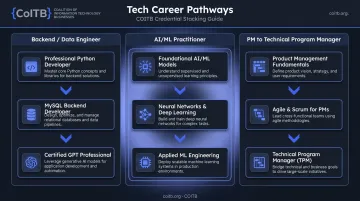
COITB documents recommended stacking sequences based on career target, so candidates can plan ahead from day one:
- Backend / Data Engineer: Professional Python Developer → MySQL Backend Developer → Certified GPT Professional
- AI/ML Practitioner: Certified GPT Professional + Professional Python Developer + MySQL Backend Developer
- PM-to-Technical Program Manager: Professional Python Developer + MySQL + Certified GPT Professional
No prior COITB certification is required before sitting the Professional Python Developer exam.
What Skills Does the Professional Python Developer Certification Validate?
The exam covers 11 documented knowledge domains, weighted toward practical, production-relevant skills.
Core Technical Domains
Object-Oriented Programming (OOP)
OOP carries the most weight on the exam. Tested areas include:
- Classes, methods, and constructors
- Inheritance, encapsulation, and polymorphism
- Magic methods (dunder methods)
- Decorators, generators, and iterators
This directly maps to real backend work. FastAPI's routing system, for example, uses @app.get() and similar path operation decorators — Python decorator fluency is how you write production API code, not just pass an exam.
File and I/O Operations
This domain covers reading, writing, and processing data from files, APIs, and user input — the exact operations behind data pipelines, log processing, and file-based integrations.
Exception Handling
This domain tests debugging, error patterns, and maintainable script design. It's the difference between code that demos well and code that holds up under real conditions.
Additional Tested Domains
- Python syntax, variables, and operators — foundational layer across all questions
- Functions and control flow — conditionals, loops, and function design
- Data structures — lists, dictionaries, strings, and built-in types
- Modules, packages, and virtual environments — including
pipand environment management - Python Standard Library —
collections,itertools,datetime,os,sys,json, andre - Advanced constructs — list/dictionary comprehensions, generators, decorators
- PEP 8 style and best practices — production-quality code standards
- Application development and automation — building scripts that solve real-world tasks
What's Not on This Exam
Network programming, GUI development, and unit testing frameworks like unittest and pytest are not included in COITB's Professional Python Developer exam. Those topics appear in separate credentials. This exam stays focused on core Python fundamentals through advanced OOP, which keeps the scope coherent and the credential clearly defined.
Career Benefits of Earning the Professional Python Developer Certification
Closing the Credibility Gap
For self-taught developers, bootcamp graduates, and career changers, the credibility gap is real. SHRM data shows nearly 70% of professional jobs required a four-year degree while fewer than 40% of US workers hold one. A third-party certification doesn't replace experience, but it gives hiring managers a standardized signal to evaluate candidates who built their skills outside a CS program.
More than 70 million Americans are classified as STARs (Skilled Through Alternative Routes), gaining competency through bootcamps, self-study, military service, and on-the-job practice. The Professional Python Developer credential is built for this population.
Roles Where This Credential Opens Doors
COITB targets the Professional Python Developer certification across four role categories:
- Backend developer — paired with MySQL Backend Developer for a full backend stack signal
- Automation engineer — the exam's application development domain maps directly to automation scripting roles
- Data engineer — the "backend / data engineer track" starts with this credential
- AI/ML practitioner — paired with the Certified GPT Professional for teams building or deploying AI solutions
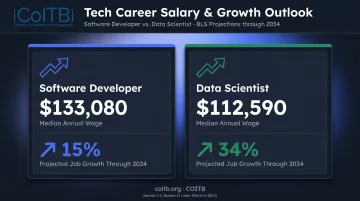
BLS reports software developers earned a $133,080 median annual wage in 2024, with 15% projected employment growth through 2034. Data scientists sit at $112,590 median with 34% projected growth. Python isn't peripheral to these roles — O*NET lists it as a hot technology for software developers specifically.
Certification as an ATS Filter
Structured tech companies increasingly use ATS screening as a first-pass filter before résumés reach human reviewers. A verifiable credential with a badge URL gives you something concrete to include that recruiters can confirm in seconds.
COITB's digital badge links to live verification — checkable directly from a LinkedIn profile or job application, with no extra steps for the recruiter.
Who Should Pursue the Professional Python Developer Certification?
The Ideal Candidate Profile
COITB recommends 0–6 months of hands-on Python practice as the readiness baseline. That experience can come from anywhere: bootcamps, self-study, coursework, or on-the-job scripting. No prior COITB certification is required.
The primary audiences COITB identifies:
- Bootcamp graduates — who have the skills but need employer-verifiable proof
- Self-taught developers — who learned through freeCodeCamp, Udemy, personal projects, or documentation
- Career changers — pivoting from finance, healthcare, engineering, or non-tech roles into backend or data positions
- Veterans and transitioning service members — particularly those with analytical, signals, or cyber MOS backgrounds, with potential funding through GI Bill, VET TEC, MyCAA, or VR&E (verify eligibility with your VA Education Benefits counselor before registering)
- Enterprise teams — engineering managers credentialing backend or AI/ML teams at scale
When This Credential Makes Sense vs. Other Options
If you're Python-focused and targeting backend, automation, or data roles, the Professional Python Developer credential gives you a language-specific signal that a generic cloud associate cert doesn't.
Cloud certifications validate platform knowledge. The Python credential validates your ability to write the code that runs on those platforms — a different signal, for a different hire.
The two aren't mutually exclusive. For a Python-first career track, the practical order is to anchor with a language credential, then layer in cloud or database specializations on top. COITB's stacking pathway — Python → MySQL → GPT — is built around exactly that progression.
How to Prepare for the Professional Python Developer Exam
Building Your Preparation Plan
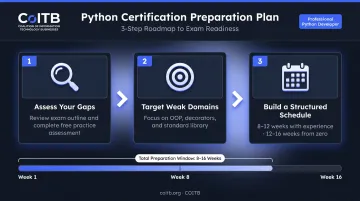
Assess your current gaps. Review the official exam outline at
coitb.org/certification-resources/exam-outlines/professional-python-developer-outlineand take COITB's free practice assessment at coitb.org/assessment to benchmark your readiness before committing to a date.Target your weak domains. Most candidates with bootcamp or self-study backgrounds are solid on syntax and data structures but shaky on OOP patterns, decorators, and the standard library. Close those gaps first.
Build a structured schedule. Plan for 8–12 weeks if you have some Python experience; 12–16 weeks if you're starting closer to zero. Consistent daily practice matters more than long cramming sessions.
Effective Study Approaches
- Start with the official exam outline — know exactly what's tested before investing time in anything else
- Build real projects: a file processing utility, a CLI automation script, or a small OOP-based application reinforces knowledge more effectively than re-reading notes alone
- Practice standard library modules —
json,os,datetime,re, andcollectionsappear in real code constantly and show up in scenario-based questions - Write PEP 8-compliant code from day one — style conventions are a tested domain, and the habit makes you a better collaborator on the job
Logistics: Remote Testing for Working Professionals
Once your preparation is solid, scheduling is straightforward. COITB's online proctored exam is available 24/7 from any US location (and most international locations). You self-schedule through your COITB account, choose your own window, and test from a quiet space with a webcam and stable internet. Military CAC and VA-issued IDs are accepted for identity verification.
For candidates fitting exam prep around existing jobs, family responsibilities, or deployment schedules, this flexibility removes the biggest practical barrier to getting certified.
Frequently Asked Questions
What do I need to be a backend developer?
Backend development requires server-side programming skills (Python is one of the strongest choices), database knowledge (SQL is standard), and API development experience. A credential like the Professional Python Developer gives you a formal, verifiable proof of the programming fundamentals that backend roles require.
What are the best certifications for developers?
For Python-focused backend or automation work, a language-specific credential like the Professional Python Developer is more relevant to employers than a general certification. Cloud and methodology certifications complement it well once the language foundation is solid.
What certifications pay $100k a year?
Python is strongly associated with roles in the $100k+ salary range. BLS reports software developers at $133,080 median pay and data scientists at $112,590 median pay in 2024 — both roles where Python is a primary tool. The Professional Python Developer credential validates the exact skills those roles screen for.
Do I need prior Python experience before taking the Professional Python Developer exam?
No prior certification is required, but hands-on Python practice is essential. COITB recommends 0–6 months of applied coding experience — basic scripting, data handling, and OOP work — before attempting the exam. Take the free practice assessment at coitb.org/assessment to gauge your readiness.
How long does it take to prepare for the Professional Python Developer certification?
Preparation typically takes 8–16 weeks depending on your current Python proficiency. Candidates with prior bootcamp or coursework experience can often prepare in 8–10 weeks with consistent daily practice. Starting from minimal Python experience, 12–16 weeks is more realistic.