For beginners, the urgency is real. But so is the confusion. Search "AI certification for beginners" and you'll get hundreds of options ranging from polished MOOCs to rigorous proctored exams — with no clear signal on which actually matter to employers.
This guide cuts through that noise. Below is a curated list of the best beginner-friendly AI certifications and courses in 2026, what separates the strong options from the filler, and how to pick the right one for where you're starting from.
Key Takeaways
- AI certifications validate skills through formal assessment, making them more credible to employers than course completions alone
- The best beginner options require no prior coding knowledge and take anywhere from a few hours to a few months
- Skills-based hiring is growing — 70% of employers now use it, up from 65% the year before
- Cost ranges from free to a few hundred dollars; there's a option for every budget
- COITB's Certified GPT Professional is an ISO/IEC 17024-aligned credential designed for beginners entering AI roles
Why AI Certifications Matter for Beginners in 2026
An AI certification isn't the same as finishing an online course. A certification validates your skills through a formal, standardized assessment — often proctored — producing a verifiable credential that employers can independently confirm. A course completion certificate tells employers you watched the videos. A certification tells them you passed the test.
That distinction matters more than ever right now. The Bureau of Labor Statistics projects data scientist roles to grow 34% between 2024 and 2034, with roughly 23,400 openings per year. Demand is outpacing the supply of credentialed candidates.
Why Certifications Help Beginners Specifically
For someone without a CS degree, years of experience, or a brand-name employer on their résumé, a certification does something specific: it bridges the credibility gap. Employers are shifting toward competency-based hiring — meaning a verifiable credential can carry real weight even without a traditional background.
The challenge is the same for most people entering tech without a conventional path:
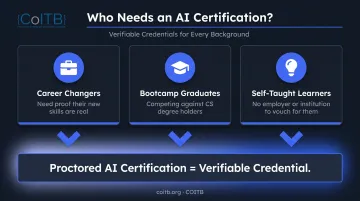
- Career changers who need proof their new skills are real
- Bootcamp graduates competing against CS degree holders
- Self-taught learners with no employer or institution to vouch for them
A proctored, standardized AI certification gives all three groups something concrete to point to — a credential employers can look up and verify independently.
Best AI Certifications & Courses for Beginners in 2026
Each option below was selected based on five criteria: beginner accessibility, industry recognition, hands-on learning, flexible format, and relevance to entry-level AI roles.
Google AI Essentials
Google AI Essentials is a short, fully non-technical course available on Coursera. It covers how generative AI works, effective prompt writing, and how to use AI tools across common work functions — no coding required. Completion takes under 10 hours, making it one of the fastest ways to build baseline AI literacy.
Google's brand recognition combined with a sub-10-hour format makes this a practical first credential. For professionals in marketing, HR, operations, or customer experience who want to demonstrate AI awareness on a résumé, few options are faster to complete.
| Detail | Info |
|---|---|
| Certifying Organization | Google (via Coursera) |
| Cost | ~$49/month after 7-day free trial |
| Best For | Non-technical beginners, marketing, HR, operations, and career changers seeking a quick AI overview |
Microsoft Azure AI Fundamentals (AI-900)
The AI-900 is a proctored vendor certification from Microsoft covering core AI and machine learning concepts, Azure Cognitive Services, and responsible AI principles. It doesn't require advanced programming experience — basic cloud awareness is helpful but not mandatory.
The AI-900 is a formal proctored exam delivered through Pearson VUE or Certiport, with a published passing score of 700 — making it more verifiable than course-completion certificates. For anyone targeting IT or cloud-adjacent roles, that third-party validation carries real weight with hiring managers.
| Detail | Info |
|---|---|
| Certifying Organization | Microsoft |
| Cost | $99 exam fee |
| Best For | Career changers and IT beginners wanting a trusted, employer-recognized vendor credential |
IBM AI Foundations for Everyone
This Coursera specialization from IBM walks learners through AI fundamentals, machine learning, deep learning, and hands-on chatbot building using IBM Watson — all without prior technical experience. Coursera lists it at approximately 4 weeks at 10 hours per week, though self-paced learners can adjust that timeline.
The practical labs are the real differentiator here. IBM's enterprise credibility paired with project-based exercises means learners finish with foundational knowledge and a tangible portfolio piece — a combination that matters when applying for entry-level roles.
| Detail | Info |
|---|---|
| Certifying Organization | IBM (via Coursera) |
| Cost | Coursera subscription (~$49–$59/month, free trial available) |
| Best For | True beginners with no technical background who want hands-on, guided learning from a globally recognized provider |
AI for Everyone by DeepLearning.AI
Taught by Andrew Ng, AI for Everyone is a 7-hour course designed specifically for non-technical professionals. It covers AI terminology, realistic expectations for what AI can and can't do, how to spot AI use cases in business settings, and societal implications — with zero math or coding.
AI for Everyone is AI literacy training — not a skills-validation credential, and it doesn't try to be. If you're a business professional who needs to communicate confidently with technical teams or evaluate AI projects, this course gives you the vocabulary and mental models to do that well.
| Detail | Info |
|---|---|
| Certifying Organization | DeepLearning.AI (via Coursera) |
| Cost | $49 for certificate; audit option may be available |
| Best For | Business professionals, aspiring AI project coordinators, and beginners who want conceptual fluency before pursuing technical certification |
COITB Certified GPT Professional
The Certified GPT Professional from COITB is a proctored, ISO/IEC 17024-aligned certification built specifically for learners with 0–6 months of hands-on AI experience. That includes career changers, bootcamp graduates, self-taught developers, and veterans transitioning into tech.
The exam consists of 60 multiple-choice and scenario-based questions completed in 75 minutes, with a passing score of 71% or higher. Unlike course completions, it's a formal assessment that produces a verifiable digital badge, shareable directly on LinkedIn and résumés.
What the exam actually covers:
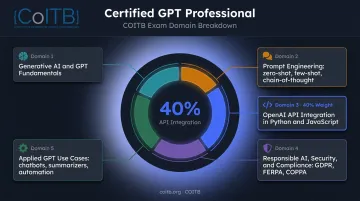
- Generative AI and GPT model fundamentals
- Prompt engineering (zero-shot, few-shot, chain-of-thought)
- OpenAI API integration using Python and JavaScript (40% of the exam)
- Responsible AI, security, and compliance (GDPR, FERPA, COPPA)
- Applied GPT use cases: chatbots, summarizers, automation workflows
The ISO/IEC 17024 alignment means COITB's credentialing process meets international standards for personnel certification — the same framework used by globally recognized credentialing bodies. That standard is what distinguishes it from self-issued course completion badges.
The exam is available via online remote proctoring or at authorized test centers. For pricing, contact COITB directly:
- Email: support@coitb.org
- Phone: +1 877 402 0840
- Free practice assessment: coitb.org/assessment
Veterans may be able to offset costs through GI Bill, VET TEC, MyCAA, or VR&E. Verify eligibility with the VA before registering.
| Detail | Info |
|---|---|
| Certifying Organization | COITB (non-profit, ISO/IEC 17024 aligned) |
| Cost | Contact COITB for current pricing; veteran funding pathways available |
| Best For | Bootcamp graduates, self-taught developers, career changers, and veterans who want a globally aligned, formally proctored credential |
How to Choose the Right AI Certification as a Beginner
The most common mistake beginners make is skipping straight to advanced or technical certifications before they've built foundational AI literacy. Start where you actually are.
Match the Credential to Your Goal
| Your situation | Where to start |
|---|---|
| No tech background, just want AI literacy | Google AI Essentials or AI for Everyone |
| Want a recognized vendor credential for IT roles | Microsoft AI-900 |
| Prefer hands-on, project-based learning | IBM AI Foundations for Everyone |
| Want a proctored credential covering Python + GPT | COITB Certified GPT Professional |
| Targeting AI/ML practitioner or developer roles | COITB Certified GPT Professional + Python credential stack |
Check Credibility Markers
Before committing to any credential, verify:
- Is it backed by a recognized organization or major tech brand?
- Does it require a formal assessment, or just video completion?
- Can it be independently verified by employers on LinkedIn or a résumé?
- Does the certifying body operate under standards like ISO/IEC 17024?
Be Realistic About Time and Cost
Beginner certifications range from free to a few hundred dollars — and more expensive doesn't mean better fit. Assess your schedule honestly before registering.
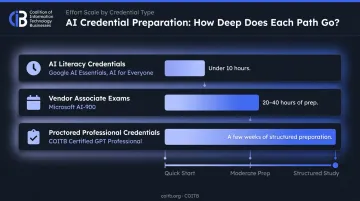
Typical time commitments by credential type:
- AI literacy credentials (Google AI Essentials, AI for Everyone): under 10 hours
- Vendor associate exams (Microsoft AI-900): 20–40 hours of prep recommended
- Proctored professional credentials (COITB Certified GPT Professional): a few weeks of structured preparation
A credential you actually earn is worth more than a premium program you abandon halfway through.
What to Expect After Earning Your First AI Certification
Immediately After Passing
- Add the credential to your LinkedIn Licenses & Certifications section — include the verification URL, not just the title
- Update your résumé with specific skills validated (e.g., prompt engineering, GPT API integration), not just the certification name
- Update any job profiles, portfolio pages, or freelance platform bios
What Comes Next
A first certification builds credibility, but employers also want to see applied capability. Complement your credential with at least one practical project:
- A simple AI chatbot built with the OpenAI API
- A prompt engineering portfolio showing different output techniques
- An AI tool integration for a real workflow (email automation, document summarizer, content generator)
The credential signals you've done the formal work. A project proves you can apply it — and hiring managers want both before moving someone to an interview. If you're starting with AI specifically, COITB's Certified GPT Professional pairs well with hands-on GPT API projects, giving you a third-party validated credential alongside real portfolio work.
Frequently Asked Questions
What is the easiest AI certification to get?
Google AI Essentials and AI for Everyone by DeepLearning.AI are both beginner-friendly options that require no coding or prior technical experience and can be completed in under 10 hours. They're the most accessible entry points for someone starting from scratch.
Is it worth getting an AI certificate?
Yes, especially for beginners and career changers. AI certifications validate foundational skills to employers, bridge the experience gap on a résumé, and signal that you're actively building relevant, current skills in a fast-moving field.
Do I need a coding background to start an AI certification?
No. Programs like Google AI Essentials, IBM AI Foundations for Everyone, and AI for Everyone require zero coding knowledge. COITB's Certified GPT Professional covers Python and API integration, but targets learners with 0–6 months of experience and recognizes self-study as a valid preparation path.
How long does it take to complete a beginner AI certification?
Non-technical introductory courses like Google AI Essentials take under 10 hours. Structured credentials with technical depth — like IBM's specialization or the COITB Certified GPT Professional — typically take a few weeks to a few months depending on your starting point and study pace.
What jobs can I get after completing a beginner AI certification?
Common entry-level roles include AI Support Associate, Junior Data Analyst, AI Prompt Engineer, AI Operations Specialist, and QA Engineer working with AI-powered tools. All of these titles show active posting volume on major job boards.
What is the difference between an AI course and an AI certification?
A course teaches concepts and skills; a certification validates those skills through a formal assessment. Certifications carry more weight with employers because they produce a verifiable, standardized credential — not just a record showing you completed the coursework.
In 2026, employers want proof — not just participation. A credential backed by a real assessment and independently verifiable carries meaningful weight on a résumé in a way that a course completion badge simply doesn't.
If you're ready to take that step, COITB's Certified GPT Professional is a formally proctored, ISO/IEC 17024-aligned certification covering prompt engineering, Python-based AI integration, and responsible AI practices — designed for learners with 0–6 months of experience. Remote proctoring is available from any location. Take the free practice assessment at coitb.org/assessment to see where you stand before you register.