Certifications solve this problem directly. They translate your technical ability into a standardized signal that hiring teams recognize. According to Pearson VUE's 2026 employer report, 92% of organizations require or strongly prioritize certification in their workforce strategy, and 93% report positive ROI from certified IT employees.
This guide covers the best backend developer certifications across databases, programming languages, cloud infrastructure, and server environments — with guidance on choosing the right credential for your current stack and experience level.
Key Takeaways
- Backend certifications validate skills through proctored exams — not course completions — and carry more weight with hiring managers
- Top backend credentials span MySQL/SQL databases, Python programming, cloud deployment, and Linux administration
- Entry-level options like COITB's MySQL Backend Developer Certification suit developers with 0–6 months of experience; Oracle's MySQL DBA cert targets senior professionals
- Beginners should start with one foundational credential, then layer in cloud and specialization credentials as experience grows
- Certified candidates often move through hiring pipelines faster than uncertified peers
What Backend Developer Certifications Actually Validate
Not all credentials are equal. A course completion certificate documents that you watched videos. A certification validates previously acquired competence through an independent, proctored assessment — one you either pass or fail based on demonstrated skill.
That distinction matters on a résumé. ANAB defines personnel certification under ISO/IEC 17024 as a process that specifically recognizes competence through independent assessment — not course completion.
The Four Core Competency Areas
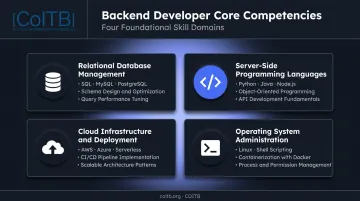
Backend developer certifications typically assess skills across these domains:
- Relational database management — SQL, MySQL, PostgreSQL schema design, querying, and optimization
- Server-side programming languages — Python, Java, Node.js syntax, OOP, and application logic
- Cloud infrastructure and deployment — AWS, Azure service integration, serverless architecture, and CI/CD
- Operating system administration — Linux system management, shell scripting, and containerization
Why Certifications Matter for Non-Traditional Developers
For self-taught developers and bootcamp graduates, certifications matter more than most candidates expect. Portfolios alone don't give employers a standardized benchmark. A proctored exam result does. The Burning Glass Institute's Credential Value Index notes that top-tier credentials can yield wage gains of nearly $5,000, with a Python developer credential delivering close to $3,000 in added earnings within one year.
Best Backend Developer Certifications
These certifications were selected based on employer recognition, real-world skill applicability, cost accessibility, and direct relevance to backend development work.
COITB MySQL Backend Developer Certification
COITB is a non-profit credentialing body whose certifications align with ISO/IEC 17024 standards. The MySQL Backend Developer Certification is designed for candidates with 0–6 months of hands-on experience, making it one of the most accessible entry points into backend credentialing.
The exam covers eight competency domains: MySQL fundamentals, relational database design, query optimization, stored procedures, and backup and recovery strategies. It's built for developers who want employer-recognized proof of skill without the experience bar that enterprise-level vendor exams typically require.
| Detail | Specifics |
|---|---|
| Focus Area | MySQL fundamentals, schema design, querying, backup/recovery, query optimization |
| Exam Format | 90 questions, 90 minutes, 70% passing score; remote online or in-person |
| Ideal For | Beginners, bootcamp graduates, self-taught developers entering backend roles |
Digital badges are issued at no additional cost upon passing and are optimized for LinkedIn and résumé verification. Contact COITB at support@coitb.org or +1 877 402 0840 for current pricing.
Oracle Certified Professional, MySQL 8.0 Database Administrator
Oracle's MySQL 8.0 DBA certification (exam 1Z0-908) is the enterprise standard for professionals managing MySQL environments in production. Mid-to-senior backend developers and DBAs typically pursue it for career advancement.
The exam tests deep operational knowledge: InnoDB architecture, replication topology, backup strategies with MySQL Enterprise Backup, security hardening, and query performance tuning.
| Detail | Specifics |
|---|---|
| Exam Format | 73 questions, 120 minutes, 62% passing score |
| Skills Tested | MySQL architecture, replication, security, backup/recovery, query optimization |
| Cost | Verify current pricing at Oracle University |
| Ideal For | Intermediate to advanced backend developers and DBAs |
Oracle Database SQL Certified Associate
The Oracle Database SQL credential (exam 1Z0-071) validates SQL fundamentals across relational database systems. It's a strong choice for junior backend developers who need to demonstrate core query-writing ability.
The exam covers SELECT statements, joins, subqueries, DML operations, data conversion functions, and aggregate operations — the SQL operations that show up in backend work every day.
| Detail | Specifics |
|---|---|
| Exam Format | 63 questions, 120 minutes, 63% passing score |
| Skills Tested | SQL SELECT, joins, subqueries, DML, DDL, conditional expressions |
| Cost | Verify current pricing at Oracle University |
| Ideal For | Junior backend developers and application developers needing SQL validation |
AWS Certified Developer – Associate
AWS holds approximately 28–32% of worldwide cloud infrastructure market share according to Synergy Research Group data. For backend developers, that market reality makes the AWS Certified Developer – Associate (exam DVA-C02) one of the most market-validated cloud credentials available.
The exam directly tests backend-relevant services: Lambda, DynamoDB, S3, API Gateway, and RDS — the tools backend developers use when building cloud-native applications.
| Detail | Specifics |
|---|---|
| Cost | $150 USD |
| Skills Tested | Serverless architecture, REST APIs, database integration, deployment automation, AWS security |
| Ideal For | Backend developers working in or transitioning to cloud-based application development |
Python Institute PCEP / PCAP Certification
The Python Institute offers a two-tier certification path: PCEP (Certified Entry-Level Python Programmer) for beginners and PCAP (Certified Associate in Python Programming) for developers moving into server-side scripting and application logic.
Python is one of the most widely used backend languages. The 2025 Stack Overflow Developer Survey reports Python at 58.6% usage, with explicit mention of its role in back-end development. These vendor-neutral credentials validate actual coding proficiency rather than surface-level familiarity.
COITB's Professional Python Developer Certification covers Python syntax, OOP, file I/O, modules, decorators, and code quality. The 58-question, 75-minute proctored exam requires a 70% passing score.
Designed for the same 0–6 month experience bracket, it pairs naturally with the MySQL Backend Developer Certification as a foundational backend stack.
| Detail | PCEP | PCAP |
|---|---|---|
| Cost | From $69 | From $295 |
| Skills Tested | Syntax, data types, loops, functions, I/O | OOP, modules, exceptions, file handling |
| Ideal For | Absolute beginners | Developers building server-side Python skills |
CompTIA Linux+
CompTIA Linux+ is the only vendor-neutral, job-focused Linux certification available. Most production backend servers run on Linux — W3Techs reports Linux powers 61.5% of websites whose operating system is known as of June 2026.
Developers who understand Linux system management, shell scripting, and containerization at the OS level are more valuable to engineering teams. The credential also directly supports transitions into DevOps roles.
| Detail | Specifics |
|---|---|
| Cost | ~$369 USD (XK0-005 pricing; verify current XK0-006 pricing at CompTIA's site) |
| Skills Tested | Linux system management, shell scripting, containerization, security, troubleshooting |
| Ideal For | Backend developers managing deployment environments or transitioning into DevOps |
How to Choose the Right Certification for Your Backend Stack
Certification choice should follow your target role, not prestige rankings.
A Tiered Approach That Works
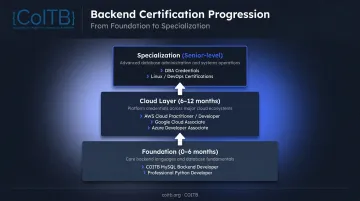
Tier 1 — Foundation (Start Here): Pick one credential that matches your current or target stack:
- Targeting database-heavy roles → COITB MySQL Backend Developer Certification
- Building Python-based APIs → COITB Professional Python Developer Certification
Tier 2 — Cloud Layer (After 6–12 months of experience):
- Add a cloud platform credential (AWS, Google Cloud, or Azure Developer Associate) once you have a working grasp of web application architecture — these sit outside COITB's catalog but pair well with a validated backend foundation
Tier 3 — Specialization (Senior-level):
- A vendor-specific database administration credential for deeper DBA work
- A Linux or DevOps credential for server management and CI/CD pipeline exposure
One Common Mistake to Avoid
Many developers chase the most prestigious certification regardless of where they actually are in their learning. Taking an advanced exam before you have the hands-on experience to back it up wastes the exam fee and study time. Match exam difficulty to your current skill level — COITB's backend certifications are designed for 0–6 months of experience, making them a practical starting point before moving up the stack.
How We Chose These Certifications
Every certification on this list was evaluated against four criteria:
- Employer recognition — does it appear in backend developer job postings?
- Real-world skill alignment — does it test what backend developers actually do daily?
- Accessibility across experience levels — are credentials available from entry-level through senior?
- Practical skill validation — does the exam go beyond theoretical memorization?
One frequent mistake candidates make is confusing course completion certificates with certifications. A completion certificate proves you finished a learning module. A proctored certification exam proves you can perform under standardized, verifiable conditions — and that distinction matters to hiring managers and ATS systems alike.
Bottom line: if a credential requires a supervised exam with a passing threshold, it's a certification. If it doesn't, it isn't — regardless of what the issuing platform calls it.
Conclusion
Employers use backend certifications as an independent signal that you can work with production databases, write server-side code, manage cloud infrastructure, and operate Linux environments. That signal carries real weight, especially when your résumé doesn't follow a traditional CS degree path.
Start with one credential that aligns with your current or target stack — earning three at once dilutes focus and slows momentum.
For developers entering backend roles from non-traditional backgrounds, COITB's MySQL Backend Developer and Professional Python Developer certifications are worth a close look. Both offer:
- ISO/IEC 17024-aligned credentialing from a non-profit body
- Entry-level scope designed for candidates with 0–6 months of hands-on experience
- Remote proctoring available from any location with a webcam and stable internet
Pick the credential that matches where you're headed, clear the exam, and put it to work.
Frequently Asked Questions
Is there a certification for MySQL?
Yes — multiple MySQL certifications exist. COITB's MySQL Backend Developer Certification is designed for entry-level developers with 0–6 months of experience, while Oracle's MySQL 8.0 DBA certification (1Z0-908) targets experienced professionals managing production MySQL environments.
How much is MySQL certification?
Pricing varies by provider and level. For COITB's MySQL Backend Developer Certification, contact support@coitb.org or call +1 877 402 0840 for current pricing. Oracle exam fees should be verified directly at Oracle University, as fees are not listed on their public pages.
Which MySQL certification is best for backend developers?
It depends on your experience level. Developers entering backend roles benefit most from COITB's MySQL Backend Developer Certification, which validates core schema design, querying, and database management skills. Mid-to-senior backend developers or DBAs typically target Oracle's MySQL 8.0 Database Administrator certification for its enterprise depth.
Is MySQL still relevant for backend developers?
Yes. DB-Engines ranks MySQL 2nd among all database management systems as of June 2026, and it remains foundational to web application backends across industries. Database proficiency in MySQL is consistently listed among technical requirements in backend developer job postings.
What certifications do backend developers need?
The strongest combination covers three areas: database management (MySQL/SQL), a server-side programming language (Python), and cloud infrastructure (AWS). No single certification is universally required — a developer building Django APIs needs different credentials than one architecting microservices on AWS.
Are backend developer certifications worth it?
For self-taught developers, bootcamp graduates, and career changers, certifications provide employer-recognized proof of competency that portfolios alone don't deliver. They help candidates clear ATS screening and signal production readiness — without replacing hands-on experience.