Here's what cuts through the noise: a well-chosen certification can compress years of retraining into a few months, signal genuine initiative to employers, and get you into a new field without a four-year degree or a tuition bill to match.
This guide covers the most practical certification categories by field, how to evaluate which one fits your situation, and what to realistically expect — including timelines, costs, and what happens after you pass the exam.
Key Takeaways
- Certifications are among the fastest, most cost-effective ways to validate readiness for a new career
- The right certification depends on your target role, timeline, and current experience level
- Tech certifications offer the shortest paths to high-demand, well-paying roles
- Certification alone rarely lands the job; pair it with portfolio work and active networking
Why Certifications Work for Career Changers
Degrees take years and cost tens of thousands of dollars. Certifications take months and cost hundreds. For someone making a mid-career pivot, that difference is significant.
According to CompTIA's 2024 research, 91% of employers believe IT certifications play a key role in hiring decisions. Separately, SHRM's 2025 Skills-First study found that 78% of HR professionals now use skilled credentials in their hiring process — up from 72% in 2021. That shift has real implications for anyone entering a new field without years of direct experience.
Certificates vs. Certifications vs. Licenses
These three terms get used interchangeably, but they mean different things:
- Certificate — Awarded for completing a course (example: Google's career certificates). Proves you finished a curriculum, not that you passed an independent assessment
- Certification — Earned by passing a standardized, exam-based assessment from a recognized credentialing body. Examples include COITB's ReactJS Framework Developer and Certified GPT Professional credentials
- License — Issued by a government or regulatory body. Required for legal practice in fields like nursing, plumbing, or electrical work
For career changers, the distinction matters. An exam-based certification from a credentialing body aligned to recognized standards — such as ISO/IEC 17024, which sets requirements for bodies that certify persons — carries more weight in hiring than a course completion record. Employers can verify it independently; they can't verify that you watched the videos.
Where Certifications Punch Hardest
Certifications are most powerful when you're entering a field actively facing talent shortages. Current shortage data illustrates just how wide those openings are:
- Healthcare: BLS projects approximately 1.9 million job openings annually through 2034
- Construction: Associated Builders and Contractors reported a need for 439,000 additional workers in 2025 alone
- Tech/Cybersecurity: Cybersecurity analyst roles are projected to grow 29% through 2034
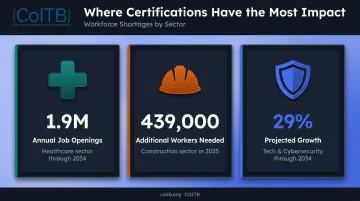
In shortage markets, a recognized credential helps you compete against candidates with more years of direct experience. That's a meaningful advantage for a career changer.
Top Career Change Certifications by Field
Here's a field-by-field breakdown of the most practical certifications to pursue, organized by target career.
Tech and IT
Tech is the most popular destination for career changers — and for good reason. Competitive salaries, remote work options, and many roles that don't require a four-year degree make it accessible in ways other fields aren't.
Entry-level starting points:
- CompTIA A+ — Foundational IT support credential; BLS reports a $61,550 median salary for computer support specialists
- Google IT Support Professional Certificate — A course-completion certificate (not an exam-based credential); typically completed in 3–6 months and widely recognized as a learning pathway
Role-specific certifications:
- AWS Certified Cloud Practitioner — Entry-level credential for cloud computing roles
- CompTIA Security+ — Baseline cybersecurity certification; information security analysts earn a $124,910 median salary with 29% projected growth through 2034
Web development and AI:
Web development, application development, and AI are particularly accessible for career changers with no prior tech experience. COITB, a non-profit credentialing body, offers ISO/IEC 17024-aligned, exam-based credentials across HTML, CSS, JavaScript, React, Python, MySQL, and GPT/AI — designed for candidates with 0–6 months of hands-on experience from any background.
For someone starting from zero, the HTML-CSS Web Designer certification is the most accessible first credential before progressing to the ReactJS Framework Developer. Career changers targeting SaaS sales engineering have a separate on-ramp: the Technical Sales Specialist certification validates MEDDIC/BANT/SPIN frameworks, demo design, and SaaS economics — no coding knowledge required.
Web developers earn a $90,930 median salary (with the lowest decile at $48,560), while software developers reach a $133,080 median with 16% projected growth.

Healthcare
Healthcare offers stable, recession-resistant careers with clear certification pathways. Most programs take 4–12 months and don't require prior healthcare experience.
| Credential | Program Length | Pay Benchmark |
|---|---|---|
| Certified Nursing Assistant (CNA) | 4–12 weeks (state-approved) | $39,430 median |
| Certified Medical Assistant (CMA) | ~1 year | $44,200 median |
| Pharmacy Technician (CPhT/PTCB) | Up to 1 year | $43,460 median |
| Medical Billing & Coding (CCA) | Certificate program varies | $50,250 median |
All four occupations show positive growth projections through 2034. CNA alone generates 211,800 openings annually.
Business and Project Management
Project management certifications are among the most versatile credentials available — they transfer across tech, healthcare, finance, construction, and manufacturing.
- CAPM (Certified Associate in Project Management) — PMI requires only a high-school diploma plus 23 hours of project management education; no prior PM experience required. Strong entry point for career changers with organizational or leadership backgrounds
- Google Project Management Certificate — Course-completion certificate; typically 3–6 months at under 10 hours per week. Lightcast's 2024 data shows 464,000 PM openings with an $87,000+ median salary for roles requiring 0–5 years of experience
PMI's 2025–2035 analysis projects a talent gap of 23–30 million project professionals globally, making this one of the broadest-demand credentials available.
Skilled Trades
Trades offer fast paths to stable, well-paying careers — and they can't be outsourced or automated away.
| Trade | Path | Median Wage | Growth |
|---|---|---|---|
| HVAC Technician | EPA 608 + trade school | $59,810 | 8% |
| Electrician | Apprenticeship | $62,350 | 9% |
| Plumber | Apprenticeship | $62,970 | 4% |
These roles are best suited for people who prefer working outside a desk environment. Entry requires apprenticeship programs or trade school — not a four-year degree.
Marketing and Creative
For career changers with communication or business backgrounds, digital marketing certifications offer accessible entry points:
- Google Digital Marketing & E-commerce Certificate — 3–6 months; course-completion certificate. Lightcast data shows 116,000+ open roles with a $71,000+ median for 0–5 year experience roles
- HubSpot Inbound Marketing Certification — Free; widely recognized by marketing teams
- Adobe Creative Suite training — Relevant for content creation and design-adjacent roles
BLS projects 7% growth and 87,200 annual openings for marketing specialists through 2034.
How to Choose the Right Certification for Your Goals
The most common mistake career changers make: picking a certification first, then figuring out what job it leads to. Work backwards instead.
Start with Job Postings, Not Certifications
Search for 20–30 job postings in your target role. Note which credentials appear most frequently in the requirements or preferred qualifications. That list tells you exactly what employers want — which is more reliable than any "best certifications" ranking.
Evaluate the Credentialing Body
Not all credentials carry equal weight. Ask:
- Is the certifying body independently accredited under ISO/IEC 17024 or a comparable personnel certification standard?
- Does the credential require passing an independent exam, or is it awarded for course completion?
- Can employers verify it independently through a digital badge or credential lookup?
A self-claimed "industry-recognized" label means less than verified accreditation. ANAB maintains a public accreditation directory for ISO/IEC 17024 personnel certification bodies — worth checking when evaluating credentials. A self-claimed "industry-recognized" label means less than verified accreditation. ANAB maintains a public accreditation directory for ISO/IEC 17024 personnel certification bodies — worth checking when evaluating credentials. COITB's programs, for instance, are aligned to ISO/IEC 17024 standards, meaning exams are independently administered and results verifiable by employers.
Match to Your Experience Level
- Zero tech background: Start foundational. COITB's HTML-CSS Web Designer certification is built for beginners entering web development with no prior experience required
- Partial self-taught or bootcamp experience: Move to role-specific credentials. COITB's ReactJS Framework Developer exam recommends 1–6 months of prior HTML/CSS/JavaScript practice — a natural next step after building that base
- Business background with transferable skills: You may be able to skip foundational credentials. COITB's Technical Sales Specialist or Certified GPT Professional are strong entry points for professionals with existing business or communication skills
Factor In Time and Budget Realistically
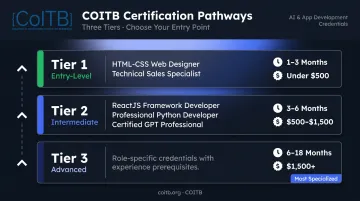
| Certification Tier | Examples | Timeline | Typical Cost Range |
|---|---|---|---|
| Entry-level | HTML-CSS Web Designer, Technical Sales Specialist | 1–3 months | Under $500 |
| Intermediate | ReactJS Framework Developer, Professional Python Developer, Certified GPT Professional | 3–6 months | $500–$1,500 |
| Advanced (third-party) | Role-specific credentials with experience prerequisites | 6–18 months | $1,500+ |
Study while you're still employed. Maintaining income during the transition reduces financial pressure and keeps employment gaps off your resume.
How to Make Your Career Change Stick After Certification
Passing the exam is step one. Getting hired is a different challenge — and certification alone rarely closes it.
Build Something Real
Employers hire people who can do the work, not just pass a test. Field-specific guidance:
- Tech/web development: Publish 3–5 projects on GitHub with clean code, documentation, and live demos
- Data analytics: Publish dashboard analyses on Tableau Public or GitHub
- Project management: Document process improvements you drove in your current role — even informal ones count
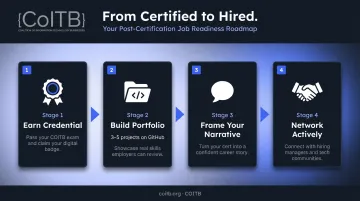
COITB describes the typical pivot pattern as: self-study → portfolio projects → certification — using the credential to validate skills for employers who don't recognize unaccredited experience alone.
Frame Your Career Change Narrative Correctly
How you explain the transition matters. Consider the difference:
Weak framing: "I'm trying to switch careers and have been studying web development."
Strong framing: "I spent eight years in marketing operations managing cross-functional projects and client-facing deliverables. I've since earned my ReactJS Framework Developer certification and built three production-ready applications — here's a link to my GitHub. I'm targeting front-end roles where that combination of product communication and technical execution applies directly."
The strong version treats prior experience as an asset, not an apology.
Once your narrative is clear, the next move is getting it in front of the right people.
Network Actively — Not Just Online
A 2022 HBR analysis of LinkedIn experiments involving 20 million people found that moderately weak ties — professional acquaintances rather than close contacts — increased job mobility more than strong ties did. For career changers, warm introductions offset the "no direct experience" concern far better than cold applications.
Specific actions that work:
- Join professional Slack communities or Discord servers in your target field
- Attend industry meetups (many are free and virtual)
- Connect on LinkedIn with people currently in your target role — not to ask for jobs, but to ask about their career path
Common Mistakes to Avoid
Certification Stacking Without Application
Collecting five certifications without applying for jobs or building projects is a trap. SHRM's 2025 research found that demonstrable, relevant skills ranked as the top hiring consideration — not credential count. One certification plus hands-on project work consistently outperforms a stack of credentials with nothing to show.
Expecting to Match Your Previous Salary Immediately
An initial pay cut is common when entering a new field at a junior level. Plan for it financially rather than being blindsided by it. Compensation recovers as experience builds, but expecting a senior-level salary on day one in a new field is unrealistic.
Quitting Before You're Certified
A 2019 study reported by SHRM found applicants with employment gaps had a 45% lower chance of receiving interviews. That gap hurts both your finances and how your resume reads. Study part-time while maintaining your current job. Most entry-level certifications are achievable in evenings and weekends over 1–3 months. Quit after you have an offer, not before.
Frequently Asked Questions
What is the easiest career to transition into?
Tech support/IT, healthcare support roles like CNA or medical assistant, and skilled trades are among the most accessible fields due to short certification timelines, no degree requirements, and strong employer demand. Web design and digital marketing are also accessible for career changers with communication backgrounds.
Is 40 too late to switch careers?
No. Career changers in their 40s and beyond often bring transferable skills — project management, client communication, domain expertise — that recent graduates lack. Industries that value maturity and reliability, such as healthcare, tech, and project management, are strong targets — and networking carries extra weight at this stage.
How long does it take to get certified for a career change?
It varies by credential. Entry-level certifications — such as HTML-CSS Web Designer or ReactJS Framework Developer — typically take 4–12 weeks of focused self-study. More advanced technical credentials can take 3–6 months depending on your existing background.
Can I get a job with just a certification and no degree?
Yes, in many tech roles. Degree requirements vary by employer — web development, front-end design, and technical sales positions frequently list certifications as sufficient. Research specific job postings in your target field to confirm what's expected.
Do certifications alone guarantee a job?
No. A recognized certification is a strong hiring signal but not a hiring guarantee. Employers also evaluate practical experience, portfolio work, and how you present your background in applications and interviews. Combining a credible certification with portfolio projects and active networking significantly improves your outcome.