That shift hits career changers, bootcamp grads, and self-taught developers the hardest. No degree. No years of experience. No network of former colleagues to vouch for you. Certifications are how you close that trust gap.
This guide breaks down the highest-paying certifications by category, which ones are realistic if you're starting from zero, and how to pick the right one for a 2026 career pivot.
Key Takeaways
- Cloud, cybersecurity, and AI credentials command the highest tech salaries in 2026
- Certifications lower hiring risk for employers, speeding up offers and often boosting starting pay
- The right certification balances market demand, ROI, and your five-year career direction
Why Certifications Drive Career and Salary Growth in 2026
Certifications work because they hand employers third-party proof instead of asking them to take your word for it. That proof shortens the hiring process and lowers the risk of a bad match.
The numbers back this up. Skillsoft's 2024 IT skills and salary survey, based on responses from more than 5,100 tech professionals, found that certified IT professionals earned meaningfully more than uncertified peers, who averaged $71,279 in salary. One in five certified respondents said they got a raise directly tied to earning their credential.
Employers see it the same way:
- 97% of IT decision-makers say certified employees add measurable organizational value
- More than a third put that value at $25,000 or more per employee, per year
- 91% of employers believe certifications play a real role in hiring decisions, according to industry research on IT certification value
In fast-moving fields like web development, AI, and backend engineering, a certification isn't a nice bonus on your resume — it's often the filter that decides whether you get an interview at all. That's especially true for career changers, bootcamp graduates, and self-taught developers who need a credential that proves their skills without a traditional degree behind them.
The Highest-Paying Certifications by Category in 2026
Not all certifications pay the same. Some open doors to six-figure roles; others mostly help you get past the resume-screening bot. Here's how the major categories stack up, including where AI and application-development skills — a category still catching up to cloud and security in average pay — are headed next.
Cloud Computing
Cloud adoption keeps outpacing the number of certified professionals who can manage it, which is why cloud architects sit near the top of every salary list.
- AWS Certified Solutions Architect - Professional: averages $221,069 in the U.S.
- Google Professional Cloud Architect: averages $190,204, ranked No. 2 in Skillsoft's 2024-2025 salary survey of 2,217 U.S. IT professionals
IDC projects that skills shortages, cloud included, will cost the global economy roughly $5.5 trillion by 2026 through missed revenue and delayed projects.
Cybersecurity
Security credentials pay well on their own, but combining security with a second scarce skill (like cloud) is where the real premium shows up.
| Certification | Average U.S. Salary |
|---|---|
| CCSP | $171,524 |
| CISSP | $168,060 |
| CISM | $157,189 |
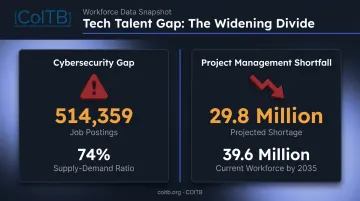
Demand isn't slowing down either. U.S. cybersecurity job postings hit 514,359 between May 2024 and April 2025, a 12% jump year over year, according to CyberSeek's June 2025 workforce data. The supply-demand ratio sits at 74%, meaning there simply aren't enough qualified workers to fill open roles.
Project Management
PMP holders reported a 17% higher median salary than non-certified peers across 21 countries. U.S. holders specifically reported a $135,000 median salary, 24% above non-certified respondents, and nearly 60% saw a compensation increase in the past year.
PMI projects a possible shortfall of 29.8 million project professionals by 2035 against a current workforce of 39.6 million, spanning IT, construction, and healthcare alike. That shortage is exactly why many PMs now stack a technical credential — like a certification in ReactJS, Python, or applied AI — on top of their PMP rather than pursuing a second PM-focused credential.
AI and Machine Learning
AI certifications are the fastest-growing category heading into 2026. Most of the demand isn't for people who build AI models from scratch — it's for people who can apply, fine-tune, and operate existing models inside real business workflows.
Skillsoft found that 20% of IT decision-makers struggle to hire AI/ML talent, and 72% are training existing staff instead of waiting to hire specialists. That gap is where practical, applied credentials — such as COITB's Certified GPT Professional certification — fit in, since they're built for people operating GPT and similar tools inside real workflows rather than researchers building models from scratch.
Business and Finance
Outside of pure tech, a few credentials still carry serious weight:
- CFA: 44% of charterholders say the charter helped secure a raise or higher compensation
- CMA: reports a 20% higher median salary globally, with CMA total compensation averaging $86,955, about $14,853 more than non-CMAs
- Six Sigma Black Belt: consistently ranks among ASQ's highest-paying quality credentials
Salary Snapshot by Category
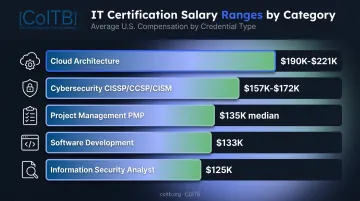
| Category | Salary Range (U.S.) |
|---|---|
| Cloud Architecture | $190,000-$221,000 |
| Cybersecurity (CISSP/CISM/CCSP) | $157,000-$172,000 |
| Project Management (PMP) | $135,000 median |
| Software Development (BLS median) | $133,080 |
| Information Security Analyst (BLS median) | $124,910 |
Best Certifications for Career Changers and Beginners
Here's the catch: most of the certifications above require years of hands-on experience before you're even eligible to sit the exam. CISSP alone requires five years across two security domains. That's not useful advice for someone starting from zero.
Beginners need a different playbook entirely.
Foundational entry points worth considering:
- HTML-CSS Web Designer Certification: no prior experience required; validates core front-end skills for entry-level design and development roles
- JavaScript Professional Developer Certification: built for candidates with 0-6 months of hands-on practice, no computer science degree needed
- ReactJS Framework Developer Certification: a natural next step once you've got HTML, CSS, and JavaScript basics down, and one of the most requested skills in front-end job postings
Here's what most people miss: a certification alone rarely lands the job. Bootcamp grads and self-taught developers who succeed usually pair a foundational credential with a portfolio of real, deployed projects. The certification proves you know the vocabulary. The portfolio proves you can actually build something.
That portfolio needs a subject, and front-end skills are the most practical place to build it. HTML, CSS, JavaScript, and React remain one of the easiest entry points into tech, with no computer science degree required. According to the U.S. Bureau of Labor Statistics, web developers earn a median $90,930, with the field projected to add roughly 14,500 openings a year through 2034.
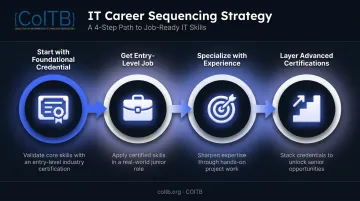
A smarter sequencing strategy:
- Start with a foundational credential like HTML-CSS Web Designer or JavaScript Professional Developer
- Get employed in an entry-level or adjacent role
- Specialize once you have real work experience to draw on, such as adding a ReactJS Framework Developer credential
- Layer advanced certifications on top, once you actually qualify for them
Trying to jump straight to an advanced credential with zero experience is usually a waste of money and time.
Validating Modern Development and AI Skills: A Faster Path In
Alongside traditional vendor certifications like AWS, CompTIA, and Cisco, a newer category of credentials has emerged specifically to validate hands-on skills in web development, application development, and AI literacy.
This is where COITB fits in. As a non-profit credentialing body, COITB offers certifications aligned with the ISO/IEC 17024 standard, the internationally recognized framework governing how certification bodies validate skills and maintain audit integrity. COITB offers seven credentials under that standard: ReactJS Framework Developer, HTML-CSS Web Designer, JavaScript Professional Developer, Professional Python Developer, MySQL Backend Developer, Certified GPT Professional, and Technical Sales Specialist.
What makes this category different:
- Designed for candidates with 0-6 months of hands-on experience — bootcamp grads, self-taught developers, and career changers included
- Exams run 58-90 questions, take 75-90 minutes, and require passing scores of 70-75% depending on the credential
- Every passing candidate receives a digital badge that's shareable on LinkedIn, verifiable on a résumé, and checkable through the COITB public registry
Two examples show how the exams weight hands-on skill over theory:
| Credential | Focus Areas | Format |
|---|---|---|
| Certified GPT Professional | 40% covers OpenAI syntax and GPT integration via Python/JavaScript API calls | 90 questions, 70% passing threshold |
| ReactJS Framework Developer | Components, hooks, state management, routing | 90 questions, 73% passing threshold |
Neither exam rewards memorized theory alone — candidates have to show they can build with the tools. That's the real value for someone stuck in the "no experience, no interview" loop: a credential answers the question every hiring manager is silently asking, can you actually do the work?
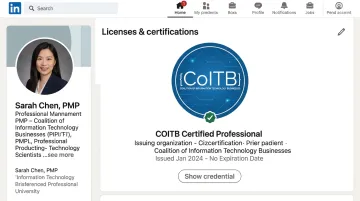
That practical focus extends to test logistics. Testing happens through remote online proctoring with flexible scheduling, or at an authorized in-person test center if you'd rather test that way, and either path issues the same digital badge. That flexibility matters if you're studying nights and weekends around a current job.
How to Choose the Right Certification for Your Career Goals
Don't guess. Research the actual market before spending money or time.
- Pull 15-20 job postings for your target role and count how many list a specific certification as required versus preferred. This tells you real market demand, not what a certification vendor claims.
- Weigh cost against realistic salary lift. A $300 certification that supports a $15,000 raise has a very different ROI than a $3,000 certification with a marginal bump.
- Confirm the certifying body is recognized by the specific employers and industries you want to enter. Prestige varies a lot by credential, region, and even individual hiring manager.
A CompTIA Security+ badge means nothing to a hiring manager screening React developer applications, just as a ReactJS Framework Developer credential won't help someone targeting a cybersecurity analyst role. Match the certification to the job, not the other way around.
This is also where checking actual postings pays off. If you're eyeing front-end roles, search for how often listings mention specific frameworks like React or foundational skills like HTML and CSS. That data point alone can tell you which credential is worth pursuing first.
Maximizing the Return on Your New Certification
Earning the certification is step one. It doesn't automatically create a salary bump — you have to actively use it.
Where the real ROI comes from:
- Switch employers or roles within the first year of earning the credential — most professionals capture the bulk of their salary lift this way, not by waiting for an internal raise
- Pair the certification with visible proof of work, such as a GitHub portfolio or a deployed project, especially if you lack a traditional resume history
- List the credential prominently in applications and raise it directly in interviews, rather than burying it in a skills section
This is where a digital badge helps close the gap. Shareable on LinkedIn and verifiable through a public registry, it lets recruiters confirm the credential is real without a phone call. Still, the badge needs a human pushing it in front of the right people, at the right time, with proof of work attached.
Frequently Asked Questions
Which certifications are most valuable?
Application development, AI, and front-end/back-end web certifications currently offer the strongest combination of salary premium and job demand. Foundational credentials like HTML-CSS Web Designer or Professional Python Developer offer the best value if you're just starting out.
Which 6-month course is best?
Structured application development and AI certification tracks, such as COITB's ReactJS Framework Developer or Certified GPT Professional credentials, are commonly built around a 6-month timeline. These suit career changers building foundational skills before specializing.
Are certifications worth it if I don't have a tech background?
Yes. Many entry-level and foundational certifications, including COITB's seven credentials, are designed specifically for candidates with 0-6 months of experience and no prior technical background.
How long does it typically take to earn a tech certification?
Foundational credentials can take a few weeks to a few months. More advanced industry certifications often require multiple years of hands-on experience before you're even eligible to sit the exam.
Can a certification replace a college degree?
Not exactly, but many employers now weigh validated skills and certifications equally or more heavily than a degree for technical roles. Certifications complement a degree rather than replace it outright.
Do employers actually check or value certifications during hiring?
Yes. Certifications help employers filter and verify candidate skills faster, which is why many employers report that certifications play a meaningful role in hiring decisions, often listing them as required or preferred in job postings.