Introduction
Many self-taught developers and bootcamp graduates hit the same wall: they can build real projects, write clean JavaScript, and solve problems on the job — but when it comes to landing that first professional role, they have no formal credential to back them up. A portfolio helps, but it doesn't replace third-party validation in a competitive hiring market.
JavaScript algorithms and data structures (DSA) knowledge fills that gap. Technical interviews and certification assessments consistently test these fundamentals — not because companies expect red-black tree implementations in production, but because DSA proficiency signals you understand how code works at a deeper level.
This guide covers what you need to know and how to prepare:
- The core data structures and algorithms tested in JS interviews and assessments
- How Big O complexity analysis fits into the picture
- How to build a study plan for a recognized credential like COITB's JavaScript Professional Developer Certification — a 90-item, scenario-based exam for developers at the 0–6 month experience level
Key Takeaways
- JavaScript's built-in structures (arrays, Maps, Sets) and custom implementations (linked lists, trees, graphs) cover the full DSA foundation tested in assessments
- Binary search, merge sort, and recursion appear most frequently in technical evaluations
- Big O notation measures growth rate, not exact speed; grasping it conceptually matters more than memorizing formulas
- A phased 4–8 week study plan outperforms cramming
- COITB's JavaScript Professional Developer certification validates real job-ready skills without requiring a CS degree
Why JavaScript Is the Right Language for Learning DSA
There's a real cost to learning DSA in a language you don't use daily. Developers who study algorithms in Java or C++ spend cognitive energy on syntax rather than problem-solving — leaving less mental bandwidth for the actual logic they're trying to learn.
JavaScript eliminates that overhead. According to the 2024 Stack Overflow Developer Survey, 62% of developers used JavaScript in 2024, making it the most widely used language in the survey series. If you already write JavaScript daily, you can apply DSA concepts in the same mental context — no context-switching required.
Built-In Tools That Speed Up Learning
JavaScript's standard library removes a lot of the boilerplate friction that slows DSA learners down in other languages:
- Array methods —
map,filter,reduce,sort,slice,splicehandle common operations natively - Map object — provides O(1) key-value lookups with any data type as a key
- Set object — enforces uniqueness and enables fast membership checks
These aren't shortcuts around understanding DSA — they're tools that let you focus on algorithm logic rather than low-level memory management.
Supported on the Platforms Where It Counts
JavaScript is supported on LeetCode and HackerRank (running Node.js v20.15.1), meaning your DSA practice translates into interview-ready skills on the same platforms technical interviewers actually use.
Core Data Structures Every JavaScript Developer Must Know
DSA knowledge splits into two categories: structures JavaScript provides natively, and structures you have to build yourself. Certification assessments test both.
Linear Data Structures
Arrays are JavaScript's workhorse structure: dynamic, index-based, and packed with built-in methods. For certification prep, the key distinctions are:
- Mutating methods:
sort(),splice(),push(),pop()— modify the original array - Non-mutating methods:
slice(),toSorted(),map(),filter()— return new arrays
Array operations (insertion, deletion, search) are the most frequently tested topic on most assessments, making them the right starting point for any study plan.
Stacks and Queues: JavaScript has no native Stack or Queue class. You build them using arrays:
| Structure | Principle | Implementation |
|---|---|---|
| Stack | Last In, First Out (LIFO) | push() + pop() |
| Queue | First In, First Out (FIFO) | push() + shift() |
Stacks power balanced-parentheses problems and call-stack modeling. Queues underpin breadth-first search. Both appear regularly in scenario-based exam questions.
Linked Lists are custom node-based structures where each node holds a value and a pointer to the next node. They're less practical than arrays in everyday JavaScript work, but they're tested because they reveal whether you understand pointer manipulation, memory allocation, and traversal logic. Practice writing insertion, deletion, and reversal operations by hand — those are the linked list tasks that show up most on assessments.
Once you're solid on linear structures, non-linear structures are where exam difficulty ramps up.
Non-Linear Data Structures
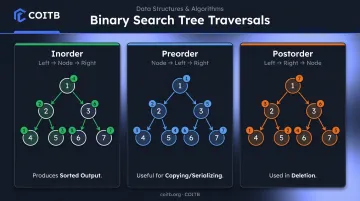
Trees organize data hierarchically. The binary search tree (BST) is the most exam-relevant variant. Each node has at most two children, with left subtree values less than the parent and right subtree values greater.
The three traversal orders you need to know:
- Inorder (left → node → right): produces sorted output from a BST
- Preorder (node → left → right): useful for copying or serializing trees
- Postorder (left → right → node): used in deletion operations
Heaps (min-heap and max-heap) are a specialized tree structure used in priority queue problems. They appear less frequently on exams, but knowing how a min-heap maintains order is enough to handle the questions that do come up.
Graphs are the most complex structure: a collection of vertices connected by edges that can be directed or undirected, weighted or unweighted. In JavaScript, graphs are typically implemented using adjacency lists via Map or plain objects. Graph traversal algorithms (BFS, DFS, topological sort) appear in advanced certification and interview scenarios.
Essential Algorithms for JavaScript Certification Prep
Searching and Sorting Algorithms
Linear search vs. binary search — two approaches with a dramatic efficiency gap:
- Linear search: O(n) — checks every element sequentially. Simple, works on unsorted data.
- Binary search: O(log n) — requires a sorted array, cuts the search space in half on every iteration.
Binary search is heavily tested precisely because it demonstrates algorithmic thinking rather than brute force. The divide-and-conquer logic behind it recurs across dozens of other problems.
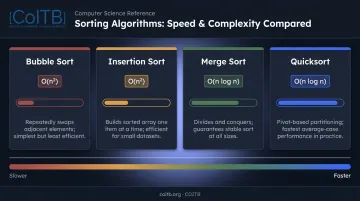
Sorting algorithms exist on a spectrum of complexity:
| Algorithm | Time Complexity | Key Characteristic |
|---|---|---|
| Bubble Sort | O(n²) | Conceptual baseline; swaps adjacent elements |
| Insertion Sort | O(n²) | Efficient for nearly sorted data |
| Merge Sort | O(n log n) | Stable sort; divide-and-conquer |
| Quicksort | O(n log n) avg | In-place; worst case O(n²) |
JavaScript's native sort() uses a variant of TimSort internally, but certification assessments expect you to understand and implement sorting algorithms manually — the underlying logic matters more than the built-in.
Recursion and Optimization Algorithms
Recursion is how a function solves a problem by calling itself with a progressively simpler version of the input. Two elements are always required:
- A base case — the condition that stops the recursion
- A recursive case — the call that moves toward the base case
Factorial and Fibonacci are the canonical examples in certification challenges. Both illustrate how the call stack accumulates frames and why unbounded recursion causes stack overflow errors.
Dynamic programming (DP) extends recursion by caching subproblem results to avoid recomputing identical subproblem results. The two approaches:
- Top-down (memoization): Recursion as-written, but results are cached as they're computed
- Bottom-up (tabulation): Start from the smallest subproblem and build up iteratively
Recognizing overlapping subproblems is the core skill here. When identical inputs produce identical outputs multiple times across a recursive solution, DP applies.
Greedy algorithms make the locally optimal choice at each step without backtracking. Where DP evaluates all options, greedy commits immediately. This works for problems like coin change (with standard denominations) and activity selection, but fails when local optima don't guarantee global optima. Knowing when greedy applies is the distinguishing skill.
Understanding Big O Notation and Complexity Analysis
Big O notation describes how an algorithm's runtime or memory usage grows as input size increases. It's not about exact speed — it's about growth rate. An O(n) algorithm on 10 elements might run faster than an O(1) algorithm in absolute terms; at 10 million elements, the difference becomes decisive.
The Complexity Spectrum
| Complexity | Name | Example |
|---|---|---|
| O(1) | Constant | Direct array index access |
| O(log n) | Logarithmic | Binary search |
| O(n) | Linear | Single loop through array |
| O(n log n) | Linearithmic | Merge sort |
| O(n²) | Quadratic | Nested loops (bubble sort) |
Most certification assessments test whether you can evaluate trade-offs between these complexities — not just recite them. Given two solutions to the same problem, which is more efficient and why? That's the reasoning the exam is testing for.
Time Complexity vs. Space Complexity
These are separate measurements that often trade against each other:
- Time complexity — how many operations an algorithm performs
- Space complexity — how much extra memory it uses
Fibonacci memoization is a practical example: storing previously computed values costs memory, but eliminates the exponential recalculation that makes the naive recursive version unusable at scale. When you see a brute-force solution that's correct but slow, ask whether caching results would cut the time complexity — that instinct applies throughout the exam.
Common Candidate Mistakes
- Assuming the code that looks faster has better complexity (visual simplicity doesn't equal efficiency)
- Ignoring space complexity entirely when analyzing solutions
- Confusing worst-case and average-case performance — most certification assessments test worst-case (Big O) unless stated otherwise
How to Structure Your JavaScript DSA Study Plan
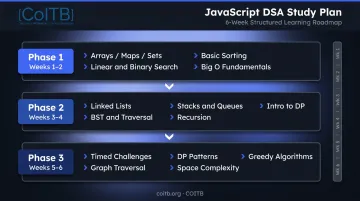
A phased approach beats linear top-to-bottom review. Most learners need 4–8 weeks of structured preparation depending on prior JavaScript experience.
Phase 1 — Weeks 1–2: Built-in Structures and Basic Algorithms
- Arrays, Maps, Sets — native operations and methods
- Linear and binary search
- Basic sorting concepts (bubble sort, insertion sort)
- Big O fundamentals — practice evaluating simple loops
Phase 2 — Weeks 3–4: Custom Structures and Recursion
- Linked lists (singly, doubly)
- Binary search trees and traversal orders
- Stacks and queues via custom implementations
- Recursion — factorial, Fibonacci, and beyond
- Introduction to dynamic programming
Phase 3 — Weeks 5–6: Timed Practice and Complexity Analysis
- Timed algorithm challenges that simulate real exam conditions
- Graph traversal (BFS and DFS)
- DP memoization and tabulation patterns
- Greedy algorithm recognition
- Space complexity analysis alongside time complexity
Active Practice Over Passive Reading
Reading about algorithms doesn't build the pattern recognition needed to apply them under time pressure. Solving problems on platforms that simulate timed, real-exam conditions does.
That's where timed simulation becomes practical. COITB's free practice assessment is a direct readiness check before sitting the JavaScript Professional Developer Certification exam — 90 scenario-based questions, 90 minutes, 73% passing threshold. The exam covers array methods, ES6+ features, async programming, and DOM manipulation — all of which connect directly to DSA fundamentals.
Targeted Revision in the Final Week
Don't review all topics equally in the days before your exam. Track which specific structures consistently trip you up — tree traversal, dynamic programming, graph algorithms — and focus revision time there. Targeted review of weak areas beats re-reading everything.
Frequently Asked Questions
What data structures are most important to know for a JavaScript certification?
Arrays, stacks, queues, linked lists, trees, and hash maps (using JavaScript's Map and Set) are the most frequently assessed. Graphs and heaps appear in more advanced scenarios and are worth understanding conceptually even if they're less commonly tested.
Do I need a computer science degree to pass a JavaScript algorithms certification?
No CS degree required. COITB's JavaScript Professional Developer Certification is designed for self-taught developers, bootcamp graduates, and career changers with as little as 0–6 months of hands-on JavaScript practice. It validates practical, job-ready skills — not academic credentials.
How long does it take to prepare for a JavaScript DSA certification?
Most learners need 4–8 weeks of structured study, with 1–2 hours of daily practice being more effective than intensive weekend cramming. Use COITB's free practice assessment to gauge readiness before scheduling your exam.
Is JavaScript a good language for learning data structures and algorithms?
Yes. JavaScript's flexibility, native array methods, and built-in Map and Set objects make it well-suited for DSA work. You apply concepts in the same language you use for web development, reinforcing both skill sets at once rather than splitting your attention.
What is the difference between recursion and dynamic programming?
Recursion breaks problems into smaller subproblems without storing results, which can lead to redundant computation. Dynamic programming extends recursion by caching (memoizing) those results or building solutions iteratively, making it far more efficient for problems with overlapping subproblems.
How does earning a JavaScript certification help my career?
COITB's JavaScript Professional Developer Certification provides third-party validation of your skills, shareable as a digital badge on LinkedIn with a one-click employer verification URL. For developers without a traditional CS degree, it's a concrete, independently verifiable credential that stands alongside — and strengthens — your portfolio.