
Those timelines aren't fixed. Your prior background, how you practice, and what role you're targeting all shift the equation considerably. This guide breaks down each stage of the SQL learning curve and gives you a realistic picture of what the job search actually looks like — so you can plan your path instead of guessing.
Key Takeaways
- Basic SQL is achievable in 1–3 weeks; job-ready intermediate skills take 1–3 months
- 55.9% of data analyst job postings list SQL as a required skill
- Consistent daily practice outperforms weekend cramming sessions
- A portfolio of 2–3 real projects carries more weight than credentials alone
- Certifications help career changers pass résumé screening when they lack a formal data work history
How Long Does It Take to Learn SQL?
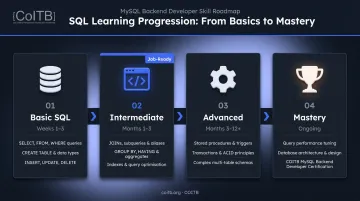
Here's a realistic breakdown of the SQL learning journey:
| Stage | Timeline | What You Can Do |
|---|---|---|
| Basic SQL | Weeks 1–3 | SELECT, WHERE, ORDER BY, basic JOINs, COUNT/SUM/AVG |
| Intermediate | Months 1–3 | Multi-table JOINs, subqueries, CTEs, GROUP BY/HAVING, DML |
| Advanced | Months 3–12+ | Window functions, indexes, stored procedures, schema design |
| Mastery | Ongoing | Performance tuning, architecture, specialization |
Job-ready means intermediate — not mastery. Most entry-level data analyst and business analyst roles don't expect you to optimize query execution plans on day one.
Stage 1 — The Basics (Weeks 1–3)
Basic SQL covers the foundations: SELECT statements, WHERE and ORDER BY clauses, simple JOINs, and aggregate functions like COUNT, SUM, and AVG. These aren't advanced concepts — they're closer to structured English than traditional programming.
Learners with no coding background can typically write functional queries within 2–3 weeks of daily practice. Those coming from Python, Excel, or similar tools often get there faster — conditional logic and data structures are already familiar territory.
Computing education research identifies specific conceptual hurdles in learning query languages — particularly understanding how JOINs work across relational tables — but you can overcome them with hands-on practice, not just reading.
Stage 2 — Building Intermediate Skills (Months 1–3)
This is the stage that makes you employable. Intermediate SQL means:
- Multi-table JOINs (INNER, LEFT, RIGHT, FULL OUTER)
- Subqueries and nested logic
- GROUP BY with HAVING filters
- Common Table Expressions (CTEs) for readable, modular queries
- Basic data manipulation: INSERT, UPDATE, DELETE
Junior data analyst, business analyst, and database support roles are realistically attainable at this stage. You don't need to be fluent in every edge case — you need to demonstrate that you can answer a business question with a well-structured query.
Stage 3 — Advanced Proficiency (Months 3–12+)
Most learners build advanced skills — window functions, performance tuning, indexes, stored procedures, schema design — on the job, not before landing their first role.
If you're targeting database administrator or data engineer positions, this level matters from the start. For most entry-level analyst roles, it doesn't — and waiting until you've mastered advanced SQL before applying is one of the most common ways people delay their job search longer than needed.
What Factors Affect Your SQL Learning Timeline?
How You Practice
This one matters more than most people expect. Research on spaced practice consistently shows that distributed study sessions produce better retention and higher post-test scores than massed cramming. Thirty minutes of daily query writing adds up to real fluency within weeks. A four-hour weekend session, without follow-up, fades almost as quickly.
Computing education studies reinforce this for query languages specifically: active, problem-based learning produces better outcomes than passive video-watching or reading documentation alone. Writing queries that solve real problems beats watching someone else write them.
Your Starting Point
Prior experience with Excel, Python, or any spreadsheet-based data work gives you a meaningful head start. You're not learning data concepts from scratch — you're learning a new syntax for familiar ideas. Someone starting with zero technical background should expect to spend more time at each stage.
Your Goal
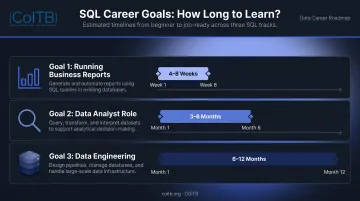
Your end goal shapes your timeline more than any other factor. Two SQL learners putting in the same hours can be months apart in readiness because their targets are completely different:
- Running weekly business reports — achievable in 4-8 weeks of focused practice
- Landing a data analyst role — typically 3-6 months including portfolio work
- Moving into data engineering — expect 6-12 months of deeper, sustained effort
Define what "job-ready" actually means for your situation before you estimate how long it will take.
What SQL Skills Do Employers Actually Look For?
What's in the Job Postings
The numbers here are clear. A 2024 analysis of data analyst job postings found that 55.9% listed SQL as a required skill — ahead of Python (31.2%) and Excel (32.2%). According to Lightcast's 2024 Digital Skills Outlook, SQL appeared in 12.98% of all job postings tracked across countries, making it one of the three most in-demand digital skills globally.
What employers are looking for at the entry level:
- Writing and reading SELECT queries accurately
- Filtering, sorting, and aggregating data
- JOINs across multiple related tables
- Translating a business question into a working query
Platform Matters
Employers also want to know which database system you've used. According to the 2024 Stack Overflow Developer Survey, PostgreSQL is used by 49% of developers — the most popular database among professionals. MySQL remains widely deployed in enterprise applications and is explicitly tested in certifications like COITB's MySQL Backend Developer credential.
Knowing the syntax gets you partway there. Hands-on experience with a specific platform — its quirks, tooling, and real-world behavior — is what job descriptions are actually testing for.
The Soft-Skills Layer
Technical accuracy gets you through screening. The ability to explain what your query found, and why it matters to the business, is what closes the hire. Interviewers regularly ask candidates to walk through their logic — not just the query, but the business reasoning behind it. SQL is the tool; communication is the skill that makes it useful.
How Long Does It Take to Find a SQL Job?
Realistic Role Targets by Stage
| SQL Level | Realistic Roles |
|---|---|
| Basic | Data entry, reporting assistant, operations analyst |
| Intermediate | Junior data analyst, business analyst, database support |
| Advanced | Database administrator, data engineer, senior analyst |
Most learners who reach intermediate proficiency — roughly 2–3 months in — and have built even two portfolio projects are competitive for entry-level roles. The job search itself typically adds another 1–3 months depending on the local market, adjacent skills, and how actively you're applying.
The Role of Credentials
Certifications don't replace experience, but they serve a concrete function for career changers: helping résumés clear automated screening and signaling structured, verified learning to hiring managers. For someone without prior data work history, that signal matters.
COITB's MySQL Backend Developer Certification (aligned to ISO/IEC 17024 standards) validates practical MySQL skills including schema design, JOINs and CTEs, stored procedures, indexes, and ACID-compliant transactions. It targets candidates with 0–6 months of hands-on experience, making it a realistic credential goal for someone 2–3 months into their SQL learning.
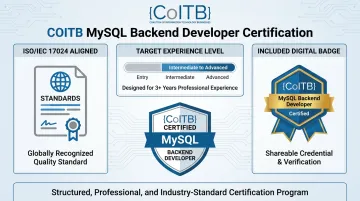
The exam is 90 questions in 90 minutes, delivered online via remote proctoring or at an authorized test center. A verifiable digital badge is included upon passing.
For career changers, veterans, and self-taught learners without a formal data background, this kind of third-party validation gives employers something concrete to verify when work history doesn't yet tell the full story.
Building a Portfolio
Credentials aren't the only path. Smaller companies and startups often weigh portfolio work just as heavily — sometimes more so. Two or three well-documented SQL projects can make a stronger impression than a certification alone. A solid portfolio project includes:
- A real or public dataset (Kaggle, data.gov, or an industry-relevant source)
- A clearly defined business question you were solving
- The SQL queries you wrote, with comments explaining your logic
- The insight or answer you extracted
- A GitHub repository or personal project page for easy sharing
How to Learn SQL Faster and Get Hired Sooner
Build the Daily Practice Habit
Thirty minutes of daily query writing beats a four-hour weekend session. To build real SQL fluency, work with platforms that require you to write queries, not just recognize them:
- HackerRank SQL challenges for structured problem sets
- Kaggle public datasets for open-ended exploration
- A personal MySQL or PostgreSQL database you build and query yourself
If you're targeting the MySQL Backend Developer credential specifically, practice in MySQL — not PostgreSQL or SQLite. The exam tests MySQL-specific syntax, tooling, stored procedures, and backup operations. Practicing on the right platform makes your preparation directly transferable.
Use Real Data From Day One
Tutorial exercises build syntax familiarity. Real datasets build judgment. Apply SQL to data from your industry — healthcare claims, e-commerce transactions, financial records — and you'll simultaneously develop portfolio-ready work while learning faster through genuine curiosity.
Pair SQL With One Complementary Tool
Most data analyst roles expect SQL plus at least one visualization or analysis tool. Even basic proficiency with one of the following opens up more job applications sooner:
- Excel or Google Sheets — pivot tables and simple charts are enough to start
- Tableau Public — free, widely recognized, and employer-friendly
- Power BI Desktop — common in corporate and finance environments
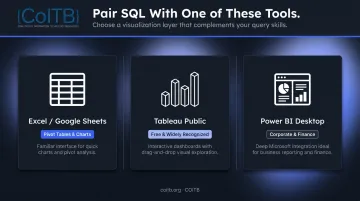
This combination lets you apply for roles now rather than waiting to achieve complete SQL mastery.
Apply Before You Feel Ready
Most hiring managers expect to train entry-level candidates on specifics. What they're screening for is curiosity, problem-solving ability, and baseline SQL competency. Waiting until you've covered every advanced topic delays your job search without improving your odds much.
Start applying once you can write clean intermediate queries and have at least one portfolio project to discuss. Each interview round will sharpen your focus and show you exactly what to work on next.
Frequently Asked Questions
Is SQL in demand in 2026?
SQL remains one of the most in-demand technical skills across industries, appearing in nearly 13% of all job postings tracked by Lightcast in 2023. Cloud data warehouse growth, with the market projected to expand through 2025–2026, has sustained demand for SQL skills rather than eroded it.
Is SQL enough to get a job?
SQL alone can qualify candidates for entry-level data analyst, junior business analyst, and database support roles. For most positions above that level, pairing SQL with Excel, Python, or a visualization tool like Tableau significantly improves your odds. Employers commonly list SQL alongside at least one complementary skill.
How long does it realistically take to go from zero to a SQL job?
Most dedicated learners reach competitive entry-level applicant status in roughly 3–6 months. That timeline assumes consistent daily practice, at least two portfolio projects, and active job searching in the final month or two.
Do I need a SQL certification to get a job?
Certifications aren't required but are genuinely helpful for career changers without formal data work history. They help résumés pass initial screening and give hiring managers a verifiable signal of structured learning — especially when paired with portfolio projects that show applied skills.
Is SQL hard to learn for complete beginners?
SQL is one of the more approachable technical skills for beginners. Its syntax reads closer to plain English than most programming languages. Computing education research identifies real conceptual hurdles — particularly around JOINs and nested queries — but most people write functional basic queries within 1–2 weeks of consistent practice.