Introduction
The U.S. Bureau of Labor Statistics projects 8% job growth for web developers through 2034, with roughly 14,500 openings per year — and that's before accounting for the surge in AI-integrated development roles reshaping hiring in 2025 and 2026. Career changers, bootcamp graduates, self-taught developers, and professionals stacking technical skills on existing credentials are all responding the same way: turning to certificate programs as a faster, more affordable path than a four-year degree.
The challenge? Programs range from completely free (freeCodeCamp) to $5,000+ university certificates, and the credential landscape is confusing by design. A certificate from a bootcamp platform and a proctored exam from a credentialing body are not the same thing — but they're often marketed identically.
This article breaks it down clearly. You'll find a breakdown of credential types, what top programs actually teach, salary data by specialization, and a practical framework for choosing the right program for your specific career target.
Key Takeaways
- Web development certificates are shorter and more affordable than degrees , making them practical for career changers and self-taught developers formalizing existing skills
- Programs range from free to $5,000+ — knowing the difference between a certificate and a certification before enrolling saves time and money
- Front-end, back-end, and full-stack specializations have distinct program options; match the curriculum to your target job role
- Credentials from accredited universities, major tech companies, or standards-aligned credentialing bodies carry the most employer weight
- Web developers earned a median $90,930 in May 2024, nearly double the all-occupation median
Web Development Certificates vs. Certifications: What's the Difference?
These two terms get used interchangeably, but they refer to distinct credential types, and the difference matters when you're trying to impress a skeptical hiring manager.
Here's how each works in practice:
- Certificate: Awarded upon completing a training program. Finish the Meta Front-End Developer course on Coursera, receive a certificate. Complete freeCodeCamp's responsive design path, receive a certificate. The credential confirms participation and project completion — not independently proven competency.
- Certification: A formal recognition issued by a credentialing body after demonstrating mastery, typically through a proctored, standardized exam. CompTIA and Cisco use this model: you prepare independently, then sit an exam that either confirms your skills or doesn't.
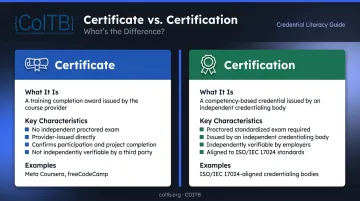
According to the Institute for Credentialing Excellence, the core distinction is that certification is an independent assessment of competence against defined standards — not tied to completing any specific program.
Why This Distinction Matters in 2026
Most web development credentials on the market are certificates, not certifications. That's fine for learning — Meta's Coursera programs are genuinely solid. But for candidates without a degree or traditional employment history, an exam-based certification from a recognized credentialing body provides something different: objective, third-party proof of competency that employers can independently verify.
ISO/IEC 17024 is the international standard for personnel certification. Credentialing bodies aligned to it are required to assess competency independently — not just track course completion. COITB, a non-profit credentialing body based in Oklahoma City, offers ISO/IEC 17024-aligned certifications covering HTML, CSS, JavaScript, React, Python, and MySQL.
Unlike course completion certificates, these credentials involve proctored exams with defined passing scores and verifiable digital badges that employers can authenticate directly.
Key Skills Covered in Web Development Certificate Programs
The Front-End Foundation
Every legitimate web development program starts with the same three technologies:
- HTML — page structure and semantic markup
- CSS — styling, layout (Flexbox, Grid), and responsive design
- JavaScript — interactivity, DOM manipulation, and dynamic behavior
These aren't optional foundations. According to the 2024 Stack Overflow Developer Survey, JavaScript is the most popular programming language for the twelfth consecutive year. Any program that skips or rushes these three is not worth your time.
Back-End and Full-Stack Additions
More advanced programs layer in:
- Python — server-side logic and back-end development
- SQL/MySQL — database querying, schema design, and data management
- React — component-based front-end framework; dominant in modern SaaS applications
- Node.js — JavaScript runtime for server-side development
- Git — version control, essential for any professional environment
Employers increasingly value developers who understand both sides of the stack. Even if your target role is front-end, familiarity with databases and APIs makes you a more credible candidate.
That foundation gets you hired. What gets you promoted — or shortlisted ahead of candidates with similar front-end skills — is increasingly what you can do with AI.
AI-Assisted Development: The 2026 Differentiator
The 2025 Stack Overflow Developer Survey reports 84% of developers are using or planning to use AI tools in their development workflow. Programs that don't address this are already behind.
Look for programs that cover:
- Working with APIs like OpenAI's /v1/chat/completions endpoint
- Prompt engineering for coding tasks
- Integrating AI-powered features into web applications
- Handling AI-related error states, rate limits, and security considerations
For developers who want to validate these skills with a recognized credential, COITB's Certified GPT Professional certification covers AI-assisted development competencies through a proctored exam. It pairs well with front-end credentials like the HTML-CSS Web Designer or JavaScript Professional Developer certifications for anyone targeting AI-integrated roles.
Top Web Development Certificate Programs and Courses for 2026
Beginner and Free Options
freeCodeCamp remains the best fully free option for structured learning. It offers project-based certifications in Responsive Web Design, JavaScript Algorithms and Data Structures, and Front-End Development Libraries. Every certification requires completing functional projects (a Survey Form, a Palindrome Checker, a Random Quote Machine), which doubles as portfolio work.
One real limitation: no proctored assessment, so the credential carries less weight as standalone proof of competency.
W3Schools offers certification exams at $95 per exam for HTML, CSS, and JavaScript. These are useful reference-level credentials with broad name recognition, but the depth of preparation required is relatively low. Good for supplementing a portfolio; less compelling as a primary credential.
Scrimba takes a different approach with interactive screencasts, where learners pause and edit instructor code directly in the browser. The HTML/CSS course includes 75+ coding challenges and requires deploying five projects. It also offers "Prompt Engineering for Web Developers," which addresses the AI skills gap directly.
That said, Scrimba excels at hands-on engagement but doesn't offer the structured credential recognition that paid programs provide.
Programiz PRO offers completion certificates and professional certificates through guided learning paths, with web development offerings in HTML/CSS and JavaScript. Certificates are included with a PRO subscription, making it cost-effective for learners who want structured paths without a major upfront investment.
University and Platform-Backed Certificates
Three platform programs stand out for credential weight and structured coverage:
- Meta Front-End Developer Professional Certificate (Coursera) — HTML, CSS, JavaScript, React, Bootstrap, and Figma over 7 months at 6 hours/week; ACE-recommended for 10 transferable college credits; starts at $49/month
- Meta Back-End Developer Professional Certificate (Coursera) — Python, SQL, cloud hosting, APIs, and Django over 8 months at 6 hours/week; also carries 10 ACE-recommended credits at the same $49/month entry price
- IBM Full Stack Software Developer Professional Certificate (Coursera) — 15 courses completable in 6 months at 10 hours/week, covering HTML, CSS, React, Node.js, Python, SQL, Kubernetes, and cloud-native tools; 18 ACE-recommended college credits, the strongest credit-transfer value of any platform program in this category
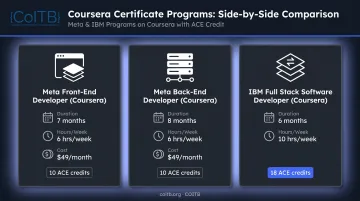
The Meta name carries real weight with hiring managers for entry-level roles. IBM's program suits learners who want full-stack breadth and the highest ACE credit count available on Coursera.
edX's Front-End Web Developer Professional Certificate from W3Cx covers foundational HTML5, CSS, and JavaScript with the W3C standards body directly behind it. A solid choice for learners who want a fundamentals-focused credential with recognizable institutional backing.
For learners willing to invest more:
| Program | Cost | Duration | Credit |
|---|---|---|---|
| eCornell Web Design & Development | $3,750 | 3 months | 6 CEUs |
| NYU SPS Full Stack Certificate | $4,760–$5,000 | 4 courses | N/A |
Both eCornell and NYU carry institutional names that resonate with traditional employers and add credibility beyond what platform-native certificates provide.
Exam-Based Credentialing
This is the category most learners overlook — and for career changers and self-taught developers, it's often the most valuable category of all.
Exam-based credentials require candidates to demonstrate proficiency through a standardized, proctored assessment, not just complete coursework.
A hiring manager skeptical of bootcamp certificates has less room for doubt when a candidate presents a credential that required passing a proctored exam with a defined score threshold.
COITB is a non-profit credentialing body offering ISO/IEC 17024-aligned certifications in technologies directly relevant to web development:
- HTML-CSS Web Designer Certification — 90 questions, 90 minutes, 75% passing score; validates semantic HTML5, modern CSS3, Flexbox, CSS Grid, responsive design, and accessibility (WCAG standards)
- ReactJS Framework Developer Certification — 90 questions, 90 minutes, 73% passing score; validates React components, Hooks (useState, useEffect, useContext), state management, React Router, and REST API integration
- JavaScript Professional Developer Certification — 90 questions, 90 minutes, 73% passing score; validates ES6+ syntax, DOM manipulation, async/await, Fetch API, and functional programming patterns
- MySQL Backend Developer Certification — 90 questions, 90 minutes, 70% passing score; validates relational database design, queries, joins, stored procedures, and backend data integration
- Certified GPT Professional Certification — 60 questions, 75 minutes, 71% passing score; validates prompt engineering, OpenAI API integration, and responsible AI deployment
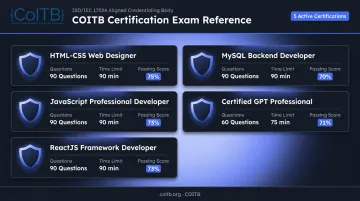
COITB does not deliver training — candidates prepare through self-study, bootcamps, or other third-party resources, then validate skills through the proctored exam. This model is specifically designed for:
- Bootcamp graduates needing third-party validation beyond a completion certificate
- Self-taught developers whose résumés lack verifiable credentials
- Veterans transitioning into civilian tech roles (military CAC and VA-issued ID accepted for exam verification)
Exams are available via remote online proctoring from any location with a webcam and stable internet, or in-person at authorized test centers. Digital badges issued upon passing are employer-verifiable through a unique badge URL and shareable directly to LinkedIn's Licenses & Certifications section and résumé credential links. Contact COITB at support@coitb.org or +1 877 402 0840 for current pricing and exam scheduling.
Web Developer Career Outlook and Salary in 2026
The BLS projects 8% job growth for web developers from 2024 to 2034, adding approximately 6,500 new positions and generating around 14,500 openings per year when turnover is factored in. That growth rate outpaces the average for all occupations.
Salary by Specialization
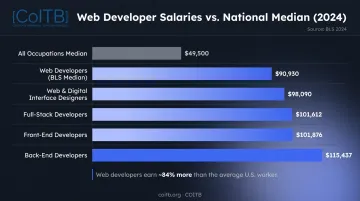
| Role | Median/Average Annual Salary |
|---|---|
| All occupations (BLS median) | $49,500 |
| Web developers (BLS median, May 2024) | $90,930 |
| Web & digital interface designers (BLS) | $98,090 |
| Front-end developers (Indeed avg.) | $101,876 |
| Full-stack developers (Indeed avg.) | $101,612 |
| Back-end developers (Indeed avg.) | $115,437 |
Web developers earn roughly 84% more than the typical U.S. worker — a premium that holds even at the entry level.
The Degree Question
Many job postings still list a bachelor's degree as preferred. But the hiring reality is more nuanced. HackerRank's 2024 Developer Skills Report found that 60% of developers and nearly half of recruiters do not believe a college degree is necessary for technical roles — and only 27% of developers think college prepares graduates with modern workplace skills.
A credential shifts the conversation — but it rarely closes the deal on its own. The strongest entry-level candidates pair a recognized certification with a portfolio of functional projects. Employers want both proof of knowledge and proof of execution.
How to Choose the Right Web Development Certificate Program
Match the Curriculum to Your Target Role
Start with job postings, not program rankings. Search for 10–15 roles you'd actually apply for, list the technologies mentioned most frequently, then cross-reference that list against program curricula. A program that doesn't teach React isn't the right fit if every front-end job posting in your target market requires it.
Evaluate Credential Credibility
Not all certificates carry equal weight. Prioritize programs backed by:
- Accredited universities (eCornell, NYU SPS)
- Major tech companies with hiring influence (Meta, IBM)
- Standards-aligned credentialing bodies (ISO/IEC 17024-aligned organizations like COITB)
Be cautious of certificates from providers with no verifiable industry recognition. If a hiring manager can't look it up and confirm it independently, it won't move the needle on a résumé.
Think Through the Cost-vs-Value Equation
Free platforms like freeCodeCamp and Scrimba are excellent for building foundational skills and project portfolios. If your goal is a credential that carries weight in a job application, paid credentials from Meta, IBM, or an exam-based credentialing body typically provide stronger employer signals.
The cost difference is real — but a verifiable credential from a recognized issuer delivers something a free course completion badge generally can't: third-party proof of ability that employers can confirm.
Check for Schedule Flexibility
Self-paced programs work better for most career changers and working adults than cohort-based formats. Before enrolling, verify:
- Is the program self-paced or cohort-based?
- Are exams available remotely, or do you need to visit a test center?
- What's the realistic completion timeline given your weekly availability?
COITB, for example, offers remote proctoring available around the clock — a practical option for candidates balancing work, family, or military service alongside their certification pursuit.
Require Hands-On Project Work
Web development hiring runs on portfolios. Before enrolling in any program, confirm it requires you to build and ship functional projects — not just complete quizzes or watch videos. A certificate unsupported by real project work gives employers nothing concrete to evaluate.
Frequently Asked Questions
Which web development certificate is best?
The right choice depends on your target role, budget, and career stage. Meta's and IBM's Coursera certificates are strong for beginner career changers entering front-end or full-stack roles. For candidates who need objective, employer-verifiable proof of competency independent of any training provider, exam-based credentials from ISO/IEC 17024-aligned credentialing bodies like COITB — which issues proctored, standards-aligned exams rather than course completions — offer a distinct advantage.
Are web development certificates worth it?
Yes, particularly for career changers and self-taught developers. Certificates give hiring managers a verifiable signal of skill, and many entry-level roles — especially at startups and mid-size companies — accept strong credentials paired with a portfolio in place of a four-year degree.
Is 40 too old to become a web developer?
No. Web development rewards demonstrated skills over age or academic background. Many developers have made successful transitions in their 40s and beyond, particularly through accelerated certificate programs and targeted credential stacks. Hiring decisions hinge on what you can build and prove — not your starting point.
How long does it take to complete a web development certificate?
Anywhere from a few weeks for single-skill programs to 6–12 months for comprehensive full-stack certificates. Meta's front-end path estimates 7 months at 6 hours/week; IBM's full-stack program is 6 months at 10 hours/week. Self-paced formats let you move faster or slower based on your schedule and prior knowledge.
Do employers value web development certificates?
Employer attitudes vary. Credentials from recognized universities, major tech companies (Meta, IBM), or standards-aligned credentialing bodies carry the most weight. A certificate is most effective when paired with a strong project portfolio — the credential signals knowledge, but the portfolio demonstrates execution.