Introduction
Introduction
The numbers tell a stark story. According to McKinsey's 2025 research, 92% of companies plan to increase AI investments over the next three years, yet only 1% describe their organizations as mature in AI deployment. That gap sits squarely on leadership's shoulders.
The problem isn't that leaders lack intelligence or ambition. Most are managing AI adoption reactively — responding to vendor pitches and board pressure without a structured knowledge foundation. The result: failed initiatives, poor budget allocation, and teams who sense their leaders don't fully understand what they're championing.
A certificate programme designed specifically for leaders addresses this directly. Not by turning executives into engineers, but by equipping them to ask sharper questions and lead transformation with genuine confidence — grounded in real understanding, not borrowed talking points.
This guide covers what these programmes include, who they're built for, how to evaluate options, and what a credential from a recognized, standards-aligned body actually signals.
Key Takeaways
- 92% of companies are increasing AI investments, yet most leaders lack the structured knowledge to guide those efforts effectively
- These programmes cover AI strategy, ethics, and change management — not coding
- Mid-to-senior managers, directors, and C-suite executives benefit most, regardless of technical background
- Credential quality varies widely; prioritize ISO/IEC 17024-aligned programmes that assess actual competency
- Certified leaders drive better AI governance, more realistic adoption goals, and stronger team outcomes
Why Leaders Can't Afford to Ignore Digital Transformation and AI
The Readiness Gap Is Measurable
AI isn't approaching — it's already restructuring how organizations operate. McKinsey's 2024 Global Survey found 65% of organizations were regularly using generative AI, nearly double the share from the prior year. Customer experience teams are deploying AI-powered support agents. HR departments are using AI to screen candidates and predict attrition. Operations leaders are automating workflows that previously required entire teams.
The leaders overseeing these functions, however, often aren't keeping pace. Accenture's 2024 research found two-thirds of executives lacked the technology and change leadership expertise needed to fully leverage generative AI's potential. That's not a minor skills gap — it's a structural vulnerability.
What the Knowledge Gap Actually Costs
When leaders lack AI and digital transformation fluency, the consequences aren't abstract:
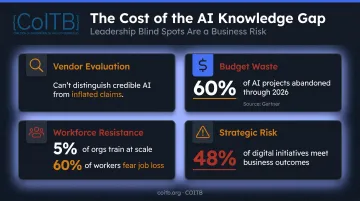
- Vendor evaluations become guesswork — leaders can't distinguish credible AI capabilities from inflated claims
- Budgets get misallocated — Gartner estimates organizations will abandon 60% of AI projects unsupported by AI-ready data through 2026
- Workforce resistance grows — only 5% of organizations are providing generative AI training at scale, while roughly 60% of workers are concerned about job loss and burnout
- Strategic risk accumulates — only 48% of digital initiatives meet or exceed their intended business outcomes
These aren't IT problems. They're leadership problems.
The Shift in What Leadership Readiness Means
Delegating all technology decisions to the CTO or IT department was a defensible position five years ago. It isn't now. NIST's AI Risk Management Framework explicitly identifies senior leadership and boards as AI governance actors — not passive sponsors. The EU AI Act goes further, mandating AI literacy for staff involved in AI deployment decisions.
For busy executives, a structured certificate program offers the fastest path to building this fluency — one focused on AI governance, risk, and deployment decisions rather than technical implementation. The goal isn't to become a developer; it's to lead with enough AI literacy that technology decisions stay in your hands.
What a Certificate Programme in Digital Transformation and AI for Leaders Covers
Leadership Programs vs. General Digital Courses
A short online course in digital transformation might introduce you to terminology, tools, and frameworks. A leadership-focused certificate program goes further, covering the decisions that only leaders can make.
The distinction matters practically. Knowing that machine learning models can exhibit bias is useful. Knowing how to design a governance framework that prevents biased AI from being deployed in a hiring or lending context — and understanding your regulatory obligations under the EU AI Act or relevant U.S. frameworks — is what a leadership program teaches.
Core Curriculum Areas
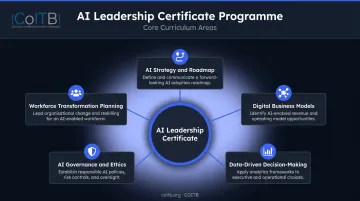
Well-structured programs for executives typically cover:
- AI strategy and roadmap development — identifying high-value use cases, sequencing adoption, aligning AI investment to business objectives
- Digital business models — how AI reshapes revenue streams, competitive positioning, and operating models
- Data-driven decision-making: interpreting AI-generated outputs, questioning algorithmic recommendations, and avoiding over-reliance on automated results
- Governance frameworks covering bias, transparency, accountability, and compliance with current regulations, including the EU AI Act
- Workforce transformation planning — reskilling teams, managing automation anxiety, sustaining organizational change
Kellogg's Senior Management Program in AI and Digital Transformation, for example, structures its 7-month blended curriculum around pillars such as Shaping AI-First Strategies and Building a Shared Vision. Stanford's executive-level AI program is explicitly designed for senior leaders with little or no technical expertise. Both illustrate what separates leadership-focused credentials from general awareness training.
What "AI Literacy for Leaders" Really Means
You don't need to write code. You do need to:
- Understand how AI systems process inputs and generate outputs well enough to spot unreliable results
- Ask the right questions when your team presents an AI-driven recommendation
- Recognize when a model's training data or design makes it unsuitable for a particular use case
- Evaluate vendor claims without outsourcing that judgment entirely to a technical team
The Change Management Component
Any program worth evaluating includes change management — not as an afterthought, but as a core module. BCG's 2025 AI at Work survey found that positive employee sentiment toward generative AI rose from 15% to 55% when strong leadership support was present. That stat illustrates what capable leadership communication actually delivers.
Top executive programs from MIT, Kellogg, and Stanford consistently include managing resistance, reskilling strategies, and building adaptive culture as curriculum pillars — because the human side of transformation is where most initiatives fail.
Credential Quality and Standards
Not all certificates carry the same weight. Look for programs that follow recognized standards — specifically, ISO/IEC 17024 alignment for competency-based personnel certification. This standard, governed by the International Organization for Standardization, defines requirements for certification bodies that assess and validate real-world competency — not just course completion. A credential issued under this framework is verifiable and traceable — meaning hiring managers and stakeholders can confirm what was actually assessed, not just that a course was completed.
For business leaders validating AI literacy specifically, COITB's Certified GPT Professional certification is one example of an ISO/IEC 17024-aligned credential built for professionals who need to demonstrate applied AI competency without a technical degree.
Who Should Enroll in This Type of Programme
The Primary Audience
These programs are built for professionals who are responsible for strategy, teams, or budgets in an environment being reshaped by AI:
- Mid-to-senior managers overseeing functions where AI tools are being deployed or evaluated
- Directors and VPs accountable for digital transformation outcomes
- C-suite executives who set AI strategy and define governance expectations across the organization
- IT leaders who need to bridge the communication gap between technical teams and business stakeholders
Most of these programs require no technical background. Stanford's AI program is explicitly designed for leaders with little or no technical expertise, and Kellogg's requires at least 10 years of leadership experience — not a computer science degree. The value lies in strategic and organizational application, not implementation skills.

Secondary Audiences Who Benefit
- Entrepreneurs building AI-enabled products who need to make sound architectural and ethical decisions
- HR and L&D leaders responsible for workforce transformation planning and reskilling at scale
- Managers with existing credentials — for example, professionals holding PMP or similar project management credentials who want to stack AI strategy competency on top of their existing qualification base
For leaders interested in validating applied AI skills rather than strategic-level literacy, COITB's Certified GPT Professional offers a technically oriented credential covering prompt engineering, responsible AI practices, and GPT integration — accessible to candidates with as little as 0–6 months of hands-on AI tool experience.
Core Skills You'll Develop as a Leader
Developing an AI Strategy and Vision
Participants learn to assess their organization's current AI readiness, identify genuinely high-value use cases (as opposed to technology-trend chasing), and build a phased adoption roadmap tied to business objectives. The emphasis is on sequencing — where to start, what to prove early, and how to build organizational confidence before scaling.
Leading Organizational Change Through Transformation
Digital transformation stalls when leaders underestimate the human side. This section builds the skills to address it directly:
- Communicating the "why" behind change in terms that address employee concerns directly
- Addressing automation anxiety without dismissing legitimate workforce worries
- Creating feedback loops that sustain momentum beyond the initial rollout phase
- Building middle-management capability to carry transformation into daily operations
McKinsey's analysis of digital and AI transformation outcomes consistently points to C-suite alignment and capability building — not technology choice — as what separates transformations that generate value from those that stall.
Navigating AI Ethics and Governance
AI ethics sits at the leadership level, not the IT department. This section covers:
- How bias enters AI systems and why standard testing may not surface it
- Data privacy implications, particularly for high-risk AI use cases in hiring, credit, or healthcare
- How to design governance frameworks that ensure AI deployment aligns with regulatory obligations and organizational values
- Their obligations under frameworks like NIST's AI RMF and the EU AI Act
Making Data-Driven Decisions with Confidence
Statistical fluency isn't the goal here. What matters is the ability to interrogate AI-generated insights — to ask why a model produced a particular output, what data shaped it, and whether it should be acted on. Leaders who develop this skill reduce over-reliance on algorithmic recommendations and make sharper operational decisions as a result.
How to Evaluate and Choose the Right Certificate Programme
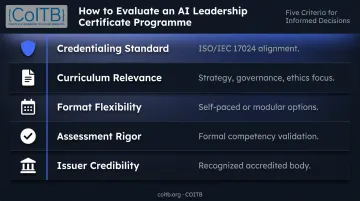
Not every certificate programme is worth your time or credibility. Evaluate candidates against these criteria:
| Criterion | What to Look For |
|---|---|
| Credentialing standard | ISO/IEC 17024 alignment — signals competency-based assessment, not just completion |
| Curriculum relevance | Leadership decisions: strategy, governance, ethics, change — not primarily tool familiarity |
| Format flexibility | Self-paced or modular options that fit full-time executive schedules |
| Assessment rigor | A formal competency validation component, not just a quiz at the end of each module |
| Issuer credibility | A recognized credentialing body or accredited institution |
Format and Time Commitment
Programmes range widely in intensity:
- 16–20 hours on-demand: HBS Online's AI for Leaders
- 6 weeks online: MIT Sloan and Oxford Said Business School
- 5–6 days in-person: Stanford and Wharton executive programmes
- 7 months blended: Kellogg's Senior Management Program in AI and Digital Transformation
Self-paced and modular formats are often more practical for leaders who can't step away from their roles. Match format to your schedule and learning style — not just prestige.
Common Pitfalls to Avoid
- Avoid curricula with no application component — without practice, knowledge rarely transfers to actual decisions
- Verify the issuing organization is recognized and independently auditable before enrolling
- Skip programmes where most of the curriculum covers specific software tools rather than strategy and leadership judgment
COITB's credentials are ISO/IEC 17024-aligned, using structured, scenario-based assessments to validate real-world competency rather than rewarding course completion. For leaders overseeing AI teams, the Certified GPT Professional credential establishes a clear, verifiable benchmark of applied capability — useful both for individual credentialing and for evaluating team readiness.
The Career and Organizational Impact of Getting Certified
Individual Career Value
A recognized certificate validates your AI and digital transformation competency to current and future employers in a way that self-reported experience cannot. SHRM research found that 79% of HR professionals consider skills assessment scores as important as — or more important than — traditional hiring criteria, and 78% reported improved hire quality from verified assessments.
For senior leaders, the credential signals readiness for expanded strategic responsibilities. In a competitive landscape where most executives claim AI familiarity, a verifiable credential from a recognized body differentiates you from peers who rely on self-reported experience alone.
Organizational Impact
Certified leaders deliver measurable value beyond their own career trajectory:
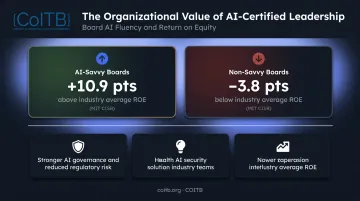
- Design AI governance frameworks that reduce regulatory and reputational risk
- Set adoption goals their teams can realistically achieve — avoiding the overpromise cycle
- Drive faster outcomes: MIT CISR research found AI-savvy boards achieved return on equity 10.9 percentage points above industry average, while non-savvy boards lagged 3.8 points below
- Avoid costly initiative failures by understanding data infrastructure requirements before committing budget
COITB's mission — to validate real-world skills, elevate professional standards, and support a future-ready IT workforce — is built on this same principle. Its credentials, including the Certified GPT Professional, require passing scenario-based assessments that verify applied competency, not just familiarity with concepts.
For organizations credentialing multiple AI team members or technical staff, COITB offers enterprise and bulk pricing designed for workforce programs. Contact their team at support@coitb.org or +1 877 402 0840 to discuss options.
Frequently Asked Questions
What is a Certificate Programme in Digital Transformation and AI for Leaders?
It's a structured learning and credentialing programme that gives business and IT leaders the strategic knowledge, AI literacy, and change management skills needed to guide organizational transformation — without requiring a technical or coding background. The emphasis is on decisions only leaders can make: strategy, governance, ethics, and workforce planning.
Who should enroll in a Digital Transformation and AI certificate programme?
The programme suits mid-to-senior managers, directors, C-suite executives, and IT leaders responsible for strategy, team performance, or budget allocation in an AI-influenced environment. Prior technical experience is not required.
How is a certificate programme different from a short online course in digital transformation?
A certificate programme typically involves a structured curriculum, formal assessment or competency validation, and a credential issued by a recognized body. A short course provides knowledge, but typically offers no verifiable industry-recognized qualification that employers or stakeholders can independently evaluate.
How long does it take to complete a Digital Transformation and AI certificate programme?
Timelines range from 16–20 hours on-demand to 7-month blended cohort formats. The right choice depends on your existing knowledge level, available time, and the depth of credential you want to earn. Self-paced and modular programmes are typically most practical for full-time executives.
What skills will I gain from a Digital Transformation and AI leadership certificate?
Core competencies include AI strategy and roadmap development, responsible AI governance, data-driven decision-making, digital business model design, and leading organizational change through transformation. The focus is strategic application, not technical implementation.
Is a Digital Transformation and AI certificate worth it for senior leaders?
Yes, provided the credential comes from a recognized, standards-aligned body and is applied directly in your leadership context. The strongest outcomes occur when certification drives real action: building governance frameworks, guiding AI adoption decisions, and developing team capability.