According to the 2025 Stack Overflow Developer Survey, JavaScript holds 66% usage among developers surveyed—ahead of HTML/CSS at 61.9% and SQL at 58.6%. It's the language more developers use than any other. But usage doesn't automatically translate into job offers, especially for self-taught developers, bootcamp graduates, and career changers without formal CS credentials.
This guide covers what JavaScript certifications actually do for your career, which programs are worth your time and money, how to evaluate credibility, and how to pick the right one based on where you are right now.
Key Takeaways
- JavaScript remains the most-used programming language, with 66% developer adoption in 2025
- Certifications add the most value for self-taught developers, bootcamp grads, and career changers competing without CS degrees
- Performance-based and proctored credentials carry more employer weight than course-completion badges
- Pairing a certification with portfolio projects is stronger than either alone
- ISO/IEC 17024-aligned credentials demonstrate independent, third-party skills assessment rather than course completion
Why JavaScript Remains One of the Most In-Demand Skills
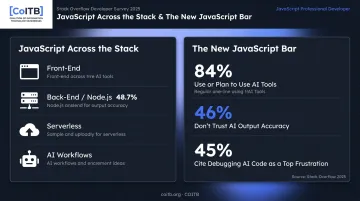
JavaScript started as browser scripting. It's now the backbone of full-stack development—front-end interfaces, back-end APIs via Node.js (used by 48.7% of developers, per the same Stack Overflow survey), serverless functions, automation, and increasingly, AI-adjacent workflows.
That versatility directly affects hiring. One language covers client and server, so employers get more from a single developer. A developer who can build a React front-end and a Node.js API means one hire instead of two specialists in separate stacks. JavaScript's reach across the full stack is a practical reason it consistently tops employer demand lists:
- Front-end UI with React, Vue, or vanilla JS
- Back-end APIs and services via Node.js
- Serverless functions and cloud automation
- AI tool integration and code review workflows
That breadth also shapes what employers now expect from JavaScript developers. The 2025 Stack Overflow survey reports **84% of developers use or plan to use AI tools**, but 46% don't trust AI output accuracy and 45% cite debugging AI-generated code as a top frustration. The bar for "knowing JavaScript" in 2026 hiring isn't just writing it—it's evaluating, debugging, and improving code that AI tools produce. Developers who can demonstrate verified JavaScript proficiency stand out in that environment.
Do JavaScript Certifications Actually Help You Get Hired?
The honest answer: it depends on your situation.
Where Certifications Help Most
Certifications aren't a substitute for demonstrated skill, but they provide third-party credibility that a résumé alone can't. That matters most in specific scenarios:
- Self-taught developers and bootcamp graduates who lack a CS degree and need independent validation of their skills
- High-volume hiring pipelines where recruiters need fast signals before reviewing portfolios
- Enterprise or regulated environments where standardized credentials reduce perceived hiring risk
- Career changers competing against candidates with more relevant professional history
SHRM's research on alternative credentials found that 90% of executives and 77% of HR professionals encountered applicants with alternative credentials, and 63% would recommend an interview for a candidate holding only an alternative credential. That's not nothing—particularly for candidates without traditional degrees.
The Screening Reality
One important caveat: SHRM also found that only 32% of automated prescreening systems recognized alternative credentials. Certifications won't always clear ATS filters automatically. Knowing how to present them clearly is what gets you past the screen.
Multiple-Choice vs. Performance-Based
Hiring managers distrust certifications that test only memorization. Proctored exams with actual coding tasks (live challenges, scenario-based questions, project submissions) carry more weight because they demonstrate what a candidate can actually do under realistic conditions. When evaluating programs, prioritize performance-based formats over pure multiple-choice.
The Portfolio Pairing Principle
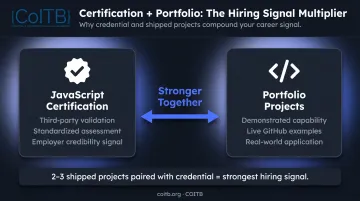
Certifications work best alongside shipped projects. A clean GitHub repository with typed code, tests, and sensible architecture is a stronger hiring signal than any credential alone. Pair your certification with two or three live projects that apply the same skills — that combination gives recruiters both the credential and the proof.
Top JavaScript Certification Programs Worth Considering
Programs vary considerably in format, cost, duration, and credibility. Matching the right program to your experience level matters more than name recognition alone.
Beginner and Entry-Level Programs
freeCodeCamp JavaScript Algorithms and Data Structures (v8)
- Free, self-paced, project-based
- Requires completing hands-on projects (Palindrome Checker, Roman Numeral Converter, etc.)
- Forum sources estimate approximately 300 hours of work
- Best for: Complete beginners who want structured learning with a portfolio-building component
- Trade-off: Course-completion model with no standardized exam; strong for learning, lighter on formal assessment signal
JSE—Certified Entry-Level JavaScript Programmer (JS Institute / OpenEDG)
- Vendor-neutral, exam-based credential
- 30 questions, 45 minutes, 70% passing score
- Prep course (JavaScript Essentials 1) estimated at 40 hours
- Exam from $69
- Best for: Beginners who want a formal, exam-verified credential after self-study
W3Schools JavaScript Developer Certificate
- Online adaptive exam, average 60 questions, 60 minutes
- Three performance levels: Intermediate (40%), Advanced (75%), Professional (90%)
- $95, valid for life
- Best for: Developers validating DOM manipulation and web fundamentals
Mimo JavaScript Certification
- Interactive learning with coding challenges and real projects (16 modules, 13 projects)
- Certificate valid indefinitely
- Best for: Beginners who prefer learn-by-doing with a structured career path
Intermediate to Advanced Programs
JSA—Certified Associate JavaScript Programmer (JS Institute / OpenEDG)
- Steps up from JSE into OOP, classes, promises, and async/await
- 40 questions, 65 minutes, 70% passing score
- Exam from $295
- Best for: Developers ready to validate JavaScript beyond the fundamentals
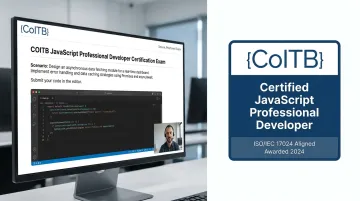
COITB JavaScript Professional Developer Certification
- Remote-proctored, exam-based credential aligned to ISO/IEC 17024 standards
- 58–90 scenario-based items, 75 minutes, 70–75% passing score; digital badge on passing
- Online proctored from any location (webcam + stable internet); also available at authorized COITB test centers
- Best for: Self-taught developers, bootcamp graduates, and career changers with 0–6 months of hands-on experience who need a third-party credential to validate job-ready JavaScript skills
Certificates.dev JavaScript (Junior / Mid / Senior)
- Three tiered levels with proctored exams and live coding challenges
- Mid-level: 30 questions + 105 minutes of coding challenges
- Examination board includes working engineers; certificate valid 3 years
- Best for: Experienced developers who want practical validation, not instruction
CIW JavaScript Specialist
- Covers DOM manipulation, AJAX/JSON, event handling, form validation
- 55 questions, 90 minutes, 70.9% passing score, Exam ID 1D0-835
- Valid 3 years; renew by retaking the exam
- Best for: Developers targeting traditional web development roles
If you're looking to extend beyond standalone JavaScript exams, platform-based certificate series bundle JavaScript with frameworks and backend skills:
- Meta Front-End Developer (Coursera): 9-course series covering React in depth; ~7 months at 6 hours/week
- IBM Full-Stack JavaScript Developer (Coursera): 12-course series including Node.js, Express, Docker; ~4 months at 10 hours/week
What Makes a JavaScript Certification Credible?
Not all certifications carry the same weight. Knowing what separates an assessed credential from a course badge prevents wasted time and money.
Completion Certificates vs. Assessed Credentials
A completion certificate confirms you watched videos and finished course modules. An assessed credential confirms you passed a standardized exam with defined passing criteria. Employers increasingly distinguish between the two—particularly in enterprise hiring, where HR teams are more likely to scrutinize credential type.
The ISO/IEC 17024 Standard
ISO/IEC 17024 is the international standard governing personnel certification programs. It requires certification bodies to demonstrate assessment validity, impartiality, consistency, and candidate protection. Organizations like ISC2 (cybersecurity) and ISACA (IT governance) cite ISO/IEC 17024 accreditation as a core credibility marker.
That's the standard COITB's JavaScript Professional Developer certification is built on. The credential operates under governance policies covering exam integrity, impartial assessment, psychometric rigor, and candidate rights—making it an industry-recognized credential rather than a course-completion badge.
The exam consists of 90 multiple-choice and scenario-based questions over 90 minutes, with a 73% passing score required.
Vendor Neutral vs. Vendor Specific
Vendor-neutral credentials — like those from JS Institute (JSE/JSA) and COITB — validate core language skills transferable to any stack or context. Vendor-specific credentials (Salesforce JavaScript Developer I, framework-specific certs) signal expertise in a particular ecosystem.
Start with a vendor-neutral foundation. Then layer in ecosystem-specific credentials if your target role requires it.
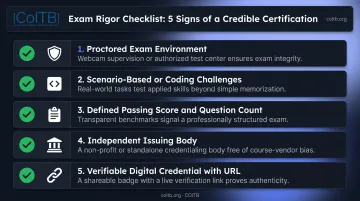
Exam Rigor Checklist
When evaluating a program, look for:
- Proctored exam environment (online or in-person)
- Scenario-based or coding challenge components (not just multiple-choice recall)
- Defined passing score and question count
- Independent issuing body (not the training provider itself)
- Verifiable digital credential with a URL employers can check
How to Choose the Right JavaScript Certification for Your Level
Decision Framework by Experience
| Experience Level | Best Approach |
|---|---|
| No prior JavaScript | Course-based cert that teaches while credentialing (freeCodeCamp, JSE) |
| 0–6 months hands-on | Entry-level exam-based validation (COITB JavaScript Professional Developer, JSE) |
| 6+ months experience | Skip instruction; pursue exam-based validation (JSA, Certificates.dev) |
| Targeting specific stacks | Add framework/platform cert after core credential (Meta/React, IBM/Node.js) |
Cost vs. ROI
- freeCodeCamp (Free): Good starting point for beginners; lacks a formal proctored exam, so carries less weight as a standalone credential
- JS Institute JSE/JSA ($69–$295): Practical exam validation for developers who already have hands-on experience and need documented proof
- W3Schools ($95): Lifetime credential, accessible entry point for web fundamentals
- Meta / IBM via Coursera ($199+): Brand-name recognition that can clear automated HR filters at larger companies
- COITB JavaScript Professional Developer: ISO/IEC 17024-aligned exam designed specifically for the 0–6 month experience range — proctored online, accepts military CAC/VA-issued ID, and may be eligible for GI Bill, VET TEC, MyCAA, and VR&E funding for qualifying veterans and military spouses (contact support@coitb.org or call +1 877 402 0840 to verify eligibility before registering)
Check the Job Boards First
Before committing to any program, spend 20 minutes searching "JavaScript developer" on LinkedIn, Indeed, or Dice in your target industry. Note which certifications, frameworks, or tools appear repeatedly in job descriptions.
What you find will vary by sector. Enterprise companies often filter for brand-name credentials (Meta, IBM). Startups and agencies care more about a portfolio and demonstrated skills. Government contractors and defense-adjacent roles may respond better to a proctored, standards-aligned credential like COITB's — especially if your background includes military service or a security clearance.
Picking a certification that already appears in listings your target employers are posting improves your odds of clearing initial resume filters and gives you a concrete talking point in interviews.
How to Pair Your Certification with Real-World Skills
A certification signals baseline competence. What employers want to see is what you've actually built.
Build During or Right After Certification
Deploy at least one project using the skills tested in your exam. For JavaScript specifically:
- A REST API integration with async/await and error handling
- A DOM manipulation project with event handling and form validation
- A small app using ES6+ modules, localStorage, and the Fetch API
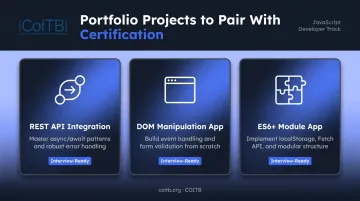
These projects transform exam knowledge into demonstrated capability—and give you concrete examples to discuss in interviews.
Present Credentials Effectively
On your résumé:
- Add a dedicated Certifications section
- List: credential name, issuing body, date earned
- Include the badge verification URL so employers can confirm it independently
On LinkedIn:
- Add the credential to the Licenses & Certifications section with the verification URL
- This enables one-click verification by recruiters—important in high-volume hiring pipelines
In interviews:
- Be ready to describe a specific project where you applied the certified skills
- Don't just name the credential; connect it to something you built
Removing scheduling barriers keeps your focus where it belongs: on the projects. COITB's JavaScript Professional Developer exam is available via remote online proctoring (24/7, from any location with a webcam and stable internet) or in-person at authorized test centers, with military CAC and VA-issued IDs accepted. Contact support@coitb.org or call +1 877 402 0840 to locate a test center or ask about scheduling.
Frequently Asked Questions
What is the best JavaScript certification?
There's no single best option—it depends on your goals. Beginners benefit from course-based programs like freeCodeCamp or the JSE. Developers with hands-on experience should pursue exam-based credentials like the JSA, Certificates.dev, or ISO/IEC 17024-aligned programs like COITB's JavaScript Professional Developer for stronger employer recognition.
Is JavaScript in demand in 2026?
Yes. The 2025 Stack Overflow Developer Survey places JavaScript at 66% usage—the highest of any language. Its reach across front-end, back-end (Node.js), serverless, and machine learning tooling makes it one of the most versatile skills a developer can hold.
Do JavaScript certifications expire or require renewal?
It varies. freeCodeCamp certifications don't expire. W3Schools and Mimo credentials are valid for life. Certificates.dev is valid for 3 years. CIW is valid 3 years with renewal by retaking the exam. For COITB's JavaScript Professional Developer certification, review the recertification policy at coitb.org/certification-resources/recertification-requirement-policy or contact support@coitb.org.
Are JavaScript certifications worth it for someone with no prior experience?
For candidates without a CS degree or professional development history, entry-level certifications provide structured learning and third-party validation — two things résumés need to clear initial screening. Pairing the credential with portfolio projects gives you the most complete profile.
How long does it take to earn a JavaScript certification?
Timelines vary: the JSE takes roughly 4–6 weeks of focused prep (JavaScript Essentials 1 estimates 40 hours). COITB's exam-based credential is accessible once you have 0–6 months of hands-on practice. Course-based programs like Meta or IBM via Coursera run 4–7 months; freeCodeCamp is self-paced and typically takes 1–6 months depending on weekly hours.