The challenge? The job market is crowded. Career changers, self-taught developers, and bootcamp graduates often have real skills but lack a recognized credential to prove it. Without that third-party validation, breaking into or advancing within a high-demand field is significantly harder — especially when competing against applicants with more traditional backgrounds.
The right certification changes that equation fast.
Key Takeaways
- High-demand domains in 2026: AI, cloud computing, cybersecurity, application development, and project management hold the strongest certification ROI.
- Top tech certifications can be earned in under six months, with no degree required.
- Choosing the right certification comes down to three factors: target role, time to completion, and employer recognition.
- Credentials aligned to standards like ISO/IEC 17024 carry stronger credibility than unaccredited course badges.
Why Professional Certifications Matter More Than Ever in 2026
The Demand Signal Is Undeniable
The U.S. tech workforce is projected to grow twice as fast as the overall U.S. workforce, according to CompTIA's State of the Tech Workforce 2025. That growth creates a replacement demand of 352,000 workers annually — and employers need candidates who can hit the ground running.
AI is compressing the skills timeline further. Lightcast found that 32% of skills required for the average job changed between 2021 and 2024, meaning a credential earned three years ago may already need an update. Certifications tied to vendor-current curricula signal that a candidate's knowledge is recent and relevant.
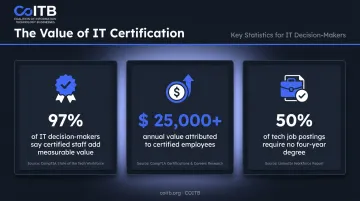
The business case is also clear from the hiring side: Skillsoft's 2025 IT Skills and Salary Report found that 97% of IT decision-makers say certified staff add measurable value, and more than one-third say certified employees bring at least $25,000 in annual added value.
Certificate vs. Certification — Why the Difference Matters
That added value only applies when the credential is a true certification — not just a course completion record. The two terms mean different things.
- A certificate confirms you completed a course or training program. It documents learning, not validated competency.
- A certification assesses previously acquired knowledge and skills against standardized, independently established criteria — and awards a professional designation when the candidate meets that bar.
The Institute for Credentialing Excellence draws this distinction formally. Certifications from recognized professional bodies are evaluated against published standards, not self-reported course hours.
Some bodies align their programs to ISO/IEC 17024, the international standard for personnel certification bodies. That benchmark signals impartiality, rigorous assessment design, and consistent scoring — all factors a hiring manager weighs when reviewing 80 résumés.
Best Certifications for Career Advancement in 2026
These are the most employer-recognized certifications across five high-growth tech domains, selected for real-world career impact, accessibility, and salary potential.
AI & Machine Learning Certifications
AI-related job postings have exploded. CompTIA tracked over 375,000 U.S. job postings seeking AI or machine learning skills over a 12-month period, and the World Economic Forum's Future of Jobs Report 2025 ranks AI and Machine Learning Specialists among the fastest-growing roles globally. The roles these credentials open include AI analyst, ML operations specialist, AI product developer, and GPT workflow engineer.
Top credentials to consider:
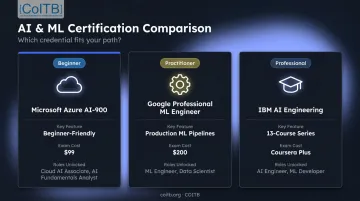
- Microsoft Azure AI Fundamentals (AI-900) — Designed for non-programmers with no prior coding required. Validates foundational understanding of AI concepts within the Azure ecosystem.
- Google Professional Machine Learning Engineer — A more advanced credential targeting practitioners building and deploying ML models on Google Cloud.
- IBM AI Engineering Professional Certificate — A 13-course Coursera series (available with Coursera Plus) covering applied ML through neural networks.
| Azure AI-900 | Google Pro ML Engineer | IBM AI Engineering | |
|---|---|---|---|
| Key Feature | Beginner-friendly; no programming required | Practitioner-level; applied ML on GCP | 13-course series; broad ML coverage |
| Approx. Exam Cost | $99 USD | $200 USD + tax | Included in Coursera Plus subscription |
| Roles It Unlocks | AI analyst, AI product specialist | ML engineer, MLOps specialist | ML engineer, AI application developer |
Cloud Computing Certifications
Cloud credentials consistently rank among the most-requested in U.S. tech job postings — and have held that position for several years running. The big three providers — AWS, Microsoft Azure, and Google Cloud — each offer a clear certification ladder from foundational to expert.
Entry-level cloud certs (like AWS CCP) establish baseline fluency and are well-suited for career changers. Role-specific certifications (AZ-104, GCP ACE) target intermediate practitioners and command higher salary benchmarks. Skillsoft's salary survey data shows Azure Administrator Associate holders averaging $148,849 and Google Associate Cloud Engineers averaging $146,533 — treat those as directional benchmarks, not guarantees.
| AWS Cloud Practitioner | Azure Administrator (AZ-104) | Google Associate Cloud Engineer | |
|---|---|---|---|
| Key Feature | No prerequisites; broad AWS overview for career changers | Role-specific; targets active Azure admins | Intermediate; deploys and manages GCP workloads |
| Approx. Exam Cost | $100 USD | $165 USD | $125 USD + tax |
| Roles It Unlocks | Cloud support, cloud operations | Cloud administrator, solutions architect track | Cloud engineer, GCP operations |
Cybersecurity Certifications
Cybersecurity is one of the most persistent skills-shortage areas in U.S. tech. The Bureau of Labor Statistics projects 29% employment growth for information security analysts from 2024 to 2034 — nearly five times the average for all occupations. Demand consistently outpaces supply.
Credentials span a clear experience ladder:
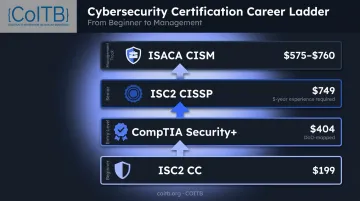
- ISC2 Certified in Cybersecurity (CC) — Best starting point. Standard registration runs $199; the ISC2 One Million CC free-exam program officially closed to new enrollments in May 2026.
- CompTIA Security+ — The entry-level gold standard for U.S. employers. DoD 8140-mapped. $404 for the exam voucher.
- CISSP — Senior-level credential requiring five or more years of paid experience across two CISSP CBK domains. $749 to sit.
- CISM — Management track from ISACA. Targets information security managers and CISOs. $575 for ISACA members, $760 for non-members.
| ISC2 CC | CompTIA Security+ | ISC2 CISSP | ISACA CISM | |
|---|---|---|---|---|
| Key Feature | Fastest beginner cert; broad employer recognition | DoD 8140-mapped; broadly required for U.S. gov/contractor roles | Senior-level; 5+ years experience required | Management track; targets IS managers and CISOs |
| Approx. Exam Cost | $199 | $404 | $749 | $575 (member) / $760 (non-member) |
| Roles It Unlocks | SOC analyst, cybersecurity analyst | Security analyst, security engineer | Security architect, CISO track | Information security manager, CISO |
Application Development & Software Certifications
Software developer employment is projected to grow 15% from 2024 to 2034, per BLS — and CompTIA tracks over 55,000 active U.S. web developer job listings in any given 12-month window. For career changers and self-taught developers, application development certifications represent one of the clearest paths into tech without a CS degree.
What to look for in an app dev credential:
- Does it validate actual coding ability or just theoretical knowledge?
- Is it vendor-neutral (broadly applicable) or platform-specific?
- Is the certifying body aligned to a recognized standard like ISO/IEC 17024?
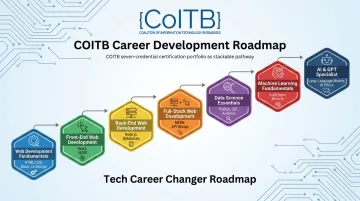
COITB (College of IT Business) is a non-profit credentialing body that addresses these criteria directly. COITB offers seven certifications spanning the modern web and AI development stack — HTML/CSS, JavaScript, React, Python, MySQL, GPT, and Technical Sales — designed for candidates with 0–6 months of experience. Exams are delivered via online remote proctoring (webcam + stable internet required; military CAC and VA-issued ID accepted) or at authorized test centers. Digital badges are issued on passing for LinkedIn and résumé verification.
The portfolio covers both individual credentials and stackable pathways:
- HTML-CSS Web Designer → foundational front-end; no prior coding experience required
- JavaScript Professional Developer → modern ES6+, DOM, async, REST APIs
- ReactJS Framework Developer → component architecture, Hooks, state, API integration
- Professional Python Developer → OOP, automation, data structures
- MySQL Backend Developer → relational databases, SQL querying, schema design
- Certified GPT Professional → prompt engineering, GPT API integration, responsible AI
- Technical Sales Specialist → technical discovery, demos, SaaS economics (ideal for non-dev career changers)
| COITB Application Development Credentials | |
|---|---|
| Key Feature | Validates the full modern web and AI stack; ISO/IEC 17024-aligned governance; remote proctored or test center delivery |
| Approx. Exam Cost | Contact COITB at coitb.org for current pricing |
| Roles It Unlocks | Front-end developer, full-stack developer, backend developer, AI application developer, web designer, SaaS sales engineer |
Project Management Certifications
Project management credentials are rare in one important way: they're genuinely cross-industry. A PMP is as relevant in healthcare as it is in construction or enterprise software — making it a strong diversification credential for professionals who want options.
PMI's own data shows PMP-certified professionals earn a 17% higher median salary than non-certified peers across 21 countries, with a reported median of $135,000 in the U.S.
The three credentials that matter most, at different experience levels:
- CAPM (Certified Associate in Project Management) — Entry-level; minimal experience required; $225 for PMI members, $300 non-members.
- PMP (Project Management Professional) — Requires documented project leadership experience (36 months with a four-year degree, or 60 months without) plus 35 hours of PM education; $405 for PMI members, $655 non-members.
- CSM (Certified ScrumMaster) — Agile-specific; no formal experience prerequisite; course + exam ranges from $250 to $2,495 depending on provider.
One important note for PMs considering a tech pivot: COITB's application development certifications are designed specifically to stack on top of existing PM credentials. A PMP paired with a ReactJS or Certified GPT Professional credential signals both delivery experience and technical depth — a combination that opens technical PM, engineering manager, and solution engineering roles.
| CAPM | PMP | CSM | |
|---|---|---|---|
| Key Feature | Entry-level; minimal experience required | Experienced practitioners; most recognized PM credential globally | Agile-specific; ideal for scrum-based environments |
| Approx. Exam Cost | $225 (member) / $300 (non-member) | $405 (member) / $655 (non-member) | $250–$2,495 (includes course) |
| Roles It Unlocks | Project coordinator, junior PM | Project manager, program manager | Scrum Master, agile delivery lead |
How to Choose the Right Certification for Your Career Goals
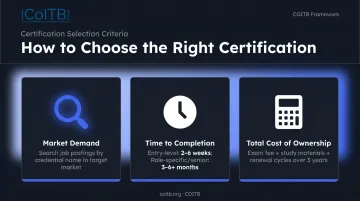
Not every credential delivers equal value for every career path. Before registering for any exam, run it through three questions:
The Three-Factor Framework
- Market demand — Search actual job postings for the credential name in your target metro or remote market. If employers aren't asking for it by name, its signal value is limited.
- Time to completion — Entry-level certifications (like COITB's web development and AI credentials, or comparable entry-level options) typically take 2–6 weeks of focused study. Role-specific and senior credentials generally require 3–6 months or more.
- Total cost of ownership — Factor in the exam fee, study materials, and renewal cycles. Some credentials carry ongoing maintenance fees of $100–$200 per year; others renew via free online assessments. COITB certifications, for instance, are designed with accessible pricing and no hidden annual maintenance costs — relevant if you're stacking multiple credentials at once.
The Ladder-Up Principle
Jumping to an advanced credential without foundational knowledge wastes money and time. A well-sequenced path in web and application development looks like this:
- Web/App Development (COITB pathway): HTML-CSS Web Designer → JavaScript Professional Developer → ReactJS Framework Developer → full-stack or front-end engineering roles
Each step builds directly on the last. Candidates who attempt the ReactJS Framework Developer exam without JavaScript fluency consistently report longer prep times and lower first-attempt pass rates.
Vendor-Neutral vs. Vendor-Specific
| Type | Examples | Best For |
|---|---|---|
| Vendor-neutral | COITB, ISC2, PMI, and similar bodies | Broad applicability across employers and tech stacks |
| Vendor-specific | AWS, Microsoft Azure, Google Cloud | Deep platform expertise; strongest when your target employer runs that platform |
COITB credentials fall into the vendor-neutral category — they validate skills in foundational languages and frameworks (HTML, CSS, JavaScript, React, Python, MySQL, GPT) that transfer across employers regardless of their tech stack.
Common Selection Mistakes to Avoid
- Chasing name recognition over role relevance — a senior-level credential is the wrong starting point if you need an entry-level role and lack the required experience
- Ignoring renewal costs — a $400 exam with $200 biennial renewal fees adds up faster than the headline price suggests; factor total three-year cost, not just the exam fee
- Choosing unaccredited bodies — credentials from organizations without recognized standards alignment carry less weight with hiring managers; look for programs aligned to frameworks like ISO/IEC 17024 (the international standard for personnel certification bodies, which COITB's programs are designed around)
Frequently Asked Questions
What are the best certifications for career advancement in 2026?
Application development and AI/ML are among the highest-demand domains for 2026, alongside broader fields like cloud computing and cybersecurity. Within any domain, the right credential depends on your target role, current skill level, and how frequently employers in your market request it by name — popularity alone is not a reliable selection criterion.
What careers are booming in 2026?
AI/ML specialist, software developer, and data analyst are among the fastest-growing tech roles. For career changers who built skills outside traditional degree programs, a recognized certification is one of the fastest ways to establish third-party validation employers can verify.
Are IT certifications worth it without a degree?
Yes. Employers across the U.S. are increasingly skills-first, and roughly half of tech job postings no longer specify a four-year degree. Industry-recognized certifications — especially those aligned to standards like ISO/IEC 17024 — serve as credible, verifiable proof of job-ready skills.
How long does it take to earn a tech certification?
Entry-level certifications typically require 2–6 weeks of focused study. More advanced or role-specific credentials (CISSP, PMP, Google Pro ML Engineer) take 3–6 months or longer. Exam costs range from under $100 to over $750 depending on the certifying body and credential level.
What is the difference between a certificate and a certification?
A certificate confirms you completed a training program. A certification validates your skills against standardized competency criteria set by a recognized professional body — and awards a professional designation when you meet that bar. Employers weight the two very differently when reviewing résumés.
Conclusion
In 2026, the right certification signals to employers that your knowledge is current, validated, and ready to apply on day one. Choosing strategically — based on where you want to go, not just where you are — makes the difference between a credential that sits on a résumé and one that opens doors.
Pair credentials with portfolio projects, hands-on experience, and continued upskilling to build long-term career value. A certification validates what you know; everything around it demonstrates what you can do.
For professionals looking to validate in-demand tech skills — from front-end web development and React to AI application building with GPT — COITB's ISO/IEC 17024-aligned certifications offer a recognized pathway into high-demand IT roles. Key details:
- Exams available remotely (webcam + internet) or at authorized test centers
- Digital badges included for LinkedIn and résumé verification
- Credentials designed for career changers, bootcamp graduates, and veterans transitioning into tech
Visit coitb.org to explore available credentials and get started.