The reason comes down to complexity. Inpatient hospital coding requires a fundamentally different skill set than outpatient physician coding, and the market pays accordingly. Certifications tied to emerging areas like risk adjustment are also climbing fast as healthcare shifts toward value-based reimbursement.
This guide breaks down the top-paying medical coding certifications by verified salary data, explains the factors that push earnings higher, and helps you map out the path that best fits your income goals.
Key Takeaways
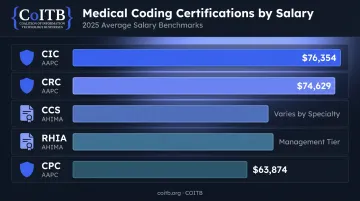
- The CIC ($76,354 avg.) and CRC ($74,629 avg.) are the highest-paying AAPC credentials based on 2025 survey data
- Inpatient and risk-adjustment coding pay more because the work is technically complex and financially high-stakes
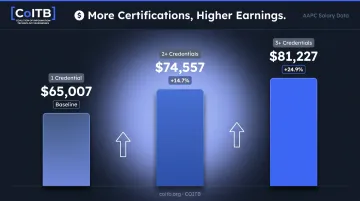
- Holding two or more AAPC certifications averages $74,557 vs. $65,007 overall — a meaningful gap
- Work setting matters: insurance carriers average $69,330 vs. $46,010 at physician offices
- The CPC is the strongest entry point, but advanced credentials are where earning potential grows
What Medical Coding Certifications Are (and Why They Drive Pay)
Medical coding certifications are credentials issued by professional bodies that verify a coder's ability to accurately translate clinical diagnoses, procedures, and services into standardized codes — ICD-10-CM, ICD-10-PCS, CPT, and HCPCS. Employers use these credentials to benchmark both competence and compensation.
The two main credentialing organizations are:
- AAPC (American Academy of Professional Coders) — over 300,000 members; issues the CPC, CIC, and CRC across physician, outpatient, and inpatient settings.
- AHIMA (American Health Information Management Association) — issues the CCS and RHIA, with deep roots in hospital and health system coding.
What actually drives salary differences is the type of coding work each credential validates — inpatient hospital coding, outpatient physician billing, or specialty-specific work — not which organization issued it.
Top-Paying Medical Coding Certifications Ranked by Salary
Salary figures below are drawn from AAPC's 2026 Medical Coding and Billing Salary Report (based on 2025 survey data). CCS and RHIA averages aren't published in current AAPC primary data, so those sections include verified exam details alongside general positioning.
Certified Inpatient Coder (CIC)
The CIC is AAPC's credential for hospital inpatient coders. It requires mastery of ICD-10-CM, ICD-10-PCS, and MS-DRG assignment — the full scope of coding an entire hospital stay rather than a single visit. That complexity is exactly why it pays the most of AAPC's specialty credentials.
Errors in inpatient coding carry direct financial consequences for facilities. Miscoded DRGs affect reimbursement on every case. Hospitals pay for coders who get it right.
| Detail | CIC |
|---|---|
| Certifying Body | AAPC |
| Prerequisites | None required; 2 years inpatient experience recommended |
| Exam Fee | $425 (one attempt) / $499 (two attempts) |
| 2025 Average Salary | $76,354 (up 41.9% from $53,811 in 2020) |
Certified Risk Adjustment Coder (CRC)
The CRC validates coding for Medicare Advantage plans and value-based care environments, focusing on Hierarchical Condition Categories (HCCs) and risk-adjustment models. It ranked second among AAPC credentials in the 2025 salary survey.
CRC salaries grew 18.6% between 2020 and 2025 (from $62,916 to $74,629), driven by continued expansion of Medicare Advantage enrollment and increasing emphasis on accurate risk capture across payer and health system contracts.
| Detail | CRC |
|---|---|
| Certifying Body | AAPC |
| Prerequisites | None required; 2 years risk-adjustment experience recommended |
| Exam Fee | $425 (one attempt) / $499 (two attempts) |
| 2025 Average Salary | $74,629 |
Certified Coding Specialist (CCS)
AHIMA's CCS covers inpatient, outpatient, and emergency department coding — a broader scope than most AAPC credentials. It's widely recognized in large health systems and academic medical centers, where DRG sequencing accuracy and payer-specific compliance knowledge directly affect reimbursement from Medicare and Medicaid.
A current AHIMA-published salary average isn't available in primary sources, but the credential's positioning in hospital settings and its inpatient scope put it in the same tier as the CIC for experienced coders.
| Detail | CCS |
|---|---|
| Certifying Body | AHIMA |
| Prerequisites | Two years of coding experience recommended (multiple pathways accepted) |
| Exam Fee | $299 (AHIMA members) / $399 (nonmembers) |
| Average Salary | Check current figures at ahima.org |
Registered Health Information Administrator (RHIA)
The RHIA is AHIMA's advanced credential combining coding expertise with health information management, compliance, and administrative leadership. It requires completion of a CAHIIM-accredited HIM program at the bachelor's or master's level — making it a longer road than other credentials on this list.
The tradeoff: RHIA holders typically move into HIM director, compliance manager, and coding supervisor roles rather than hands-on coding work — which pushes earnings well beyond the standard coder pay scale.
| Detail | RHIA |
|---|---|
| Certifying Body | AHIMA |
| Prerequisites | CAHIIM-accredited bachelor's or master's degree in HIM required |
| Exam Fee | $229 (AHIMA members) / $299 (nonmembers) |
| Average Salary | Check current figures at ahima.org |
Certified Professional Coder (CPC)
The CPC is AAPC's most recognized credential and the standard entry point for most coders entering the field. It covers outpatient and physician services using CPT, HCPCS Level II, and ICD-10-CM.
At $63,874 average in 2025, it's the lowest-paying credential on this list — and also the most accessible, with the widest job market of any coding cert. That salary floor moves when coders add specialty credentials: AAPC data shows an 11% median salary increase when a specialty add-on is stacked on top of the CPC.
| Detail | CPC |
|---|---|
| Certifying Body | AAPC |
| Prerequisites | None required; associate degree and 2 years experience recommended |
| Exam Fee | $425 (one attempt) / $499 (two attempts) |
| 2025 Average Salary | $63,874 |
What Actually Moves the Salary Needle Beyond Certification
Certification type sets your floor. These factors determine how high you go above it.
Work Setting
Where you work matters as much as what you're credentialed in. BLS May 2023 data for medical records specialists shows the spread clearly:
| Employer Type | Mean Annual Wage |
|---|---|
| Insurance carriers | $69,330 |
| General medical/surgical hospitals | $57,600 |
| Outpatient care centers | $56,510 |
| Offices of physicians | $46,010 |
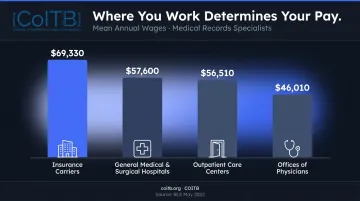
Insurance carriers and health systems pay the most. Small physician practices pay the least. For a certified coder choosing between job offers, the employer type can matter as much as the credential they're bringing.
Credential Stacking
Holding multiple certifications compounds your value. AAPC's 2025 salary survey of more than 20,000 member responses shows:
- Overall average: $65,007
- Two or more AAPC credentials: $74,557
- Three or more AAPC credentials: $81,227
That's roughly a $16,000 gap between a single-credential coder and one with three credentials. The numbers make the case on their own.
Experience
Experience compounds predictably:
- 0–1 years: $45,377 average
- 10–15 years: $67,331 average
- 31+ years: $80,479 average
The jump from entry-level to mid-career is substantial. Certified coders who stay in the field long-term and add credentials along the way consistently land at the top of the pay range.
Location
Geography still drives pay, though remote work is narrowing the gap. AAPC's 2025 survey placed the Pacific region at $74,409 average, with Delaware topping state averages at $77,708. BLS data shows the San Jose metro at $83,150 mean for medical records specialists.
Remote work has reshaped what geography means for pay: 64.8% of surveyed medical records specialists worked fully remotely in 2025. For high-demand certified coders in risk adjustment and inpatient coding, that access to better-paying coastal employers is increasingly real — regardless of where they live.
How to Choose the Right Certification for Your Income Goals
The highest-paying certification isn't always the right one to pursue first. Your starting point, timeline, and target work environment all factor in.
Start here if you're new to the field: The CPC has the strongest job market, the most accessible exam requirements, and serves as the foundation for every advanced credential that follows. Certified specialists earn an average of $67,260 vs. $55,721 for uncertified colleagues (a 20.7% difference), so getting certified early matters.
Already coding outpatient and want higher pay? Two paths lead clearly to the $75,000+ range:
- Transition to inpatient coding by pursuing the CIC — additional study in ICD-10-PCS and DRG logic is required, but the salary jump is well-documented
- Move into risk adjustment with the CRC, where Medicare Advantage expansion and growing remote availability are driving consistent demand
Targeting management or health IT leadership? The RHIA opens doors that hands-on coding credentials don't. HIM directors, compliance managers, and coding supervisors operate on a different pay scale entirely. This path requires a CAHIIM-accredited degree, but it shifts your role category — not just your salary band.
Conclusion
The highest-paying medical coding certification is the one that best matches where you want to work and how far you want to go. CIC and CRC lead on verified salary data for hands-on coders. The RHIA opens a management track with a higher ceiling. The CPC remains the most practical starting point for anyone entering the field.
Certification works best as a sequence. Start with a foundational credential that gets you employed, then invest in the advanced or specialty credential that reflects the direction you want to grow. Each step — from CPC to CIC, from a single credential to multiple, from outpatient to inpatient — is backed by salary data showing real gains.
Before committing to an exam, verify current requirements and fees directly with AAPC or AHIMA, and factor the full career ROI — not just exam cost — into your decision.
Frequently Asked Questions
Is becoming a CPC worth it?
Yes. The CPC is the most in-demand outpatient coding credential in the U.S., and certified coders earn roughly 20% more than their uncertified counterparts. It's also the foundational credential from which specialty and advanced certifications are built.
What is the highest-paying medical coding certification?
For hands-on coding roles, the CIC ($76,354 average in 2025) leads among AAPC credentials. The RHIA has a higher ceiling overall because it leads to management and director-level roles, though it requires a CAHIIM-accredited degree.
Which pays more — CCS or CPC?
The CPC has a verified 2025 average of $63,874. A current AHIMA-published CCS salary average isn't available in primary sources, but the CCS covers more complex inpatient and facility coding, which generally commands higher pay than outpatient-only credentials.
Can I earn more with multiple certifications?
Yes. AAPC's 2025 survey shows coders holding two or more credentials average $74,557, compared to $65,007 across all respondents — and three or more credentials averages $81,227.
Do I need a degree to earn a high salary in medical coding?
Not for most certifications — CPC, CIC, and CRC have no mandatory degree requirements. The RHIA does require a CAHIIM-accredited degree. Education does correlate with pay, though: AAPC data shows bachelor's degree holders average $68,354 and master's degree holders $82,207.
How does location affect medical coding salaries?
Significantly. The Pacific region averages $74,409, and metro markets like San Jose reach $83,150. Remote work is now common for 64.8% of medical records specialists, making high-paying markets accessible to credentialed coders anywhere.