Introduction
Hiring has shifted. A growing number of employers now evaluate candidates on what they can do, not just what institution they attended. According to SHRM, 25% of HR professionals report their organizations have already removed degree requirements for some positions — and that figure is rising.
Certifications address this shift directly. They provide a standardized, verifiable signal of competency that résumés alone can't deliver. For competitive fields like cybersecurity, project management, and tech development, the right credential can determine whether you reach a recruiter's desk at all.
This guide covers certifications with strong employer demand and clear salary impact — with specific attention to entry points for career changers, veterans, and professionals with no prior tech background.
Key Takeaways
- Certifications validate specialized skills faster and at lower cost than traditional degrees
- High-demand credentials now span web development, AI, application development, and technical sales — fields with strong and growing job openings
- PMP-certified project managers earn a 44% higher median salary than their non-certified peers
- Certifications aligned to ISO/IEC 17024 carry greater employer credibility
- Entry-level tech certifications — including those in web development and AI — are designed for candidates with as little as zero to six months of hands-on experience
Why Career Certifications Are a Smart Investment in 2025
Before evaluating which certification to pursue, it helps to understand what you're actually buying — because not all credentials carry the same weight with employers. The terminology matters:
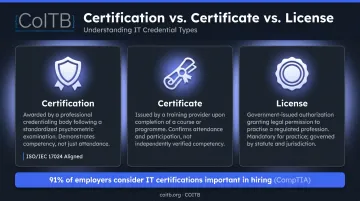
- Certification — Awarded by a professional body after passing a standardized exam assessing knowledge, skills, and abilities
- Certificate — Issued by a training provider to confirm course completion (not the same as passing an independent assessment)
- License — A government-issued authorization to practice a regulated profession
Employers treat these differently — and increasingly, the gap matters. A certification from a credentialing body aligned to ISO/IEC 17024 (the international standard for personnel credentialing) signals that the qualification was validated through a rigorous, auditable process. A certificate of completion signals only that you showed up.
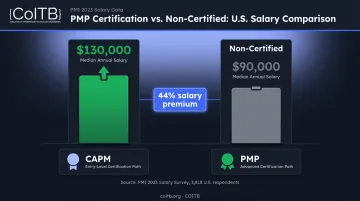
On the employer side, the data is clear: CompTIA reports that 91% of employers consider IT certifications important in hiring and predictive of employee success. For project management specifically, the salary gap is substantial — PMI's salary survey found PMP-certified professionals earn a $130,000 median salary versus $90,000 for non-certified peers, a 44% difference.
That salary gap isn't unique to project management. Across tech roles, employers are tying compensation and hiring decisions to verified, credential-backed skills — which means the right certification can pay for itself within the first few months on the job.
The Best Career Certifications by Category
These certifications were selected based on employer demand, salary impact, issuing body credibility, and accessibility across experience levels.
Web Development & Application Development Certifications
Web and application development remains one of the most in-demand skill areas in tech. Front-end skills (HTML, CSS, JavaScript, React) and back-end competencies (Python, databases) power every digital product in use today — and employers consistently need people who can build with them.
What makes development certifications particularly valuable right now is their accessibility. Unlike many advanced credentials, entry-level web development certifications are achievable without a computer science degree or years of prior experience.
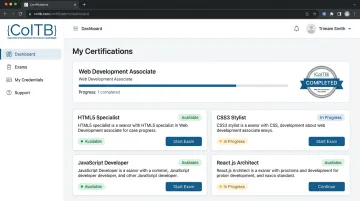
COITB, a non-profit credentialing body, offers ISO/IEC 17024-aligned certifications in HTML, CSS, React, JavaScript, Python, and MySQL. Exams are available via online proctoring or in-person at authorized test centers, with no prerequisites required — making them a practical fit for career changers, bootcamp graduates, and self-taught developers.
| Details | |
|---|---|
| Time to Earn | Weeks to a few months with focused study |
| Typical Salary Range | Web developers: $90,930 median (BLS, May 2024); Software developers: $133,080 median |
| Best For | Career changers, bootcamp graduates, self-taught developers with 0–6 months of experience |
AI & Emerging Technology Certifications
AI certifications are the fastest-growing credential category in tech — and the labor market data backs that up. According to the Stanford AI Index via Lightcast, U.S. job postings mentioning generative AI skills jumped from 16,000 in 2023 to more than 66,000 in 2024.
Formal degree programs haven't kept pace with this demand. Professionals who can demonstrate practical AI skills — prompt engineering, GPT API integration, AI workflow automation — have a real head start over candidates who can't.
COITB's Certified GPT Professional certification addresses this gap directly. The 60-item exam covers prompt engineering, OpenAI API integration (Python and JavaScript), responsible AI practices, and applied GPT use cases. It's designed for candidates with 0–6 months of AI exposure, making it accessible to developers, analysts, career changers, and project managers stacking AI credentials on existing PM qualifications.
| Details | |
|---|---|
| Time to Earn | Entry-level AI certifications typically achievable in weeks to 2–3 months |
| Typical Salary Range | AI-adjacent roles vary widely; skills commanding a 28% salary premium over non-AI counterparts per Lightcast 2025 |
| Best For | Developers adding AI capabilities, career changers targeting digital-age roles, PMs building technical credibility |
Project Management Certifications (PMP / CAPM)
The PMP (Project Management Professional) and CAPM (Certified Associate in Project Management), both issued by the Project Management Institute (PMI), are among the most employer-requested certifications across construction, healthcare, IT, and finance.
The salary data is the clearest available for any certification category:
- PMP median salary: $130,000 (PMI 2023 survey, 3,818 U.S. respondents)
- Non-certified median: $90,000
- Premium: 44%
The CAPM serves as the accessible entry point — requiring 23 hours of project management education plus an exam, with no professional experience required. The PMP requires 35 hours of training plus documented project leadership experience.
For professionals who already hold PM credentials, these serve as the foundation — COITB's technical certifications (React, Python, GPT) are designed to stack on top of existing PMP or PSM credentials for those pivoting into technical PM or engineering manager roles.
| Details | |
|---|---|
| Time to Earn | CAPM: 23 hours education + exam prep; PMP: 35 hours training + work experience |
| Typical Salary Range | PMP: $130,000 median; Non-certified: $90,000 median (PMI 2023, U.S.) |
| Best For | Mid-career professionals across any industry; CAPM suited for those earlier in their PM career |
Cybersecurity Certifications (CompTIA Security+ / CISSP)
Cybersecurity is structurally understaffed. ISC2's 2024 workforce study estimated a 4.8 million global talent gap, and BLS data shows information security analysts earn a $124,910 median salary with 29% projected job growth through 2034 — among the fastest of any occupation tracked.

Two certifications dominate hiring for this field:
- CompTIA Security+ — No mandatory prerequisites. Recognized against current DoD 8140 work roles. The practical entry point for IT professionals moving into security.
- CISSP — Requires five years of experience across at least two security domains. The gold standard for senior security practitioners and information security managers.
| Details | |
|---|---|
| Time to Earn | Security+: 2–3 months prep; CISSP: 3–6 months prep plus 5 years work experience |
| Typical Salary Range | Information security analysts: $124,910 median (BLS, May 2024) |
| Best For | Security+: IT professionals transitioning into security; CISSP: experienced practitioners targeting senior roles |
Data Analytics Certifications (Google Data Analytics / IBM Data Analyst)
Employers across business, healthcare, marketing, and operations now treat data literacy as table stakes. Google's Data Analytics Professional Certificate and IBM's Data Analyst Professional Certificate are the two most widely recognized programs for candidates building this skill set from scratch.
One distinction worth noting: both are completion-based certificates, not exam-based personnel certifications under the ISO/IEC 17024 framework. That doesn't diminish their practical value. Google's program connects graduates with 150+ U.S. employer partners, and both build portfolio-ready skills in SQL, data visualization, and spreadsheet analysis that hiring managers can evaluate directly.
| Details | |
|---|---|
| Time to Earn | Google: ~3 months at 20 hrs/week or 6 months at 10 hrs/week; IBM: ~4 months at 10 hrs/week |
| Typical Salary Range | Entry-level data analyst roles vary by region and industry; BLS projects 35% job growth for data scientists through 2032 — well above the average for all occupations |
| Best For | Career changers in any field adding analytical skills; professionals targeting business intelligence or marketing analytics roles |
How to Choose the Right Certification
What the Best Credentials Have in Common
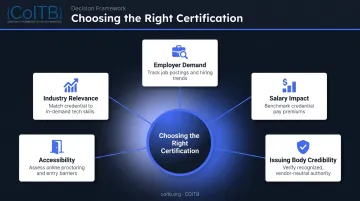
These certifications were evaluated on five criteria:
- Employer demand — frequency in U.S. job postings
- Salary impact — documented premium over non-certified professionals
- Issuing body credibility — alignment to recognized standards like ISO/IEC 17024
- Accessibility — available to candidates across experience levels
- Industry relevance — tied to high-growth sectors
The Most Common Mistake Candidates Make
Choosing a certification based on brand familiarity or low cost rather than whether target employers actually look for it. What matters is whether the credential appears in job postings and ATS filters in your specific field — not how recognizable the issuing organization is to the broader public.
Why Issuing Body Standards Matter
Certifications aligned to ISO/IEC 17024 follow internationally recognized personnel credentialing criteria. That means the qualification process is standardized and auditable — giving employers a consistent benchmark when assessing candidates they haven't worked with before.
Conclusion
The right certification does more than add a line to your résumé. It gives employers a concrete signal that you've been assessed against a recognized standard of competency — one you pursued on your own initiative.
The key is alignment. A targeted credential in your specific field will outperform a generic one chosen for convenience. Match the certification to your target role, verify that employers in your industry actively seek it, and confirm the issuing body meets recognized credentialing standards.
ISO/IEC 17024 is one such standard — and for those targeting careers in tech, COITB builds its credentials around it. The non-profit credentialing body offers certifications in web development, application development, and AI, covering HTML, CSS, React, JavaScript, Python, MySQL, and GPT. No prior experience is required, exams are available online via remote proctoring (military CAC accepted), and digital badges are issued on passing for immediate LinkedIn and employer verification.
Take the free practice assessment at coitb.org/assessment or reach the team directly at support@coitb.org to get started.
Frequently Asked Questions
Which certification is most in demand?
IT and tech certifications consistently top employer demand lists — cybersecurity, cloud, AI, and web development credentials lead most U.S. job posting analyses. Demand varies by industry: Security+ dominates in government and defense, AI and GPT credentials in software and enterprise tech, and front-end development skills across virtually every sector building digital products.
What is the highest paying certification?
CISSP and AWS Solutions Architect are consistently cited among the highest salary-correlated credentials in the U.S. AI and software development roles — the career pathways that credentials like COITB's Certified GPT Professional and ReactJS certifications target — feed directly into these salary tiers. Entry-level AI developer roles already average $95,000–$115,000 nationally, with senior positions well above that.
What are the most useful certifications to have?
Start with your target role, then match the credential to it. For web development and front-end work, HTML/CSS and ReactJS certifications are broadly transferable. For AI and automation roles, GPT and Python credentials carry real weight. The most useful certification is the one your target employers actually look for in job postings — search 10–15 listings for your goal role before deciding.
How long does it take to earn a career certification?
Entry-level certifications — including COITB's web development and AI exams — can be achieved in weeks to a few months with focused preparation. More advanced credentials with experience prerequisites (such as cybersecurity or enterprise architecture certs) typically require several months of study before you're eligible to sit the exam.
Can I get a job with just a certification and no degree?
Many employers in tech, data, and project management hire based on demonstrated skills and recognized certifications — particularly for entry-level roles. Skills-based hiring is growing: a 2024 survey of over 1,000 employers found 81% used skills-based hiring, with 30% having removed degree requirements entirely.
Are online certifications recognized by employers?
Employer recognition depends on the issuing body's credibility, not the delivery format. Certifications from established bodies — whether earned online or in-person — carry equivalent weight. COITB's online-proctored and in-person exams produce the same digital badge and credential record, verified identically by employers.