Introduction
If you're building a career without a four-year degree, the hiring landscape has shifted in your favor. According to SHRM's 2025 report, 21% of U.S. companies removed four-year degree requirements in 2024 — including Google, IBM, Apple, and Accenture. Demonstrated skills increasingly outweigh academic credentials in hiring decisions.
For anyone weighing a $30,990-per-year public university tuition against a faster, cheaper alternative, certifications offer a compelling path. Many can be earned in weeks to months, cost a fraction of a degree, and carry real weight with employers — especially in tech, healthcare, business, and the trades.
Whether you're a career changer, a veteran transitioning into civilian work, a bootcamp grad looking to validate your skills, or simply exploring alternatives to a traditional degree — this guide covers 15 high-value certifications you can earn without a four-year degree: what each one pays, who issues it, and how to choose the right fit for your goals.
Key Takeaways
- Many high-paying careers no longer require a four-year degree — employers now hire based on verified, demonstrable skills.
- Tech certifications (especially cybersecurity, cloud, and AI) carry some of the highest salary ceilings with the lowest degree barriers.
- Certifications differ from certificates: certifications validate skills through an exam against a professional standard and carry more employer weight.
- Credentials aligned to ISO/IEC 17024 signal stronger quality assurance than course-completion certificates alone.
- Pick your certification by matching it to a specific job title, confirming employer demand in that role, and your realistic timeline to exam-ready.
Why Certifications Are Replacing Degrees for Career Entry
Skills-First Hiring Is Real — But Not Universal
The shift is genuine. The World Economic Forum identified Accenture, Apple, General Motors, Google, IBM, and others as employers that have removed degree requirements for certain roles. Still, scope matters: SHRM noted that IBM still requires degrees for roughly 50% of its positions. Skills-first hiring is growing, not absolute.
What has changed is the signal employers accept. Verified credentials tied to industry-recognized exams now substitute for a diploma in many job categories.
Certificate vs. Certification vs. License
These terms get used interchangeably online, but they mean different things to employers:
- Certificate — Confirms you completed a learning program. Assessment is tied to the course itself (example: Google Career Certificates).
- Certification — An independent assessment of competence against professional standards, typically through a proctored exam. Renewal is usually required (example: CompTIA A+, AWS Cloud Practitioner).
- License — Government-issued authorization to practice a regulated occupation. Required by law in specific fields (example: electrician journeyman license, CDL).
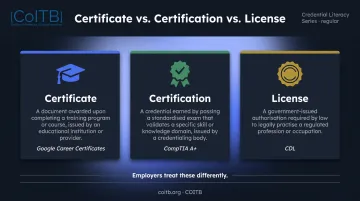
Employers — especially in tech and healthcare — treat these differently. A certification carries more weight than a certificate because it's validated independently, not self-assessed through a course you paid for.
The Cost-Time Advantage
| Credential Type | Typical Cost | Time to Earn |
|---|---|---|
| Public 4-year degree (in-state) | $30,990/year | 4 years |
| Entry-level certification | $100–$300 exam fee | Weeks to 12 months |
Not every credential carries equal weight, though. When evaluating options, look for:
- An independent issuing body (not just the course provider)
- A proctored exam requirement that validates knowledge objectively
- Renewal standards that keep the credential current over time
Top 15 Certifications to Start Your Career Without a Degree
These 15 credentials are selected based on employer demand, salary potential, accessibility without a degree, and clear career entry paths — across IT, healthcare, business, and trades.
IT and Tech Certifications
1. CompTIA A+ The baseline credential for IT support roles. Covers networking, troubleshooting, hardware, and operating systems. No prerequisites required. Computer support specialists earned a $61,550 median salary in May 2024, according to the BLS. Recognized by Intel, Dell, HP, Best Buy, Verizon, and Wells Fargo, among others.
2. Google IT Support Professional Certificate Fully online and beginner-accessible, with no prior experience required. Graduates gain access to a consortium of over 150 U.S. employer partners, including AT&T, Google, and Wells Fargo. Keep in mind: this is a course-completion certificate, not an independently proctored certification — a distinction that matters when comparing it to exam-based credentials.
3. AWS Cloud Practitioner The entry point for cloud computing, one of the fastest-growing areas in tech. No prerequisites and no prior cloud experience required. The closest BLS wage benchmark for network support roles sits at $73,340 median — cloud-specific salary data isn't broken out separately. Recognized globally across industries and issued by Amazon Web Services.
4. CompTIA Security+ The foundational cybersecurity certification, approved across 30 work roles under the U.S. Department of Defense's 8140 framework. Information security analysts earned $124,910 in May 2024, with 29% projected job growth through 2034 — one of the fastest-growing occupations tracked by the BLS. No degree required; exam-based.
5. Web Development Certification (HTML, CSS, JavaScript, React) Web developers and digital designers earned $95,380 in May 2024, with 7% projected growth through 2034. BLS notes that candidates may not need formal education credentials if prior work or projects demonstrate their abilities.
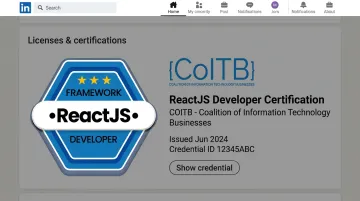
To validate front-end skills with a structured credential, COITB — a non-profit credentialing body — offers ISO/IEC 17024-aligned certifications in HTML/CSS Web Design and ReactJS Framework Development. Exams run up to 90 questions over 75–90 minutes, delivered via remote proctoring or authorized test centers, and target candidates with 0–6 months of hands-on experience. Digital badges are issued upon passing for LinkedIn and résumé display.
6. AI and GPT Certification Lightcast data cited in the 2025 Stanford AI Index recorded over 66,000 U.S. job postings mentioning generative AI in 2024, with prompt-engineering postings growing from roughly 1,400 to nearly 6,300 in the same period. These aren't exclusively developer roles — demand spans healthcare, marketing, finance, and operations.
COITB's Certified GPT Professional credential validates prompt engineering, API integration, AI application architecture, and responsible AI practices. The exam is 60 questions over 75 minutes and requires a 71% passing score. Designed for both technical and non-technical professionals with as little as 0–6 months of AI tool experience — making it one of the most accessible ways to validate generative AI skills without a technical background.
Healthcare Certifications
If healthcare is your target field, these three credentials offer direct entry without a four-year degree.
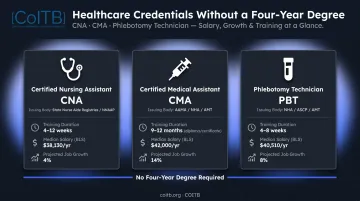
7. Certified Nursing Assistant (CNA) One of the fastest paths into healthcare. Programs typically run 4–12 weeks and conclude with a state competency exam — no degree required. Nursing assistants earned $39,530 in May 2024, with BLS projecting 211,800 annual openings through 2034. A strong stepping stone toward LPN and RN roles.
8. Certified Medical Assistant (CMA) Combines clinical tasks (vitals, injections) with administrative duties (scheduling, coding). Issued by the AAMA after a proctored exam. Medical assistants earned a $44,200 median salary in May 2024, with 12% projected growth through 2034. Note: while no four-year degree is required, the AAMA exam does require completion of an accredited medical assisting program.
9. Phlebotomy Technician Certification An accessible healthcare entry point with training programs averaging 3–6 months. Phlebotomists earned $43,660 in May 2024, with 6% projected job growth through 2034. Credentials are issued by organizations including the National Phlebotomy Association (NPA) and the ASCP Board of Certification — multiple eligibility routes available, including a high school diploma plus qualifying training.
Business and Operations Certifications
10. CAPM (Certified Associate in Project Management) PMI's entry-level project management credential. Requirements: a high school diploma or GED plus 23 hours of project management education — no degree, no work experience needed. PMI reports a $70,000 average U.S. salary for CAPM holders. Recognized globally; well-suited to operations, tech, and consulting roles. Exam fees: $225 for PMI members, $300 for non-members.
11. Google Digital Marketing & E-commerce Certificate Fully online and beginner-accessible, covering SEO, paid advertising, email marketing, and e-commerce fundamentals. Like the Google IT Support credential, this is a course-completion certificate backed by a network of 150+ employer partners. Google's page cites Lightcast data referencing 213,000+ U.S. digital marketing and e-commerce openings for 2025 — though these openings don't specifically require this certificate.
12. Salesforce Administrator Certification A no-degree credential with rising employer demand as CRM adoption grows across industries. The exam covers 60 scored questions, requires a 68% passing score, and costs $200 to register — with no formal prerequisites. No publicly verified national average salary exists, but ecosystem demand is significant: a Salesforce-commissioned IDC study projected 11.6 million net new jobs tied to the Salesforce ecosystem globally through 2028.
Skilled Trades Certifications
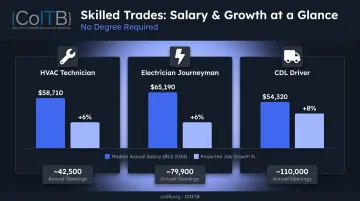
13. HVAC Technician Certification HVAC mechanics and installers earned $59,810 in May 2024, with 8% projected growth through 2034. Two key credentials: NATE certification (the largest U.S. nonprofit HVACR technician-certification organization) and EPA Section 608 (federally required for anyone handling regulated refrigerants, and it never expires). Training typically runs 6–12 months, with strong potential for self-employment or union work.
14. Electrician Journeyman License After completing a paid apprenticeship, a state-issued journeyman license opens access to high-paying electrical work. Electricians earned $62,350 in May 2024, with 9% projected growth through 2034 and approximately 81,000 annual openings. Licensing requirements vary by state — most require passing an exam based on the National Electrical Code plus local codes. The apprenticeship is paid, making this a debt-free path to a solid salary.
15. Commercial Driver's License (CDL) Heavy and tractor-trailer drivers earned $57,440 in May 2024, with 237,600 annual openings projected through 2034. CDLs are state-issued following federal FMCSA standards. Training programs vary in length — FMCSA specifies required curricula but does not mandate a universal minimum training duration. Strong demand across logistics, medical supply, and specialized transport.
How to Choose the Right Certification for Your Goals
Start With the Job, Not the Credential
Work backwards from the outcome you want:
- Search job postings in your target role and city — note which certifications appear as "required" vs. "preferred"
- Identify the issuing body — is it an independent organization with a proctored exam, or a course platform issuing its own completion badge?
- Check renewal requirements — credentials requiring continuing education stay current; one-time completions may not
Common Mistakes to Avoid
- The cheapest credential isn't always the most recognized — weigh cost against employer acceptance
- Online delivery is fine, but only when the exam is proctored and the issuing body is credible
- Credentials aligned to ISO/IEC 17024 standards hold more weight with employers than unverified alternatives
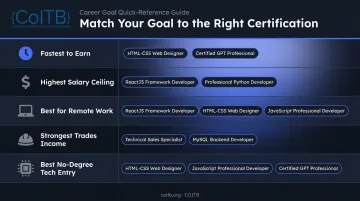
Quick-Reference by Career Goal
| Goal | Best Fit |
|---|---|
| Fastest to earn | CNA, CDL, Phlebotomy |
| Highest salary ceiling | AI/GPT credentials, Cybersecurity, Cloud platforms |
| Best for remote work | ReactJS, HTML/CSS Web Design, JavaScript, Digital Marketing |
| Strongest trades income | Electrician, HVAC |
| Best no-degree tech entry | HTML/CSS Web Designer, JavaScript Developer, CompTIA A+ |
Conclusion
The certifications on this list prove the point: credentials that are exam-based, issuer-recognized, and employer-validated can open the same doors as a four-year degree — in a fraction of the time and at a fraction of the cost.
Start with your target job title. Verify that the credential is exam-based and employer-recognized. Match the timeline and cost to what's realistic for you.
If the tech credentials on this list caught your attention, COITB is a non-profit credentialing body worth exploring. It offers ISO/IEC 17024-aligned certifications in web development (HTML/CSS, ReactJS), JavaScript, Python, and AI (Certified GPT Professional) — all designed for candidates with 0–6 months of experience, including career changers, veterans, bootcamp graduates, and self-taught developers.
Exams are remote-proctored with flexible scheduling and accept military CAC and VA-issued ID. Explore available certifications at www.coitb.org or take a free practice assessment at coitb.org/assessment.
Frequently Asked Questions
Can I get a high-paying job without a college degree if I have a certification?
Yes — many employers, including major tech companies, now prioritize verified skills over degrees for a growing number of roles. Certifications in tech, healthcare, and trades regularly lead to salaries at or above the national median, particularly in cybersecurity, cloud computing, and skilled trades.
What is the difference between a certificate and a certification?
A certificate confirms you completed a course; a certification validates your skills against a professional standard — typically through a proctored exam. Employers and licensing bodies generally give certifications more weight because the assessment is independent, not tied to the same organization that delivered the training.
How long does it take to earn a career certification?
Timelines vary considerably. A CDL or phlebotomy credential can be earned in weeks, while IT certifications like CompTIA A+ or Security+ typically take 3–6 months of preparation and HVAC training runs 6–12 months. The right timeline depends on the field and the depth of skills being validated.
Are online certifications recognized by employers?
Online certifications can be employer-recognized, but only when issued by an accredited or industry-respected body, delivered through a proctored exam, and aligned to standards that hiring managers in that field actually check for. Online delivery alone doesn't determine credibility — the issuing body and exam structure do.
Which certifications are best for getting into tech without a degree?
Strong entry points include CompTIA A+, Google IT Support, AWS Cloud Practitioner, CompTIA Security+, and web development or AI certifications. Credentials aligned to ISO/IEC 17024 standards — such as those offered by COITB for web development and AI — add an extra layer of employer credibility by demonstrating independent, standards-based assessment.
How much do certifications cost compared to a college degree?
Most certification exams range from $100 to $300 individually, compared to $30,990 or more per year for a public in-state university. Many employers also offer tuition reimbursement or sponsored training for in-demand credentials. Veterans should verify eligibility through GI Bill, VET TEC, or VR&E programs before registering.