But here's the problem: knowing Python and proving you know Python are two completely different things—especially when you're competing against candidates with CS degrees.
For self-taught developers, bootcamp graduates, and career changers, this gap is career-defining. Skills are real. Evidence is invisible. Employers screening 200 applications can't assess what they can't see, which means qualified candidates get filtered out before anyone reads their portfolio.
This article covers what Python certification actually delivers in concrete career terms—hiring visibility, salary leverage, and skill credibility—so you can decide whether it's the right move for your situation.
Key Takeaways
- Converts self-reported Python skills into employer-verifiable proof — helping non-traditional candidates clear résumé screening filters
- 97% of IT decision-makers say certified staff add measurable value to their organizations
- Third-party validation fills the credibility gap for career changers and self-taught developers without a traditional degree
- Exam prep closes the structured knowledge gaps that self-directed learning tends to leave behind
- An early credential opens entry-level doors — and the hands-on experience that follows accelerates every step after
What Is a Python Certification?
A Python certification is a credential issued by a recognized body that verifies a candidate can apply Python programming skills to real-world tasks—not just that they watched a course.
Certification vs. Course Completion: A Critical Distinction
The two credentials are not interchangeable:
- Course completion badge — Confirms you attended or finished a program. No assessment, no pass/fail threshold, no standard measured against.
- Certification — Requires passing a formal exam against a published competency framework. You either meet the standard or you don't.
Credentials aligned with ISO/IEC 17024 (the international standard for personnel certification bodies) follow a structured competency framework with defined pass/fail thresholds — meaning the credential has a measurable standard behind it. COITB's Professional Python Developer Certification, for example, is a 58-item, 75-minute proctored exam with a 70% passing threshold. A candidate who scores 69% does not receive the credential. That's the difference between a participation record and a proof of competency.
For employers scanning résumés, a proctored certification answers a question a course badge cannot: can this person perform under a defined standard? That's the credential worth putting on a job application.
Key Advantages of Getting Python Certified
The advantages below are grounded in operational career outcomes—not abstract promises. These are the metrics job seekers, hiring managers, and career changers actually track.
Resume Credibility That Clears the Screening Filter
In high-volume hiring, your resume has seconds to survive before a human ever reads it. Applicant tracking systems and initial screeners use credentials as a fast-pass filter—a Python certification gets your name into consideration before your portfolio is ever opened.
For self-taught developers and career changers, this is where the battle is often lost. The label "self-taught" carries implicit uncertainty for employers who have no reference point to assess skill level. A certification replaces that ambiguity with a standardized proof point.
The numbers behind this problem:
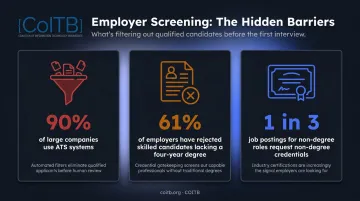
- About 90% of large companies use automated applicant tracking systems to screen resumes, filtering out roughly half of all applications before a human reviews them
- 61% of surveyed employers acknowledged rejecting applicants who had the skills to succeed—simply because they lacked a four-year degree requirement
- Nearly 1 in 4 job postings now request some form of non-degree credential; for roles not requiring a bachelor's degree, that figure rises to 1 in 3
Career metrics this directly affects:
- Interview callback rate
- Application-to-interview conversion
- Time to first job offer
- Visibility in recruiter searches (LinkedIn credential filters)
When this matters most: Career changers entering tech from unrelated fields, self-taught developers without a CS degree, and anyone applying to roles that list certification as "preferred" or "required."
Higher Earning Potential and Salary Negotiation Leverage
Certification shifts salary conversations from subjective to objective. Instead of asking for more money based on self-assessment, you enter negotiations with documented evidence of your skill level.
The salary landscape for Python developers is strong. Entry-level Python developers average $101,419 annually, while senior Python developers average $146,908—a gap that reflects the career trajectory certification helps you climb faster.
The BLS reports software developer median wages at $133,080, with the tech sector overall paying a median of $112,667—more than double the median wage for all U.S. occupations.
Certification does one specific thing here: it gives you a concrete basis to request compensation at the higher end of a band. Employers screening for certifications are also reducing their hiring risk—and they pay more for reduced risk.
Broader IT certification context: 97% of IT decision-makers say certified staff add value to their organizations, and 22% estimate that value at $30,000 or more annually. While this is a broad IT figure rather than Python-specific data, it reflects how employers think about certified vs. uncertified candidates across the industry.
The compounding effect: Early certification helps you land entry-level roles faster. Those roles provide experience that qualifies you for mid-level positions sooner. The salary gap between entry and senior Python developer is roughly $45,000—certification accelerates how quickly you move through that gap.
Career metrics this directly affects:
- Starting salary offer
- Negotiation leverage at offer stage
- Time to first salary increase
- Access to mid-level vs. entry-level pay bands
When this matters most: Negotiating a first tech role, transitioning from a non-tech salary baseline, or moving from junior to mid-level where documented competency serves as evidence of readiness.
Structured Skill Validation That Closes Hidden Knowledge Gaps
Self-directed learning has a consistency problem. Online tutorials cover what's popular and accessible—not necessarily what employers need. Certification study forces systematic coverage of the full skill set, exposing gaps that months of project-based learning can leave untouched.
What a well-designed exam actually covers
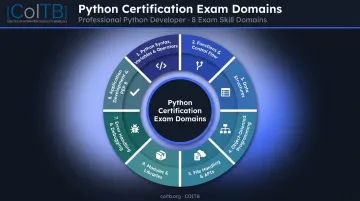
COITB's Professional Python Developer Certification exam assesses eight distinct skill domains:
- Python syntax, variables, and operators
- Functions and control flow
- Data structures (lists, dictionaries, strings)
- Object-oriented programming (classes, inheritance, encapsulation, polymorphism)
- File handling and APIs
- Modules, libraries, and virtual environments
- Error handling and debugging
- Application development and PEP 8 best practices
A developer who's spent six months building personal projects might be strong in areas 1-3 but have never properly touched areas 4-7. The certification exam doesn't let gaps like that stay hidden.
"Knowing Python" in a casual sense and applying it confidently in a professional environment are genuinely different things. The World Economic Forum's 2025 Future of Jobs Report found that 63% of global employers cite skills gaps as the primary barrier to business transformation. Employers aren't just struggling to find Python users—they're struggling to find Python users who are actually job-ready.
Certification study bridges the difference between knowing Python casually and applying it with the consistency a technical interview—and your first 90 days on the job—will demand.
This advantage hits hardest for self-taught developers and bootcamp graduates with uneven foundational knowledge, and for professionals transitioning from adjacent roles like data analysis or IT support into full Python development. The direct payoff shows up in:
- Faster on-the-job ramp-up
- Stronger performance in technical interview challenges
- Better code quality and peer review outcomes
- Greater day-one confidence
What Happens When Certification Is Skipped
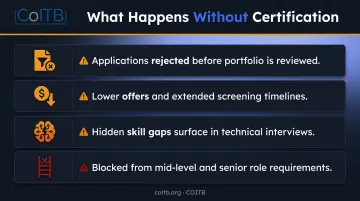
Skipping certification doesn't just slow career progress — it creates specific, recurring problems that show up at every stage of the job search:
- ATS systems and initial screeners filter out uncredentialed applications before a human ever reviews the portfolio.
- Employers assessing self-taught candidates without a reference point often default to lower offers or extend screening timelines to compensate for the uncertainty.
- Uneven foundational knowledge goes undetected without a structured assessment milestone, then surfaces during technical interviews or on the job.
- Mid-level and senior roles increasingly require documented proof of competency — something informal project experience alone doesn't provide.
How to Get the Most Value from Python Certification
Certification delivers the most value when treated as a starting point, not a finish line. A few specific practices that compound the return:
Build a portfolio alongside it. Certification clears the screening filter; a portfolio of Python projects convinces the hiring manager. You need both, and they work in sequence.
Pick a credential tied to a recognized standard. Certifications aligned to ISO/IEC 17024—like COITB's Professional Python Developer Certification—signal independent, standards-based assessment rather than course completion. That distinction matters to employers.
Choose an exam format that fits your situation. COITB's exam is available via remote proctoring (webcam + stable internet; military CAC and VA-issued IDs accepted) or in person at authorized test centers.
Put it to work right away. Take on Python-specific projects, contribute to open-source work, or apply to roles listing Python as a requirement. The credential stays visible when it's connected to real activity.
Test your readiness before registering. COITB offers a free practice assessment at coitb.org/assessment so you know where you stand before exam day. No formal prerequisites apply — the exam is built for candidates with 0–6 months of hands-on Python experience from any pathway: self-study, bootcamp, coursework, or on-the-job.
For veterans and transitioning service members: GI Bill, VET TEC, MyCAA, and VR&E may cover the cost of the Professional Python Developer Certification. Verify eligibility with your VA Education Benefits counselor before registering — coverage depends on COITB's current status in the VA WEAMS database and your State Approving Agency approval.
Conclusion
Python certification delivers concrete, measurable career value: it makes skills visible to employers who can't otherwise assess them, opens hiring pipelines that screen for credentials, supports stronger salary negotiations with documented proof, and fills gaps that informal learning tends to leave open.
For self-taught developers, bootcamp graduates, and career changers who have real Python skills but no institutional credential to show for it, certification is the most direct path to making those skills count in a competitive market. COITB's Professional Python Developer Certification is built specifically for that situation — a third-party, industry-recognized credential you can earn online and put to work immediately.
Frequently Asked Questions
Is a Python certification worth it for someone who is self-taught?
For self-taught developers, certification provides the third-party validation that replaces institutional credibility—making skills visible and verifiable to employers who cannot otherwise assess them. Without it, "self-taught" on a resume often creates more uncertainty than confidence for hiring managers reviewing hundreds of applicants.
What skills does a Python certification typically validate?
A well-designed Python certification validates applied skills including data structures, functions, control flow, object-oriented programming, error handling, file I/O, modules, and practical application development. COITB's Professional Python Developer exam covers all eight of these domains across 58 scenario-based and multiple-choice items.
How does a Python certification compare to just having a portfolio?
Both matter, and they do different jobs. Certification clears the screening filter by giving recruiters a verifiable proof point; a portfolio convinces the hiring manager that you can execute. Relying on only one leaves a gap that the other fills.
Can a Python certification help someone change careers into tech?
Certification is especially useful for career changers because it provides a recognized proof point independent of prior job title or degree. It gives hiring managers a concrete basis to evaluate non-traditional applicants rather than defaulting to credential uncertainty.
How long does it take to earn a Python certification?
Most candidates with foundational Python experience are exam-ready within a few weeks of focused study. COITB's remote proctoring option means flexible scheduling from any location with a webcam and stable internet—no test center travel required.
What jobs become more accessible with a Python certification?
Entry-level to mid-level roles across back-end development, data engineering, automation, and AI/ML application development all list Python as a core requirement. The BLS projects software developer employment to grow 15% from 2024 to 2034, adding roughly 287,900 jobs—and data scientist roles to grow 34% over the same period, adding 82,500 more.