Introduction
The software development job market in 2026 is crowded. According to Stack Overflow's 2024 Developer Survey, 82% of developers learned to code through online resources, while less than half went through traditional school programs.
That means hiring managers are sorting through résumés from self-taught developers and bootcamp graduates who all claim the same skills — with little to distinguish one from another.
Certifications have become one of the few ways to stand out from that stack. But not all credentials carry equal weight — picking the wrong one wastes months of preparation and hundreds of dollars with little to show for it in a job search.
This guide covers the best programming certifications for 2026, what makes each one worth pursuing, and how to choose the right one for your specific career goals.
Key Takeaways
- React, JavaScript, and Python credentials align directly with the front-end, full-stack, and application development roles employers are actively hiring for
- Python and JavaScript remain the highest-demand languages — certifications in both translate directly to open roles
- ISO/IEC 17024-aligned credentials signal a higher standard of rigor than course completion badges
- Career changers and beginners should start with foundational credentials before investing in advanced cloud certs
- Pairing a credential with a verifiable portfolio and a shareable digital badge gives employers concrete proof of job-ready skills
Why Programming Certifications Still Matter in 2026
The traditional CS degree no longer serves as the default filter for tech hiring. CompTIA's 2024 research found that roughly 40% of software developer job postings do not require a bachelor's degree — which means employers need other ways to assess candidates. Certifications fill that gap.
With tens of thousands of bootcamp graduates and self-taught developers entering the market each year, a résumé listing "knows React" or "proficient in Python" carries almost no signal on its own. Employers cannot verify those claims. A recognized certification validates those claims.
Certificate vs. Certification: Why the Distinction Matters
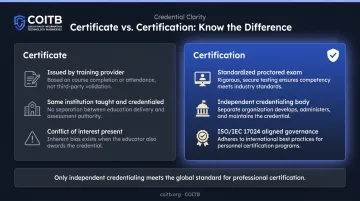
These two terms are frequently confused, but they mean very different things to employers:
- Certificate — A course completion credential issued by a training provider or bootcamp. The same institution that taught you also issued your badge, which creates an obvious conflict of interest.
- Certification — A credential earned by passing a standardized, proctored exam administered by an independent credentialing body. The issuer had no role in teaching you.
Certifications aligned with ISO/IEC 17024 (the international standard for personnel certification bodies) carry the most weight. These organizations must maintain formal audit procedures, defined passing thresholds, appeals processes, impartiality policies, and recertification requirements. That governance infrastructure is what separates a credible certification from an unverified self-claim.
Who Benefits Most from Programming Certifications in 2026
- Self-taught developers who lack a CS degree and need third-party skill validation
- Bootcamp graduates whose course completion certificates come from the same institution that trained them
- Career changers moving from non-tech backgrounds (project management, finance, healthcare) into software roles
- Backend and full-stack engineers targeting cloud-native roles at startups or enterprises
- AI/ML practitioners formalizing skills in Python and generative AI tooling
- Veterans and military spouses translating service experience into verifiable civilian tech credentials
Best Programming Certifications for 2026
The following credentials were selected based on industry recognition, alignment with in-demand job roles, accessibility across experience levels, and visibility in real employer job postings.
AWS Certified Developer – Associate
One of the most sought-after credentials for developers building cloud-native applications on AWS. The exam covers CI/CD pipelines, SDK usage, serverless architecture, and core AWS services — skills that appear constantly in job descriptions for backend and full-stack roles at both startups and large enterprises.
Worldwide IaaS public cloud services grew 22.5% in 2024 to $171.8 billion, with Amazon maintaining market leadership. That growth translates directly into hiring demand — and this certification signals platform-specific readiness that reduces onboarding friction for employers.
| Detail | Info |
|---|---|
| Issuing Body | Amazon Web Services (AWS) |
| Exam Cost | $150 USD |
| Duration | 130 minutes; 65 questions |
| Validity | 3 years |
| Best For | Backend developers, full-stack engineers, developers targeting cloud-first roles |
Microsoft Certified: Azure Developer Associate (AZ-204)
A leading enterprise-cloud certification validating the ability to build and manage Azure compute solutions, serverless functions, APIs, and deployment pipelines. It appears frequently in job postings at Microsoft-stack organizations across finance, healthcare, and government.
Important note for 2026 candidates: Microsoft has listed AZ-204 for retirement on July 31, 2026. Verify the replacement certification path on Microsoft Learn before registering.
| Detail | Info |
|---|---|
| Issuing Body | Microsoft |
| Exam Cost | $165 USD |
| Duration | 100 minutes |
| Validity | Annually renewed via free online assessment |
| Best For | Enterprise developers, cloud-transition candidates, Microsoft technology stack roles |
Oracle Certified Professional: Java SE 21 Developer
A globally recognized credential validating Java proficiency aligned to the Java SE 21 LTS release — covering OOP principles, concurrency, the Streams API, and modern features like pattern matching. Java's long-standing dominance in financial services and large-scale enterprise systems makes this certification consistently relevant.
The exam (1Z0-830) tests applied, hands-on coding ability across 50 questions in 120 minutes, with a 68% passing threshold. The format tests applied coding ability, not memorization.
| Detail | Info |
|---|---|
| Issuing Body | Oracle |
| Exam Cost | ~$245 USD (verify at oracle.com/education) |
| Duration | 120 minutes; 50 questions |
| Validity | No expiration (LTS-version aligned) |
| Best For | Java developers, enterprise backend engineers, finance and large-scale software roles |
Python Institute PCAP – Certified Associate Programmer
An internationally recognized certification for intermediate Python programmers, covering core language features, modules, exception handling, and object-oriented programming. GitHub reported Python became the most used language on its platform in 2024, driven largely by AI activity — making Python fluency one of the most hireable skills a developer can validate right now.
Version deadline for 2026 candidates:
- PCAP-31-03 retires August 31, 2026 (lifetime validity for those who pass before retirement)
- PCAP-31-04 is in development with a 7-year validity window
- Register for 31-03 now or confirm 31-04 availability at pythoninstitute.org before scheduling
| Detail | Info |
|---|---|
| Issuing Body | OpenEDG Python Institute |
| Exam Cost | $295+ (verify at pythoninstitute.org) |
| Duration | 65 minutes; 40 questions; 70% passing score |
| Validity | Lifetime (PCAP-31-03); 7 years (PCAP-31-04) |
| Best For | Python developers, career changers entering data science or backend roles |
Meta Front-End Developer Professional Certificate
A project-based credential offered through Coursera covering HTML, CSS, JavaScript, and React across nine structured courses. Designed for beginners, it emphasizes real front-end projects that candidates can show directly to employers — making it particularly strong for those with no formal tech background entering UI or web development.
Note this is a certificate (course completion credential), not a standardized-exam certification. Its strength lies in portfolio development and structured learning, not independent skill validation.
| Detail | Info |
|---|---|
| Issuing Body | Meta (via Coursera) |
| Cost | Platform-dependent; Coursera programs start from $49/month |
| Duration | ~7 months at 6 hours/week; 9-course series |
| Validity | No expiration (completion-based) |
| Best For | Beginners targeting front-end roles, career changers with no prior coding experience |
COITB Application Development & AI Certifications
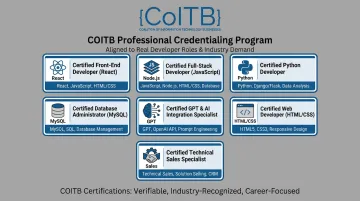
COITB is a non-profit credentialing body offering ISO/IEC 17024-aligned certifications in web development and AI — built for aspiring developers, bootcamp graduates, veterans, and career changers who need a recognized, standards-backed credential to strengthen their résumé.
A few things distinguish COITB from vendor-specific or academic credentials:
- Entry-level accessible: Designed for candidates with 0–6 months of hands-on experience
- Remote-proctored: Exams taken from any location; military CAC cards accepted for ID verification
- Immediately deployable: Digital badges issued on passing for LinkedIn and résumé use
The seven COITB certifications:
| Certification | Technologies Covered |
|---|---|
| ReactJS Framework Developer | JSX, React Hooks, Router, API integration, state management |
| HTML-CSS Web Designer | HTML5, CSS3, Flexbox, Grid, responsive design, accessibility |
| JavaScript Professional Developer | ES6+, async/await, Fetch API, DOM manipulation, REST APIs |
| Professional Python Developer | OOP, exception handling, modules, standard library, PEP 8 |
| MySQL Backend Developer | Schema design, SQL querying, indexes, transactions, ACID |
| Certified GPT Professional | Prompt engineering, GPT API integration, AI application design |
| Technical Sales Specialist | SaaS product knowledge, MEDDIC, RFP response, technical objection handling |
Exams run 75–90 minutes with 58–90 items and passing thresholds between 70–75%, depending on the credential.
| Detail | Info |
|---|---|
| Issuing Body | COITB (non-profit, ISO/IEC 17024 aligned) |
| Technologies | HTML, CSS, JavaScript, React, Python, MySQL, GPT/AI |
| Best For | Career changers, bootcamp graduates, self-taught developers, veterans entering the digital workforce |
How to Choose the Right Programming Certification
Match the Credential to Your Career Stage
Where you are in your career should drive your first certification decision:
- Beginners and career changers: Start with foundational credentials — Python PCAP, the Meta Front-End certificate, or COITB's web development and AI credentials — before investing $150–$245 in cloud or enterprise exams. Portfolio-backed skills make advanced certifications far more defensible in interviews.
- Experienced developers: Target credentials that close a specific skills gap visible in the job postings you're actively pursuing. If every role you want lists AWS experience, the AWS Developer Associate is a straightforward call.
Research Real Job Demand First
Pull 3–5 actual job postings for your target role and note which certifications and technologies appear most frequently as required or preferred qualifications. Credentials that appear repeatedly in listings deliver more return than ones that sound impressive but never show up in the roles you want.
Vet the Credentialing Body
Not all credentials carry equal weight. Check whether the issuing organization:
- Administers standardized, proctored exams with defined passing thresholds
- Is independent from any training provider (no conflict of interest)
- Maintains ISO/IEC 17024 alignment or equivalent industry recognition
- Issues verifiable digital badges with unique Credential IDs
Course completion certificates from training providers don't meet this bar. Employer-facing credentials need independent verification.
Weigh Cost, Renewal, and ROI
| Credential | Exam Cost | Renewal |
|---|---|---|
| AWS Developer Associate | $150 | 3 years |
| Azure AZ-204 | $165 | Annually (free online) |
| Oracle Java SE 21 OCP | Contact Oracle | Verify with Oracle |
| Python PCAP | $295+ | Lifetime (PCAP-31-03) |
| Meta Front-End | ~$49/month platform fee | N/A (course completion) |
| COITB Credentials | Contact COITB | ISO/IEC 17024 aligned; digital badge verification included |
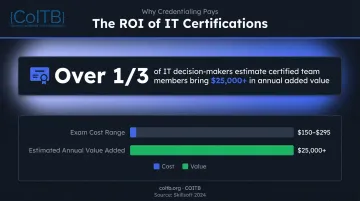
Skillsoft's 2024 IT Skills & Salary Report found that over one-third of IT decision-makers estimate certified team members bring at least $25,000 in annual added value. Factor that against your exam fees.
Conclusion
The best programming certification for 2026 is the one that matches a specific career goal, reflects real employer demand in your target job postings, and comes from a credentialing body that hiring managers can independently verify. A credential that checks all three boxes is worth pursuing — one that checks only one rarely pays off.
Start with foundational credentials that validate the skills you already have before investing in high-cost advanced ones. Stack upward as your experience grows and your target roles become clearer.
If you're ready to put a recognized credential behind the skills you've already built, COITB offers ISO/IEC 17024-aligned certifications in web development and AI for every experience level — whether you're a bootcamp graduate, self-taught developer, or career changer. Take a free practice assessment at coitb.org/assessment, or register at coitb.org/auth/signup. Questions? Reach the team at support@coitb.org or +1 877 402 0840.
Frequently Asked Questions
What are the best programming certifications for 2026?
The top picks depend on your career level. Cloud roles benefit most from AWS Developer Associate or Azure AZ-204. Java enterprise developers should target Oracle's OCP Java SE 21. For Python and data roles, the Python Institute PCAP is the standard. Beginners and career changers are best served by COITB's web development and AI credentials or the Meta Front-End certificate on Coursera.
Which programming languages will be most in demand in 2026?
Python, JavaScript, Java, and SQL remain consistently in-demand across virtually every industry. Python has surged in particular; it became the most used language on GitHub in 2024, driven by AI activity. Frameworks like React and AI/ML tooling are seeing strong employer interest, and certifications in these areas reflect actual market demand.
What are the most in-demand programming jobs in 2026?
The BLS reports a median annual wage of $133,080 for software developers in May 2024, with 15% employment growth projected through 2034. High-demand roles span cloud development (AWS/Azure), full-stack engineering (React, JavaScript, Python), backend development (Python, MySQL, Java), and AI/ML engineering.
Is learning programming still worth it in 2026?
Yes. Software development ranks among the highest-compensating skill sets across finance, healthcare, and tech alike, and BLS projections show sustained long-term growth. Certifications give non-traditional candidates a structured, employer-recognized way to signal job-ready skills.
How long does it take to earn a programming certification?
Entry-level credentials like COITB's web development certifications or Python PCAP typically take 1–2 months of focused preparation for candidates with 0–6 months of hands-on experience. Cloud certifications like AWS Developer Associate or Azure AZ-204 generally require 3–4 months of structured study, particularly if you're building cloud skills from scratch.
Do programming certifications expire?
Expiration policies vary. AWS Developer Associate is valid for 3 years; Azure AZ-204 renews annually via a free online assessment. Python PCAP-31-03 carries lifetime validity, though PCAP-31-04 (in development) will have a 7-year term. COITB certifications are subject to a renewal cycle with continuing education requirements — full details are available at coitb.org/certification-resources/recertification-requirement-policy.