The problem? There are dozens of programs to choose from — self-paced courses, bootcamps, exam-based credentials, and membership platforms — and their quality varies dramatically. This guide cuts through the noise and focuses on the certifications genuinely worth your time in 2026.
Key Takeaways
- The Bureau of Labor Statistics projects 7% growth for web developers and digital designers from 2024 to 2034 — faster than many comparable occupations
- Exam-based credentials outweigh course-completion certificates with employers — they validate demonstrated skills, not just attendance
- Credential costs vary widely — evaluate programs by rigor, employer recognition, and alignment to ISO/IEC 17024 standards, not price alone
- The right credential matches your experience level, career goal, and whether you need to build skills or validate existing ones
- ISO/IEC 17024-aligned credentials provide the clearest proof of competency and are worth prioritizing when comparing programs
What Is a UX Design Certification and Why It Matters in 2026
A UX design certification is a credential earned by demonstrating proficiency in user experience design, either through structured learning, an exam, or both. A course-completion certificate proves you attended a program. An exam-based certification proves you can actually apply the skills — and employers increasingly know the difference.
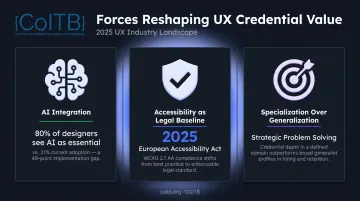
Three Forces Reshaping UX Credential Value in 2026
Three forces are making verified credentials more valuable right now:
- AI integration: Figma's 2025 AI report found that more than 80% of designers and developers believe learning to work with AI will be essential to future role success — yet only 31% of designers currently use AI for core work, compared to 59% of developers. That gap represents both a risk and an opportunity.
- Accessibility as a legal baseline: The European Accessibility Act began enforcement in June 2025. US DOJ Title II rules require state and local governments to meet WCAG 2.1 Level AA by April 2026. Designers without documented accessibility skills face real exposure when clients or employers assess compliance readiness.
- Specialization over generalization: Employers are hiring for specific UX skill depth, not broad familiarity. According to NN/g's State of UX in 2026, practitioners who thrive will treat UX as strategic problem solving — not a toolkit.
What to Look for in a Credential
When evaluating any program, check for three things:
- Portfolio projects — real work to show employers, not just theory
- Exam-based validation — proof of skills, not just course attendance
- ISO/IEC 17024 alignment — the internationally recognized standard for personnel certification, signaling rigorous, consistent skills validation
Top UX Design Certifications Worth Considering in 2026
These certifications were selected based on industry recognition, skill depth, format flexibility, and relevance to what employers are actually hiring for in 2026.
Google UX Design Professional Certificate
A beginner-level, self-paced certificate offered through Coursera and backed by Google. The program spans eight courses covering UX foundations, research, wireframing, prototyping in Figma, and usability testing — completable in three to six months at five to ten hours per week.
Google's brand recognition makes this one of the most résumé-visible entry-level credentials available. Google reports that more than 70% of US graduates from its Career Certificate programs reported a positive career outcome — a new job, promotion, or raise — based on 2024 graduate surveys. The low monthly cost and built-in portfolio projects make it accessible for career changers with no prior design experience.
The trade-off: no mentorship, no live instruction, and no job placement support. Self-motivated learners benefit most.
| Detail | Info |
|---|---|
| Cost | $49/month (after a 7-day free trial) |
| Duration | 3–6 months at 5–10 hours/week, self-paced |
| Best For | Beginners seeking an affordable, brand-recognized introduction to UX with portfolio projects |
Nielsen Norman Group (NN/g) UX Certification
NN/g — co-founded by the person who coined the term "user experience" at Apple — offers a certification earned by passing exams across any five of their 50+ live online courses. Advanced options include Specialty Recognition and a UX Master Certification requiring 15 courses.
NN/g is one of the most recognized names in UX research globally, with 500+ companies having attended or funded its training. Exam logistics are straightforward:
- Online exams, 30 questions each
- 80% passing score required
- Must be completed within 35 days of the course
- Credential doesn't expire; updated digital certificates issued as you complete additional courses
NN/g states directly that its certification is not accredited. The prestige comes from NN/g's industry standing, not from a third-party accreditation body.
| Detail | Info |
|---|---|
| Cost | ~$6,400 (standard, 5 courses + exams); ~$19,300 (Master, 15 courses + exams) |
| Duration | 30+ hours for standard; 100+ hours for Master, completed within a 3-year window |
| Best For | Mid-career and experienced UX professionals seeking a globally recognized, exam-validated credential |
Designlab UX Academy
A fully online bootcamp-style certificate covering the end-to-end UX/UI design process, with full-time (21 weeks), part-time (36 weeks), and self-paced (up to 18 months) options. Students complete four portfolio case-study projects including a client capstone.
The 1:1 mentor matching is the key differentiator — students receive 30 mentor sessions with working designers for personalized feedback. Full-time and part-time students who meet requirements and don't land a qualifying job offer within six months of graduation are eligible for tuition reimbursement. Designlab explicitly does not call this a "job guarantee."
Designlab holds a 4.78/5 rating on Course Report based on 835 reviews — strong independent validation.
| Detail | Info |
|---|---|
| Cost | ~$8,499 upfront (without Foundations discount); payment plan options available |
| Duration | 21 weeks full-time; 36 weeks part-time; up to 18 months self-paced |
| Best For | Career changers who need structured mentorship, real portfolio projects, and career support to transition into UX |
Interaction Design Foundation (IxDF)
A membership-based platform offering 41 UX/UI and AI courses plus 149 one-hour Master Classes. Career programs include pathways for UX designers, UI designers, and AI-powered human-centered design. All courses are asynchronous and self-paced.
IxDF is the most affordable structured UX education option on the market. It doesn't offer live mentorship or personalized career support, but it works well as a knowledge-building resource — whether you're exploring UX before committing to a bootcamp, adding specialized skills to an existing design role, or following an AI-integrated curriculum on a tight budget.
| Detail | Info |
|---|---|
| Cost | ~$22/month (billed annually at $264/year); student rate ~$15/month |
| Duration | Self-paced; individual courses range from a few hours to several weeks |
| Best For | Budget-conscious learners, working designers upskilling in specific areas, or those exploring UX before committing to a bootcamp |
COITB UI Design and Front-End Certifications
COITB is a non-profit credentialing body offering ISO/IEC 17024-aligned certifications that validate UI design and front-end implementation skills through remote online exams with flexible scheduling. The certifications most relevant to UI/UX professionals are:
- HTML-CSS Web Designer — validates semantic HTML5, modern CSS3, Flexbox, CSS Grid, responsive design, and accessibility (WCAG compliance accounts for 20% of the exam)
- ReactJS Framework Developer — validates component architecture, React Hooks, state management, event handling, React Router, and API integration
- JavaScript Professional Developer — validates ES6+ JavaScript, DOM manipulation, async programming, and REST API integration
These three credentials form a stackable front-end pathway: HTML-CSS → JavaScript → React. Together they signal end-to-end implementation capability, from layout to component architecture.
Unlike course-completion certificates, COITB's credentials are exam-based and aligned to ISO/IEC 17024 — the internationally recognized standard for personnel certification bodies. That alignment is backed by a 14-policy governance framework covering impartiality, exam integrity, candidate fairness, complaint processes, and credential lifecycle management. The credential reflects demonstrated competency, not hours logged.
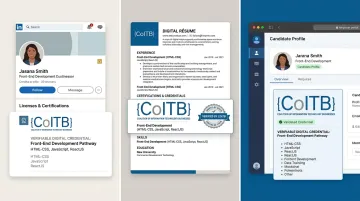
For UX designers, the HTML-CSS credential's accessibility domain maps directly to WCAG compliance requirements now enforced under the European Accessibility Act and US ADA Title II rules. Passed exams include a verifiable digital badge for LinkedIn, résumés, and employer portals — useful for bootcamp graduates, self-taught designers, and career changers who need third-party validation alongside a portfolio.
Testing options include:
- Online remote proctoring, available 24/7 from any US location
- In-person testing at authorized COITB centers
- Military CAC and VA-issued IDs accepted for identity verification
| Detail | Info |
|---|---|
| Cost | Contact COITB at support@coitb.org or visit coitb.org for current pricing |
| Duration | Flexible; 90-question exams with 90-minute time limits, self-scheduled |
| Best For | Aspiring UI designers, front-end developers, and bootcamp graduates seeking ISO/IEC 17024-aligned credentials to validate HTML, CSS, JavaScript, and React skills |
How to Choose the Right UX Design Certification
Match Format to Your Learning Style
| If you are... | Consider... |
|---|---|
| A disciplined, independent learner | Google Certificate or IxDF |
| Someone who needs accountability and feedback | Designlab UX Academy |
| A professional wanting to validate existing skills | NN/g or COITB |
| A career changer needing technical validation | COITB HTML-CSS or React credentials |
Evaluate Credential Quality Beyond Brand Recognition
Brand name alone is not a reliable proxy for quality. Look for:
- Real portfolio projects — not just theory assessments
- Exam-based validation — proof of skills, not attendance
- ISO/IEC 17024 alignment — signals rigorous, standardized competency testing
Consider Cost-to-Outcome
Prices range from under $300 (IDF annual, Google six months) to $19,300 (NN/g Master). Higher cost doesn't automatically mean a better credential.
Ask whether the program includes mentorship, career support, refund or placement guarantees, or portfolio development that justifies the premium.
Factor In 2026 Market Demands
Strong UX candidates in 2026 combine:
- Strong UX methodology and research skills
- AI literacy and practical AI tool fluency
- Accessibility knowledge tied to current regulations (WCAG 2.1 AA)
- Product thinking and measurable impact orientation
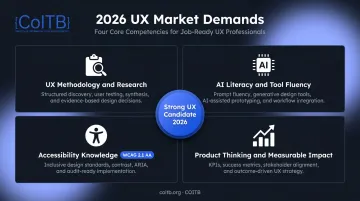
When evaluating any certification, check whether its curriculum reflects these priorities. A program that skips AI fluency and accessibility entirely is unlikely to prepare you for today's hiring bar.
Conclusion
The UX certification landscape in 2026 offers genuinely strong options at every budget and experience level. The right choice comes down to your current skill level, your career goal (entering the field vs. advancing within it), and the kind of validation that resonates with your target employers.
For professionals who want their skills to speak for themselves, credentials backed by real competency assessment, particularly those aligned to ISO/IEC 17024, provide the clearest signal to hiring managers. Hiring managers are getting better at distinguishing between credentials that confirm program completion and those that verify you can actually perform the work — and ISO/IEC 17024-aligned certifications fall firmly in the latter category.
If you're a bootcamp graduate, self-taught developer, or career changer looking to pair that distinction with a credential that holds up to scrutiny, COITB's HTML-CSS Web Designer and ReactJS Framework Developer certifications are worth a close look. Both are aligned to ISO/IEC 17024 and assessed through proctored exams — not coursework completion. Contact COITB at support@coitb.org or visit coitb.org for current pricing and exam details.
Frequently Asked Questions
Is UI/UX still in demand in 2026?
Yes. The Bureau of Labor Statistics projects 7% employment growth for web developers and digital designers from 2024 to 2034, with a median annual wage of $95,380. Roles are evolving toward specialization and AI integration, but demand for skilled UX and UI professionals has not declined.
Which UI/UX certification is best?
It depends on your experience level and goals. Google suits budget-friendly beginners; NN/g is the prestige pick for experienced professionals; Designlab works for career changers needing mentorship. COITB is the option for validating front-end and UI implementation skills through an ISO/IEC 17024-aligned, exam-based credential.
What are the UX/UI trends in 2026?
The key trends are AI integration into design workflows, growing demand for accessibility expertise (driven by the European Accessibility Act and US ADA Title II enforcement), increased role specialization in areas like UX research and AI experience design, and employer preference for designers who can demonstrate measurable product impact.
Do I need a UX certification to get a job in UX design?
No certification is legally required, but a strong portfolio and demonstrable skills are essential. Certifications accelerate the process by providing structured learning, portfolio projects, and a credentialing signal — particularly valuable for career changers or self-taught designers who can't point to a design degree.
How long does it take to complete a UX certification?
Timelines range from a few weeks (self-paced) to 21–36 weeks for bootcamp-style programs. Exam-based credentials like NN/g depend on your course pace. Remote online proctored options, including COITB's, offer the most scheduling flexibility and can shorten the overall timeline.
What is the difference between a UX certificate and a UX certification?
A certificate confirms course completion; a certification is an exam-based credential that validates demonstrated skills. ISO/IEC 17024-aligned certifications carry more weight with employers because they require passing an independent assessment, not just finishing coursework.