Introduction
SQL isn't going anywhere. In the 2025 Stack Overflow Developer Survey, 58.6% of developers reported using it extensively in the past year, ranking it third among all programming and scripting languages, right behind JavaScript and HTML/CSS.
That demand creates a problem: too many certification options. Vendor-specific exams, free quizzes, $245 proctored tests, credentials that expire, credentials that don't. Picking the wrong one wastes money and, worse, time you could've spent job hunting.
This guide breaks down the leading SQL certification courses by cost, format, and career stage, so you can choose based on your actual goals instead of guesswork.
Key Takeaways
- SQL certifications pay off most for career changers, entry-level candidates, and credential-required roles
- Costs range from under $100 to $245+, and vendor renewal cycles can add long-term expense
- Vendor-neutral, ISO/IEC 17024-aligned programs like COITB avoid vendor lock-in across MySQL and general SQL skills
- Certification paired with a portfolio beats certification alone in front of a hiring manager
Why Pursue an SQL Certification
A certification exists to answer one question fast: can this person actually write a query, join two tables, or design a schema without breaking things? Employers can't test that in a 30-minute phone screen, so they lean on credentials instead.
That matters most if you don't have a traditional resume to fall back on.
Certifications carry the most weight for:
- Career changers moving from sales, healthcare, or operations into tech
- Bootcamp graduates without paid SQL work history
- Self-taught developers who learned from YouTube and documentation, not a classroom
- Anyone applying to employers or government contracts that mandate specific credentials
Here's the honest caveat: a certificate alone rarely closes the deal. HackerRank's 2025 Developer Skills Report, surveying 13,732 developers and hiring professionals, found that 96% of developers believe problem-solving should outweigh memorization in technical hiring, and 66% preferred practical coding challenges over credential checks.
Hiring managers still want to see you solve real problems, not just recite JOIN syntax.
So where does a certification actually earn its keep?
- Entry-level applications, where you need something concrete on the resume
- Employer or government mandates that require a specific credential before you can start
- Resume screening software, which often filters for keyword-matched credentials before a human ever looks
- Structured self-assessment, giving you a benchmark for where your skills actually stand
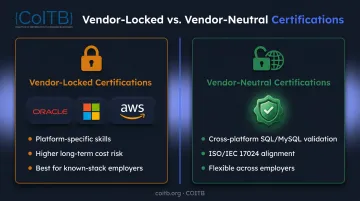
Not every certification carries equal value, either. Oracle, Microsoft, and AWS credentials are vendor-locked, meaning they prove you know that platform's flavor of SQL.
Vendor-neutral programs, like COITB's MySQL Backend Developer Certification, an ISO/IEC 17024-aligned credential, validate SQL and MySQL competency without tying you to one ecosystem. That flexibility matters if you're still deciding which stack you'll end up working in.
Best SQL Certification Courses to Consider in 2026
This isn't an exhaustive ranking. It's a shortlist covering beginner-friendly, vendor-neutral, and enterprise-recognized paths, so you can match the credential to where you actually stand.
| Certification | Cost | Format | Expiration |
|---|---|---|---|
| COITB MySQL Backend Developer | Contact for pricing | 90 questions, 90 min, 70% pass | Term-based, recertification required |
| Oracle 1Z0-071 | $245 | 63 questions, 120 min, 63% pass | Not publicly stated |
| Microsoft DP-900 | $99 | Multi-format, 100+ min typical | Never expires |
| Oracle MySQL DBA 1Z0-908 | $245 | 73 questions, 120 min, 62% pass | Not publicly stated |
| W3Schools SQL | $95 | 60 questions, 60 min, adaptive | Never expires |
| EDB PostgreSQL (Associate/Pro) | $200 | Six-week completion window | Not published |
COITB MySQL Backend Developer Certification
COITB doesn't sell a separately branded "SQL certification." Instead, SQL and database competency gets validated through the MySQL Backend Developer Certification, a non-profit, ISO/IEC 17024-aligned credential built for people with roughly 0-6 months of hands-on database experience.
The exam runs 90 questions in 90 minutes, with a 70% passing score required, covering:
- Relational database schema design (tables, keys, relationships)
- SQL querying, including SELECT, INSERT, UPDATE, DELETE
- Joins, subqueries, and aggregate functions
- Indexing, query optimization, stored procedures, and backup strategies
There's no mandatory prerequisite course. You register, prep on your own, and sit the exam through remote online proctoring (webcam, stable internet, government-issued or military-accepted ID) or at an authorized COITB test center.
Passing earns a digital badge, verifiable through COITB's public registry and shareable directly on LinkedIn. It's compatible with standard employer background-check platforms.
This makes it a solid fit for bootcamp grads, self-taught developers, and career changers. Transitioning veterans and military spouses can often apply GI Bill, VET TEC, MyCAA, or VR&E funding toward the exam fee (verify eligibility with the VA before registering).
Note that the badge is tied to a certification term rather than a lifetime credential. Check COITB's recertification policy before assuming it's a one-and-done purchase.
Oracle Database SQL Certified Associate (1Z0-071)
If your target employer runs an Oracle-heavy stack, this one carries real weight. The exam costs $245, runs 63 questions in 120 minutes, and requires a 63% passing score. Oracle gives you a six-month window to take the exam after purchasing your attempt. Best suited for professionals aiming at enterprise environments already standardized on Oracle databases.
Microsoft Azure Data Fundamentals (DP-900)
DP-900 costs $99 and covers core data concepts, relational and non-relational data on Azure, and analytics workloads. Unlike most Fundamentals-tier credentials, it never expires and requires no renewal fee. It's the natural pick if you're targeting a Microsoft or Azure-centric employer, even though it leans more toward cloud data concepts than deep SQL querying.
MySQL Database Administrator (Oracle)
The Oracle Certified Professional MySQL 8.0 DBA credential (exam 1Z0-908) costs $245, with 73 questions over 120 minutes and a 62% passing score. No formal prerequisite exam is required. This one fits DBAs supporting MySQL-based web applications, especially at startups running lean infrastructure.
W3Schools SQL Certification
At $95 (occasionally discounted), this is the most budget-friendly formal exam on this list. It's adaptive, 60 questions in 60 minutes, with performance tiers at 40% (Intermediate), 75% (Advanced), and 90% (Professional). The certificate never expires. Good option for absolute beginners who want low-stakes exam experience before committing to a pricier credential.
PostgreSQL Certification (EnterpriseDB)
PostgreSQL has no single official certifying body, so third-party providers like EnterpriseDB fill the gap. Their Associate and Professional-level exams run $200 with a six-week completion window. Best for professionals specifically targeting PostgreSQL-heavy environments, though be aware pricing on their newest exam versions isn't yet published.
SQL Certification Cost Breakdown
Costs span a wide range: $95 at the low end (W3Schools) to $245 at the high end (Oracle), with COITB and EDB pricing available on request.
The sticker price only tells half the story. The recurring cost is what most people miss. Some certifications never expire (Microsoft DP-900, W3Schools). Others, like several Oracle credentials, may require periodic recertification depending on the specific credential, though Oracle doesn't publish a renewal fee for 1Z0-071 on its official pages. That ambiguity alone is worth a phone call to the vendor before you commit five years of budget to one ecosystem.
Quick cost comparison over time:
| Certification | Upfront Cost | Renewal Fee | Validity |
|---|---|---|---|
| DP-900 | $99 | $0 | Lifetime |
| W3Schools SQL | $95 | $0 | Lifetime |
| Oracle 1Z0-071 / MySQL DBA | $245 | Unclear | Confirm with Oracle |
| COITB MySQL Backend Developer | Contact for pricing | Not published | Confirm directly with COITB |
No-expiration credentials tend to be easier to budget around precisely because there's no surprise renewal invoice two years later. If unpredictable recurring fees worry you, that's a real factor to weigh, not just a footnote.
How to Get SQL Certified Online
The process looks roughly the same across providers:
- Pick a certification aligned to your goal — vendor-specific, like COITB's MySQL Backend Developer Certification, if you know your stack, or vendor-neutral if you don't
- Complete self-paced prep using documentation, practice datasets, or a bootcamp curriculum
- Register for the exam and schedule a remote proctored session or in-person test center slot
- Verify your identity on exam day using a government-issued ID
- Sit the exam in a quiet, private space with a working webcam and stable connection
Remote proctoring follows a consistent pattern across providers:
- Submit a photo of yourself and your workspace before check-in
- Verify your ID with a government-issued or military CAC/VA-issued document
- Use a secure, monitored browser environment throughout the exam
COITB, for example, supports 24/7 remote scheduling and accommodates deployed service members and OCONUS candidates. That flexibility matters if you're not near a physical test center.
One thing that matters more than the exam format: practice on real datasets before test day. Memorizing syntax gets you through multiple-choice questions. Writing actual queries against messy, real-world data is what gets you through a technical interview afterward.
Choosing the Right SQL Certification for Your Goals
Before spending a dollar, check job postings for your target role. If three out of five postings call out a specific database platform, that tells you something. If they just say "strong SQL skills," a vendor-neutral credential covers more ground.
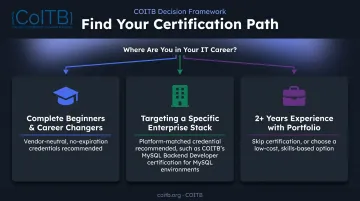
A simple decision framework:
- Complete beginners and career changers: prioritize vendor-neutral, no-expiration credentials that build foundational knowledge without locking you into one platform
- Targeting a specific enterprise stack: match the credential to what that employer runs; for MySQL-based stacks, COITB's MySQL Backend Developer Certification directly validates those skills
- Already have 2+ years of hands-on SQL experience and a real portfolio: skip certification entirely, or pick a low-cost, skills-based credential just to check a box on a resume screener
Don't buy a $245 exam attempt because it sounds impressive. Buy the one that matches what's actually sitting in the job description.
Frequently Asked Questions
How much does it cost to get SQL certified?
Costs range from $95 for self-paced online certificates to $245 for major database vendor exams, with COITB and similar non-profit bodies requiring a direct pricing inquiry. Some vendor certifications also carry annual renewal fees, while non-profit and no-expiration options avoid that entirely.
How do I get SQL certification online?
Complete self-study or coursework, register with your chosen certification body, and take a remote proctored exam from home using a webcam and government-issued ID. Most providers, including COITB, also offer in-person testing as an alternative.
Is SQL certification worth it for beginners?
Yes, particularly for career changers and beginners without a formal work history to prove SQL skills. It won't replace a portfolio, but it helps you clear resume screening and initial interview rounds.
Do SQL certifications expire?
Many vendor certifications require renewal every one to a few years, and renewal fees aren't always published upfront. Open-source and non-profit credentials often run on longer certification terms with less frequent recertification.
Which SQL certification is best for career changers?
Vendor-neutral, beginner-friendly options like COITB's MySQL Backend Developer Certification work well since they combine structured validation with accessibility and no platform lock-in.
Can I get an IT job with just an SQL certification and no experience?
A certification helps you pass initial resume screening, but it rarely closes the deal alone. Pair it with portfolio projects, freelance work, or volunteer database work to show you can actually apply what you learned.