That dominance creates a problem for anyone trying to break in: too many certification choices. Python Institute, IBM, Google, Harvard, and non-profits like COITB all offer credentials, and they don't overlap as much as you'd think. Picking wrong wastes months and money.
This guide breaks down the best Python certifications for 2026 by career goal, cost, and recognition, so you can choose with confidence instead of guessing.
Key Takeaways
- Employer recognition depends on proctoring rigor and vendor credibility, not just certification volume — COITB's Professional Python Developer Certification uses remote-proctored exams aligned to ISO/IEC 17024 standards
- Costs range from free (Harvard CS50P) to $325+ (PCPP1), with timelines from weeks to months
- Certifications work best paired with portfolio projects, not as standalone proof of skill
- Your choice should hinge on career goal, proctoring credibility, and experience level, not brand name
- Entry-level and career-changer credentials, like COITB's Python certification, fit best for 0-6 months of hands-on experience
Overview of Python Certifications in the IT Job Market
A real Python certification requires passing a proctored, timed exam with a defined passing score. A course completion certificate just confirms you finished watching the videos.
That distinction matters more than most people realize:
- Proctored certifications (PCAP, PCEP, PCPP, and COITB's Professional Python Developer credential) verify identity and monitor the test session
- Completion certificates (many Coursera/edX programs) confirm participation, not performance under exam conditions
- Employers increasingly ask which type you hold, especially for technical roles
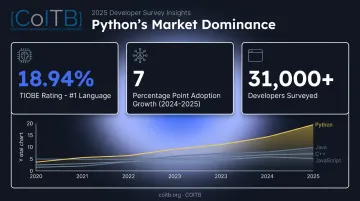
That scrutiny makes sense given how fast Python demand is growing. Python's grip on the job market keeps tightening. On Stack Overflow's 2025 Developer Survey, Python adoption grew 7 percentage points from 2024 to 2025 among more than 31,000 developers surveyed. That's not a small bump for a language already near the top.
The certifications below are organized to help three groups: beginners looking for their first credential, career switchers moving into tech from another field, and working professionals adding Python to an existing skill set. Not every certification fits every goal, so read the "best for" notes closely.
Top Python Certifications to Consider in 2026
This list blends proctored exams, university-backed programs, and non-profit credentialing bodies, selected for industry recognition, cost transparency, and how well each one validates real-world skill.
PCEP – Certified Entry-Level Python Programmer
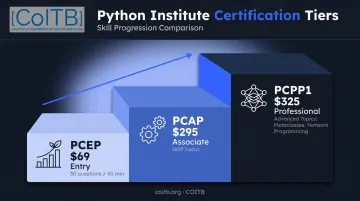
Python Institute's PCEP is the cheapest formal Python credential available, with no prerequisites and a beginner-friendly exam structure of 30 questions in 40 minutes.
It's best treated as a stepping stone toward PCAP rather than a career-defining credential on its own. Note: the current version is valid for 5 years, not lifetime, despite older claims floating around online.
| Cost | Level | Best For |
|---|---|---|
| $69 | Entry | Absolute beginners wanting formal validation |
PCAP – Certified Associate in Python Programming
PCAP is the most widely recognized Python-specific certification among employers. It's delivered through Pearson VUE proctoring (in-person or online) and covers object-oriented programming heavily, which entry-level credentials skip.
Cisco Networking Academy's Python Essentials 2 course prepares learners for PCAP, and Stanford IT runs a dedicated prep workshop. Neither is a formal endorsement, but both signal the exam's standing in training circles. It's a strong fit for junior-to-mid developers and career changers who need proof beyond a bootcamp certificate.
| Cost | Level | Best For |
|---|---|---|
| $295 | Associate | Junior-to-mid-level developers, career changers |
PCPP1 & PCPP2 – Certified Professional in Python Programming
These are advanced, professional-level credentials. PCPP1 covers:
- Advanced OOP and metaclasses
- Tkinter GUI programming
- Network programming (sockets, HTTP, REST, JSON)
- SQLite database access
PCPP1 (exam code PCPP-32-101) is active and priced from $325, correcting the outdated $195-295 range you'll see on older blogs. It also carries lifetime validity under the current version. PCPP2 is still listed as "in development" at Python Institute, so treat it as a future credential rather than something you can sit for today.
| Cost | Level | Best For |
|---|---|---|
| $325 (PCPP1) | Professional | Senior developers, software architects |
Beyond Python Institute's proctored track, non-profit credentialing bodies offer an alternative path worth comparing.
COITB Python Certification
COITB is a non-profit credentialing body offering an ISO/IEC 17024-aligned Professional Python Developer Certification. It's built for candidates at any experience level, not just those with formal computer science backgrounds.
The exam covers ground that matches real job requirements:
- Python syntax, data types, and control flow
- Data structures (lists, dictionaries, strings)
- Object-oriented programming with classes and methods
- File handling, APIs, and error handling
- Automation scripting and application development
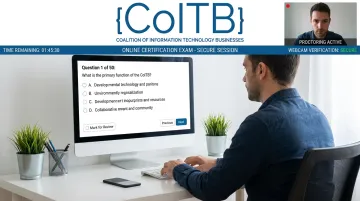
At 58 questions in 75 minutes with a 70% passing threshold, it's actually the most compact exam in COITB's seven-credential catalog. It's delivered online via remote proctor or at an authorized test center, making it accessible for candidates anywhere, including deployed service members and rural candidates. COITB recommends 0-6 months of hands-on Python practice, but there's no mandatory prerequisite blocking registration.
| Cost | Level | Best For |
|---|---|---|
| Contact COITB for pricing | All levels | Career changers, bootcamp grads, self-taught developers seeking an accessible, industry-recognized credential |
For those targeting data roles specifically or preferring a university- or employer-backed name, the next few options shift toward structured, multi-course pathways.
IBM Data Science Professional Certificate
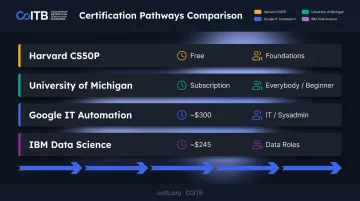
This Coursera program is the most comprehensive entry-level Python-to-machine-learning pathway on the market. It's a 12-course series covering pandas, Matplotlib, Seaborn, Scikit-learn, SQL, and a capstone project, with no prior experience required.
IBM's brand recognition helps career switchers stand out, and the program carries an ACE recommendation for up to 12 US college credits (subject to institutional acceptance). The program runs through Coursera Plus subscription access rather than a fixed one-time fee, so budget around $59/month until you finish.
| Cost | Level | Best For |
|---|---|---|
| ~$245 total (estimated at typical pace) | Beginner-Intermediate | Career changers targeting data analyst/scientist roles |
Google IT Automation with Python Professional Certificate
Built for IT professionals who want to automate repetitive tasks, this seven-course series covers Python fundamentals, OS interaction, Git/GitHub, troubleshooting, and cloud configuration management.
Google backs it with access to an employer consortium of 150+ companies, including AT&T and Wells Fargo. That's consortium participation, though, not a hiring guarantee. Google reports that over 70% of surveyed US Career Certificate graduates saw a positive career outcome (new job, promotion, or raise) within six months, though that figure spans Google's broader certificate portfolio, not this program alone.
| Cost | Level | Best For |
|---|---|---|
| ~$49/month, most finish under $300 | Beginner | IT professionals, sysadmins, help desk staff |
Harvard CS50P: Introduction to Programming with Python
This is a free, university-backed course taught by Harvard, ideal for building strong foundations without spending a dollar. The structure is rigorous:
- Nine problem sets (numbered 0-8)
- A final project requiring
main()plus three additional functions - pytest-based testing for at least three functions
- A three-minute demo video
Harvard's own pages list it as both a 9-week and "ten weeks of material" course, so expect some flexibility in exact timing.
| Cost | Level | Best For |
|---|---|---|
| Free | Beginner | Beginners wanting a globally recognized free credential |
University of Michigan: Python for Everybody Specialization
A beginner-friendly gateway covering Python fundamentals, web scraping, databases, and data visualization across five courses. It's rated 4.8/5 with over 280,000 reviews and nearly two million enrollments, strong proof of learner satisfaction even if it doesn't carry the proctored-exam weight of PCAP or PCEP.
| Cost | Level | Best For |
|---|---|---|
| Subscription-based, no fixed total published | Beginner | Non-technical professionals and data science-curious beginners |
How to Choose the Right Python Certification
The most common mistake? Picking the certification everyone talks about instead of the one that matches your actual career goal. Data science, software development, and automation each reward different skill emphases, and no single certificate covers all three equally well.
Before committing, weigh these factors:
- Proctoring and credibility: Is it a timed, monitored exam or a completion badge?
- Prerequisites and experience level: Does it assume prior coding knowledge?
- Cost versus time investment: Can you realistically finish before the material goes stale?
- Employer recognition: Do job postings in your target field actually name-check this credential?
That last point matters most. Open five to ten job listings for the role you want and search for certification names directly. If PCAP or a specific Coursera program keeps showing up, that's your signal. If nothing does, prioritize skills validation over brand chasing. A remote-proctored, ISO/IEC 17024-aligned option like COITB's Professional Python Developer certification can validate that skillset directly, paired with a portfolio to show it in action.
Are Python Certifications Worth It for Your Career?
Short answer: yes, with conditions. Certifications work best for breaking into tech, filling specific skill gaps, or getting past automated résumé screening that filters for keywords.
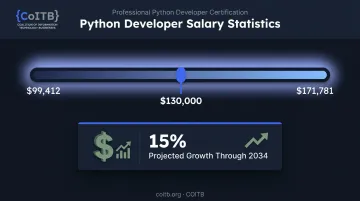
The salary numbers back up Python's career value. Glassdoor reports US Python Developer median total pay of $130,000, with a typical range of $99,412 to $171,781 depending on experience and location. The Bureau of Labor Statistics separately projects 15% growth for software developers overall through 2034, a broader occupational category that includes Python-heavy roles.
No certification body has published data proving that earning a credential causes a salary bump, though. Treat certifications as career context that supports your case, not a guaranteed payoff on its own.
What actually moves the needle:
- Certifications fill résumé gaps for career changers with no formal CS background
- Entry-level roles weight certifications more heavily during initial screening
- Senior positions care far more about your GitHub history and shipped projects than your badge collection
- Pairing a certificate with 2-3 portfolio projects demonstrates the coding ability employers actually test for in interviews
If you're early-career, pair a credential like COITB's Professional Python Developer Certification with 2-3 shipped projects on GitHub. A hiring manager scanning résumés sees proof of skill twice over, not just a badge.
Conclusion
There's no single "best" Python certification for everyone. The right choice depends on your career stage, your budget, and where you're headed, not which name sounds most impressive on LinkedIn.
Your best fit depends on where you're starting:
- Starting from zero: Harvard CS50P costs nothing and builds real foundations
- Targeting data roles: IBM's program goes deeper into data-specific applications
- Want flexible, practical validation: COITB's Professional Python Developer Certification skips rigid prerequisites and fits career changers, bootcamp grads, and veterans using GI Bill, VET TEC, MyCAA, or VR&E benefits (verify eligibility with the VA before registering)
Whatever you choose, pair it with hands-on projects — that combination is what actually gets you hired.
Ready to start? Visit coitb.org/auth/signup to create your account, or take the free practice assessment first to gauge your readiness.
Frequently Asked Questions
What is the most respected Python certification?
PCAP from the Python Institute is widely regarded as the most respected due to Pearson VUE proctoring and its associate-level depth. IBM's and Google's certificates carry strong platform recognition, especially with career changers, while COITB's Professional Python Developer Certification offers a proctored, ISO/IEC 17024-aligned alternative for candidates with 0-6 months of hands-on experience.
What is the average salary for a Python developer?
Glassdoor reports a US median total pay of $130,000 for Python developers, with a typical range of $99,412 to $171,781. Actual pay varies widely by experience level, location, and specialization.
Are Python certifications worth it in 2026?
Yes, especially for beginners and career switchers who need to fill résumé gaps. Pair any certification with portfolio projects, particularly if you have limited professional coding experience.
Can I get a Python certification for free?
Harvard's CS50P is completely free. Many Coursera and edX courses can also be audited at no cost, though you won't receive the certificate without paying.
How long does it take to earn a Python certification?
Timelines range from a few weeks for PCEP to several months for IBM, Google, or university programs. Your prior experience and weekly study hours determine where you land.
What's the difference between PCEP, PCAP, and PCPP?
PCEP is entry-level with no prerequisites. PCAP is associate-level, covering OOP in depth. PCPP1 and PCPP2 are professional-level, covering advanced topics like metaclasses and network programming, with higher costs at each step up.