Introduction
Demand for engineers who can actually build GenAI systems — not just use them — is accelerating. Lightcast's 2025 analysis of over 1.3 billion job postings found 800% growth since 2022 in generative AI roles across non-tech industries, and jobs requiring AI skills command a 28% salary premium — nearly $18,000 more per year.
A generative AI user prompts ChatGPT. A generative AI engineer builds RAG pipelines, deploys LLM chains in production, implements AI agents, and monitors model drift.
That distinction matters to hiring managers. Self-taught skills are notoriously hard to verify in a field this new — certified proof of hands-on technical capability is increasingly what separates candidates.
If you're deciding which credential to pursue, this guide breaks down the five most career-relevant certifications for GenAI engineers in 2026 — what each tests, who it's built for, and how to match the right credential to your experience level and tech stack.
Key Takeaways
- GenAI engineer certifications validate hands-on skills — RAG pipelines, LLM deployment, prompt engineering, and AI governance — that employers are actively hiring for.
- Costs range from $100 to $550, with options across entry-level and associate-level experience tiers.
- Platform-specific credentials (Databricks, NVIDIA) fit engineers in those ecosystems; AWS, CGAI™, and COITB offer broader cross-industry recognition.
- COITB's Certified GPT Professional is ISO/IEC 17024-aligned, requires no prerequisites, and accepts military CAC for remote proctoring.
- Match your cert to your actual tech stack, not just the most recognizable brand name.
Why Generative AI Engineer Certifications Matter in 2026
A generative AI engineer in 2026 designs LLM-powered applications, builds retrieval-augmented generation systems, deploys AI agents, and maintains model performance in production. The skills required are specific — and employers are actively trying to identify who actually has them.
Deloitte's 2024 research found that 75% of global organizations expected GenAI to change their talent strategies within two years — with 47% prioritizing upskilling and reskilling as part of those changes. That urgency is reshaping how both engineers and hiring teams think about credentials.
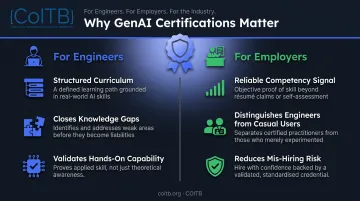
Certifications serve two practical purposes here:
- Engineers get a structured, validated curriculum that closes genuine knowledge gaps — self-directed learning in a fast-moving field often leaves blind spots that only show up on the job.
- Employers get a reliable competency signal — especially valuable when most hiring managers can't easily distinguish a strong GenAI engineer from someone who's only used the tools casually.
Both needs point to the same gap: validated, role-specific credentials for engineers doing the actual technical work. The five certifications below were selected for exactly that audience — not business strategists or executives — based on technical depth, issuing body credibility, cost-to-value ratio, and real-world relevance to GenAI engineering workflows.
Top Generative AI Engineer Certifications in 2026
Databricks Certified Generative AI Engineer Associate
Background: Launched in January 2024 and updated through March 2026, this is one of the most engineering-specific GenAI credentials available. It tests your ability to design, build, evaluate, and deploy LLM-powered applications — including RAG pipelines and AI agents — on the Databricks platform.
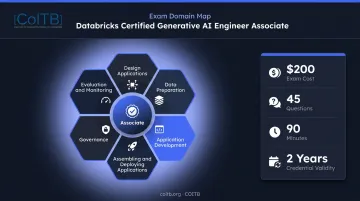
Why it stands out: The exam maps directly to production workflows across six domains:
- Design Applications
- Data Preparation
- Application Development
- Assembling and Deploying Applications
- Governance
- Evaluation and Monitoring
Coverage includes LangChain, Mosaic AI Vector Search, MLflow tracing, Unity Catalog, and AI Gateway — tools actively used in enterprise AI stacks.
| Detail | Info |
|---|---|
| Cost | $200 |
| Format | 45 scored questions, 90 minutes; online-proctored or test center |
| Validity | 2 years |
| Prerequisites | None formal; 6+ months hands-on experience recommended |
| Best For | Data engineers, ML engineers, AI solutions architects using Databricks |
Databricks Academy offers free self-paced prep, making the cost-to-value ratio strong for engineers already in the Databricks ecosystem.
NVIDIA Generative AI LLMs Certified Associate
Background: NVIDIA's associate-level credential validates knowledge in developing, integrating, and deploying AI applications using LLMs with NVIDIA solutions. It's valid for two years and issues a digital badge on passing.
Why it stands out: The exam covers concrete infrastructure-layer skills. Study guide domains include Core ML and AI Knowledge (30%), Software Development (24%), Experimentation (22%), Data Analysis (14%), and Trustworthy AI (10%). Specific coverage spans Python libraries (spaCy, NumPy, Keras), prompt engineering, model scalability and deployment, vector databases, and A/B testing for model evaluation.
| Detail | Info |
|---|---|
| Cost | $125 |
| Format | 50–60 questions, 60 minutes; online remote-proctored |
| Validity | 2 years |
| Prerequisites | Basic understanding of GenAI and LLMs |
| Best For | Software engineers, ML engineers, AI DevOps, and cloud architects |
AWS Certified AI Practitioner
Background: Amazon's entry-level AI credential validates knowledge of AI, ML, and GenAI concepts within an AWS enterprise context. The 2026 version covers Amazon Bedrock and Amazon Q, both increasingly common in production GenAI stacks.
Why it stands out: At $100, it carries wide employer recognition and a three-year validity period — the longest on this list. Exam domains include Fundamentals of Generative AI (24%), Applications of Foundation Models (28%), Guidelines for Responsible AI (14%), and Security/Compliance/Governance (14%).
| Detail | Info |
|---|---|
| Cost | $100 |
| Format | 65 mixed-format questions, 90 minutes; Pearson VUE or online-proctored |
| Validity | 3 years |
| Prerequisites | None; up to 6 months AWS exposure recommended |
| Best For | Developers and engineers building on AWS who want a widely recognized baseline credential |
Certified Generative AI Specialist — CGAI™
Background: Offered by the Chartered Institute of Professional Certifications, the CGAI™ covers the full technical breadth of GenAI: machine learning foundations, neural network architectures (CNNs, RNNs, GANs), NLP, multimodal models, and AI ethics. It's a curriculum-driven credential rather than a platform-specific exam.
Why it stands out: With 71 lectures totaling nearly 11 hours of content and unlimited exam retakes at no additional charge, CGAI™ offers more structured learning than most vendor certs. The CPD Certification Service recognizes the issuing organization (CPD Provider No. 1722). Note: CPD accreditation covers training and learning activities — it's distinct from ISO/IEC 17024 personnel certification body accreditation.
| Detail | Info |
|---|---|
| Cost | $550 (US pricing; verify regional variations) |
| Format | 50 questions; unlimited retakes included |
| Validity | Not specified; verify with issuer |
| Prerequisites | None formal; basic ML knowledge helpful |
| Best For | Software developers, data scientists, IT professionals wanting a vendor-neutral, curriculum-heavy GenAI credential |
COITB Certified GPT Professional
Background: Offered by COITB — a non-profit credentialing body whose programs are designed in alignment with ISO/IEC 17024 standards — the Certified GPT Professional validates practical skills in GPT-based application development. The exam covers five domains: Foundations of Generative AI (10%), Prompt Engineering and Output Control (20%), OpenAI Syntax and GPT Integration (40%), Responsible AI and Compliance (15%), and Applied GPT Use Cases (15%).
Why it stands out: The largest domain — OpenAI Syntax and GPT Integration at 40% — tests real engineering tasks: implementing GPT API calls in Python and JavaScript, parsing JSON responses, displaying output in a React interface, integrating GPT with N8N or Flowise automation workflows, and connecting to external APIs. Every tested skill maps to something you'd actually build on the job.
No formal prerequisites are required. Remote online proctoring accepts military CAC and VA-issued ID, making it accessible for veterans, bootcamp graduates, career changers, and self-taught developers entering GenAI from non-traditional backgrounds.
| Detail | Info |
|---|---|
| Cost | Contact COITB directly; veterans may qualify for GI Bill/VET TEC coverage (verify with VA before registering) |
| Format | 60 questions, 75 minutes; 71% passing score |
| Validity | Time-bound; recertification policy published at coitb.org |
| Prerequisites | None; 0–6 months hands-on AI experience recommended |
| Best For | Aspiring GPT engineers, career changers, bootcamp graduates, veterans, and professionals entering GenAI from non-traditional backgrounds |
For full exam details, visit coitb.org/certifications/certified-gpt-professional.
How to Choose the Right Certification
These credentials weren't selected from a generic "top AI certs" list — they were filtered specifically for engineers who build and deploy GenAI systems. Business strategy and leadership credentials were excluded.
Evaluation criteria used:
- Does the exam test actual engineering skills — RAG, LLM deployment, API integration, governance?
- Is the issuing body an established tech company, ISO-aligned credentialing body, or independently accredited organization?
- Does the exam fee justify employer recognition and career impact?
- Are prerequisites realistic for your experience level?
- Is the exam available online with remote proctoring and flexible scheduling?
These criteria narrow the field fast — but the final call still trips up a lot of candidates. The biggest mistake is choosing a cert based on brand recognition rather than tech stack alignment. If you work daily in Databricks, the Databricks Associate cert will carry more weight than a vendor-neutral credential. Building AWS-native apps? Start with the AWS AI Practitioner. Coming from a non-technical background or a bootcamp? COITB and AWS both offer low barrier-to-entry paths worth considering.
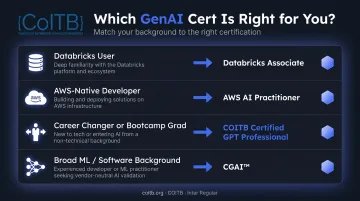
Pick the credential that reinforces your existing or target tech stack — not one that signals familiarity with tools you'll never actually use.
Conclusion
In 2026, RAG pipelines, LLM deployment, and AI governance are expected skills for competitive IT professionals — not niche specializations. A well-chosen certification validates those skills to employers and gives you a structured framework to close gaps that self-directed learning often leaves open.
For beginners and career changers: Start with an accessible, vendor-neutral credential — AWS AI Practitioner or COITB Certified GPT Professional both have no prerequisites and cover foundational engineering skills.
For experienced engineers: Go platform-specific. Databricks or NVIDIA credentials carry more weight when they directly match your production environment.
If you're starting from scratch, COITB's Certified GPT Professional is built for exactly that — no experience required, fully remote, and recognized against ISO/IEC 17024 standards.
Frequently Asked Questions
What skills should a generative AI engineer have before pursuing certification?
Basic Python proficiency, familiarity with REST APIs, and a working understanding of how LLMs process input and generate output are helpful starting points. Entry-level credentials like AWS AI Practitioner and COITB Certified GPT Professional require no formal prerequisites, so candidates from non-technical backgrounds can sit these exams after focused self-study.
How long does it take to prepare for a generative AI engineer certification?
It varies by exam and prior experience. Entry-level credentials typically require 2–4 weeks of focused preparation. Associate-level exams like the Databricks Generative AI Engineer Associate generally require 6+ months of hands-on experience plus dedicated exam prep.
Are generative AI engineer certifications worth it for software developers in 2026?
Yes. AI skills are associated with a 28% salary premium according to Lightcast's 2025 analysis, and 75% of global organizations expect GenAI to reshape their talent strategies within two years. Certification gives developers a structured credential that stands out in hiring alongside practical skill validation.
What is the difference between a generative AI certification and a generative AI certificate?
A certification is a formal, standardized assessment of competency that confirms professional capability independent of any specific course. A certificate confirms completion of a training program. Per the Institute for Credentialing Excellence, certifications generally carry more weight with employers because they assess skills independently.
Which generative AI engineer certification is best for beginners with no AI background?
AWS Certified AI Practitioner ($100, no prerequisites) and COITB Certified GPT Professional (no prerequisites, remote proctoring, flexible scheduling) are the most accessible starting points. Both build from foundational concepts and require no prior engineering experience.
Do generative AI engineer certifications expire?
Most do. NVIDIA's GenAI LLMs Associate and Databricks Associate are valid for two years; AWS AI Practitioner is valid for three. COITB certifications are time-bound with a published recertification policy, so verify the specific renewal cycle at coitb.org before registering.