Here's the problem: there are too many SQL certifications competing for your attention. Microsoft, Oracle, AWS, Google, MySQL-specific credentials, free platforms — the list keeps growing. Many people struggle to figure out which one actually moves the needle with employers versus which one just drains time and money.
This guide breaks down whether certification is worth pursuing in 2026, which options fit which career paths, and how to choose without wasting a paycheck on the wrong exam.
Key Takeaways
- SQL certifications matter most for career changers, entry-level candidates, and roles with employer-mandated credentials
- The "best" certification depends on your target employer's tech stack — Oracle, Microsoft, MySQL, or cloud platforms
- Real query-writing skills and portfolio projects matter as much as the certificate itself
- ISO/IEC 17024-aligned, non-profit bodies offer accessible entry points — COITB's MySQL Backend Developer Certification is one option for beginners with limited hands-on experience
Are SQL Certifications Worth It in 2026?
Hiring managers care more about whether you can solve a real query problem than whether you have a certificate hanging on your resume. But that doesn't mean certifications are worthless — it means they play a specific, limited role.
Pearson VUE's April 2026 survey of 505 IT and HR leaders found that 48% used certification as a hiring prerequisite and 62% said it helped recruitment. That's broad IT hiring data, not SQL-specific proof — but it tells you certification still opens doors, especially past the initial resume screen.
That said, a certificate alone won't carry you past a skills check. SHRM's 2022 research found 79% of HR professionals weighed skills-assessment scores as much as or more than traditional criteria like degrees or certificates. In practice, certification gets your resume noticed; your query performance in the interview closes the deal.
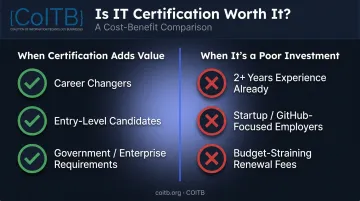
When Certification Adds Real Value
- Career changers who need structured proof they can actually query a database
- Entry-level candidates without a work history to point to
- Government contracts or enterprise employers that explicitly require named credentials
When It's a Poor Investment
- You already have 2+ years of hands-on SQL experience
- You're applying to startups that care more about GitHub commits than badges
- Renewal fees would strain your budget more than they'd help your career
That last point matters more than most people realize. Certifications aren't always a one-time cost. Many database credentials in this range run $150-$200 upfront, with renewal costs that vary widely by provider — some are free annually, others require repurchasing after a few years. COITB's MySQL Backend Developer Certification, for instance, targets candidates with limited hands-on experience and is designed as a one-time validation rather than a recurring subscription cost.
Certification works best as one piece of a bigger strategy — paired with real projects, a GitHub portfolio, or freelance client work — not as a standalone ticket to a job offer.
The Confidence and Resume Factor
Even when a hiring manager barely glances at your certifications, they often matter earlier in the process. Many companies still run resumes through automated ATS filters that scan for keywords like "SQL certified" or specific credential names before a human ever sees your application.
Certifications also build confidence that's hard to measure but easy to feel. Passing a timed exam on joins, indexes, and query optimization proves you can perform under pressure — a fact that shows up in how you answer technical interview questions, whether or not the interviewer ever asks to see the badge.
Best SQL Certifications in 2026
There's no single "best" SQL certification. The right pick depends entirely on your career stage and the tech stack your target employer runs. Below is a breakdown by use case.
Best for Beginners and Career Changers
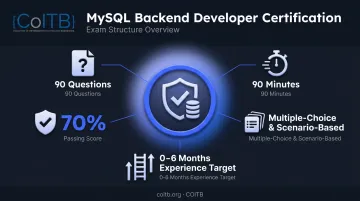
If you're just starting out, skip the advanced cloud exams. COITB's MySQL Backend Developer Certification is built specifically for candidates with 0-6 months of hands-on MySQL or SQL experience, whether that experience came from a bootcamp, self-study, coursework, or early on-the-job work.
The exam runs 90 questions in 90 minutes, mixing multiple-choice and scenario-based items, with a 70% passing score. That's one of the more accessible thresholds in COITB's portfolio, compared to 75% for HTML-CSS or 73% for JavaScript and ReactJS.
As a non-profit credentialing body with ISO/IEC 17024-aligned programs, COITB offers a budget-conscious way to validate real database skills without a multi-year vendor renewal cycle. Candidates can gauge readiness first with a free practice assessment.
If your target employer runs a specific cloud platform, entry-level vendor exams like W3Schools' SQL Certificate ($95) or Microsoft's Azure Data Fundamentals (DP-900, $99) can complement a skills-based credential like COITB's.
Best for Database Administrators
- Oracle Database SQL Certified Associate (1Z0-071) — 63 questions, 120 minutes, 63% passing score. Oracle's official pages don't currently list a public USD price or a fixed renewal cadence (confirm pricing directly with Oracle).
- Microsoft Azure Database Administrator Associate (DP-300) — $165 USD, 100-minute proctored exam. Renews annually at no cost through a Microsoft Learn assessment. Strong fit for enterprises running Azure SQL or on-prem SQL Server.
Best for Cloud Data Engineering
- Google Professional Cloud Database Engineer — $200 plus tax, 2-hour exam, 50-60 questions. Google recommends 5 years of database experience, including 2 years on Google Cloud specifically. Valid 2 years.
- AWS Certified Data Engineer – Associate — $150 USD, 130-minute exam, 65 questions. AWS recommends 2-3 years of data engineering experience. Valid 3 years, renewable with a 50% voucher.
Both test broader data pipeline skills, not just SQL syntax: think orchestration, storage design, and cloud-native tooling.
Best Free or Low-Cost Options
- TestDome SQL Certification — Free for jobseekers who finish in the top 25% of test-takers. Timed, real-world coding tasks including CRUD operations. Certificate never expires.
- Oracle Cloud Infrastructure Foundations — Zero-cost per Oracle's last official statement (verify current pricing before registering).
How to Choose the Right SQL Certification for Your Career Path
Before picking a certification, run through this checklist honestly.
- Assess your skill level first. Beginner, intermediate, or advanced: don't buy an associate-level cloud exam if you've never written a JOIN clause.
- Research target job postings. Look for which database platforms come up repeatedly, such as MySQL, SQL Server, Oracle, or PostgreSQL, and match your certification to that stack.
- Calculate total cost of ownership. Factor in renewal fees over 3-5 years, not just the sticker price of the first exam.
- Match the format to your learning style. Traditional multiple-choice exams suit some people; hands-on, scenario-based credentialing suits others better.
- Check for standards alignment. Certifications aligned to ISO/IEC 17024 signal a rigorous, standardized assessment process rather than a simple pay-to-pass exam. COITB's MySQL Backend Developer Certification, for instance, carries this alignment despite being a smaller non-profit credential.
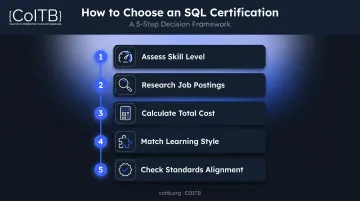
Once you've worked through this checklist, you'll have a shortlist that fits your budget, skill level, and target job market — not just the most heavily marketed option.
SQL Certification Comparison at a Glance
Before committing time or money, compare the major SQL credentials side-by-side. Costs, prep time, and renewal terms vary widely across issuing bodies.
| Certification | Issuing Body | Approx. Cost | Prep Time | Renewal Cycle | Best For |
|---|---|---|---|---|---|
| W3Schools SQL | W3Schools | $95 | ~48 hrs (course estimate) | Never expires | SQL basics, vendor-neutral |
| MySQL Backend Developer | COITB | Contact for pricing | Varies (0-6 mo. experience) | Aligned to certification term | Backend/database career changers |
| Azure Data Fundamentals (DP-900) | Microsoft | $99 | ~6 hrs (modules) | Never expires | Azure-curious beginners |
| OCI Foundations Associate | Oracle | Free (verify current) | Not published | 24 months | Oracle Cloud beginners |
| Oracle SQL Certified Associate | Oracle | Not publicly listed | Not published | Not specified | Oracle-heavy enterprises |
| Azure Database Admin (DP-300) | Microsoft | $165 | ~24 hrs (modules) | Annual, free | Azure SQL administrators |
| Cloud Database Engineer | $200 + tax | Not published | 2 years | Google Cloud specialists | |
| Data Engineer Associate | AWS | $150 | Not published | 3 years | AWS-centric data engineers |
| TestDome SQL | TestDome | Free | Not published | Never expires | Quick, no-cost skill proof |
Certifications with no expiration, like W3Schools, TestDome, and COITB's MySQL Backend Developer Certification, offer better long-term value if you're budgeting carefully. Vendor certs tied to annual or multi-year renewals can add hundreds of dollars over time.
COITB's MySQL Backend Developer Certification stands out for career changers moving into backend and database roles. The exam runs 58-90 questions over 75-90 minutes, is available through remote online proctoring or authorized test centers, and issues a digital badge on passing. Transitioning veterans and military spouses using GI Bill, VET TEC, MyCAA, or VR&E benefits should verify eligibility with the VA or their SAA before registering. Bookmark this table before you commit money or study hours to any single path.
Frequently Asked Questions
What is the most recognized SQL certification?
Recognition depends entirely on the employer's tech stack. Microsoft/Azure certs dominate enterprise environments, Oracle certs matter most in Oracle-heavy industries, and AWS or Google credentials carry more weight at cloud-first companies.
Are SQL certifications worth it?
They're worth it for career changers, entry-level candidates, and situations where an employer explicitly requires one, especially credentials like COITB's MySQL Backend Developer Certification that are built for candidates with 0-6 months of experience. Once you have real-world portfolio experience, the certificate matters less than your actual query skills.
Do SQL certifications expire?
Many vendor certifications — Microsoft, Oracle, AWS, Google — require renewal every 1-3 years. Others, like MySQL-focused credentials, W3Schools, and TestDome, do not expire.
How long does it take to get SQL certified?
Timelines range from under an hour for skills-based tests like TestDome to 2-4 months for complete beginners working through a structured beginner credential, depending on prior experience.
Can I get a job with just an SQL certification and no experience?
It's possible for entry-level roles, but significantly harder without supporting portfolio projects, internships, or freelance work that demonstrate you can actually write and debug queries.
Which SQL certification is best for beginners?
Low-cost, no-prerequisite options like W3Schools work well for a first step. COITB's MySQL Backend Developer Certification is another solid choice, built specifically for candidates with 0-6 months of hands-on experience.