For professionals looking to break into AI roles or advance within them, a formal credential is increasingly the difference between getting screened in or screened out. But with dozens of options spanning multiple experience levels, price points, and technical depths, picking the right one is genuinely confusing.
This guide cuts through the noise. Below are ten AI certifications selected for employer recognition, career relevance, breadth of coverage, and accessibility across experience levels — from a $50 security credential to a $26,000+ academic program.
Key Takeaways
- Beginners can validate AI skills fast with entry-level credentials like COITB's Certified GPT Professional
- Developers building cloud AI solutions should target the Google Professional ML Engineer certification
- Security and governance professionals have a dedicated AI credential pathway through ISACA
- PMs and non-engineers can add technical AI credentials — like Certified GPT Professional — on top of existing PM credentials to pivot into technical leadership roles
- Exam-based certifications carry more employer weight than course-completion certificates — know the difference before listing one on your résumé
Why AI Certifications Matter for Career Advancement
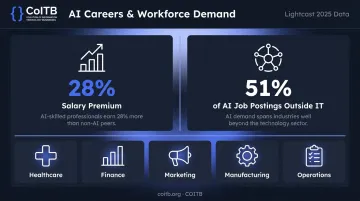
Employer demand for AI skills has moved well beyond the tech sector. Lightcast's 2025 Global AI Skills Outlook, based on 1.3 billion job postings across 150 countries, found a 28% salary premium for jobs requiring AI skills — and that 51% of AI-skill postings in 2024 were outside IT and computer science. Marketing, operations, healthcare, and finance roles now list AI proficiency as a required or preferred skill.
Those numbers change how you should think about credentials. Self-study and online courses build knowledge, but employers have no standardized way to verify what you can do from a course completion alone. A formal certification — one backed by a proctored exam and a defined competency framework — gives hiring managers a concrete, comparable benchmark.
The ten credentials below were selected across entry to advanced levels, covering technical AI development, business applications, security governance, and program management. Each was evaluated on exam rigor, industry recognition, and relevance to roles hiring now.
Top 10 AI Certifications for Career Advancement
These credentials were selected based on employer recognition, career relevance, breadth of coverage, and accessibility. The list includes both vendor-specific credentials (AWS, Google) and vendor-neutral options (ARTiBA, CertNexus, COITB) across multiple career tracks.
1. AWS Certified AI Practitioner
Offered by Amazon Web Services, this entry-level certification validates foundational AI/ML knowledge and practical familiarity with AWS AI services. It's designed for business analysts, project managers, IT support staff, and non-technical professionals who need AI fluency without deep coding requirements.
| Detail | Info |
|---|---|
| Best For | Non-technical professionals, business analysts, project managers new to AI |
| Cost & Duration | $100 exam fee; 90-minute exam, 65 questions |
| Key Skills Covered | AI/ML fundamentals, responsible AI, generative AI concepts, AWS AI services |
No hard prerequisites are required. AWS describes the target candidate as someone with up to six months of exposure to AI/ML on AWS — making this the most accessible gateway on this list for professionals in non-engineering roles.
2. Google Professional Machine Learning Engineer
This advanced certification from Google Cloud targets ML engineers and data scientists who design, build, and deploy machine learning models into production environments at scale. It covers the full ML lifecycle within Google Cloud infrastructure.
| Detail | Info |
|---|---|
| Best For | ML engineers and data scientists managing end-to-end model production on GCP |
| Cost & Duration | $200 plus applicable tax; 2-hour exam, 50–60 questions |
| Key Skills Covered | Model architecture, MLOps, data pipelines, scalable AI deployment on Google Cloud |
Google recommends 3+ years of industry experience, including at least one year managing solutions on Google Cloud. Mid-to-senior ML engineering roles treat this credential as a meaningful differentiator.
3. Microsoft Azure AI Engineer Associate (Retired June 30, 2026)
Important note: The Azure AI Engineer Associate certification and its AI-102 exam were officially retired on June 30, 2026. As of this writing, the exam is no longer available for purchase. Professionals who held this credential before retirement should check Microsoft Learn for any successor credential announcements, as Microsoft's certification roadmap continues to evolve.
It's included here because it remains widely referenced in job postings and professional profiles, and understanding its former scope helps candidates identify relevant successor credentials.
| Detail | Info |
|---|---|
| Best For | Developers and junior AI engineers building AI-powered apps on Azure |
| Status | Retired June 30, 2026 — check Microsoft Learn for current alternatives |
| Key Skills Covered | Azure AI services, model deployment, responsible AI, NLP, computer vision |
4. IBM AI Developer Professional Certificate (Certificate, Not Certification)
Offered through Coursera in partnership with IBM, this is a course-completion certificate — not an exam-based certification. The distinction matters for your résumé (more on that below), but it's a 10-course beginner program spanning approximately 6 months at 4 hours per week, with no prior programming experience required.
| Detail | Info |
|---|---|
| Best For | Career changers and complete beginners building foundational AI and development skills |
| Cost & Duration | Coursera subscription; approximately 6 months at 4 hrs/week |
| Key Skills Covered | Python, generative AI, prompt engineering, AI app development with Flask |
For candidates who prefer guided, structured learning before sitting a proctored exam, this is a practical first step into AI development.
5. ARTiBA Artificial Intelligence Engineer (AiE)
Offered by the Artificial Intelligence Board of America, the AiE is one of the earliest vendor-neutral AI certifications and remains widely recognized. Three eligibility tracks accommodate different backgrounds: bachelor's degree, master's degree, or professional experience pathway.
| Detail | Info |
|---|---|
| Best For | CS/IT professionals, self-taught engineers, and AI practitioners pursuing engineering roles |
| Cost & Duration | $750 all-inclusive (exam, learning resources, digital badge, credential kit) |
| Key Skills Covered | Machine learning, NLP, neural networks, computer vision, deep learning, ethical AI |
One important correction to watch for: the AiE expires after three years and requires paid renewal ($200 standard). It is not a lifetime credential, despite some older sources claiming otherwise.
6. CertNexus Certified Artificial Intelligence Practitioner (CAIP)
The CAIP is a vendor-neutral credential designed for data professionals who want to formalize foundational-to-intermediate AI and ML knowledge. The current exam blueprint (updated March 2025) lists no hard prerequisites.
| Detail | Info |
|---|---|
| Best For | Data professionals, analysts, and engineers formalizing AI and ML competency |
| Cost & Duration | $367.50 exam voucher; self-paced preparation |
| Key Skills Covered | AI/ML for business problems, model training and optimization, deploying ML systems |
Recommended background includes applied mathematics, Python programming, and statistical modeling. Data analysts and engineers who already work adjacent to AI will find this credential transferable across industries and platforms — a practical choice for formalizing skills that are already in use.
7. PMI Certified Professional in Managing AI (PMI-CPMAI)
From the Project Management Institute, this tool-agnostic certification targets project managers, technologists, and consultants who lead AI initiatives without necessarily building the models themselves. No prior experience is required.
| Detail | Info |
|---|---|
| Best For | Project managers, technology leaders, and consultants overseeing AI programs |
| Cost & Duration | $699 member / $899 non-member (bundle pricing; verify current rates with PMI) |
| Key Skills Covered | AI project lifecycle, cross-functional team management, AI strategy and operationalization |
As organizations build dedicated AI program management functions, this credential addresses a real skills gap. It validates the ability to align cross-functional teams and deliver measurable AI outcomes without a deep engineering background.
8. ISACA Advanced in AI Security Management (AAISM)
ISACA's AAISM targets security professionals who manage AI risks, governance frameworks, and compliance obligations. One important pricing correction: the exam costs $459 for ISACA members or $599 for non-members, plus a separate $50 certification application fee. The often-cited "$50 total" figure is inaccurate.
Also note: candidates must hold an active CISM or CISSP to be eligible.
| Detail | Info |
|---|---|
| Best For | Security professionals, risk managers, and IT auditors working in AI governance |
| Cost & Duration | $459 member / $599 non-member exam fee + $50 application fee |
| Key Skills Covered | AI security management, risk assessment, AI governance frameworks, compliance |
ISACA also offers companion credentials in AI Risk (AAIR) and AI Audit (AAIA) — creating a full governance and security credentialing pathway for compliance-focused professionals.
9. Stanford Artificial Intelligence Graduate Certificate (Academic Certificate)
Stanford's graduate certificate is the most academically rigorous option on this list — and like the IBM offering, it awards a certificate of completion rather than an exam-based certification. It covers ML, deep learning, NLP, robotics, computer vision, and probabilistic modeling, with credits that may apply toward a master's degree (subject to academic-department approval, not guaranteed).
| Detail | Info |
|---|---|
| Best For | Graduate-level professionals seeking advanced academic credentials with research or leadership ambitions |
| Cost & Duration | $20,470–$26,775 total (current Stanford pricing); 1–2 years typical, maximum 3 |
| Key Skills Covered | ML, deep learning, NLP, computer vision, robotics, reinforcement learning |
Entry requirements include a bachelor's degree with a 3.0+ GPA, college-level calculus and linear algebra, and programming experience. This is a serious long-term investment suited for professionals targeting senior AI research or leadership roles.
10. COITB Certified GPT Professional
Offered by COITB, a non-profit credentialing body headquartered in Oklahoma City, the Certified GPT Professional is an exam-based certification aligned to ISO/IEC 17024 standards — the internationally recognized framework for personnel credentialing bodies. The credential is specifically designed for professionals entering the AI workforce regardless of prior background.
| Detail | Info |
|---|---|
| Best For | Career changers, bootcamp graduates, veterans, self-taught developers, and project managers entering AI roles |
| Cost & Duration | Contact COITB for current pricing; 75-minute exam, 60 items, 71% passing score |
| Key Skills Covered | Prompt engineering, OpenAI API integration, responsible AI, applied GPT use cases |
The exam covers five domains:
- Foundations of Generative AI and GPT Models (10%)
- Prompt Engineering and Output Control (20%)
- OpenAI Syntax and GPT Integration (40%)
- Responsible AI, Security, and Compliance (15%)
- Applied GPT Use Cases and Industry Solutions (15%)
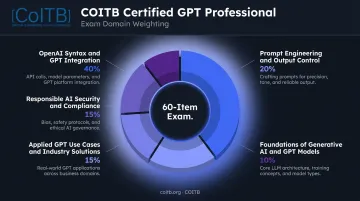
The heavy weighting on API integration (40%) reflects the credential's emphasis on practical, hands-on implementation — not just conceptual knowledge. Available via remote online proctoring or authorized test centers, with military CAC and VA-issued IDs accepted for identity verification.
COITB actively supports veterans and military spouses through potential GI Bill, VET TEC, MyCAA, and VR&E funding pathways. Verify eligibility with your VA Education Benefits counselor or State Approving Agency before registering, as coverage depends on COITB's current WEAMS approval status.
For career changers and self-taught developers, COITB recommends pairing this credential with the Professional Python Developer certification for a complete AI practitioner stack. A free practice assessment is available at coitb.org/assessment.
AI Certification vs. AI Certificate: What's the Difference?
The terms look similar on paper, but they carry different weight with employers — especially when you're stacking credentials for a career pivot.
- A certificate proves you completed a learning program — IBM's Coursera series and Stanford's graduate certificate both fall into this category. They document participation and learning outcomes.
- A certification is awarded by an independent credentialing body after you pass a proctored exam that measures competency against a defined standard. AWS, Google, ARTiBA, CertNexus, PMI, ISACA, and COITB all issue certifications in this sense.
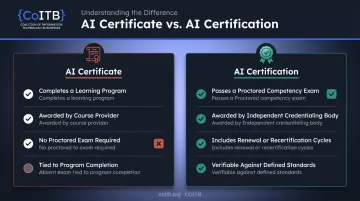
That distinction matters beyond terminology. [ANAB/ANSI clarifies that certifications typically include ongoing requirements like renewal cycles, while certificates are tied to the program you completed.] When listing credentials on a résumé or LinkedIn profile, specifying which type you hold matters for accuracy. Most hiring managers recognize the difference, and mislabeling a certificate as a certification can raise questions you don't want to answer in an interview.
How to Choose the Right AI Certification
Match Your Starting Point to the Right Level
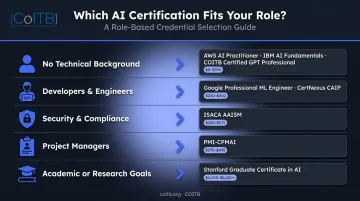
- No technical background: AWS Certified AI Practitioner, IBM AI Developer Professional Certificate, or COITB Certified GPT Professional — all three require no prior experience, with COITB's option fully remote-proctored from any location are the most accessible starting points
- Developers and engineers: Google Professional ML Engineer or CertNexus CAIP offer role-specific validation
- Security and compliance professionals: ISACA AAISM (note the CISM/CISSP prerequisite)
- Project managers: PMI-CPMAI validates leadership of AI programs without requiring engineering depth
- Academic or research ambitions: Stanford's graduate certificate, with the understanding of the time and financial commitment involved
Vendor-Specific vs. Vendor-Neutral
The credential type affects where it opens doors:
- Vendor-specific (AWS, Google): Strongest at organizations already running those platforms — ideal if you know your target employer's tech stack
- Vendor-neutral (ARTiBA, CertNexus, COITB): Broader applicability across industries and company sizes, useful when you're not locked into a single cloud ecosystem
Practical Factors to Evaluate
| Factor | What to Check |
|---|---|
| Time commitment | Weeks of self-study vs. 6-month structured programs vs. 1–3 years academic |
| Budget | Ranges from $100 (AWS) to $26,000+ (Stanford) |
| Renewal requirements | Microsoft's credential retired; ARTiBA renews every 3 years; COITB has a formal recertification policy — check before you invest |
| Prerequisites | ISACA AAISM requires active CISM or CISSP; Google ML Engineer recommends 3+ years experience |
Conclusion
The right AI certification depends on where you're starting and where you're heading. From the $100 AWS exam for non-technical professionals to Stanford's multi-year graduate certificate, every career stage and budget has a meaningful credential option.
Start with a clear-eyed look at where you stand: your current skill level, your target role, and whether exam-based certification or structured course completion suits how you learn and work.
Once you've mapped that out, match it to a credential that fits. For professionals entering the AI workforce without a traditional CS degree, COITB's Certified GPT Professional is an ISO/IEC 17024-aligned option built for that path — with remote online testing, flexible scheduling, and a verifiable digital badge. Reach out to COITB at support@coitb.org or +1 877 402 0840 to learn more.
Frequently Asked Questions
Are AI certifications worth it for career advancement?
For most professionals, yes. AI skills command a 28% salary premium according to Lightcast's 2025 data, and employers increasingly want verifiable proof of competency rather than self-reported experience. A formal, exam-based certification delivers that third-party validation — something online courses alone can't provide.
Which AI certification is best for beginners with no technical background?
The AWS Certified AI Practitioner ($100, no prerequisites) is the most accessible vendor-specific option. COITB's Certified GPT Professional targets candidates with 0–6 months of hands-on experience and is open to career changers, bootcamp graduates, and self-taught practitioners — making it one of the more inclusive entry points in the field.
How much do AI certifications typically cost?
The range is wide: $100 for AWS, $200 for Google ML Engineer, $367.50 for CertNexus CAIP, $459–$599 plus $50 application fee for ISACA AAISM, $699–$899 for PMI-CPMAI, $750 for ARTiBA AiE, and $20,470–$26,775 for Stanford's graduate certificate. For most career changers and early-stage professionals, the $100–$750 range offers the strongest return relative to hiring impact.
What is the difference between an AI certificate and an AI certification?
A certificate confirms you completed a structured learning program (such as IBM's Coursera series or Stanford's graduate program). A certification requires passing a proctored exam from an accredited credentialing body — and carries more hiring weight because it verifies demonstrated skill against an independent standard, not just course completion.
How long does it take to earn an AI certification?
Exam-based certifications like AWS AI Practitioner or COITB's Certified GPT Professional can be earned in weeks with focused preparation. Program-based credentials like Stanford's graduate certificate typically take 1–2 years. Your existing knowledge and available study time are the primary variables.
Do AI certifications expire or require renewal?
Yes, most do. ARTiBA's AiE is valid for three years and requires paid renewal; COITB maintains a formal recertification policy (details at coitb.org/certification-resources/recertification-requirement-policy). Always verify a credential's maintenance requirements before registering — renewal costs and timelines vary widely.