Introduction
Breaking into IT without a degree or years of experience feels like a catch-22. Employers want experience; you need a job to get experience. That cycle stops a lot of people before they start.
The right certification changes that equation. BLS projects computer and mathematical occupations will add 545,600 jobs by 2034, a 10.1% growth rate with no signs of slowing.
According to CompTIA, nearly 50% of tech job postings no longer require a four-year degree. Skills matter more than credentials now — but you still need proof of those skills.
Beginner IT certifications solve that problem directly. They validate real competency, signal job-readiness to employers, and cost a fraction of a degree. This guide covers the best options for 2026 — what each costs, what the exam looks like, and which career path each one opens.
Key Takeaways
- Most beginner IT certifications require zero prior experience and can be earned in 2–8 weeks of focused study
- Top options for 2026: CompTIA Tech+, Google IT Support, AWS Cloud Practitioner, ISC2 CC, and COITB certifications
- 32% of certified candidates received a salary increase, and 23% received a promotion, per Pearson VUE's 2025 report
- Match your certification to your target role — IT support, cloud, cybersecurity, and development each have a distinct starting point covered in this guide
- Developer certifications in JavaScript, React, Python, and GPT are among 2026's fastest-growing entry points
Why IT Certifications Matter More Than Ever in 2026
An IT certification is a vendor- or organization-issued credential that validates specific technical skills through a standardized exam. Unlike a degree, it's focused, fast, and directly tied to the skills employers are actually hiring for.
For beginners, that specificity is the whole point. You don't spend two years studying general education requirements — you study the skills the job actually needs, pass an exam, and demonstrate competency to employers without needing prior work experience.
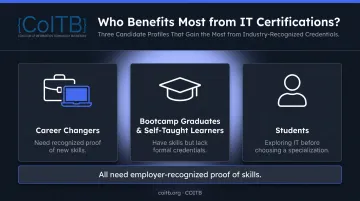
Three groups benefit most from this model:
- Career changers leaving non-tech roles who need recognized proof of new skills
- Bootcamp graduates and self-taught learners who have the skills but lack formal credentials
- Students exploring IT before committing to a specialization
All three groups share the same challenge: employers need proof. Skills-first hiring has accelerated that demand, and certifications have become the clearest way to provide it — no degree required, no prior job title needed.
Easiest IT Certifications for Beginners in 2026
Each certification below was selected on four criteria: minimal prerequisites, accessible study materials, manageable exam difficulty, and strong employer recognition in the US job market. If you're starting from zero, these are the credentials worth your time.
CompTIA Tech+
CompTIA Tech+ (formerly ITF+) is the most beginner-friendly vendor-neutral certification available. It covers hardware, software, networking, security, and databases at a foundational level — designed for people who are completely new to IT and want to explore the field before committing to a specialization.
No prerequisites. No prior work experience required. It's positioned explicitly as a pre-professional stepping stone, most commonly used before pursuing CompTIA A+.
| Detail | Info |
|---|---|
| Exam Cost | $138 (US, as of December 2024) |
| Exam Format | Up to 70 questions, 60 minutes, multiple-choice; no prerequisites |
| Best For | Absolute beginners; students exploring IT; career changers with no technical background |
One practical note: CompTIA Tech+ does not expire. There's no renewal requirement, which removes a long-term cost burden for beginners.
Google IT Support Professional Certificate
The Google IT Support Professional Certificate is a Coursera-based program covering networking fundamentals, operating systems, system administration, and IT security basics. It prepares candidates directly for help desk and technical support roles.
The format is different from most certifications — there's no single proctored exam. Completion involves graded assignments, quizzes, and hands-on labs throughout the course. That makes it genuinely accessible for people who struggle with high-stakes exam environments.
| Detail | Info |
|---|---|
| Exam Cost | $49/month (after 7-day free trial); financial aid available |
| Exam Format | Self-paced online program; graded assignments and quizzes; shareable certificate on completion |
| Best For | Career changers targeting IT support roles; beginners who prefer coursework over a formal exam |
Graduates gain access to an employer consortium of more than 150 US companies, including Deloitte, Target, and Verizon. Most candidates complete it in 3–6 months at under 10 hours per week.
AWS Certified Cloud Practitioner
The AWS Certified Cloud Practitioner is Amazon's entry-level cloud credential. It covers AWS services at a conceptual level — billing, security, support tiers, and core cloud architecture — without requiring any technical background.
This credential is a low-barrier entry point to one of the fastest-growing fields in tech, and it pairs naturally with the AWS AI Practitioner certification for candidates interested in AI.
| Detail | Info |
|---|---|
| Exam Cost | $100 USD |
| Exam Format | 65 questions, 90 minutes; multiple-choice and multiple-response; no prerequisites |
| Best For | Beginners interested in cloud; non-technical professionals (project managers, operations, sales) who work alongside cloud teams |
AWS provides free exam prep resources through AWS Skill Builder, including a practice question set and pretest. Failed candidates must wait 14 days before retaking and pay the $100 fee again.
ISC2 Certified in Cybersecurity (CC)
The ISC2 CC comes from the organization behind CISSP — the industry's most recognized advanced cybersecurity credential. The entry-level CC covers five domains: Security Principles, Network Security, Access Controls, Security Operations, and Business Continuity/Disaster Recovery.
No work experience required to sit for the exam. The content is intentionally simpler than CompTIA Security+, designed to build a foundational cybersecurity workforce. ISC2's One Million Certified in Cybersecurity program has offered free training and an exam voucher — check their official program page to see if free access is still active.
CyberSeek counted 514,359 US cybersecurity job listings between May 2024 and April 2025 — demand for this skill set is not slowing.
| Detail | Info |
|---|---|
| Exam Cost | $199 standard; free through ISC2's 1MCC program (verify current availability) |
| Exam Format | 100–125 questions, 2 hours; multiple-choice and advanced item types; no experience required |
| Best For | Beginners targeting cybersecurity; those planning to pursue CompTIA Security+ or CISSP later |
COITB Certifications: A Modern Pathway for Developers and AI Professionals
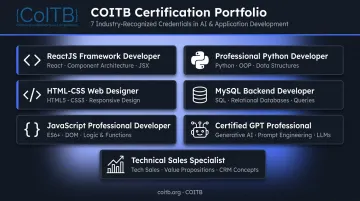
COITB is a non-profit credentialing body offering seven industry-recognized certifications aligned to ISO/IEC 17024 standards. Unlike infrastructure-focused certifications, COITB validates the actual coding and AI skills that application development and front-end/back-end roles require.
All seven credentials are designed for candidates with 0–6 months of hands-on experience — no formal experience required.
Available certifications:
| Certification | Core Technology |
|---|---|
| HTML-CSS Web Designer | HTML5 / CSS3 |
| JavaScript Professional Developer | JavaScript (ES6+) |
| ReactJS Framework Developer | React / JSX / Hooks |
| Professional Python Developer | Python 3 |
| MySQL Backend Developer | MySQL / SQL |
| Certified GPT Professional | GPT / Generative AI |
| Technical Sales Specialist | Technical Sales / SaaS |
The HTML-CSS Web Designer and ReactJS Framework Developer certifications are COITB's most beginner-accessible credentials. They're designed as a sequential pathway — HTML/CSS first, then React — and are frequently stacked together as a complete front-end credential package.
The HTML-CSS credential carries the highest passing threshold (75%) in the lineup, which reflects the professional-level rigor behind what looks like an accessible starting point.
The Certified GPT Professional is worth particular attention in 2026. McKinsey reported that demand for AI fluency in US job postings grew approximately sevenfold over two years. COITB's GPT credential validates prompt engineering, GPT API integration, fine-tuning fundamentals, and responsible AI practices — practical skills directly tied to that demand.
Exam format (all credentials):
| Detail | Info |
|---|---|
| Questions | 58–90 items (varies by credential) |
| Time | 75–90 minutes |
| Question Types | Multiple-choice and scenario-based items |
| Passing Score | 70–75% (varies by credential) |
| Delivery | Online remote-proctored OR in-person authorized test center |
| On Passing | Digital badge for LinkedIn and résumé verification |
Exams can be taken remotely from any location with a webcam and stable internet (minimum 1 Mbps). Military CAC and VA-issued IDs are accepted for identity verification — a practical consideration for veterans and transitioning service members. For pricing and registration, contact COITB at support@coitb.org or +1 877 402 0840, or register at coitb.org/auth/signup.
How to Choose the Right Beginner Certification
The easiest exam to pass isn't always the right one. Picking a certification without matching it to your target role is one of the most common (and costly) beginner mistakes.
Common mistakes beginners make:
- Choosing based on name recognition alone without checking whether the cert aligns with their target role
- Ignoring total cost, which includes study materials, practice tests, and potential retake fees — not just the exam fee
- Treating certification as a replacement for skills rather than proof of them
Match your cert to your career goal:
| Career Goal | Best Starting Point |
|---|---|
| IT support / help desk | CompTIA Tech+ or Google IT Support |
| Cloud computing | AWS Cloud Practitioner |
| Cybersecurity | ISC2 CC |
| Front-end / web development | COITB HTML-CSS → ReactJS |
| Software development | COITB JavaScript or Python |
| AI / generative AI | COITB Certified GPT Professional |
| Technical sales | COITB Technical Sales Specialist |
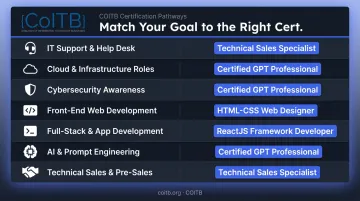
The criteria that matter most: no or minimal prerequisites, affordable exam fee, accessible study materials, and a clear employer market that recognizes the credential. Every certification in this guide meets that bar. Use the table above to find the one that fits where you're headed.
Conclusion
The best beginner IT certification in 2026 isn't the one with the easiest exam — it's the one that opens the specific career door you're aiming for. Starting with the right credential saves months of redirected effort later.
For those targeting software development, front-end or back-end roles, or AI-adjacent careers, COITB's certifications are designed around today's most-hired entry-level tech stacks. As a non-profit credentialing body, COITB validates job-relevant skills for candidates with 0–6 months of hands-on experience — with remote, flexible testing and a digital badge that displays on LinkedIn and résumés immediately.
Credentials available:
- ReactJS Framework Developer
- HTML-CSS Web Designer
- JavaScript Professional Developer
- Professional Python Developer
- MySQL Backend Developer
- Certified GPT Professional
Explore COITB's certification programs at coitb.org or reach out at support@coitb.org to find the right starting point.
Frequently Asked Questions
Which certification is best for beginners?
It depends on your target role. CompTIA Tech+ or Google IT Support suit those entering general IT or help desk work. AWS Cloud Practitioner works for cloud-curious learners. COITB certifications (HTML-CSS, ReactJS, JavaScript, Python, GPT) are the right starting point for anyone targeting software development or AI roles.
What are the easiest tech certifications to pass?
Certifications with no prerequisites and objective multiple-choice formats are the most accessible. CompTIA Tech+, AWS Cloud Practitioner, and ISC2 CC fall into this category. Note that Microsoft AI-900 was retired on June 30, 2026, and is no longer available for scheduling.
Can I get an IT certification with no prior experience?
Yes. CompTIA Tech+, AWS Cloud Practitioner, ISC2 CC, and all COITB certifications require no prior work experience — each is designed for first-time entrants and career changers from non-tech backgrounds.
How long does it take to prepare for a beginner IT certification?
Most foundational exams take 2–8 weeks to prepare for with consistent daily study. Google IT Support runs longer at 3–6 months self-paced. CompTIA puts Tech+ prep at roughly 15–25 hours total.
How much do entry-level IT certifications cost?
Most fall between $100 and $199 for the exam itself. CompTIA Tech+ is $138, AWS Cloud Practitioner is $100, and ISC2 CC is $199 standard (free through the 1MCC program). Google IT Support costs $49/month after a 7-day trial. Budget separately for study materials and potential retake fees.
Do beginner IT certifications expire or require renewal?
Policies vary. CompTIA Tech+ does not expire — no renewal required. CompTIA A+ and Security+ require renewal every three years. ISC2 CC requires maintaining active membership. COITB certifications require continuing education for renewal; review the Recertification Requirement Policy at coitb.org for details.