The problem isn't demand. It's proof.
Career changers, bootcamp graduates, and self-taught developers often have real, job-ready skills but no formal credential to show for them. Resumes alone can't verify proficiency—employers have no way to distinguish someone who used React for six months in production from someone who watched a few tutorials and added it to their skills section.
Technical certifications close that gap. They're standardized, third-party validated, and tied to specific competencies—giving employers something concrete to evaluate. This article covers 10 certifications across web development, backend engineering, cloud computing, networking, and AI, each selected for career impact and accessibility.
Key Takeaways
- Technical certifications provide verifiable, exam-based proof of skills — far more credible to employers than self-reported resume claims
- Certifications are especially valuable for career changers and self-taught candidates competing without a CS degree
- Coverage spans software development, cloud, networking, and AI to reflect the full range of available career paths
- Choosing the right certification comes down to your target role, current skill level, and budget
- Credentials aligned to standards like ISO/IEC 17024 signal stronger credibility to employers
What Are Technical Certifications and Why Do They Matter?
Technical certifications are credentials issued after passing a standardized exam—developed by an industry body, technology vendor, or non-profit credentialing organization. They validate a defined set of skills, not general academic knowledge.
There are two broad categories:
- Vendor-specific certifications (AWS, Cisco) validate proficiency within a specific company's products or ecosystem
- Vendor-neutral certifications (CompTIA, ISO/IEC 17024-aligned bodies like COITB) validate skills in widely-adopted technologies, applicable across employers and platforms
The Career Impact Is Measurable
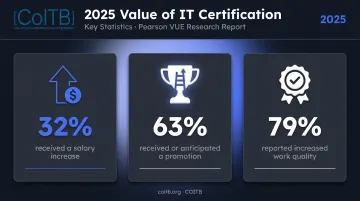
According to Pearson VUE's 2025 Value of IT Certification report, 32% of certified candidates received a salary increase after earning a credential, with 31% of those seeing raises exceeding 20%. Another 63% received or anticipated a promotion.
Beyond pay, 79% reported increased work quality and 70% said they were more productive on the job.
Why Certifications Matter More in Software and AI
Formal degrees are less common in software development and AI than in other engineering disciplines. Many of the most productive developers are self-taught, bootcamp-trained, or career changers. That's a genuine strength of the field — but it creates a credibility gap when hiring managers can't verify skill level from a resume alone.
Certifications fill that gap with an independent, exam-based assessment that a portfolio or bootcamp certificate alone can't provide. For anyone entering web development, backend engineering, or AI without a CS degree, a recognized certification is one of the most direct ways to land interviews and compete for roles.
10 Top Technical Certifications to Boost Your Career
The certifications below were selected based on employer demand, career ROI, and accessibility for entry-level and career-change candidates. They cover software development, cloud computing, networking, and AI.
1. HTML & CSS Developer Certification
HTML and CSS are the structural and visual foundation of every website and web application. For career changers and beginners, a certification in these skills provides a credible, verifiable entry point into front-end development, even with zero prior coding experience.
Credentialing organizations like COITB, a non-profit credentialing body whose programs are ISO/IEC 17024-aligned, offer certifications specifically designed for candidates with 0–6 months of experience. COITB's HTML-CSS Web Designer credential validates semantic HTML5, CSS3, Flexbox, Grid, responsive design, and accessibility fundamentals across a 90-question, 90-minute exam.
| Category | Details |
|---|---|
| Target Roles | Front-end developer, UI developer, web designer, freelance web developer |
| Ideal For | Beginners, bootcamp graduates, and career changers with 0–6 months of experience |
2. JavaScript Developer Certification
JavaScript is used by 62.3% of developers according to Stack Overflow's 2024 Developer Survey, making it the world's most widely used programming language and one of the highest-demand skills in software development.
A JavaScript certification validates proficiency in scripting, DOM manipulation, async programming, and application logic. It's the natural next step after HTML/CSS and the foundation for any front-end or full-stack role.
COITB's JavaScript Professional Developer certification covers ES6+, Fetch API, promises, async/await, REST API integration, and functional programming patterns — 90 questions, 90 minutes, 73% passing score.
| Category | Details |
|---|---|
| Target Roles | Front-end developer, full-stack developer, web application developer |
| Ideal For | Self-taught coders, bootcamp graduates, developers seeking formal skill validation |
3. React Developer Certification
React is the dominant JavaScript library for building user interfaces, used across the industry from startups to Fortune 500 companies. A React certification demonstrates expertise in component-based architecture, hooks, state management, and building scalable front-end applications.
For JavaScript developers, React specialization opens doors to a wider range of front-end and full-stack roles. COITB's ReactJS Framework Developer certification covers the core skills employers expect: 90 questions, 90 minutes, 73% passing score. It targets candidates with 1–6 months of hands-on React experience, making it accessible from bootcamp or self-study.
| Category | Details |
|---|---|
| Target Roles | React developer, front-end engineer, UI engineer, full-stack developer |
| Ideal For | JavaScript developers looking to specialize in modern front-end frameworks |
4. Python Developer Certification
Python spans web development, data science, automation, and AI, making it one of the most versatile languages in the industry. Stack Overflow's 2025 survey found Python adoption increased by 7 percentage points year-over-year. On the compensation side, Indeed reports the average base salary for a U.S. Python developer at $61.44/hour, with a range of $45–$83/hour.
Python certification validates core coding ability and is recognized across multiple disciplines — one of the highest-ROI credentials for career changers entering backend development, data engineering, or AI.
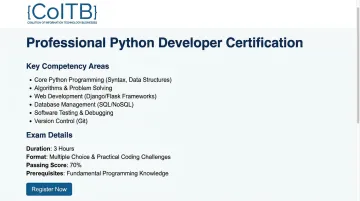
COITB's Professional Python Developer certification covers OOP, file I/O, exception handling, standard library, decorators, generators, and PEP 8 — 58 questions, 75 minutes, 70% passing score.
| Category | Details |
|---|---|
| Target Roles | Backend developer, automation engineer, data analyst, AI/ML engineer |
| Ideal For | Career changers, aspiring developers, professionals entering data science or AI |
5. MySQL Developer Certification
MySQL is the world's most popular open-source relational database. Database skills are a core requirement for backend and full-stack development — every production application needs someone who can design schemas, write complex queries, and manage relational data.
COITB's MySQL Backend Developer certification validates schema design, normalization, SQL querying (JOINs, CTEs, subqueries), stored procedures, transactions, ACID properties, and query optimization — 90 questions, 90 minutes, 70% passing score.
| Category | Details |
|---|---|
| Target Roles | Backend developer, database administrator, full-stack developer, data analyst |
| Ideal For | Developers building backend systems, aspiring full-stack engineers |
6. AI/GPT Practitioner Certification
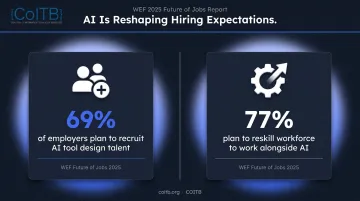
AI is reshaping hiring expectations across every technical discipline. The World Economic Forum's 2025 Future of Jobs Report found that 69% of employers plan to recruit talent skilled in AI tool design, and 77% plan to reskill their workforce to work alongside AI.
An AI/GPT practitioner certification validates foundational knowledge in generative AI, prompt engineering, GPT API integration, and responsible AI practices. This isn't just for engineers — it's relevant to any technical role where AI is becoming an expected competency.
COITB's Certified GPT Professional credential covers prompt engineering, OpenAI API integration, fine-tuning fundamentals, AI application architecture, and compliance standards — 60 questions, 75 minutes, 71% passing score.
| Category | Details |
|---|---|
| Target Roles | AI developer, prompt engineer, AI solutions specialist, technical AI consultant |
| Ideal For | Developers, technical professionals, and career changers entering the generative AI space |
7. CompTIA A+
CompTIA A+ is one of the most widely recognized foundational IT certifications globally. It covers hardware, operating systems, networking, troubleshooting, and security — and requires passing two separate exams (Core 1: 220-1201 and Core 2: 220-1202). Many employers list it as a requirement or preference for IT support and help desk roles.
| Category | Details |
|---|---|
| Target Roles | Help desk technician, IT support specialist, desktop support analyst, field service technician |
| Ideal For | Individuals entering IT support with no prior experience |
Note: CompTIA's official per-exam pricing should be confirmed directly at comptia.org, as pricing varies and changes periodically.
8. CompTIA Security+
Security+ (exam code SY0-701) is among the most requested cybersecurity certifications by employers, with an official exam cost of $439. It covers threat management, cryptography, identity management, and risk mitigation — and is accepted for specific DoD 8140 work roles.
on the market. It validates a high-level understanding of AWS services, core cloud concepts, security fundamentals, and pricing models.
The BLS projects 12% growth for Computer Network Architects through 2034 — a role that increasingly encompasses cloud infrastructure design. With 88% of enterprise buyers already operating hybrid cloud environments, foundational cloud knowledge is becoming a baseline expectation.
| Category | Details |
|---|---|
| Target Roles | Cloud support associate, junior cloud engineer, cloud operations specialist |
| Ideal For | IT beginners and professionals transitioning from on-premise to cloud environments |
10. Cisco CCNA
The Cisco Certified Network Associate (CCNA) is the gold standard entry-level networking credential, covering routing, switching, IP connectivity, security fundamentals, and network automation. The exam costs $300 USD, runs 120 minutes, and the certification is valid for three years.
On compensation, PayScale data puts CCNA-certified Network Engineer pay at $63k–$121k (average: $90,055). Senior network engineers with CCNA average $120,536.
| Category | Details |
|---|---|
| Target Roles | Network administrator, network engineer, NOC technician, junior systems engineer |
| Ideal For | Aspiring network professionals and IT generalists moving into networking or infrastructure |
How to Choose the Right Technical Certification for Your Goals
Start With the Job Posting, Not the Certification
The single most useful filter is role alignment. Search job listings for the specific titles you're targeting—front-end developer, cloud engineer, security analyst—and see which certifications appear most frequently. If a credential keeps appearing in job postings for roles you want, it's likely the one hiring managers actually recognize.
Software development roles (front-end, full-stack, backend) call for different credentials than networking or cybersecurity roles. Choosing the wrong path wastes both time and money.
Apply Two Practical Filters
Before committing to any certification:
- Cost vs. ROI — Exam fees range from $100 (AWS Cloud Practitioner) to $439 (Security+) and higher. Weigh the total investment against realistic salary outcomes for that certification's target roles.
- Prerequisite requirements — Some certifications have no prerequisites and are designed for complete beginners. Others expect foundational knowledge. Honest self-assessment here saves significant preparation time.
Prioritize Credibility Over Convenience
Not all certifications carry the same employer weight. Course completion badges from training platforms are not the same as credentials issued by an independent credentialing body.
Look for certifications from recognized organizations whose credentialing processes align to ISO/IEC 17024—the international benchmark for personnel certification. This standard governs exam design, security, and independence. A credential built to that standard signals to employers that the assessment process was rigorous, not just a training completion checkbox.
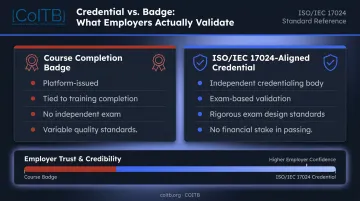
COITB is one example of this model. As a non-profit credentialing body—not a training provider—its programs are ISO/IEC 17024-aligned.
That distinction matters: when the organization assessing you has no financial stake in your passing, the credential carries more weight with employers who know how to evaluate it.
Conclusion
Technical certifications are one of the most direct paths into a tech career for professionals who didn't come through a traditional CS degree program. The right certification signals to employers that your skills have been independently validated—not just self-reported.
For those targeting software development or AI roles, COITB offers ISO/IEC 17024-aligned certifications covering the technologies employers actively hire for:
- HTML-CSS Web Designer
- JavaScript Professional Developer
- ReactJS Framework Developer
- Professional Python Developer
- MySQL Backend Developer
- Certified GPT Professional
Exams are available via remote online proctoring (military CAC accepted) with flexible scheduling, and credentials are designed for professionals at any experience level. Visit COITB to take the free practice assessment or get started.
Frequently Asked Questions
What are technical certifications?
Technical certifications are credentials earned by passing a standardized exam, issued by industry bodies, technology vendors, or non-profit credentialing organizations. Unlike training certificates, they represent independent, third-party validation of actual skill — not just course completion.
What are some examples of technical certifications?
Examples span several categories: CompTIA A+ (IT fundamentals), CompTIA Security+ (cybersecurity), AWS Cloud Practitioner (cloud), Cisco CCNA (networking), and application development certifications in JavaScript, Python, React, MySQL, and AI/GPT for software and development roles.
What is the best technical certification to have?
It depends on your target career path. For software and web development roles, certifications in JavaScript, React, Python, MySQL, or AI/GPT align directly with employer demand. Cybersecurity, networking, and cloud careers each have their own domain-specific credentials. Start with the path that matches your goal, then build from there.
What is the highest-paying technical certification?
Certifications in AI/ML engineering and cloud architecture tend to command the highest salaries. BLS data puts the median annual wage for Computer and Information Research Scientists at $140,910 (May 2024), and roles in this space are projected to grow 20% through 2034.
How long does it take to get a technical certification?
Entry-level certifications typically require 4–12 weeks of part-time study. Mid-level and advanced credentials may take 3–12 months depending on prior experience, the exam's complexity, and how much time you can dedicate per week.
Are technical certifications worth it for career changers?
Yes. They provide third-party validation of skills acquired outside a formal degree program, which matters when you don't have traditional credentials to point to. A recognized certification helps employers assess competence quickly and gives you a concrete credential to present alongside a portfolio.