Introduction
Hiring managers aren't just looking for professionals who have "explored" AI — they want proof. According to the 2024 Microsoft and LinkedIn Work Trend Index, 66% of leaders said they would not hire someone without AI skills, and 71% would choose a less-experienced candidate with AI skills over a more-experienced candidate without them.
Self-study helps. When two candidates apply for the same role — one with a verified AI credential, one without — the hiring decision rarely favors ambiguity. A formal certification converts knowledge into proof employers can act on immediately.
This article covers three specific career advantages AI certifications deliver, what happens when you skip them, and how to get the most out of one once you've earned it.
Key Takeaways
- AI certifications give hiring managers a verifiable signal that cuts through unvalidated claims on a résumé
- Job postings mentioning AI skills advertise salaries 28% higher — nearly $18,000 more annually — than postings without them
- General IT certification holders report promotions (23%), new jobs in the same industry (23%), and expanded responsibilities (59%) after certifying
- Skipping certification has a compounding cost: slower hiring, weaker salary offers, and fewer opportunities to advance
- The credential that moves your career forward is industry-recognized, exam-based, and matched to the role you're targeting
What Is an AI Certification?
An AI certification is a formal, exam-based credential that validates a professional's ability to apply AI knowledge and tools in real-world contexts. It's different from completing a course or earning a certificate of attendance — a certification requires passing a proctored exam against a defined skill standard.
That distinction matters to employers. A certificate confirms attendance. A certification confirms you can perform when tested against a defined standard.
AI certifications apply across roles — software developers, data professionals, business analysts, project managers, and IT specialists all have use for them. They're not confined to engineering teams. Lightcast data shows 51% of job postings requiring AI skills are outside IT and computer science, spanning finance, marketing, HR, and education.
With demand for AI skills this broad, the credentialing standard behind a certification matters. Credentialing bodies like COITB issue AI certifications aligned to ISO/IEC 17024 — the international standard governing personnel certification bodies. That alignment means the credential goes through formal exam development, impartial review, and recertification requirements under an independently governed process. For employers, that's a verifiable, third-party credential — not a self-issued badge.
COITB's Certified GPT Professional credential, for example, is designed for professionals with 0–6 months of hands-on AI experience — making it accessible to career changers, veterans, bootcamp graduates, and self-taught professionals who need a recognized credential to validate the skills they've already developed.
Key Advantages of AI Certifications for Career Growth
These three advantages map directly to the outcomes professionals and employers track: time-to-hire, salary offers, promotion timelines, and role access.
Advantage 1: Instant Credibility in a Crowded Hiring Market
In a job market where AI appears on virtually every job description, a certification cuts through the noise. It gives hiring managers a standardized, verifiable signal rather than relying on a candidate's self-reported claims during an interview.
CompTIA counted 454,534 AI-related job postings in 2024 alone. With that volume of applicants, resume screening filters out unvalidated candidates fast. A certification moves a candidate past that first gate.
Where this advantage shows up:
- Application-to-interview conversion rate
- Recruiter engagement and shortlisting frequency
- Time-to-first-offer
- Competitive positioning against candidates with similar experience
Who benefits most from this:
- Career changers entering tech without a traditional CS degree
- Self-taught professionals whose skills can't be evaluated through degree pedigree
- Bootcamp graduates competing against CS graduates for the same entry-level roles
COITB's digital badge system makes this credibility concrete. When a certified professional lists their Certified GPT Professional credential on LinkedIn or a résumé, employers can click a verification URL and confirm the credential's authenticity in real time. That one-click verification is something a self-reported skill claim cannot provide.
Beyond hiring, 82% of Pearson VUE respondents said certification gave them the confidence to explore and pursue new opportunities — shaping how they show up in every conversation that follows.
Advantage 2: Stronger Salary Positioning and Earning Potential
A certification shifts a professional's negotiating position. A documented credential anchors their value in a salary conversation in a way that a self-reported interest in AI simply cannot.
Salary negotiation is as much about perceived risk as it is about skill. An uncredentialed candidate asking for a premium salary requires the employer to take their word for it — a certified candidate carries third-party validation that lowers that risk. Employers consistently pay more when uncertainty is off the table.
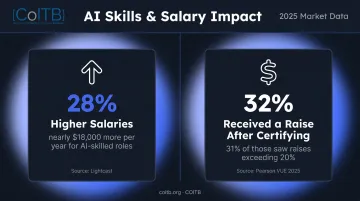
The market data reflects this. Lightcast's analysis of more than 1.3 billion job postings found that postings mentioning AI skills advertise salaries 28% higher — nearly $18,000 more per year — than postings without them. That's a meaningful gap, and it compounds over a career.
The Pearson VUE 2025 Value of IT Certification report found that 32% of certified IT professionals received a salary increase after certification, with 31% of that group receiving raises exceeding 20%.
Career metrics this advantage influences:
- Starting salary offer
- Year-over-year salary growth
- Bonus eligibility
- Access to premium roles with higher base compensation
When this matters most:
- At initial job offers, where certified candidates have documented leverage
- During internal promotions, where a credential can justify reclassification into a higher pay band
Advantage 3: Faster Access to Advanced Roles and Career Mobility
A certification signals to employers and internal decision-makers that someone has invested in future-readiness, which accelerates their path to more senior or specialized roles.
Without a credential, professionals often plateau in roles that don't require validated AI expertise. Career mobility depends on trust, and certifications build that trust faster than tenure alone. Certified professionals are more likely to be tapped for AI-focused projects, stretch assignments, and team lead opportunities.
The Pearson VUE survey found that among general IT certification holders:
- 23% received a promotion
- 23% found a new job in the same industry
- 8% found a new job in a different industry
- 59% gained new responsibilities in their current or a new role
AI-specific credential interest is accelerating alongside those outcomes. Planned AI and machine learning certifications nearly doubled , rising from 17% in 2022 to 35% in 2024 , making AI the second-largest planned certification specialty in that survey.
Career metrics influenced:
- Time-to-promotion
- Number of roles accessible
- Lateral mobility across industries
- Eligibility for AI-focused or technology-strategic positions
One meaningful advantage: an AI certification isn't locked to one employer or sector. A COITB Certified GPT Professional credential travels with the professional. Whether they move from a project management role into a Technical PM position, or from a non-tech sales background into sales engineering, the credential is portable. COITB explicitly maps these pathways , including PM-to-Technical Program Manager and non-tech sales-to-SaaS sales engineering transitions, as documented stacking patterns for career changers.
What Happens When You Skip AI Certification
The 66% of leaders who said they would not hire someone without AI skills aren't evaluating portfolios first. In high-volume hiring, resume filters remove uncredentialed candidates before a human ever sees their application.
Those consequences compound:
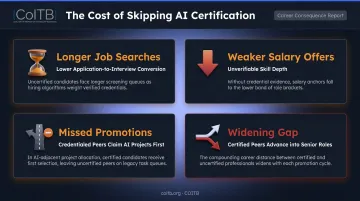
- Longer job searches from lower application-to-interview conversion rates
- Weaker salary offers because employers can't verify skill depth
- Missed promotions as credentialed colleagues claim AI-adjacent projects first
- A widening gap as certified peers move into senior roles and pull further ahead
The WEF projects that AI and information-processing technologies will create 11 million jobs and displace 9 million by 2030. Employers already expect 39% of core skills to change within that window.
Professionals who enter that environment without credentials aren't competing on even footing — they're starting a signal down. The candidates who build verified AI expertise now will have a compounding advantage over those who wait.
How to Get the Most Value from Your AI Certification
Earning a certification matters. So does what you do with it. Three principles separate candidates who see real career returns from those who don't:
Pick exam-based, governed credentials. Course completion badges signal effort; proctored exams signal competency. Look for credentials from bodies with formal governance — COITB's certifications are aligned to ISO/IEC 17024, meaning exam development, candidate rights, and credential integrity meet an internationally recognized standard.
Put skills to visible use. Employers want proof you can apply what you know. Projects, portfolio samples, and GitHub contributions turn a credential into demonstrated capability — not just a résumé line item.
Recertify as the field evolves. AI moves fast. Professionals who refresh their credentials stay ahead of those who certify once and stop. COITB's recertification requirements ensure the credential reflects current, verified knowledge rather than a single point in time.
The Certified GPT Professional is designed for professionals with 0–6 months of AI experience, making it accessible whether you're just starting out or validating existing skills. A free practice assessment is available at coitb.org/assessment.
For organizations credentialing teams at scale, COITB offers bulk pricing for enterprise workforce programs. The AI/ML team stack — Certified GPT Professional paired with Professional Python Developer — is the most common enterprise pattern for organizations building third-party validation into their AI workforce.
Conclusion
The career growth advantage of AI certifications comes down to three compounding outcomes: credibility that opens interviews, earning power that rewards your investment, and mobility that keeps your options open.
These advantages don't arrive automatically. They build when you choose credentials deliberately: exam-based, recognized by employers, and matched to where you want to go. Applying that credential through visible work — and treating it as the start of a learning practice rather than a finish line — is what turns a certificate into a career move.
For professionals at any stage — whether entering tech for the first time or formalizing skills developed through years of self-teaching — an AI certification is one of the most concrete steps available to show employers exactly what you can do.
Frequently Asked Questions
What are the benefits of AI certification?
AI certifications give employers a verifiable credential to act on — tied to higher salary offers and faster advancement into senior roles. They also validate skills that self-study builds informally but rarely confirms in a way employers can verify.
Do AI certifications help you get a job without prior experience?
Yes — certifications are particularly valuable for candidates without traditional CS degrees or work history. They give employers a third-party signal of practical capability when no degree or work history can speak for them. COITB's Certified GPT Professional is designed specifically for candidates with 0–6 months of hands-on AI experience.
How long does it take to earn an AI certification?
Timelines vary by program and candidate. Exam-based credentials like the COITB Certified GPT Professional are available on demand — online proctored 24/7 — so a prepared candidate can register and sit the exam quickly. Preparation time depends on existing experience, but the recommended baseline is 0–6 months of hands-on AI practice.
What is the difference between an AI certificate and an AI certification?
A certificate confirms course completion. A certification requires passing a formal proctored exam that validates skill against an industry standard. Employers generally place higher trust in certifications for hiring decisions because the competency has been independently assessed — not self-reported.
Are AI certifications worth it for non-technical professionals?
Yes. Certifications like the Certified GPT Professional cover prompt engineering, workflow automation, and responsible AI — directly relevant to business analysts, project managers, and marketing professionals, not just developers. Over half of AI-skill job postings are outside IT and computer science.
How do AI certifications compare to a computer science degree for career growth?
Certifications are faster, more focused, and lower-cost than degrees — making them well-suited for upskilling or career pivots. They validate specific, current skills against an industry standard rather than broad academic foundations. The two are complementary, not equivalent.