The wrong choice is costly. Finishing a course that doesn't align with your target role, or one that leaves you with no verifiable credential, can stall your career progress significantly. This guide cuts through the noise with a curated shortlist built around real career outcomes — covering what each course delivers, who it's best for, and how to match it to your specific goals.
Key Takeaways
- The best coding courses are project-based, cover in-demand languages like Python and JavaScript, and result in a verifiable portfolio or credential
- Career outcomes depend on completing a course and validating skills in a way employers can independently verify
- Top picks here span front-end, back-end, full-stack, and AI tracks, covering beginners through career-switchers
- Matching a course to your target job role, not just your interests, drives the strongest return on your learning investment
Why Coding Skills Are Essential for Career Growth Right Now
According to the U.S. Bureau of Labor Statistics, software developer employment is projected to grow 15% from 2024 to 2034 — nearly four times the average for all occupations — with a median annual wage of $133,080. Data scientists are on an even steeper trajectory: 34% projected growth over the same period.
Beyond those projections, the skills gap is widening. The World Economic Forum's Future of Jobs Report 2025 found that 63% of employers identified skills gaps as their top barrier to business transformation through 2030.
Another 70% plan to hire specifically for emerging in-demand tech skills — meaning the window to differentiate with a verified technical credential is open right now.
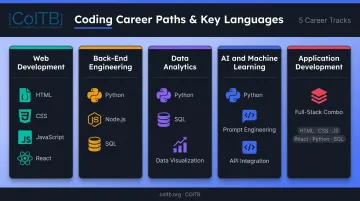
Coding unlocks distinct career paths, each with different language and skill requirements:
- Web development — HTML, CSS, JavaScript, React
- Back-end engineering — Python, Node.js, SQL/MySQL
- Data analytics — Python, SQL, data visualization tools
- AI and machine learning — Python, prompt engineering, API integration
- Application development — full-stack combinations of the above
Best Coding Courses to Boost Your Career Growth
These courses were selected based on curriculum relevance, career alignment, learning format, and the quality of credential or portfolio output they produce.
freeCodeCamp
freeCodeCamp is a nonprofit platform offering a fully free, self-paced curriculum covering HTML, CSS, JavaScript, Python, and data visualization. The platform has undergone a significant 2025 curriculum update, structuring its content around a Certified Full Stack Developer path (approximately 1,800 hours) alongside six smaller certifications of roughly 300 hours each.
Certifications are earned by building and submitting verified projects — not just watching videos. The result is a tangible portfolio, not just a completion badge. That distinction matters when applying for your first development role.
| Feature | Details |
|---|---|
| Cost | Free (donations accepted) |
| Best For | Beginners, self-paced learners, front-end and JavaScript track |
| Credential Output | Project-based certifications including Responsive Web Design, JavaScript Algorithms, Python, and Full-Stack Developer |
Codecademy
Codecademy is an interactive platform offering courses in 17 programming languages, with structured Career Paths that take learners from beginner fundamentals to job-ready skill levels. The Career Center lists 12 beginner-friendly paths, including Full-Stack Engineer, Front-End Engineer, and AI Engineer.
The Career Paths structure works particularly well for career changers — each path maps to a specific role, includes portfolio projects, and preps learners for industry certification exams. The in-browser coding environment lets beginners start coding immediately, no local setup required.
| Feature | Details |
|---|---|
| Cost | Free tier available; Pro plans from $19.99/month (billed annually) |
| Best For | Career changers, structured learners, those targeting specific job roles |
| Credential Output | Course completion certificates; exam prep for industry certifications |
Coursera — Python for Everybody (University of Michigan)
Coursera partners with universities and major tech companies to deliver structured, accredited-style courses. The standout for career-focused learners is Python for Everybody from the University of Michigan — a 5-course specialization with nearly 2 million enrolled learners, a 4.8 rating, and approximately 79 hours of content covering Python fundamentals through database access.
This track maps directly to data analytics, automation, and AI roles — areas where Python is the dominant language. Audit mode allows free access to course materials on many Coursera courses, though certificates require a paid subscription.
| Feature | Details |
|---|---|
| Cost | ~$59/month (Coursera Plus); individual course audit often free |
| Best For | Beginners targeting data analytics, automation, or AI/ML career paths |
| Credential Output | Verified certificate from University of Michigan |
Udemy — The Complete Full-Stack Web Development Bootcamp (Dr. Angela Yu)
Dr. Angela Yu's course on Udemy is one of the most-enrolled coding courses available, with over 1.5 million students, 471,000+ ratings, and a 4.6/5 score. It covers HTML, CSS, JavaScript, React, Node.js, APIs, PostgreSQL, and Git across 61 hours of content and dozens of hands-on projects.
The single one-time purchase model — typically $15–$25 during frequent Udemy sales — means lifetime access with no subscription pressure. For someone targeting a full-stack or front-end role, it delivers more technology coverage per dollar than almost any comparable option.
| Feature | Details |
|---|---|
| Cost | One-time purchase, typically $15–$25 during Udemy sales |
| Best For | Aspiring full-stack and front-end developers who prefer video-led learning |
| Credential Output | Udemy course completion certificate; substantial project portfolio |
Boot.dev
Boot.dev is a subscription-based platform built specifically for backend development careers. The curriculum covers Python, Go, JavaScript, SQL, Linux, Docker, and data structures through gamified, in-browser challenges — structured as a progressive career path rather than isolated courses.
Unlike general platforms, Boot.dev's entire curriculum points toward one outcome: a backend developer job. The RPG-style gamification (quests, leaderboards, daily challenges) meaningfully improves completion rates. The active Discord community adds mentorship that self-taught learners often can't find elsewhere. Over 1.2 million students have used the platform.
| Feature | Details |
|---|---|
| Cost | Free to read/watch; $49/month or $349/year for full interactive access |
| Best For | Intermediate learners, career-switchers targeting backend or full-stack roles |
| Credential Output | Course completion certificates; hands-on project portfolio; structured career path proof |
One consideration these platforms share: completion certificates and portfolio projects demonstrate effort, but many employers want third-party validation that skills meet an industry standard. Learners who've worked through freeCodeCamp, Udemy, or Codecademy often pair their training with an independently proctored credential — like COITB's certifications in HTML/CSS, JavaScript, React, or Python — to give hiring managers a verifiable, objective data point alongside their portfolio work.
How We Chose the Best Coding Courses
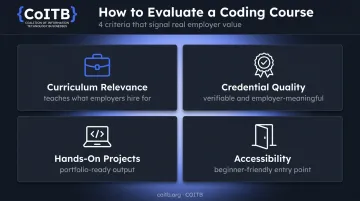
Selection focused on career outcomes over brand recognition. Every course here was evaluated against four criteria:
- Curriculum relevance — does it teach what employers are actually hiring for?
- Credential quality — is the output verifiable, specific, and meaningful to employers?
- Hands-on projects — does it produce portfolio-ready work, not just videos watched?
- Accessibility — can someone with no prior tech background start and finish it?
One common mistake learners make is choosing based on price or platform name rather than career alignment. Picking a general Python course when your target role is front-end development wastes months. Finishing a course with no verifiable credential wastes an opportunity.
The Credential Gap — and Why It Matters
The 2024 Stack Overflow Developer Survey found that 82% of developers learned to code through online resources, while only 49% learned in school. Skills-based hiring is accelerating — SHRM research indicates 73% of employers were using skills-based hiring approaches in 2023.
The practical problem is straightforward: course completion certificates are self-reported. Employers cannot independently verify whether a Udemy certificate represents 10 hours or 60 hours of serious work. Platform badges carry no standardized assessment behind them.
This is where third-party credentialing matters. COITB, a non-profit credentialing body aligned to ISO/IEC 17024 standards, offers proctored certification exams in HTML/CSS, JavaScript, React, Python, MySQL, and GPT/AI — designed for candidates with 0–6 months of hands-on experience.
Passing a proctored exam with a defined passing threshold produces a verifiable digital badge that employers, recruiters, and background-check vendors can independently confirm. That's a structurally different signal than a course certificate from the platform where you studied.
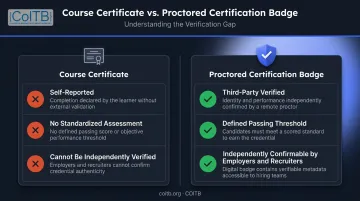
For bootcamp graduates and self-taught developers in particular, a verified badge gives recruiters and background-check vendors something they can actually confirm — independent of where or how you learned.
Conclusion
The best coding course is the one matched to your specific career target, delivered in a format you'll actually finish, and validated by output employers can verify.
Start by identifying your target role, then filter the options above accordingly rather than defaulting to whatever's trending:
- Back-end development: Boot.dev or Coursera's Python track
- Front-end development: freeCodeCamp or Codecademy's Front-End Engineer path
- Full-stack: Angela Yu's bootcamp or The Odin Project
- Data or AI: fast.ai or DeepLearning.AI's specializations
Once you've completed a course, consider strengthening your résumé with a third-party credential. COITB is a non-profit credentialing body offering ISO/IEC 17024-aligned certifications in HTML/CSS, JavaScript, React, Python, MySQL, and GPT. Each exam is remotely proctored and produces a verifiable digital badge you can share on LinkedIn or your résumé. Take a free practice assessment at coitb.org/assessment to check where you stand before registering.
Frequently Asked Questions
Which coding course is best for the future?
Courses covering Python, JavaScript, and AI-adjacent skills like prompt engineering offer the strongest long-term value. These languages underpin web applications, data pipelines, and AI development — three areas with the most projected job growth through 2034.
Is 25 too old to start coding?
Not even close. Course Report data puts the average coding bootcamp student age at 31, with 6–7 years of prior work experience. Employers care about demonstrated skill, not age or academic background.
What is the best programming language to learn first for career growth?
Python for data, AI, or automation roles; JavaScript and HTML/CSS for web development. SQL is a useful complement to either path and appears in most back-end and data job descriptions.
How long does it take to complete a coding course and get a job?
Foundational courses take 3–6 months of consistent part-time effort. Job placement timelines depend heavily on portfolio quality and networking; most bootcamp alumni who find jobs do so within 1–6 months of finishing, per Course Report data.
Do I need a degree to get a coding job?
Many employers in web development, application development, and IT hire based on demonstrated skills and verified credentials rather than degrees. Portfolio projects and third-party certifications carry the most weight in entry-level hiring decisions.
How do I prove my coding skills to employers after completing a course?
The strongest signals are a GitHub portfolio of real projects and industry-recognized credentials tied to specific technologies. Credentials from proctored exams with verifiable digital badges carry more weight than platform completion certificates in entry-level hiring decisions.