The stakes are higher than they might seem. Choose the wrong course and you could spend months learning a language no employer is hiring for, or build skills in a format that never translates to an actual job interview. Meanwhile, the Bureau of Labor Statistics projects 15% employment growth for software developers from 2024 to 2034, with roughly 129,200 job openings annually — so the opportunity is real, but only if you train for what the market actually needs.
This guide walks you through exactly how to evaluate and choose a programming course that fits your goals, your schedule, and the job market you're targeting.
Key Takeaways
- Your career goal should drive your language and format choice — start there, not with trending lists
- Match the curriculum to technologies appearing in real job postings
- Prioritize hands-on coding practice over passive video-only content
- Check instructor credentials and confirm when the course was last updated
- Course completion certificates show attendance; third-party, employer-recognized certifications validate what you can actually do
What Is a Programming Course?
A programming course teaches the concepts, syntax, and practical application of a coding language or technology stack through structured instruction. The goal is to take someone from unfamiliar with a technology to functional with it — capable of writing, debugging, and applying code in real scenarios.
Three Course Formats Worth Knowing
The format you choose shapes your experience as much as the content itself:
| Format | Time Commitment | Best For |
|---|---|---|
| Self-paced online | Flexible, weeks to months | Full-time workers, self-starters |
| Cohort-based programs | Scheduled deadlines, peer accountability | Those who need structure |
| Intensive bootcamps | Full-time, 6–28 weeks | Career changers with time to commit |
Each format carries a different price point and accountability level. A self-paced course on Udemy might cost $15 on sale; a full-stack bootcamp can run $10,000–$20,000. Your schedule, budget, and need for accountability should drive that decision — not the course name alone.
Why the Right Course Actually Matters
A well-matched course does more than teach syntax. It builds problem-solving habits, exposes you to real-world workflows, and prepares you for the technologies employers are actively hiring for — React, Python, JavaScript, and AI tools among them.
Self-taught developers and bootcamp graduates in particular benefit from courses built around in-demand tech stacks. Unguided or poorly sequenced learning tends to leave gaps in fundamentals, and hiring managers conducting technical interviews will surface those gaps fast.
What to Consider When Choosing a Programming Course
Not all courses are created equal. The right course for a data scientist won't work for someone building e-commerce websites. These six factors help connect your personal situation to outcomes that actually matter: skill acquisition, job readiness, and credential value.
Your Career Goal
Start here. Without a clear destination, any course feels acceptable — and that's how people spend months learning the wrong stack entirely.
Use this quick reference to match your goal to the right technologies:
- Front-end development → HTML, CSS, JavaScript, React
- Back-end development → Python, MySQL
- Full-stack development → HTML, CSS, JavaScript, React, Python, MySQL
- AI/automation → Python, GPT/generative AI tools
- Web design → HTML, CSS (design fundamentals, responsive layouts)
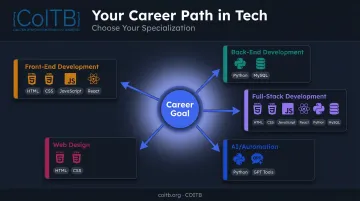
Once you know your target role, the right course becomes much easier to identify — and the wrong ones easier to rule out.
Your Current Skill Level
Mismatching your skill level to a course is one of the most common reasons people quit. A beginner dropped into a React course without HTML or CSS foundations will disengage within days — not because they lack ability, but because the prerequisite knowledge isn't there.
What each tier should look for:
- Beginner — Courses covering foundational syntax, core concepts, and basic project builds. Start here before anything framework-specific.
- Intermediate — Framework-specific content or specialization (React, async JavaScript, OOP in Python). You have the basics; now go deeper.
- Advanced — Architecture, system design, performance optimization, and complex problem-solving. Lectures matter less here than projects and code review.
Honest self-assessment before you pay for anything saves significant time and frustration.
Curriculum and Tech Stack Relevance
The syllabus must be evaluated against the real-world job market — not just what sounds interesting or what a platform happens to promote. Before committing to a course, search active job postings in your target role and see which languages and tools appear most frequently.
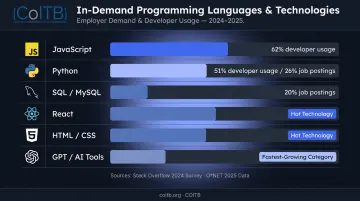
O*NET's 2025 employer posting data shows Python in 26% and SQL in 20% of US software developer postings. JavaScript and major web development tools are classified as Hot Technologies. The 2024 Stack Overflow Developer Survey puts JavaScript at 62% usage and Python at 51% among active developers.
In-demand technologies worth prioritizing:
- HTML, CSS, JavaScript, React (front-end and full-stack)
- Python, MySQL (back-end and data)
- GPT/AI tools (fastest-growing skill category in job postings)
A course covering outdated or niche languages can cost you months of time with limited career ROI.
Learning Format and Flexibility
Format matters beyond personal preference. Someone working a full-time job needs a self-paced course with no hard deadlines. Someone with three months free before a job search may get more out of an intensive structured program with enforced accountability.
The method of instruction matters too. Courses that include:
- Interactive coding environments (write code, not just watch it)
- Real project builds with defined deliverables
- Problem-solving exercises that simulate actual work
...consistently outperform passive video-only formats for practical readiness. Watching someone code and being able to code are different skills entirely.
Instructor Expertise and Community Support
Format quality only goes so far — the curriculum itself has to come from someone with real industry experience. When evaluating an instructor or course team, check for:
- Verifiable industry background, not just teaching credentials
- Recent updates (a JavaScript course from 2020 won't reflect modern ES6+ patterns)
- Community access — forums, Discord groups, or cohort peers
Learners who get stuck with no one to ask tend to quit. Access to even an asynchronous community cuts that dropout risk considerably.
Certification and Post-Course Validation
Completion certificates from course platforms carry limited weight with employers on their own. They signal that you showed up and finished, not that you can actually perform the job.
SHRM research found that industry or professional certifications were the most compelling alternative credential for executives, supervisors, and HR professionals — ranked above training certificates and course completion documents across all three employer groups.
Before enrolling, ask: What proof will I have that I can do this job? The answer should be more than a PDF with your name on it.
How COITB Can Help You Validate Your Programming Skills
Finishing a programming course builds your skills. Proving them to employers is a separate step — and it requires structured, independent validation, not just a completion certificate from the same platform that taught you.
COITB is a non-profit credentialing body offering ISO/IEC 17024-aligned certifications across the technologies today's employers are actively hiring for. Unlike course completion certificates — issued by the same organization that taught the content — COITB functions purely as an assessment body that delivers no training or bootcamps. That separation is what gives its credentials their employer-facing credibility.
COITB's certification portfolio covers:
| Technology | Certification |
|---|---|
| HTML & CSS | HTML-CSS Web Designer |
| JavaScript | JavaScript Professional Developer |
| React | ReactJS Framework Developer |
| Python | Professional Python Developer |
| MySQL | MySQL Backend Developer |
| Generative AI | Certified GPT Professional |
| Technical Sales | Technical Sales Specialist |
What sets COITB apart from course-completion certificates:
- Targets candidates with 0–6 months of hands-on experience, making it accessible to bootcamp graduates, self-taught developers, and career changers
- Offers remote online proctoring 24/7 from any location, with military CAC and VA-issued IDs accepted
- Issues digital badges upon passing, shareable on LinkedIn with one-click recruiter verification
- Spans UI design, application development, AI, and back-end development in a single credential portfolio
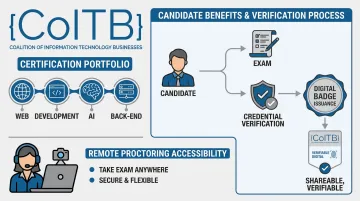
For self-taught developers and bootcamp graduates especially, a COITB credential converts self-reported skills into a verifiable, employer-recognized signal that any recruiter can confirm independently — no degree or prior work history required.
To gauge readiness before registering, COITB offers a free practice assessment at coitb.org/assessment.
Conclusion
Choosing the right programming course deserves more thought than a quick search for "best coding course 2024." The goal isn't to find the most popular platform — it's to find the course that fits your specific career goal, matches your current skill level, and teaches the technologies employers are actually hiring for.
Finishing a course gets you to the starting line. The course certificate shows you completed the material — but what employers want is evidence you can actually apply the skills. That's where a third-party credential from an organization like COITB comes in: an independently verified badge that confirms your proficiency, whether you're a bootcamp graduate, a self-taught developer, or a career changer making your move into tech.
Frequently Asked Questions
How do I know which programming course is right for my skill level?
Honest self-assessment comes first — identify whether you're a beginner (no prior code), intermediate (basics down, need frameworks), or advanced (ready for architecture and specialization). Most platforms offer free preview lessons; try one before paying to confirm the difficulty level fits where you actually are.
Should I choose a free or paid programming course?
Free courses work well for exploring a language before committing. Paid courses tend to offer more structure, hands-on projects, and instructor support — all of which improve your odds of actually finishing. Both can be effective; the format and curriculum matter more than the price tag.
What programming language should a complete beginner start with?
Python and HTML/CSS are the most beginner-friendly starting points, depending on your goal. Python suits those heading toward back-end, data, or AI; HTML/CSS is the natural entry point for web design or front-end development. The specific language matters less than logging consistent practice — even 30 minutes daily compounds quickly.
How long does it take to complete a programming course?
Bootcamps typically run 6–28 weeks (average: ~14 weeks of intensive work). Self-paced courses range from a few weeks for intro content to several months for a full-stack curriculum at part-time pace.
What is the difference between a course certificate and an industry certification?
A course completion certificate confirms you finished a program — issued by the same organization that taught you. An industry-recognized certification requires passing an independently administered, proctored exam; employers can verify it externally, which is why it carries more weight in hiring decisions.
How do I validate programming skills I've learned on my own or through a bootcamp?
Structured credentialing programs like COITB's ISO/IEC 17024-aligned certifications offer an independent, proctored assessment that gives employers a standardized, verifiable proof of capability — no matter your training background.