With that kind of demand, it's no surprise that job seekers and career changers are asking whether a Python certification will give them an edge.
The honest answer: it depends. Certifications can help you clear hiring filters and signal genuine commitment — but they're not a shortcut to employment. This guide breaks down what Python certifications actually test, which credentials matter most, when they're worth pursuing, and how to build a strategy around them.
Key Takeaways
- Python certifications help early-career and self-taught candidates clear resume filters — less impactful once you have a strong portfolio
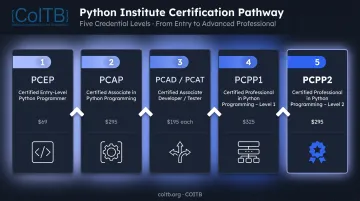
- The Python Institute's structured pathway (PCEP → PCAP → PCPP1 → PCPP2) costs between $69 and $325 per exam
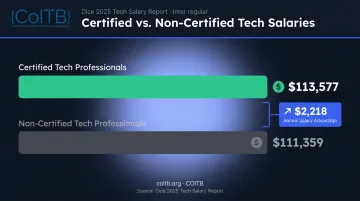
- The Dice 2025 Tech Salary Report shows certified tech professionals earn roughly $2,218 more than non-certified peers — a modest but real difference
- Certifications and portfolios work together; neither alone is sufficient
- Exams backed by credentialing standards and live proctoring carry more weight than a course completion badge
What Python Certifications Actually Test (and What They Don't)
Most Python certification exams assess syntax, data types, control flow, functions, OOP principles, modules, and standard library usage. They confirm you know the language — not that you can deploy it effectively in the real world.
What Gets Tested
The Python Institute's PCEP exam, for example, breaks down into four domains:
- Control flow — 29% of the exam
- Functions and exceptions — 28%
- Collections — 25%
- Fundamentals — 18%
The PCAP goes deeper, with OOP accounting for 34% of its syllabus, plus strings, modules, comprehensions, and I/O operations.
What Doesn't Get Tested
Certifications won't tell an employer whether you can:
- Write clean, production-ready code in a team environment
- Debug a failing microservice at 2 a.m.
- Design a data pipeline that handles edge cases gracefully
- Translate an ambiguous business requirement into a working solution
These are the skills that separate good candidates from great ones in technical interviews — and no multiple-choice exam captures them.
Certification vs. Certificate: A Distinction That Matters
These terms get used interchangeably, but they mean different things. According to the Institute for Credentialing Excellence, each credential has a distinct scope:
- Certification — occupation-based, requires passing an independent proctored assessment, and carries renewal requirements
- Certificate — confirms course completion; you finished the assignments and received the badge
Experienced hiring managers notice the difference. A proctored exam credential carries more weight than a completion badge — and that distinction becomes especially relevant when you're weighing whether a Python certification is worth pursuing at all.
Types of Python Certifications: From Entry-Level to Expert
The Python Institute is the primary credentialing body for Python-specific exams, with a structured four-level pathway.
Beginner Level: PCEP and PCED
PCEP (Certified Entry-Level Python Programmer): Covers basic syntax, data types, control flow, and functions. No prerequisites, exam starts at $69 — the right starting point if you're new to programming and want a verified credential fast.
PCED (Certified Entry-Level Data Analyst with Python): Released in July 2025, this parallel credential covers data acquisition, preprocessing, validation, and visualization. Also starts at $69, and better suited for candidates targeting analytics roles rather than software development.
Associate and Specialized Level
PCAP (Certified Associate in Python Programming): Covers OOP, modules, error handling, and advanced string operations. Starts at $295, recommended for candidates with some Python experience or a background in another language.
Specialized associate options include:
- PCAD (data analytics focus, starting at $195)
- PCAT (software testing and automation focus, starting at $195)
Both launched in 2025. If your target role is data or QA/automation specifically, these are more focused — and less expensive — than the general PCAP.
Professional Level: PCPP1 and PCPP2
PCPP1 (Professional in Python Programming 1): Covers advanced OOP architecture, GUI development, networking, and file processing. Starts at $325, aimed at developers building full-scale Python applications or targeting senior roles.
PCPP2 (Professional in Python Programming 2): Covers testing frameworks, design patterns, database interactions, and clean code optimization. Starts at $295. As of current official sources, PCPP2 remains in development and is not yet active.
When a Python Certification Is Worth It — and When It Isn't
Worth It: Early-Career and Self-Taught Developers
For candidates entering the job market without a CS degree or substantial work history, an entry-level certification provides something valuable: an objective, third-party credential. It can help a resume clear automated screening systems and signal genuine commitment to employers who might otherwise skip past unverified skills.
If your resume currently shows "self-taught Python developer" with no supporting evidence, an entry-level certification changes that equation.
Worth It: Career Changers
Professionals moving from finance, healthcare, marketing, or operations into Python-centric roles face a credibility gap. A structured certification pathway gives them two things simultaneously: a learning framework that builds real knowledge, and a verifiable credential that bridges the gap for employers unfamiliar with their background.
Worth It: Certain Industries and Geographies
Employer attitudes aren't uniform. Before deciding, research the hiring culture in your specific target market. Contexts where credentials carry more weight include:
- Mid-market companies and enterprises outside major tech hubs
- Hiring cultures in parts of Europe and South Asia
- Enterprise IT departments in the Midwest and Southeast
A certification that barely moves the needle at a Silicon Valley startup may be a meaningful differentiator in these environments.
Not Worth It: Experienced Developers With Strong Portfolios
For developers with a solid GitHub profile, a track record of shipped projects, and real professional experience, a Python-specific certification rarely justifies the prep time. That time is better spent on open-source contributions, specialization in AI/ML or cloud infrastructure, or projects that showcase exactly what employers want to see.
The Salary Reality
Those "not worth it" caveats aside, salary data does show a measurable upside. The Dice 2025 Tech Salary Report found that certified US tech professionals earn an average of $2,218 more per year than their non-certified counterparts ($113,577 vs. $111,359). That gap spans all tech certifications — not Python specifically — so treat it as a directional signal, not a guarantee. The real return on a Python certification isn't a direct pay bump; it's access and credibility at the resume screening stage.
What Employers Actually Think About Python Certifications
Large Tech Companies
Google, Amazon, Meta, and Microsoft place very little weight on Python certifications in hiring decisions. Their evaluation relies on technical interviews, coding assessments, and demonstrated project work. If you're targeting these companies, spend your preparation time on LeetCode and a strong GitHub profile, not certification exams.
Mid-Sized and Non-Tech Employers
Financial services, healthcare IT, enterprise operations, and marketing-tech companies view certifications more favorably — particularly for roles where Python is a tool rather than the core job function. In roles like these, a certification gives hiring managers who aren't developers a concrete signal of job-ready competency:
- Automation and scripting
- Data reporting and business intelligence
- Enterprise operations support
The Hiring Manager Consensus
Across employer types, the pattern holds: a certification gets your résumé past the first filter and can serve as a tiebreaker between equally qualified candidates. Demonstrated project work is what ultimately lands candidates the job. Use both — the credential opens the door; your portfolio proves you belong there.
Certifications vs. Portfolio: Building a Strategy That Works
For most career stages, the strongest move is to treat certification and portfolio work as complementary. Use the certification syllabus as a structured learning guide, then apply that knowledge to real projects you can show employers.
What a Strong Python Portfolio Looks Like
Projects that signal genuine capability to hiring managers:
- A data analysis dashboard pulling from a real dataset with visualizations
- A web scraper or automation script solving a specific, practical problem
- A Flask or Django web application with a clear use case
- A machine learning model with documented methodology and results
- An open-source contribution — even a bug fix with a well-written PR description
A GitHub profile with well-documented, purposeful projects outweighs a certification in technical hiring decisions. Credentials signal foundational knowledge. Projects prove you can apply it.
For Candidates With Limited Time
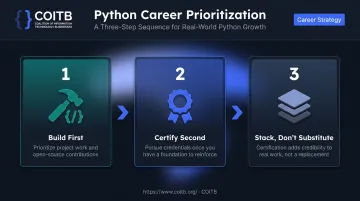
Hours spent studying for certification exams are hours not spent building projects, contributing to open source, or networking. If your time is limited, sequence your efforts deliberately:
- Build first: prioritize project work and open-source contributions
- Certify second: pursue credentials once you have a foundation to reinforce
- Stack, don't substitute: a certification adds credibility to real work — it doesn't stand in for it
How to Choose the Right Python Certification for Your Goals
Match Certification Level to Your Experience
| Your Situation | Recommended Starting Point |
|---|---|
| No programming background | PCEP (Python Institute) or COITB Professional Python Developer |
| Some Python or programming experience | PCAP or PCED (data focus) |
| Targeting data/analytics roles | PCED or PCAD |
| Professional developer, senior track | PCPP1 |
| Testing/automation specialization | PCAT |
Consider the Credentialing Body's Rigor
Prioritize certifications from organizations that administer proctored, standardized exams over course completion certificates that require nothing more than watching videos. Proctored exams produce independently verifiable credentials, a meaningful distinction when an employer checks your LinkedIn certifications section.
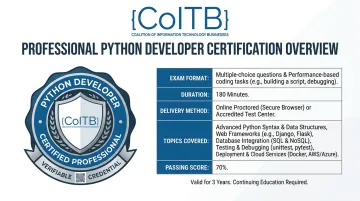
COITB, a non-profit credentialing body based in Oklahoma City, offers a Professional Python Developer certification built on this model. Key exam details:
- Format: 58 questions, 75 minutes, 70% passing threshold
- Delivery: Remote online proctoring or authorized test centers
- Credential: Digital badge verifiable by employers directly
The credential targets candidates with 0–6 months of hands-on Python experience and covers OOP, exception handling, file I/O, modules, generators, decorators, and PEP 8 practices. No prerequisites required. It works for self-taught developers, bootcamp graduates, and career changers. Veterans can explore funding through GI Bill, VET TEC, MyCAA, or VR&E programs; verify eligibility through the VA before registering.
Stack Credentials Strategically
Python certifications deliver more value when combined with credentials that tell a coherent specialization story:
- Python + MySQL Backend Developer → back-end development track
- Python + Certified GPT Professional → AI/ML practitioner track
- Python + MySQL + Certified GPT Professional → data engineering or technical program manager track
Employers hire for specific roles, not generic "Python developer" profiles. Credential stacking aligns with how that hiring actually works.
Frequently Asked Questions
Is Python still in demand in 2026?
Yes. TIOBE ranked Python No. 1 with an 18.94% rating as of mid-2026, IEEE Spectrum ranked it No. 1 for jobs in 2025, and Stack Overflow's 2025 survey showed 57.9% developer usage — a 7-point year-over-year jump. Python's dominance in AI and data science keeps demand consistently high.
Will a Python certification help me get a job?
A certification alone won't get you hired. It can help your resume clear early screening filters and signal commitment — especially for entry-level candidates and self-taught developers without a CS degree. It works best when paired with a portfolio of real projects that demonstrate what you can actually build.
What is the difference between a Python certificate and a Python certification?
A certification requires passing a proctored, scored exam and validates demonstrated proficiency against a standardized benchmark. A certificate typically confirms course completion — attendance and participation, not independently assessed competence. Employers familiar with credentialing will evaluate the two very differently.
How long does it take to prepare for a Python certification?
Preparation time varies by level. The PCEP may require 4–8 weeks of focused study for a beginner; the PCAP may take several months, depending on your existing Python experience. The study process itself builds structured knowledge that goes beyond what the exam directly tests.
Are Python certifications worth it for career changers with no tech background?
Entry-level Python certifications are well-suited for career changers — they provide a structured learning path and a third-party credential that bridges the credibility gap when employers don't yet know your transferable skills. For candidates without a CS degree or tech work history, that external validation carries real weight.