That gap is exactly where a generative AI certification earns its value.
US job postings mentioning generative AI skills jumped from 16,000 in 2023 to over 66,000 in 2024, according to Stanford HAI and Lightcast. Meanwhile, more than one-third of entry-level jobs now explicitly require AI skills — nearly triple the amount reported just months earlier. The demand is real, and it's accelerating.
This article cuts through the noise. No abstract learning benefits, no marketing claims — just what the labor market data actually shows about the career outcomes that follow a recognized generative AI credential.
Key Takeaways
- Certified AI professionals earn an average of $8,000 more than non-certified peers in equivalent roles
- Certified workers show 18.1% salary growth at their next job transition vs. 15.3% for non-certified peers
- 78.5% of certified workers changed roles after certification vs. 76.1% of non-certified peers
- Skills-assessed credentials carry more weight than course completion badges with employers
- Career changers, bootcamp graduates, and veterans benefit most from third-party credential validation
What Is a Generative AI Certification?
A generative AI certification is a credential that formally validates a person's ability to understand and work with generative AI tools — including large language models (LLMs), prompt engineering, and GPT-based systems. It differs from a course certificate in one critical way: it requires passing a skills assessment against a recognized competency standard, not simply completing a series of videos or modules.
These credentials serve a range of roles:
- Technical roles — AI engineers, developers, prompt engineers, solutions architects
- Non-technical roles — product managers, business analysts, marketing professionals, operations leads
- Leadership roles — executives and team managers validating AI literacy across their workforce
The certification functions as a third-party signal. When a hiring manager sees a recognized credential, it communicates that the holder was independently assessed against a defined standard — not self-reported. Credentials aligned to ISO/IEC 17024 reinforce this further: that standard governs how certification bodies assess and verify competence, separating a skills-validated credential from a course completion badge.
COITB's Certified GPT Professional is an example of this type of credential — a structured, exam-based assessment covering prompt engineering, GPT API integration, responsible AI, and applied use cases, designed for candidates with as little as 0–6 months of hands-on AI experience.
Key Career Advantages of a Generative AI Certification
The advantages below are grounded in measurable outcomes — hiring data, salary research, and job mobility metrics from workforce studies. Each maps to specific career KPIs.
Career Credibility and Employer Recognition
In a crowded market where many candidates claim AI familiarity, a recognized generative AI certification provides verifiable proof of capability: proof that hiring managers can trust regardless of how the candidate built their skills.
That shift matters most at the screening stage. Instead of relying on self-reported AI experience (which is impossible to verify), candidates with a recognized credential can point to a defined competency standard that has already been externally assessed.
Why this advantage is significant:
- Employer demand for AI skills has roughly quadrupled in two years, creating intense competition among candidates claiming similar skill sets
- Automated screening tools and HR gatekeepers increasingly filter by credentials, not just keywords
- For candidates without a traditional computer science degree, a certification aligned to a recognized standard provides credibility that self-reported experience simply cannot replicate
Who this matters most for: Career changers entering tech, self-taught developers, bootcamp graduates, and veterans transitioning into AI roles. These professionals benefit most from a third-party credential that substitutes for traditional educational pedigree.
KPIs this affects: Interview callback rate, résumé screening pass rate, time-to-hire, and access to roles previously gated by degree requirements.
Higher Earning Potential
The salary data on AI certifications is among the clearest labor market evidence available on any credential category.
According to a Revelio Labs workforce study, AI certification holders earn an average of $8,000 more than non-certified peers within the same occupation and seniority level, based on a matched-workforce comparison controlling for role, tenure, and location.
The transition premium is where it gets more interesting:
| Metric | Certified | Non-Certified | Gap |
|---|---|---|---|
| Salary growth at next job transition | 18.1% | 15.3% | +2.8 pp |
| Average salary premium | +$8,000 | — | — |
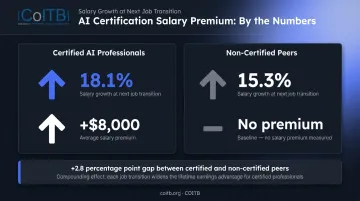
That 2.8 percentage-point gap compounds. Over three or four job transitions across a career, the cumulative salary difference becomes substantial.
A certification signals readiness for more complex, AI-specific responsibilities: the kind that command premium compensation and open access to roles with stricter qualification filters.
KPIs this affects: Base salary, salary growth rate at job transitions, total compensation trajectory, and access to senior or specialized AI roles.
When it matters most: For professionals pivoting into AI-adjacent roles, or those seeking promotion in environments where AI skills aren't yet common among their peer group.
Greater Job Mobility and Career Advancement
A generative AI certification has a measurable effect on career movement: role changes, promotions, and access to opportunities at new organizations all improve with a verified credential.
The Revelio Labs data is direct on this point:
- 78.5% of certified workers changed roles at their next transition vs. 76.1% of non-certified peers
- 38.9% of certified workers moved into a higher-seniority role vs. 32.5% of non-certified peers
- Certified workers were also more likely to transition to new employers
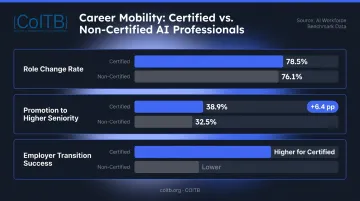
The seniority gap of 6.4 percentage points is notable. It reflects how a credential shifts employer risk perception: promoting or hiring someone with a verified AI credential is a lower-stakes decision than betting on self-reported skills.
Generative AI requirements are also spreading beyond core IT. Lightcast reports 9x growth in non-IT job postings requesting generative AI skills from 2022 to 2024, spanning product management, solutions architecture, and enterprise architecture. This expanding footprint means certified professionals have an ever-wider range of roles accessible to them.
Promotion rate, role-change frequency, employer transition success rate, and access to cross-functional AI roles are all KPIs this credential directly affects. It matters most for mid-career professionals in roles with high AI exposure who want to move proactively, before the lack of a credential becomes a barrier.
What Happens When You Skip the Certification
Without a recognized generative AI credential, professionals risk something specific: being filtered out before a human ever reads their application.
Automated screening tools don't evaluate nuance. They scan for signals — credentials, keywords, recognized certifications. A portfolio of self-directed AI work is genuinely valuable, but it requires far more effort to communicate in an interview context, and it may not satisfy initial filters at all.
There's also a mounting cost to waiting. Consider what the data shows:
- AI certifications' share of all professional credentials has grown over 20x since ChatGPT launched, reaching nearly 30% by 2026, per Revelio Labs
- As the certified workforce expands, an absent credential becomes more visible — not less
- The salary and mobility gap between certified and non-certified professionals is unlikely to narrow on its own
Earning a recognized credential carries a one-time cost. Being passed over repeatedly does not.
How to Get the Most Value from a Generative AI Certification
Earning a certification is the beginning, not the finish line. The credential delivers its highest career value when you can show how you've applied it.
Start by choosing the right certification. Look for credentials that are:
- Assessed through a structured exam, not just course completion
- Governed by a recognized standard (ISO/IEC 17024 alignment is a meaningful quality signal)
- Designed to validate practical capability — prompt engineering, API integration, real-world use cases
- Recognized in the industries and roles you're targeting
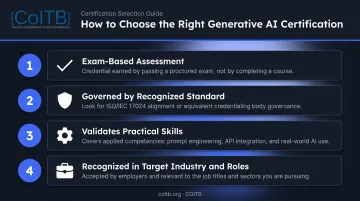
COITB's Certified GPT Professional is structured precisely this way — a 60-question exam covering prompt engineering techniques, GPT API integration using Python and JavaScript, responsible AI principles, and applied generative AI use cases, all assessed through remote-proctored or in-person testing. It's designed for candidates across a range of backgrounds, from developers and analysts to project managers and career changers.
A credential like that gets you in the door. What keeps you there is proof of application. Build a GPT-powered project. Automate a workflow. Integrate an AI feature into an existing application. The certification validates your knowledge; the project demonstrates how you use it.
Keep building after you pass. A generative AI credential from 18 months ago already needs supplementing with current applied experience. The most effective certified professionals treat the exam as a foundation — then add specializations, adjacent technical credentials, and real-world implementations on top.
Conclusion
The data points in one direction. A generative AI certification improves hiring outcomes, salary potential, and career mobility — but only when the credential is recognized, skills-based, and backed by a rigorous assessment standard.
The advantage compounds over time. Professionals who earn a legitimate generative AI certification and actively apply those skills aren't just better positioned today — they're building hiring leverage and skill depth that grow more valuable as AI becomes embedded in every industry and every job function.
If you're ready to validate your AI skills with a credential built on real-world assessment, COITB's Certified GPT Professional certification offers a structured, recognized pathway — designed for professionals at any stage, from career changers to team leads building AI competency. That's where the return on a generative AI certification actually starts.
Frequently Asked Questions
Is a generative AI certification worth it?
Yes — and workforce data backs it up. Certified AI professionals earn measurably more, transition to higher-seniority roles at higher rates, and change jobs more successfully than non-certified peers. The value is strongest when the certification is industry-recognized and assessed through a skills evaluation — not just a course completion badge.
Which is the best generative AI certification?
The best option depends on your goals and experience level. Look for credentials assessed against a recognized standard (COITB's Certified GPT Professional, for instance, is ISO/IEC 17024 aligned), evaluated through scenario-based exams, and relevant to your target industry. Research what employers in your field are actually asking for.
What jobs can you get with a generative AI certification?
Common roles include AI engineer, prompt engineer, AI product manager, AI solutions consultant, and generative AI developer. Many non-technical roles in marketing, operations, content strategy, and business analysis are also increasingly accessible to professionals with validated AI credentials — particularly as generative AI requirements spread beyond core IT.
Do I need a technical background to earn a generative AI certification?
Many programs, including the COITB Certified GPT Professional, are designed for candidates with 0–6 months of hands-on AI tool experience. No formal programming degree is required. That said, some domains — particularly API integration and Python-based implementations — reward candidates who invest preparation time in technical basics.
How much can I earn with a generative AI certification?
Salaries vary by role and location, but Glassdoor data for 2026 shows ranges of $103K–$168K for prompt engineers, $110K–$204K for generative AI engineers, and $163K–$243K for AI product managers. Certified professionals earn an average of $8,000 more than non-certified peers in equivalent roles.
How long does it take to get a generative AI certification?
Timelines vary by program and experience level. Entry-level credentials like the Certified GPT Professional target candidates with 0–6 months of AI tool experience, and many candidates prepare through self-study while working full time. Remote-proctored exams run on a flexible schedule — sit when you're ready, not when a cohort opens.