This article breaks down the four most widely pursued certifications — CPC, CCA, CCS, and CBCS — plus a quick look at specialty credentials worth knowing. More importantly, it walks through a practical decision framework so you can match a certification to your target work setting, experience level, and budget.
Key Takeaways
- No single IT certification fits every goal — the right credential depends on your background, target role, and experience level.
- The ReactJS Framework Developer certification is COITB's top credential for front-end and full-stack roles sought by employers.
- The HTML-CSS Web Designer certification is the strongest entry point for freelancers, career changers, and bootcamp graduates.
- The Certified GPT Professional credential targets AI-focused roles and suits professionals adding generative AI skills to existing experience.
- Veterans and military spouses can use GI Bill, VET TEC, MyCAA, or VR&E benefits — verify eligibility with VA/SAA before registering.
What Are Medical Coding Certifications and Why Do They Matter?
A medical coding certification is a nationally recognized credential that validates your ability to translate clinical diagnoses, procedures, and treatments into standardized code sets — primarily ICD-10-CM, CPT, and HCPCS — for insurance billing and reimbursement.
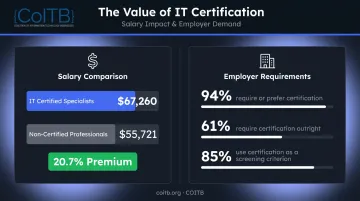
Certification isn't always legally required, but skipping it puts you at a real disadvantage. According to AAPC's 2026 Medical Coding and Billing Salary Report, certified medical records specialists earn an average of $67,260 per year, compared to $55,721 for non-certified specialists — a 20.7% premium. That gap compounds over a career.
Employer preference reinforces this further. A 2025 employer survey found that 94% of employers require or encourage certification for billing and coding specialists, with 61% requiring it outright and 85% using it as an application-screening criterion.
Certifications are issued by three main organizations:
- AAPC — issues the CPC, COC, CIC, and specialty credentials
- AHIMA — issues the CCA, CCS, and CCS-P
- NHA — issues the CBCS
Each organization sets its own exam format, eligibility requirements, and renewal process. Understanding those differences is the foundation for making the right choice.
Top Medical Coding Certifications Explained
Here's a side-by-side breakdown of the most widely recognized certifications, including who each one suits best, what the exam looks like, and what it costs.
Certified Professional Coder (CPC) — AAPC
The CPC is AAPC's flagship credential — and the most widely held in the field. It's particularly valued for outpatient and physician-based coding, and most job postings targeting professional-fee coders list it as preferred or required.
Exam quick facts:
- 100 multiple-choice questions, open book
- 4-hour time limit
- 70% passing score
- Available via live remote proctoring or at a testing center
Cost: $425 for one attempt or $499 for two attempts. Active AAPC membership is required ($229/year for individuals; $164/year for students).
One important caveat for beginners: candidates who pass without prior work experience receive a CPC-A (apprentice) designation. Removing the "A" requires one of the following:
- Two years of verified coding employment
- One year of employment plus an 80-hour coding course or AAPC's Practicode program
- An 80-hour coding course plus Practicode (minimum 600 cases at 70% overall)
Experience accumulated before certification can count toward these requirements.
Certified Coding Associate (CCA) — AHIMA
The CCA is AHIMA's entry-level credential, covering coding across both inpatient and outpatient settings. It's a strong starting point for people new to healthcare and a natural stepping stone toward AHIMA's more advanced credentials like the CCS.
Exam quick facts:
- 105 questions (90 scored, 15 pretest)
- 2-hour time limit
- Computer-based via Pearson VUE
Cost: $199 for AHIMA members / $299 for non-members.
The CCA has a lower barrier to entry than the CPC. No professional membership is required (membership only unlocks a discounted exam price). Eligibility requires a high school diploma.
AHIMA recommends six months of coding experience or completion of an approved training program, but neither is mandatory.
Certified Coding Specialist (CCS) — AHIMA
This is not an entry-level exam. The CCS targets experienced coders specializing in hospital and inpatient settings, validating proficiency with ICD-10-CM and ICD-10-PCS across inpatient, outpatient, and ED scenarios.
Exam quick facts:
- 107 total items (97 scored, 10 pretest)
- Includes multiple-choice and medical scenario sections
- 4-hour time limit
Cost: $299 for AHIMA members / $399 for non-members.
There's no mandatory experience prerequisite, but AHIMA recommends one of the following before attempting the CCS:
- Two years of relevant coding experience
- Relevant coursework combined with one year of coding
- An existing RHIA or RHIT credential
Pursue this after establishing a solid coding foundation, not as a first credential.
Certified Billing and Coding Specialist (CBCS) — NHA
Unlike purely coding-focused credentials, the CBCS covers the full billing-and-coding workflow: insurance claims processing, healthcare reimbursement, and coding fundamentals.
Exam quick facts:
- 100 scored items plus 25 pretest items
- 3-hour time limit
- Multiple-choice format
- Available at PSI testing centers, affiliated schools, or via live remote proctoring
Cost: NHA directs candidates to a representative for current individual and bundled pricing — confirm directly with NHA or your training program before budgeting.
The CBCS is particularly well-suited for candidates who want a role that blends billing and coding responsibilities rather than coding-only work. Many affiliated training programs bundle exam vouchers into tuition, which can significantly reduce out-of-pocket costs — worth asking about before enrolling.
Other Certifications Worth Knowing: COC, CIC, CCS-P
These credentials are typically better choices for coders who already hold a foundational cert and want to specialize:
| Credential | Issuer | Best For |
|---|---|---|
| COC (Certified Outpatient Coder) | AAPC | Hospital outpatient/facility coding |
| CIC (Certified Inpatient Coder) | AAPC | Hospital inpatient/facility coding |
| CCS-P | AHIMA | Physician-based outpatient coding (experienced) |
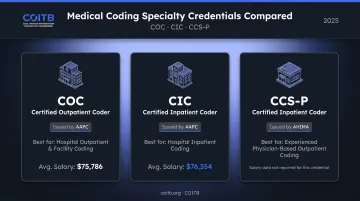
Per AAPC's 2026 salary data, CIC holders average $76,354 and COC holders $75,786 annually — both higher than the CPC average — reflecting the premium that facility-setting specialization commands. The CCS-P costs $299 for AHIMA members and $399 for non-members.
How to Choose the Right Certification for You
The right certification comes down to five factors: work setting, experience level, exam cost, career goals, and maintenance requirements. Working through each one will narrow the field quickly.
Work Setting: Inpatient vs. Outpatient
This is the most important early decision:
- Physician offices and clinics (outpatient): Prioritize the CPC or CBCS.
- Hospitals (inpatient): Target the CCS or CIC once you have foundational experience.
- Undecided or flexible: The CCA covers both settings and works well as a bridge credential.
Before committing, review actual job postings for roles in your area. Employer preferences vary by region, and real listings will tell you which credentials hiring managers actually request.
Experience Level
| Your Situation | Best Starting Point |
|---|---|
| No coding experience, want lowest barrier | CCA or CBCS |
| No coding experience, want most employer recognition | CPC (expect CPC-A status initially) |
| 1–2 years of coding experience | CCS, COC, or CIC |
Taking an accredited coding training program before any certification exam improves pass rates and prepares you for real-world coding tasks — don't skip this step.
Exam Cost and Budget
Here's a realistic cost picture per credential:
- CBCS: Contact NHA for current pricing; often bundled with affiliated programs
- CCA: $199 (member) / $299 (non-member)
- CCS: $299 (member) / $399 (non-member)
- CPC: $425 (one attempt) / $499 (two attempts), plus $229/year AAPC membership
Factor in study materials and potential retake fees. If your training program bundles an exam voucher, that can offset a significant portion of these costs.
Career Goals and Salary Potential
According to AAPC's 2026 salary data:
- CPC holders: $67,147 average annual salary
- CIC holders: $76,354 average annual salary
- COC holders: $75,786 average annual salary
Facility-setting credentials (CIC, COC) and advanced credentials (CCS) consistently command higher pay than entry-level outpatient certs. Start with one credential, then stack specialty or advanced certs as your experience grows to maximize earnings over time.
Certification Maintenance and CEU Requirements
All major certifications require continuing education for renewal:
| Credential | CEUs Required | Cycle | Notes |
|---|---|---|---|
| CPC | 36 CEUs | 2 years | Annual AAPC membership also required |
| CCA | 20 CEUs | 2 years | $100 renewal fee (member) / $249 (non-member) |
| CCS | 20 CEUs | 2 years | $100 renewal fee (member) / $249 (non-member) |
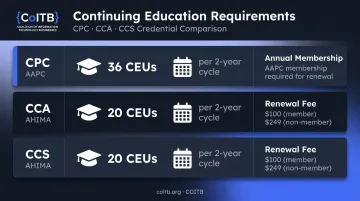
AAPC and AHIMA membership provides ongoing access to low-cost or free CEU opportunities, making the membership fee worthwhile well past the exam date.
Certification Career Path: From Entry-Level to Advanced
A logical progression for most coders looks like this:
- Start with an entry-level credential — CBCS, CCA, or CPC-A — to qualify for your first coding role.
- Gain 1–2 years of on-the-job experience in your chosen setting.
- Pursue advanced or specialty credentials — CCS, COC, CIC, or specialty certs — to increase earning potential and move into higher-level roles.
AAPC and AHIMA credentials aren't mutually exclusive, either. A coder might start with the CBCS, earn the CPC, then add the CCS when targeting hospital roles. Many experienced coders hold credentials from both organizations.
AI-assisted coding tools are becoming standard across healthcare settings. Staying certified and keeping up with continuing education requirements keeps coders competitive as the role evolves — and that's exactly why CEU credits are worth pursuing proactively, not just to maintain compliance.
Conclusion
There's no single "best" IT certification — only the right one for where you're headed, where you're starting from, and what you can realistically commit to right now. The ReactJS Framework Developer credential fits front-end roles at modern web shops. The HTML-CSS Web Designer certification makes sense if you're building a freelance client base or breaking into UI work. The JavaScript Professional credential bridges the gap between design and full-stack development. If backend or AI roles are the target, the Python, MySQL, or GPT certifications each serve a distinct niche.
Before you register for any exam, take three practical steps:
- Check job postings in your target role for credential preferences and required technologies
- Compare eligibility requirements for each exam against your current experience level
- Confirm whether you qualify for VA, VET TEC, MyCAA, or VR&E funding before paying out of pocket
Choosing the right credential from the start means you spend less time backtracking and more time building the career you're after.
Frequently Asked Questions
What type of coding certification pays the most?
Advanced and facility-setting credentials consistently show the highest average salaries. Per AAPC's 2026 data, CIC holders average $76,354 and COC holders $75,786 annually. Salary also depends on experience, geographic location, and work setting.
Is the CPC or CCA better for beginners?
Both are accessible to beginners. The CCA has a lower cost and doesn't require membership, making it the lower-barrier option. The CPC carries broader employer recognition but comes with apprentice (CPC-A) status until you complete the work experience or practicum requirements.
How long does it take to get a medical coding certification?
Preparation timelines vary by program. AAPC's self-paced CPC prep course averages 4–8 months; its instructor-led version runs 16 weeks. Once training is complete, you can schedule and sit for the exam within weeks.
Do employers require medical coding certification?
Not universally by law, but practically speaking, yes. A 2025 employer survey found that 94% of employers require or encourage certification for billing and coding specialists, and 85% use it as a screening criterion during hiring.
Can I take the CPC exam without prior work experience?
Yes. There's no experience prerequisite to sit for the CPC exam. However, candidates who pass without qualifying work experience receive a CPC-A (apprentice) designation, which remains until they fulfill the experience or practicum requirements.
How often do medical coding certifications need to be renewed?
Most credentials require renewal every two years. AAPC requires 36 CEUs per cycle for CPC holders; AHIMA requires 20 CEUs per cycle for CCA and CCS holders, along with applicable renewal fees.