
The U.S. Bureau of Labor Statistics projects 5% employment growth for sales engineers between 2024 and 2034, outpacing the 3% average for all occupations, with roughly 5,000 openings projected each year as companies replace departing staff and add new roles.
Here's the part most career changers miss: you don't need to be a developer to break into this field. Many aspiring tech professionals assume every IT career requires writing code. Technical sales proves otherwise — it rewards people who can translate complexity into clarity.
This guide walks through what the role actually involves, the skills and credentials that matter, and a realistic roadmap from your first title to a leadership seat.
Key Takeaways
- Technical sales specialists pair product expertise with sales skills to sell tech products.
- Certifications and hands-on experience often outweigh formal degree requirements.
- Career growth moves from entry-level support to specialist, account, and leadership roles.
- COITB's Technical Sales Specialist credential lets career changers prove skills fast.
What Is a Technical Sales Specialist?
A technical sales specialist sits between a complex product and a customer who needs to understand why it matters. They combine deep product knowledge with sales instincts, answering technical questions that a generalist sales rep can't.
Their inventory isn't limited to physical gear, either. Technical sales specialists sell:
- Hardware and equipment: networking gear, industrial systems, specialized machinery
- Software and SaaS platforms: cloud tools, enterprise software, developer platforms
- Consulting and technical services: implementation support, integration work, custom configurations
This work spans both B2B and B2C markets, though B2B tends to dominate because enterprise buyers usually require more technical vetting before signing a contract.
Technical Sales vs. Traditional Sales: What's the Real Difference?
Traditional sales reps focus on relationship-building, pricing conversations, and closing techniques. That's valuable work, but it doesn't require explaining how an API integration will affect a client's existing infrastructure.
Technical sales specialists need domain expertise to handle objections that go beyond price. A prospect might ask about system architecture, data security protocols, or how a product will scale with their user base, questions a traditional rep would have to escalate.
In practice, this looks like:
- Running live product demonstrations that address specific technical use cases
- Answering integration and architecture questions on the spot
- Collaborating directly with engineering teams to confirm a solution will actually work for the client's environment
That last point is where the role earns its name. Specialists solve problems in real time, in front of the customer, rather than simply pitching a product.
A Day in the Life: Core Duties and Responsibilities
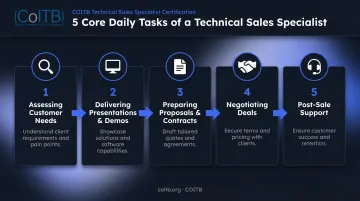
No two days look identical, but most technical sales specialists rotate through the same core tasks:
- Assessing customer needs: asking diagnostic questions to understand a prospect's technical environment and pain points
- Delivering presentations and demos: showing how the product solves a specific problem, not just listing features
- Preparing proposals and contracts: often in collaboration with engineering or product teams to keep terms technically accurate
- Negotiating deals: addressing pricing pushback alongside technical objections
- Providing post-sale technical support: staying involved after the contract closes to ensure smooth implementation
Responsibilities shift as you gain seniority. Entry-level reps typically shadow senior staff and absorb product knowledge before taking on their own accounts. Senior specialists, by contrast, shape sales strategy and mentor newer team members.
Skills Required to Succeed as a Technical Sales Specialist
Product knowledge is the foundation. Specialists can't build client trust if they're guessing their way through a technical question, so they need working fluency in the systems, software, or hardware they represent.
But technical knowledge alone doesn't close deals. Communication is what turns expertise into revenue.
- Translating complex features into clear business value for non-technical stakeholders
- Structuring demos around outcomes, not just a feature-by-feature walkthrough
- Reading the room to know when a prospect needs more technical depth versus a simpler business case
There's also a practical toolkit every specialist needs:
- CRM platforms — Salesforce remains the most commonly requested tool in job postings for this occupation, according to O*NET's employer-demand data
- Sales methodologies — consultative and solution-selling frameworks that focus on diagnosing a customer's actual problem before pitching a fix
- Presentation software — PowerPoint and similar tools for structuring demos and proposals
Forbes Technology Council has noted that sales engineers reduce buyer risk precisely because they can evaluate technical viability during the sales process itself, something a generalist rep can't credibly do. That combination of product fluency, consultative communication, and CRM proficiency is exactly what COITB's Technical Sales Specialist Certification validates, giving candidates a credential employers can trust as proof of job-readiness.
How to Become a Technical Sales Specialist: Education, Experience & Certifications
Here's some good news for anyone without a computer science degree: there's no single required credential for this career. The Bureau of Labor Statistics lists a bachelor's degree in engineering or a related field as typical, and 57% of professionals in this occupation report a bachelor's degree as required. Still, that leaves a meaningful percentage who got in without one.
Common Entry Points
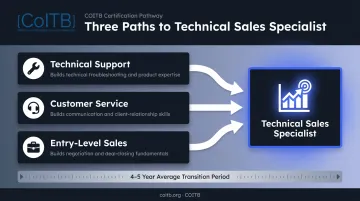
Most people land in technical sales through adjacent experience rather than a direct path:
- Technical support roles: building product familiarity and troubleshooting instincts
- Customer service positions: developing the communication skills that translate directly to client-facing sales
- Entry-level sales roles: learning the sales process before specializing in a technical vertical
There's no universal timeline for how long this transition takes. Some industry career guides suggest an average of four to five years to move into a dedicated technical sales role, though this varies widely based on your starting point and industry.
Where Certifications Fit In
This is where career changers, bootcamp grads, and self-taught professionals can close the credibility gap without going back for a degree. Industry-recognized certifications aligned to ISO/IEC 17024 standards, the international benchmark for personnel certification bodies, signal that your skills were validated under a governed framework rather than self-reported.
COITB, for example, offers a Technical Sales Specialist certification built specifically for this transition. A few practical details:
| Detail | Specification |
|---|---|
| Format | 60 questions, multiple-choice and scenario-based |
| Time limit | 75 minutes |
| Passing score | 70% or higher |
| Delivery | Online proctored or authorized test center |
| Recommended experience | 0–6 months in tech or sales environments |
The exam tests scenario-based judgment across needs assessment, demos, objection handling, and CRM usage: the actual daily work, not abstract theory. It's designed for people coming from medical device sales, financial services, or B2B industrial backgrounds who already know how to sell but need to prove technical sales competency to a hiring manager.
Beyond certifications, build a portfolio that shows applied problem-solving:
- Add completed certification badges to your LinkedIn profile
- Record mock product demos to share during interviews
- Write case study analyses showing how you'd approach a hypothetical client's technical needs
Technical Sales Specialist Career Path: Job Titles and Advancement Opportunities
Career progression in technical sales generally moves through three broad stages, each bringing more autonomy, strategic input, and mentorship responsibility.
Entry-Level Roles to Start Your Career
At this stage, the focus is learning products and supporting more experienced reps rather than owning accounts outright. A credential such as the COITB Technical Sales Specialist certification can help you qualify for these roles by validating core skills before you've built a sales track record. Common titles include:
- Technical Sales Representative: handles initial customer outreach and basic product questions
- Sales Engineer Associate: shadows senior engineers during technical demos and discovery calls
- Technical Sales Support Specialist: provides backend research and proposal support for the sales team
Mid-Level Roles After Several Years of Experience
Once you've built product fluency and closed deals independently, titles shift toward greater ownership:
- Technical Sales Engineer: manages the technical side of the sales cycle for assigned accounts
- Technical Account Manager: owns ongoing client relationships and renewal strategy
- Solutions Consultant: works alongside sales executives as the technical expert in enterprise deals
- Business Development Manager: identifies and develops new market opportunities
Senior and Leadership Roles
At the top of the ladder, the work shifts from individual selling to shaping strategy and developing people:
- Senior Solutions Architect: designs complex technical solutions across major accounts
- Director of Technical Sales: sets sales strategy and manages a team of specialists
- VP of Sales Engineering: influences product direction and owns organization-wide sales engineering strategy
Not every path leads straight up the ladder, either. Many professionals pivot laterally into account management, customer success management, product management, or solutions architecture, all of which draw on the same technical-plus-customer-facing skill set built in technical sales.
Salary Expectations & Job Outlook
Compensation numbers vary depending on how you measure them. Understanding the difference between base pay and total earnings helps set realistic expectations for this role.
- The BLS reports a $121,520 median annual wage for sales engineers as of May 2024
- PayScale reports an average base salary of $83,531, with additional commission ranging from $6,000 to $45,000 depending on performance and industry
- Glassdoor's data shows a median total pay figure closer to $158,000 when bonuses and commission are factored in
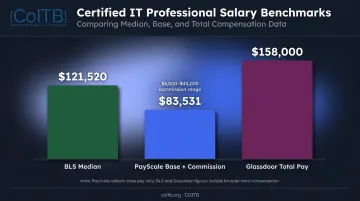
The gap between these numbers comes down to methodology rather than contradiction. Base salary reflects guaranteed pay, while total compensation includes commission, which can swing significantly based on how much revenue you close.
This commission structure matters more than it might seem. High performers in tech-heavy sectors like SaaS, enterprise software, and cloud infrastructure can substantially outearn the median by closing bigger deals more consistently.
Job Market Outlook for Sales Engineers
Hiring data confirms what's already happening in the market. Demand for professionals who understand both technology and sales continues to climb, and companies are actively building out sales engineering teams to support product-led growth strategies.
Frequently Asked Questions
What does a technical sales specialist do?
They combine technical product expertise with sales skills to identify customer needs, run product demos, and close deals. The role blends discovery, presentation, proposal writing, and post-sale support.
What is the difference between sales and technical sales?
Technical sales requires deep product or domain expertise to handle complex questions, live demos, and integration concerns. Traditional sales focuses more on relationship-building and pricing negotiation without that technical depth.
Do I need a technical degree to become a technical sales specialist?
Not necessarily. While technical degrees help, employers often value certifications and hands-on product experience equally, especially for candidates transitioning from adjacent sales roles.
How much do technical sales specialists typically earn?
Base salaries average in the low-to-mid $80,000s, while total compensation with commission often exceeds $120,000 for high performers. Exact figures vary by industry and performance level.
What certifications help advance a technical sales career?
Certifications in core technologies and sales methodology both strengthen a candidate's profile. COITB's Technical Sales Specialist certification specifically validates needs analysis, demos, objection handling, and CRM skills for career changers.
Is technical sales a good career path for career changers?
Yes. Backgrounds in customer service, technical support, or bootcamp training transfer well into technical sales, particularly when paired with a certification that validates the specific skills employers are screening for.